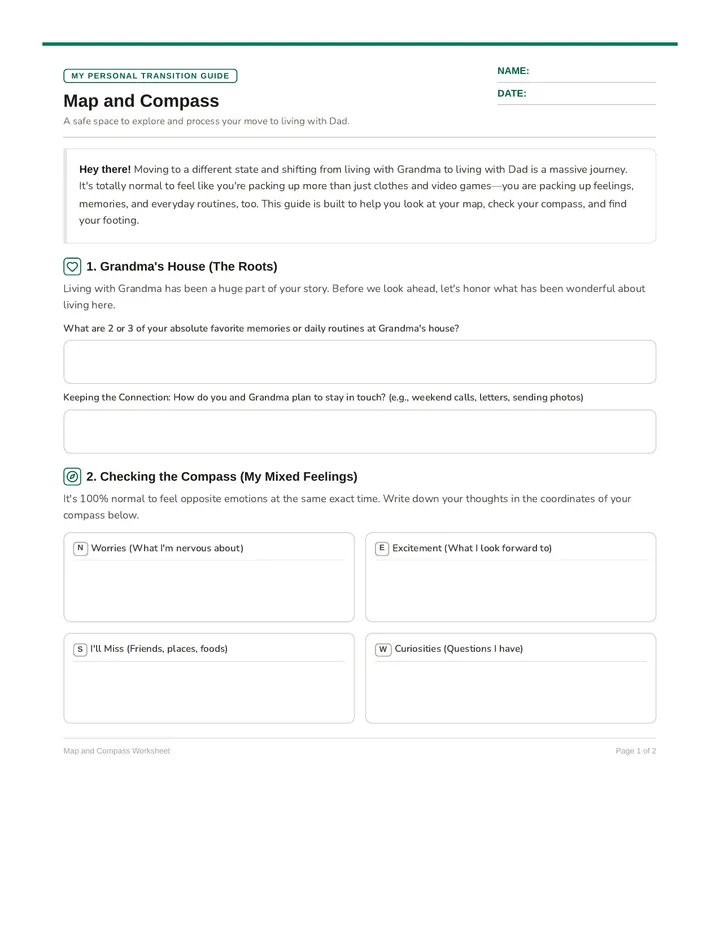
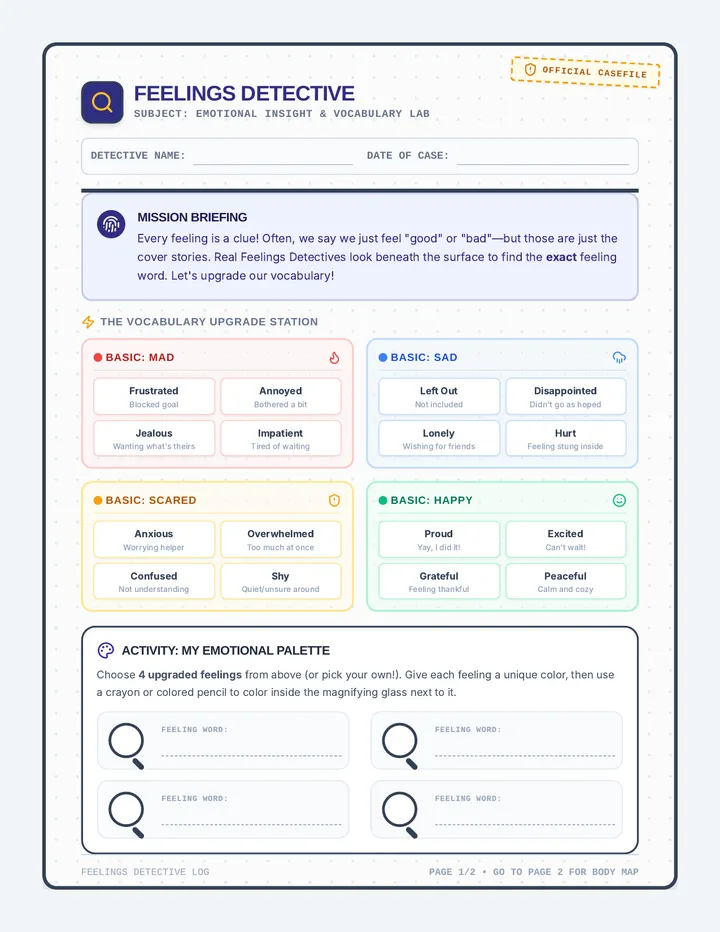
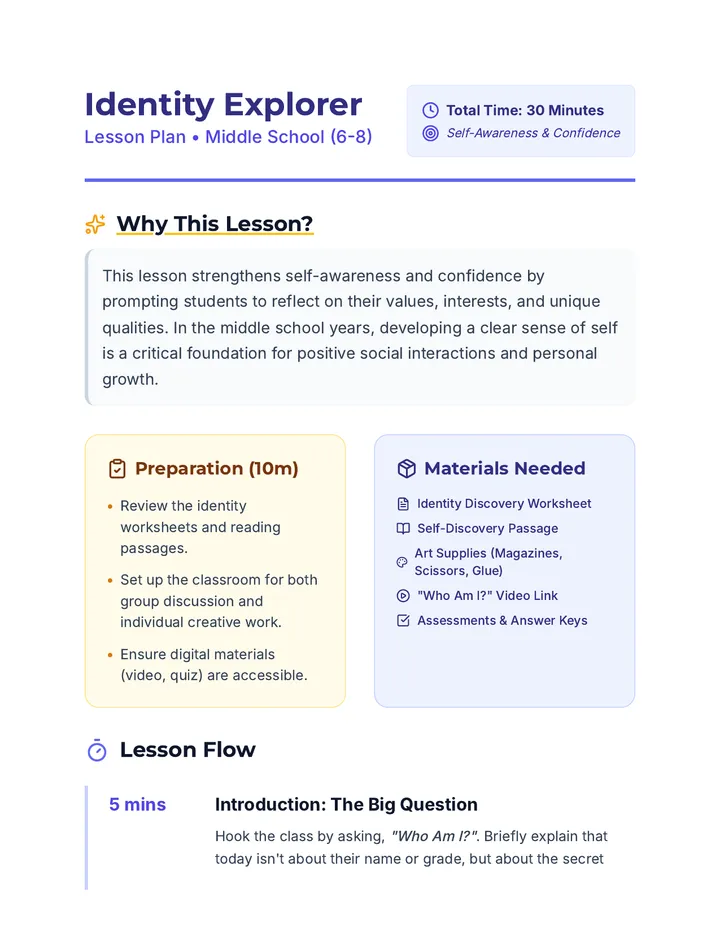
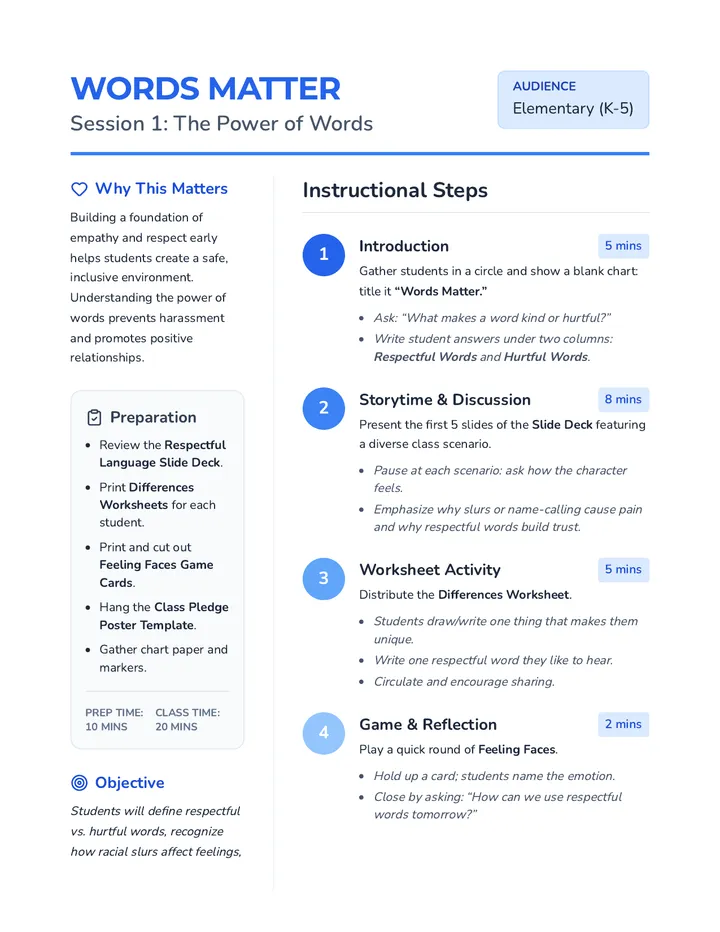
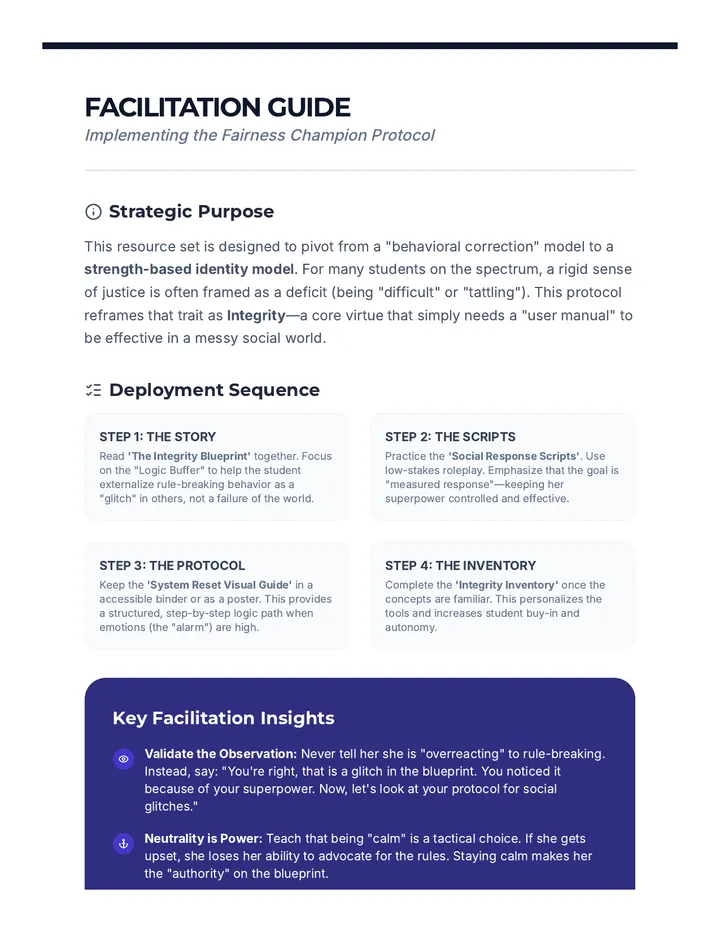
Emotion recognition ranging from basic feelings to complex nuances and mixed states. Strengthens accurate self-assessment through identity exploration, strength identification, and values-based decision making.
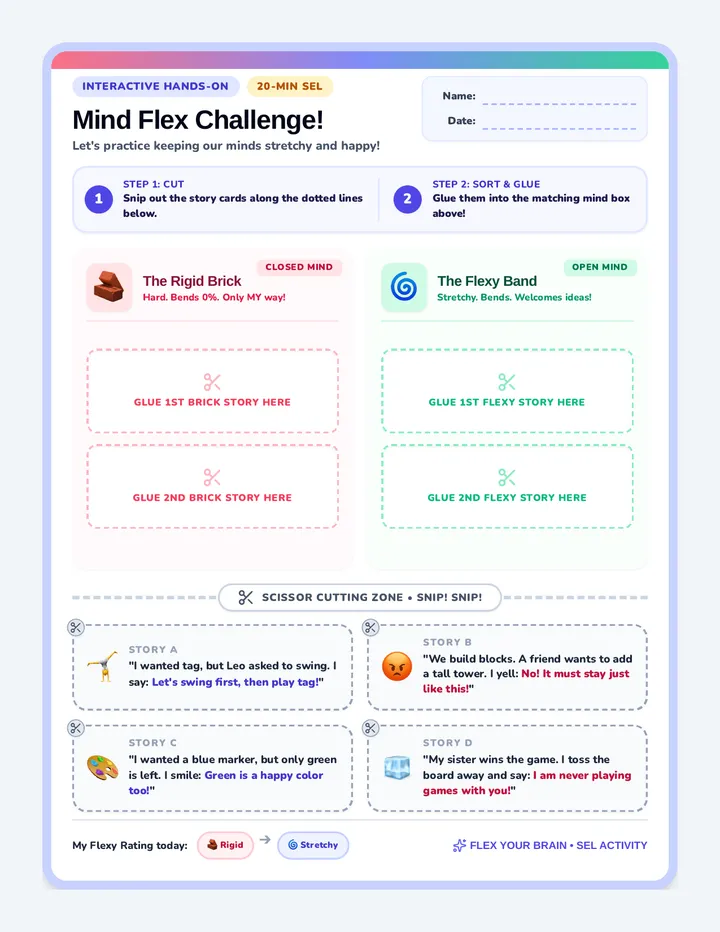
A social-emotional learning unit for first graders to master peer conflict resolution. Through physical metaphors, visual scaling, and calming exercises, students learn to transition from rigid thinking to flexible problem-solving.
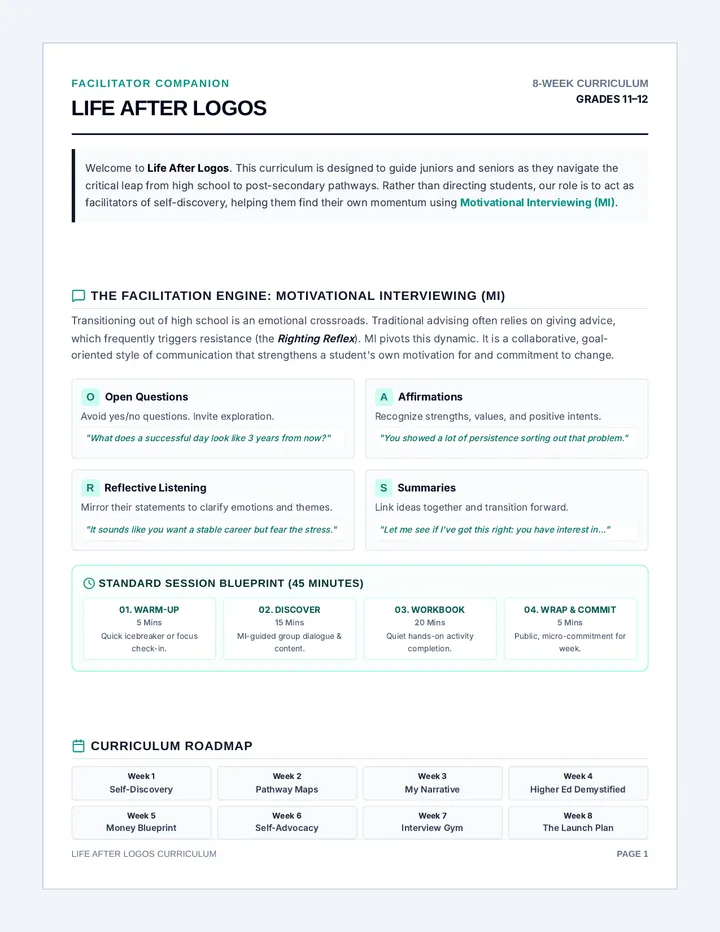
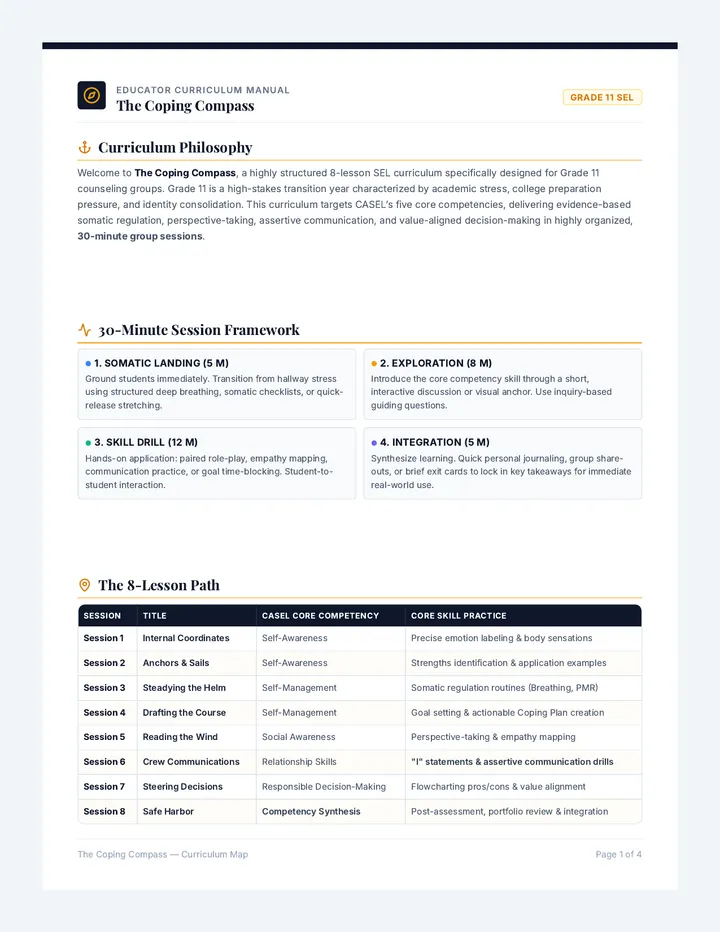
A comprehensive 14-session CBT and DBT skills curriculum designed for school counselors. Features structured session facilitation guides, student worksheets, and portable coping tool cards to build resilience, emotional regulation, and strong peer relationships across 14 complete lessons.
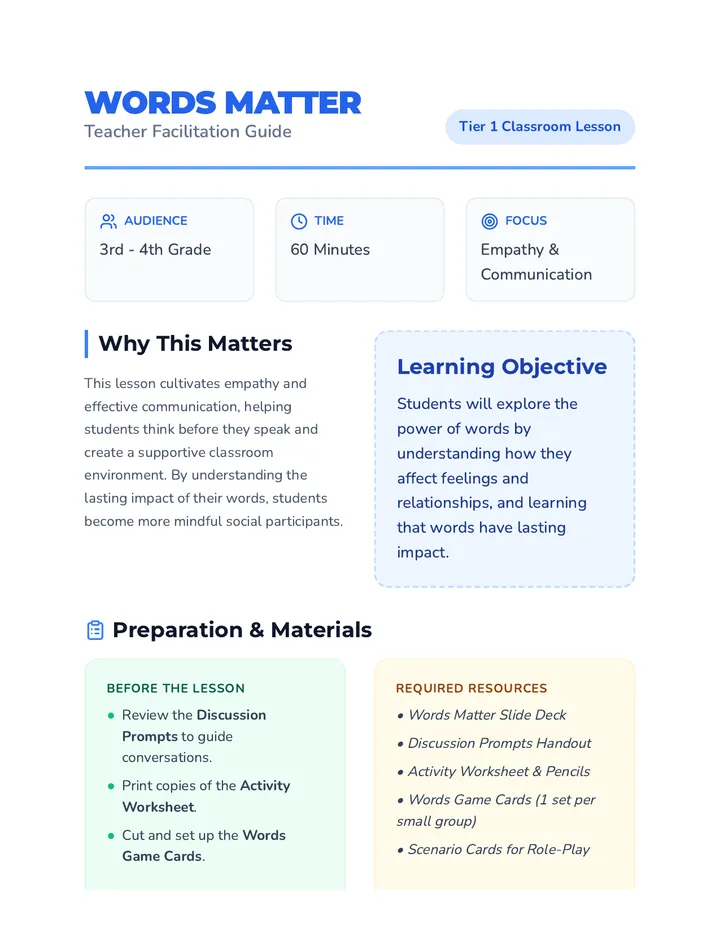
A 3-day small group social-emotional learning sequence focused on developing empathy for grades 3-5. Aligning with the CASEL framework, students practice recognizing feelings, listening actively, and responding to peers with compassionate words and actions.
A 3-session coming-of-age curriculum and presentation series designed for young boys transitioning into adolescence. The curriculum utilizes a maritime and outdoor navigation motif ('The Navigator\'s Code') to explore emotional literacy, personal responsibility, and proactive self-advocacy.
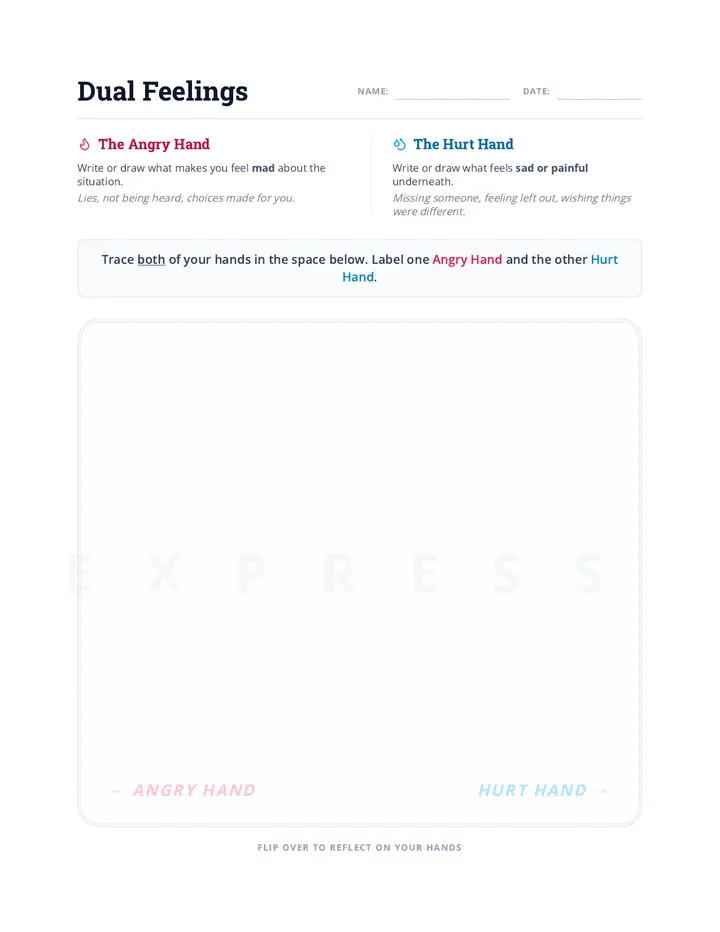
A two-lesson counseling sequence designed for a small group (3rd and 4th graders) focusing on self-advocacy strategies. The sequence guides students from pre-advocacy de-escalation (breathing and grounding) to active self-expression (I-statements and situational script practice).
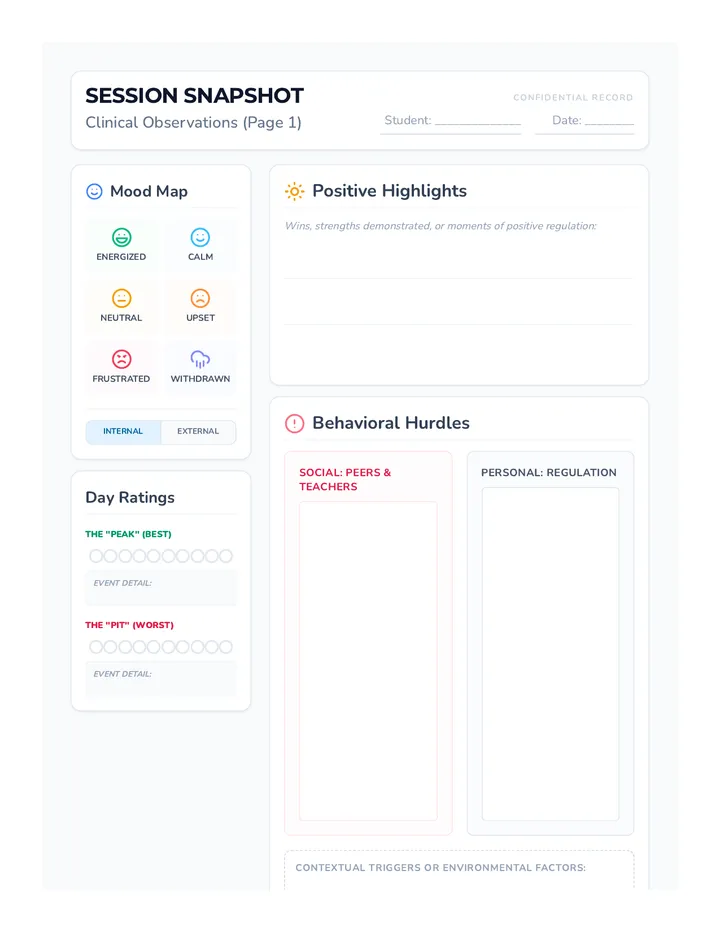
A three-session clinical protocol designed to establish rapport, build safety, and lower conversational demands for depressed, highly withdrawn, or non-verbal high school students. It moves systematically from parallel presence to indirect expression, and finally to visual grounding.
A 4-day small group emotion regulation curriculum for middle school students (grades 6-8) using a 1-5 emotional thermometer metaphor. Students learn to recognize emotional intensity, identify triggers, explore coping strategies, and design their own personalized stress-management plan.
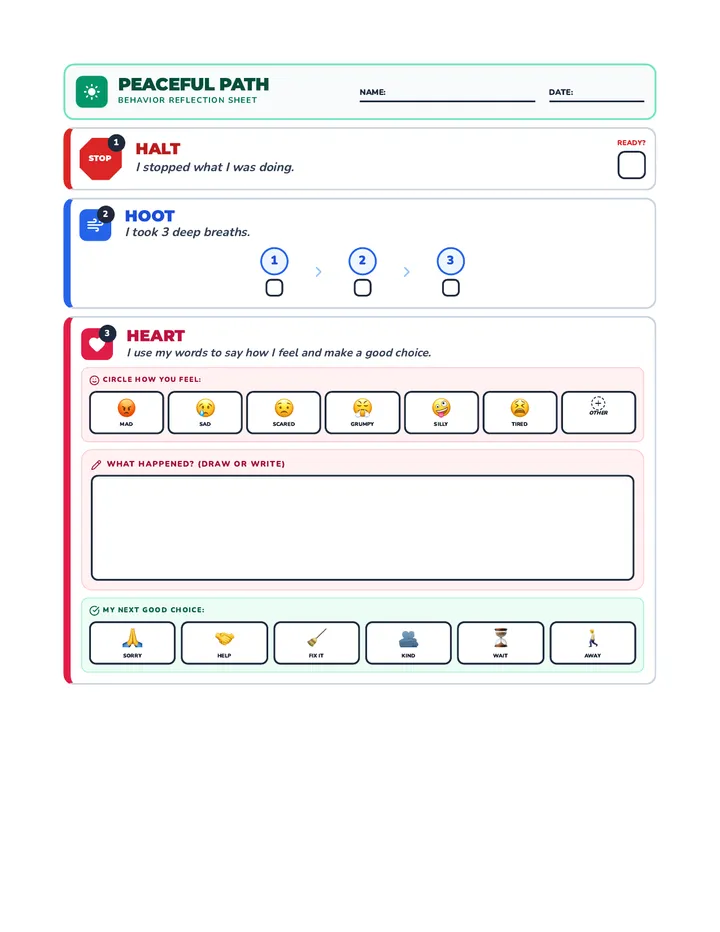
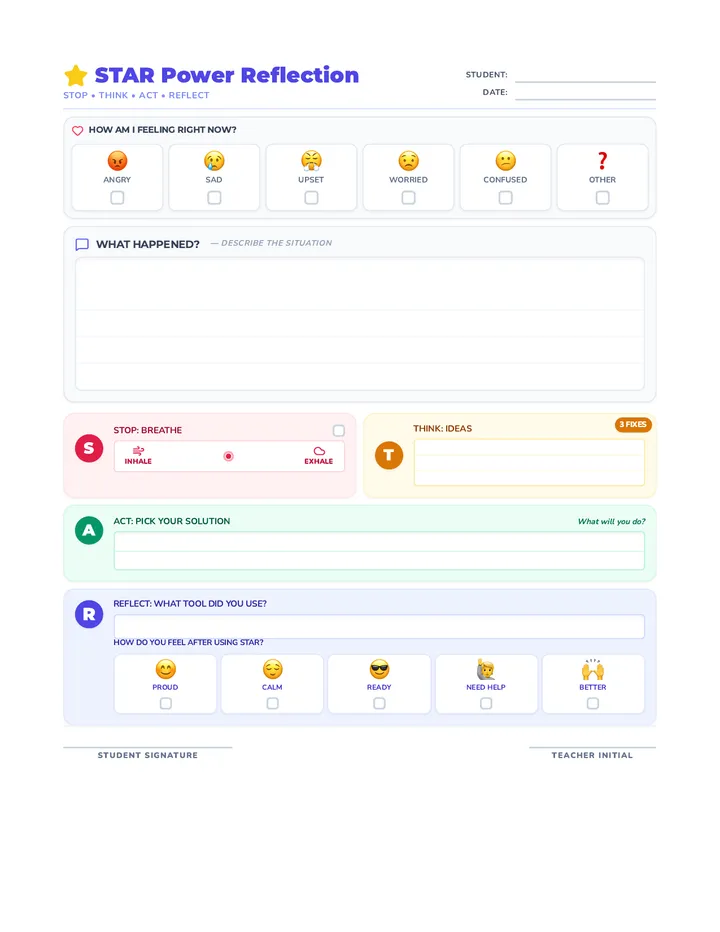
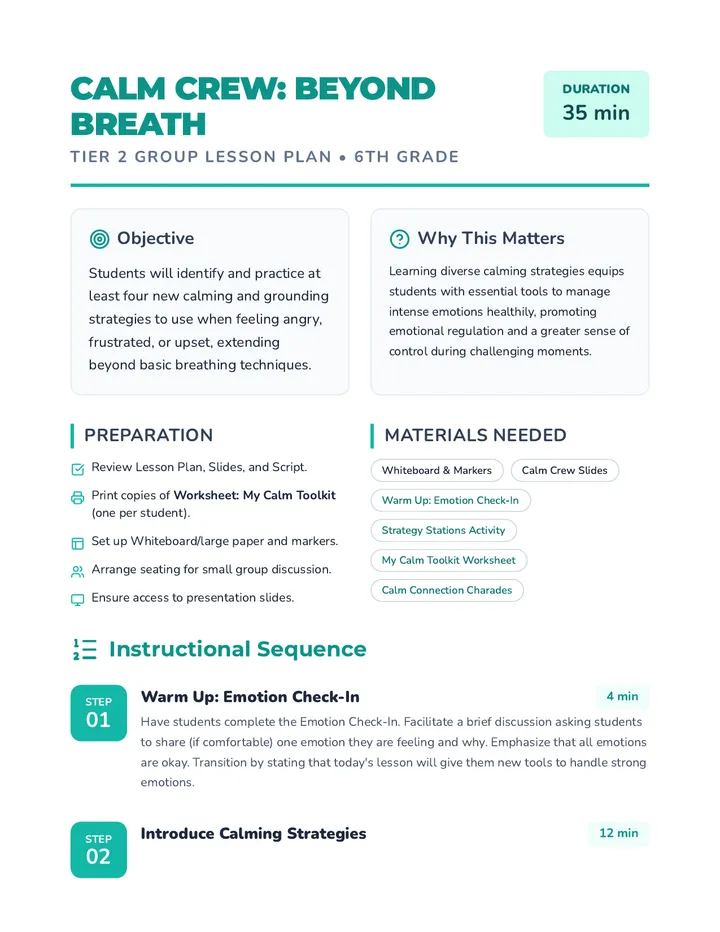
A 3-day small group SEL intervention for grades 3-5 focused on self-management and impulse control. Students learn to pause and select a school-appropriate calming strategy (deep breath, take a break, or rest 5 minutes) before responding to high-emotion situations.
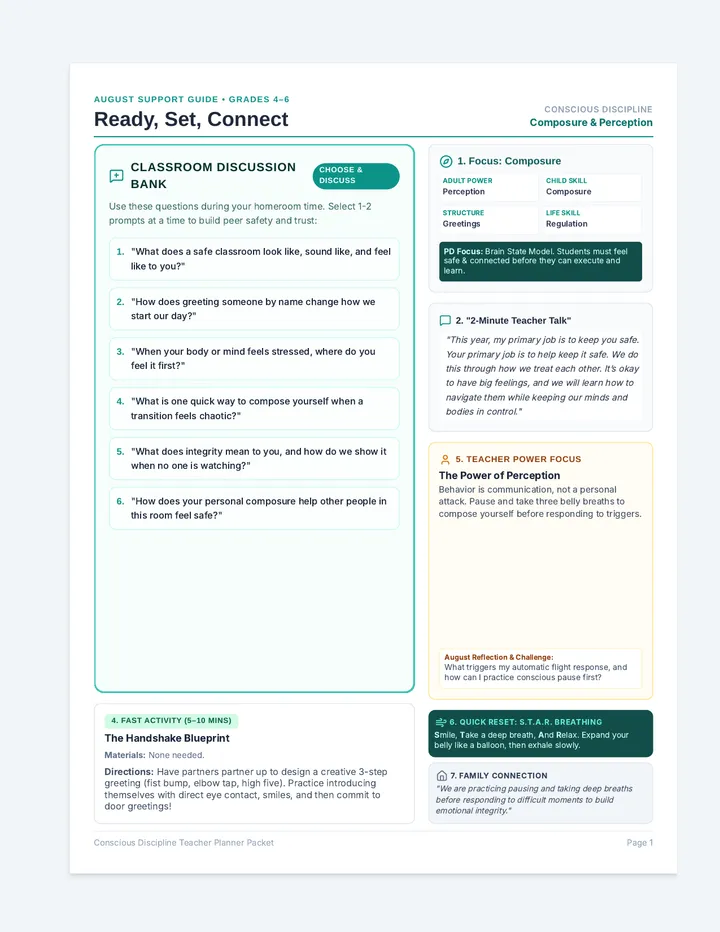
A comprehensive, proactive middle school curriculum designed to counter discipline trends of verbal aggression, profanity, drama, and disrespect through social-emotional learning, interactive role-plays, parent partnership, and a unified school-wide visual campaign.
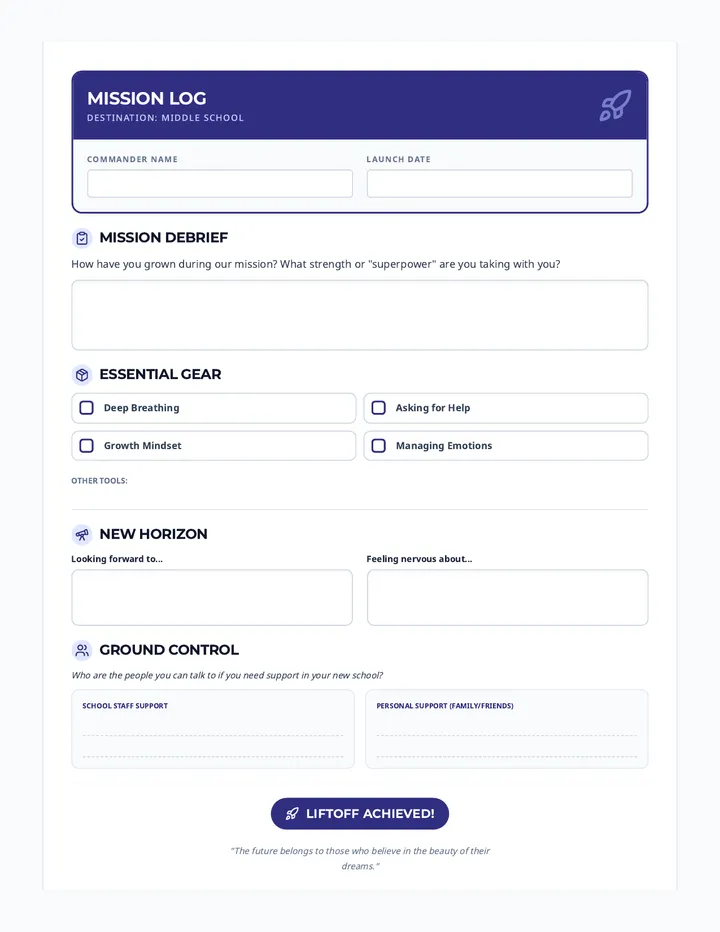
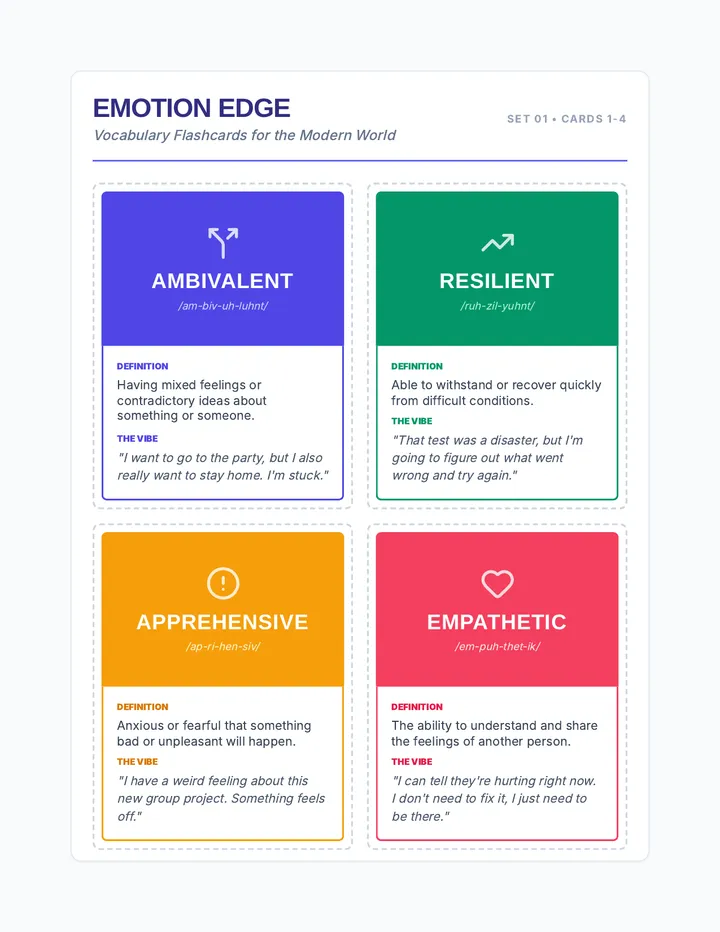
An SEL curriculum unit designed to help middle school students navigate complex emotional landscapes by distinguishing subtle emotional nuances. Focuses on critical distinctions like guilt vs. shame and excitement vs. anxiety to build self-awareness and self-management skills.
A 4-day small-group SEL unit for grades 3-5 focusing on the CASEL framework for identifying basic and complex emotions, tracking emotional shifts, and developing coping strategies.
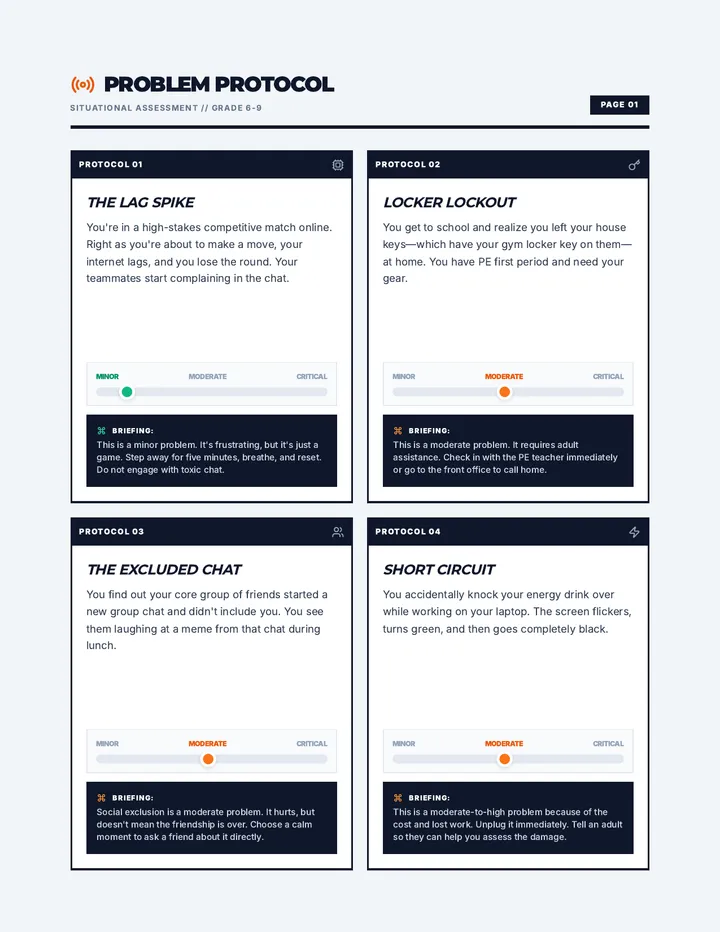
An emotional regulation and perspective-taking sequence for 4th-grade students, focusing on size of the problem, self-talk, unstructured environments, and partner cooperation.
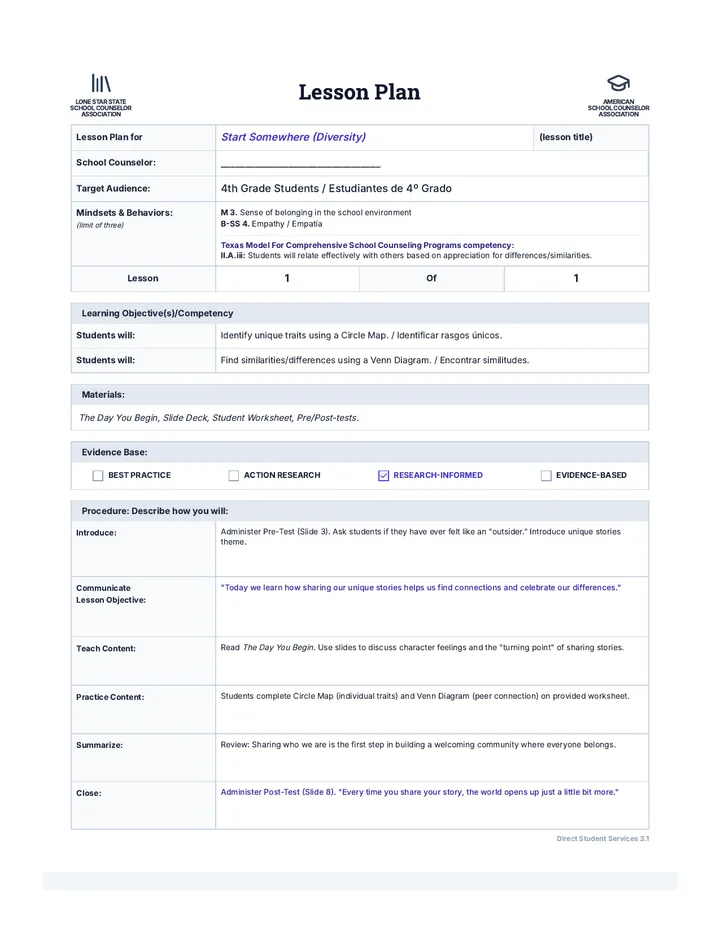
A 3-lesson unit on culture, identity, empathy, and building an inclusive school community. Students explore the cultural iceberg, share personal perspective narratives, and collaborate on actionable school-wide inclusion plans.
A high school counseling sequence focused on building perspective-taking, cognitive flexibility, and active collaboration strategies for Grade 12 Seniors navigating professional capstone projects, advanced career-technical labs, and workplace transitions.
A two-lesson celebratory sequence for 5th-8th grade Black and Brown boys to reflect on their classroom charter, map their growth, and practice random acts of kindness as a brotherhood.
Séquence d'accompagnement pédagogique pour les élèves de CAP Agricole en Nouvelle-Calédonie, visant à acquérir les compétences de l'Objectif 5 du module MP1 (Insertion du salarié dans l'entreprise) pour leur rapport de stage (PFMP).
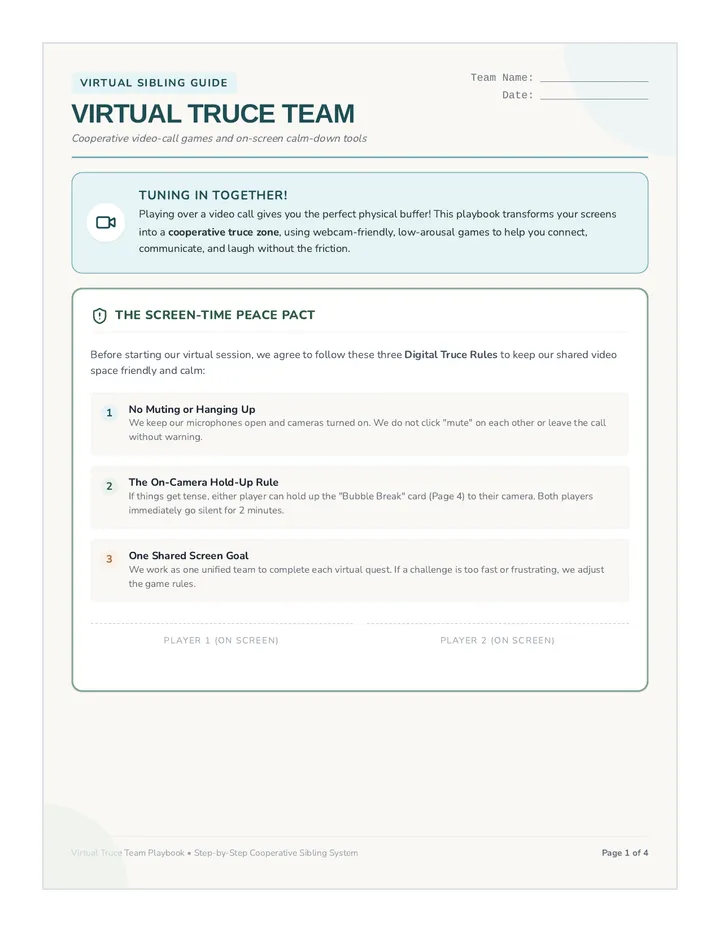
A 2-session individual counseling sequence using Carol Gray social story and cognitive behavioral principles to help neurodivergent middle schoolers safely explore connection, reduce rejection-shame, and practice safe social risk-taking.
A comprehensive bilingual (English/Spanish) counselor-led curriculum for 6th-grade students transitioning into US and global school environments. Aligned with ASCA Mindset standards, this series cultivates manners, social maturity, respect, and a strong sense of belonging through interactive discussions and cross-cultural comparisons.
A high school counseling sequence focused on building perspective-taking, cognitive flexibility, and active collaboration strategies for students navigating academic projects and trade-school shop floors.
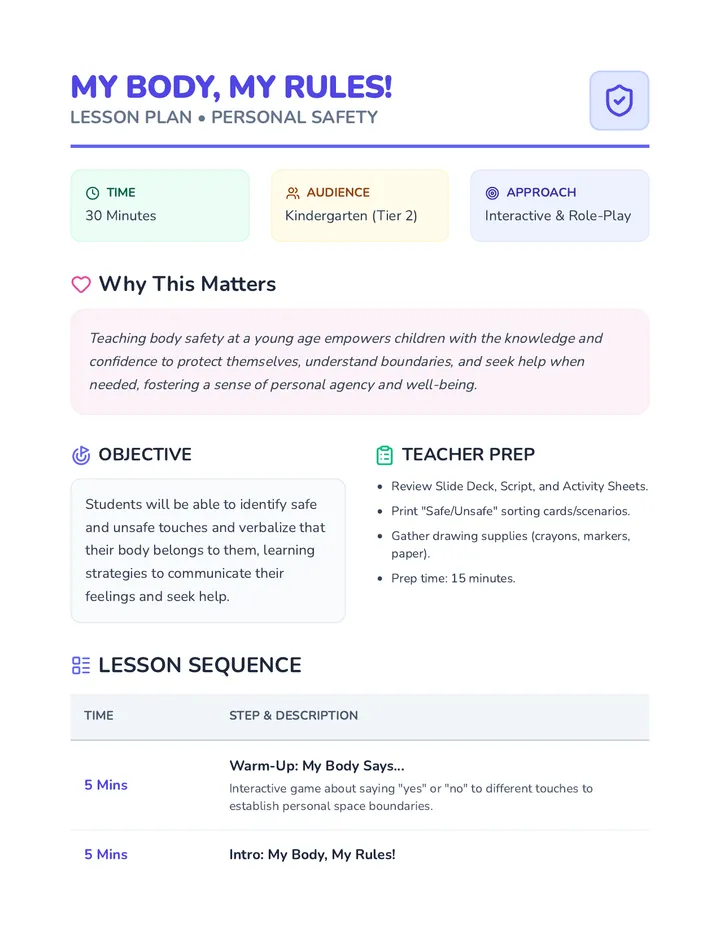
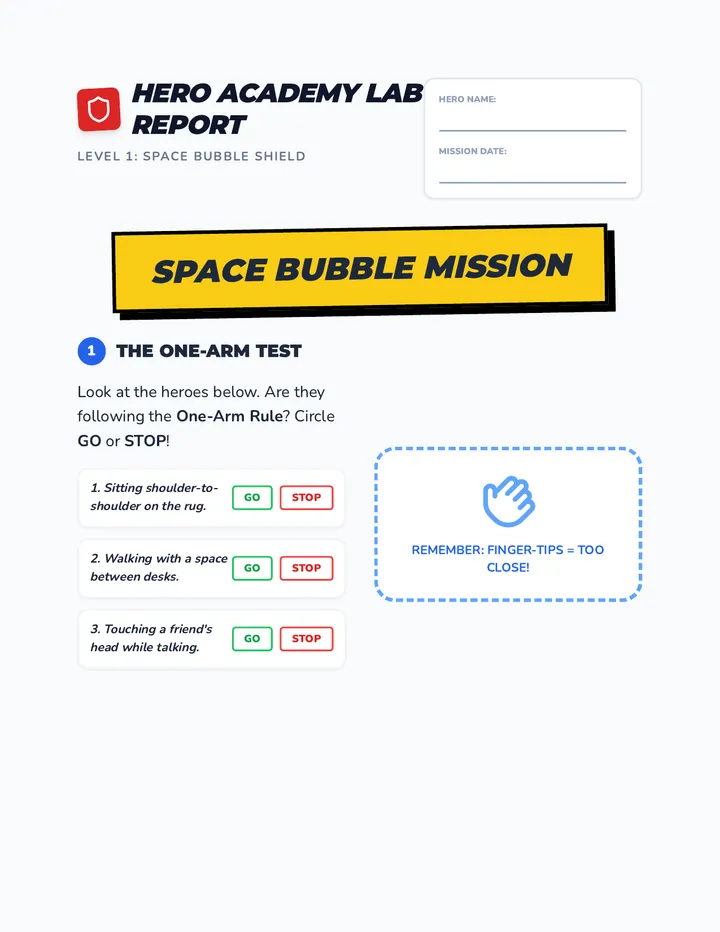
A comprehensive social skills unit focusing on personal space and boundaries across various school settings and routines for the week of May 25th. This unit differentiates for four distinct classroom groups (Kean, Ramapo, WP, and WashU) with tailored social stories and activities.
A three-day orientation sequence designed to build classroom community through team challenges, interdisciplinary puzzles, and reflective goal-setting with an 'Expedition Basecamp' theme.
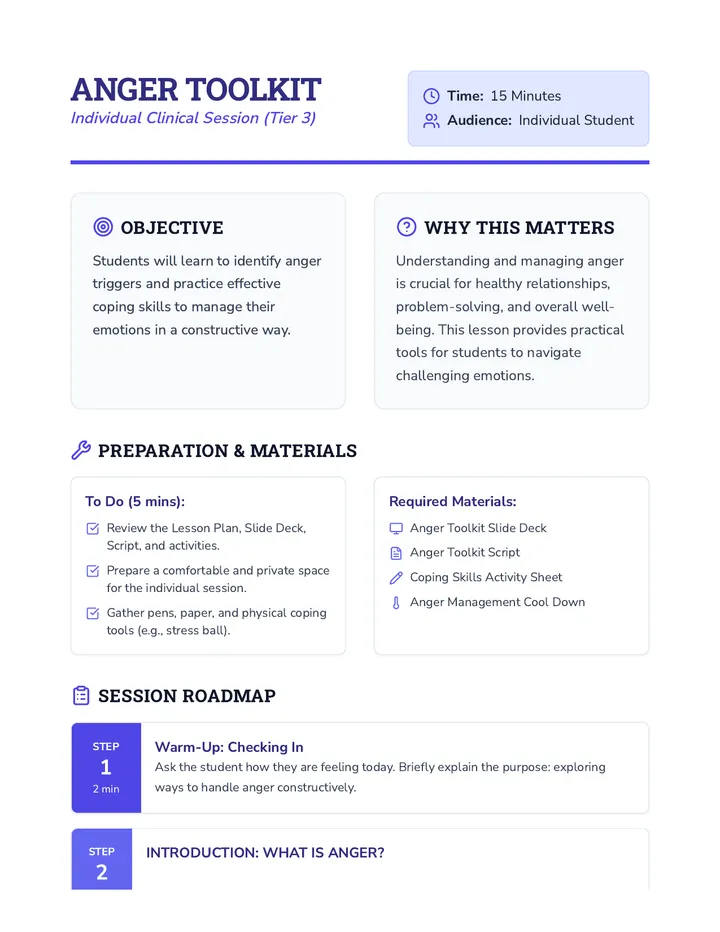
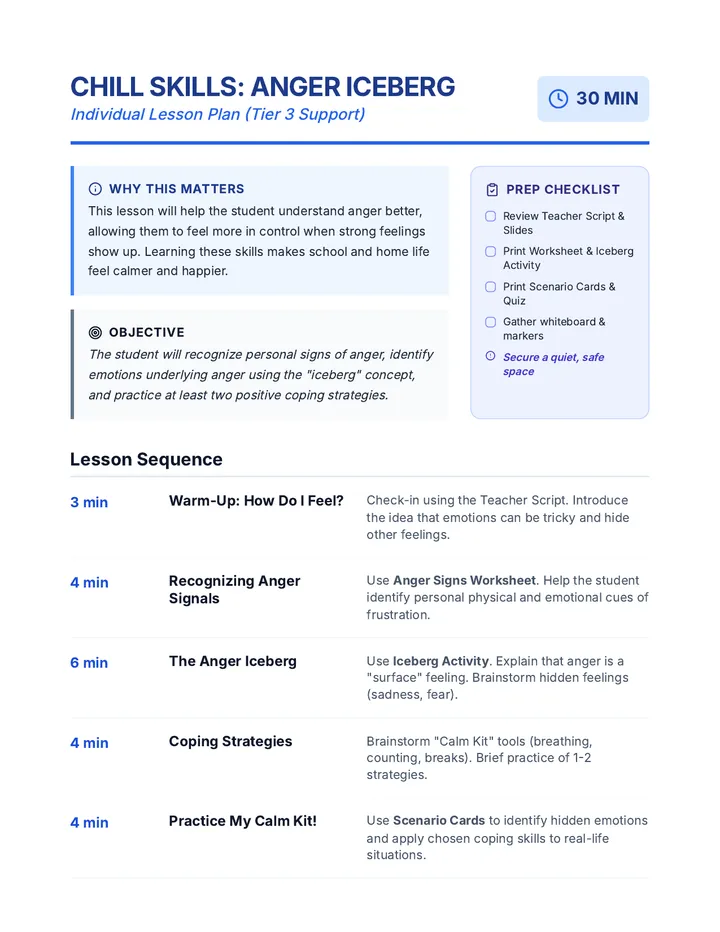
A comprehensive suite of evidence-based mental health interventions and resources for school clinicians, covering grief, depression, anxiety, conduct disorders, and crisis prevention for K-12 students.
A 4-part morning meeting series designed to help 8th-grade students navigate the logistical, social, and emotional transition to high school using a 'playbook' theme.
A comprehensive toolkit for school counselors and staff to support students experiencing prolonged grief. This sequence provides age-appropriate emotional regulation tools, communication strategies, and professional development for staff to create a trauma-informed environment.
A systemic approach to stress and burnout prevention for graduate students, reframing personal well-being as a design challenge. Students develop a personalized 'resilience architecture' through structural changes in time management, sleep hygiene, and boundary setting.
A comprehensive workshop sequence for graduate students to address academic anxiety through cognitive restructuring. The sequence explores Impostor Phenomenon, cognitive distortions, perfectionism, and professional identity to build long-term resilience.
A graduate-level exploration of the biological underpinnings of stress. Students move from theoretical understanding of the autonomic nervous system and Polyvagal Theory to practical application of somatic regulation and interoceptive awareness, culminating in a personalized physiological safety plan.
A comprehensive workshop-style sequence for undergraduate students to master cognitive reframing techniques. Students progress from identifying distortions to deconstructing beliefs and building resilient internal narratives.
A Pre-K sequence focused on building self-esteem and positive experiences through mastery, growth mindset, and persistence. Students learn to navigate challenges and celebrate their own progress.
A Pre-K sequence focused on moving from individual joy to shared happiness through social connection, invitations, collaboration, and celebration. Students learn how community and play amplify positive emotions and build resilience.
A Pre-K sequence introducing behavioral activation concepts by helping a puppet character navigate low moods through small, physical actions and kindness. Students learn that 'doing' can change 'feeling' in a developmentally appropriate, narrative-driven way.
A Pre-K sequence focused on helping young learners identify personal interests and activities that bring them joy, fostering self-awareness and emotional regulation through the creation of a 'Happy List'.
A Kindergarten sequence focused on shared positive experiences to boost mood and build social connections through invitations, cooperation, laughter, altruism, and gratitude.
A project-based sequence for Kindergarteners to build emotional resilience by designing and practicing daily routines that prioritize fun, rest, and connection. Students learn to sequence their day, brainstorm rewarding activities, and commit to 'Positive Pauses' for emotional well-being.
A Kindergarten sequence focused on teaching emotional regulation through positive actions. Students learn to use activities like physical movement, deep breathing, and creative expression to 'switch the channel' from negative to positive emotions, building a toolkit of coping strategies.
A 5-lesson unit for 3rd graders focused on building emotional resilience through habit formation. Students learn to audit their time, identify small 'micro-moments' of joy, and design balanced daily schedules that prioritize positive experiences.
Students synthesize their knowledge to create a personalized physiological safety plan for high-stress periods. They identify triggers, early warning signs, and pre-planned somatic interventions.
Students evaluate somatic bottom-up processing techniques like diaphragmatic breathing and thermal regulation. They learn to choose the right physical strategy for their specific physiological profile.
Learners practice interoception—the sense of the internal state of the body. They test their accuracy in detecting heart rate and tension, connecting poor awareness with high anxiety.
A culminating event where students plan and execute a simple shared activity (like a dance party or snack share). They reflect on how doing things together feels different than doing them alone.
Dives into Polyvagal Theory to distinguish between fight/flight mobilization and dorsal vagal shutdown. Students analyze behaviors like procrastination and isolation as biological responses.
Students present their collages to small groups, articulating why they chose specific activities. Peer listeners practice affirming others' choices.
Students present their Joy Menus to small groups, allowing peers to borrow ideas to add to their own lists. The lesson concludes with a commitment to try one menu item over the weekend.
Students learn to identify when a friend does something good and how to celebrate them (clapping, cheering). This shifts focus from self-gratification to finding joy in others' success.
Students integrate their knowledge to create a personal 'bio-map' of their stress escalation cycle. They present how specific physiological interventions can interrupt this cycle at various stages.
Using a collage format, students select and paste images of their favorite activities onto a personal poster. This visual aid serves as a concrete reference tool.
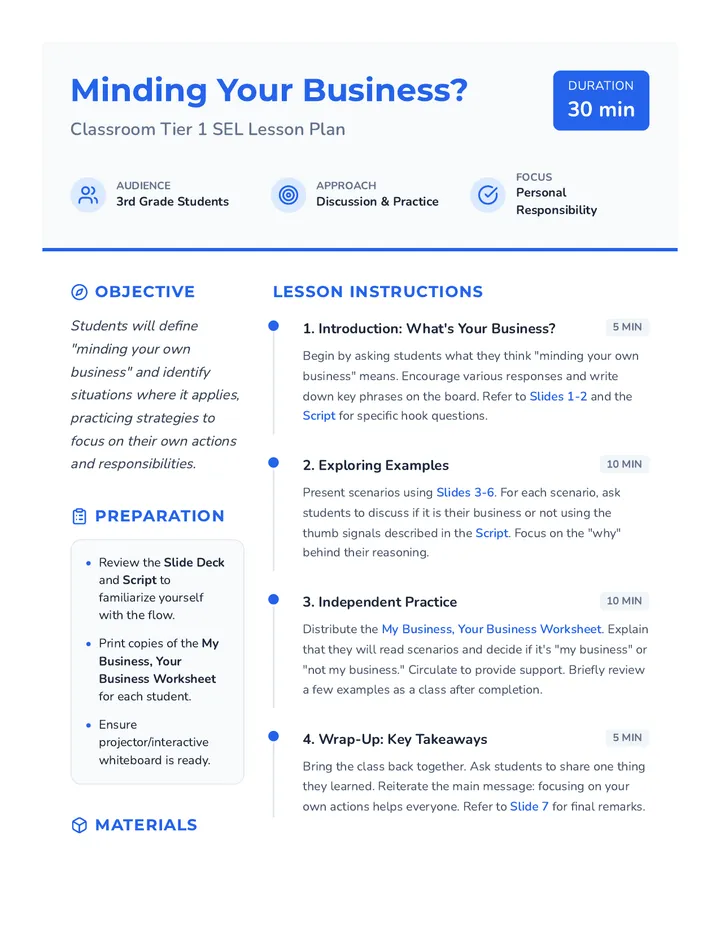
Participants investigate the role of the vagus nerve in regulating heart rate and calming the nervous system. They experiment with specific physical maneuvers (like cold exposure or humming) that stimulate vagal tone.
Focuses on the anatomy of the stress response, the sympathetic and parasympathetic branches of the ANS, and the role of the vagus nerve. Students map their own physiological 'early warning signs'.
A reflective counseling lesson celebrating emotional expression, triumph over shyness, and setting intentions for speaking up with confidence in group settings.
A restorative leadership module designed for a 5th-grade student transitioning to middle school. Focuses on channeling natural social influence into positive leadership, specifically protecting and looking out for others, rather than leading peers into conflict.
An at-home extension lesson designed for the student to work on independently or with a family member tonight, focusing on practicing guitar techniques as emotional outlets and setting positive household commitments.
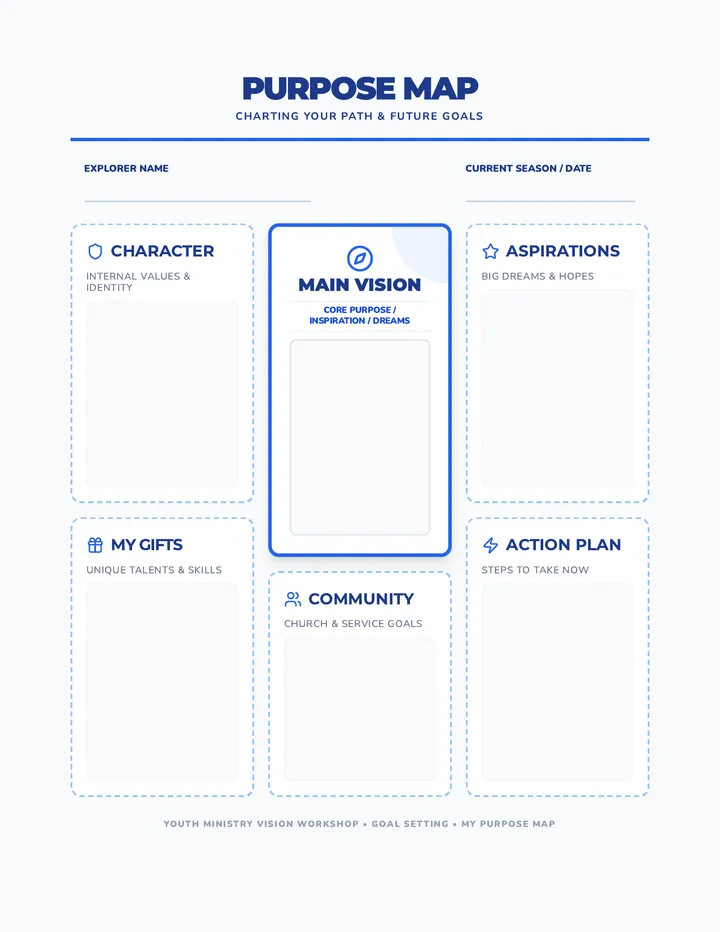
A transformative mentoring curriculum designed for a student transitioning to high school, using his passion for heavy metal and guitar to guide reflection on peer pressure, resist hate symbols, and channel his influence into positive leadership.
A supportive, highly visual transition lesson for primary students (grades K-2) to reflect on classroom successes, map out summer coping tools and trusted helpers, and build confidence through sensory-friendly drawing prompts and a somatic brave chant.
A supportive transition lesson for upper elementary students to reflect on the past year, create a visual coping plan for summer, and build confidence for entering the next grade.
A supportive, mountain-trail-themed final counseling session designed for students on IEPs to celebrate their personal growth, develop summer coping strategies, set future goals, and process closure with their counselor.
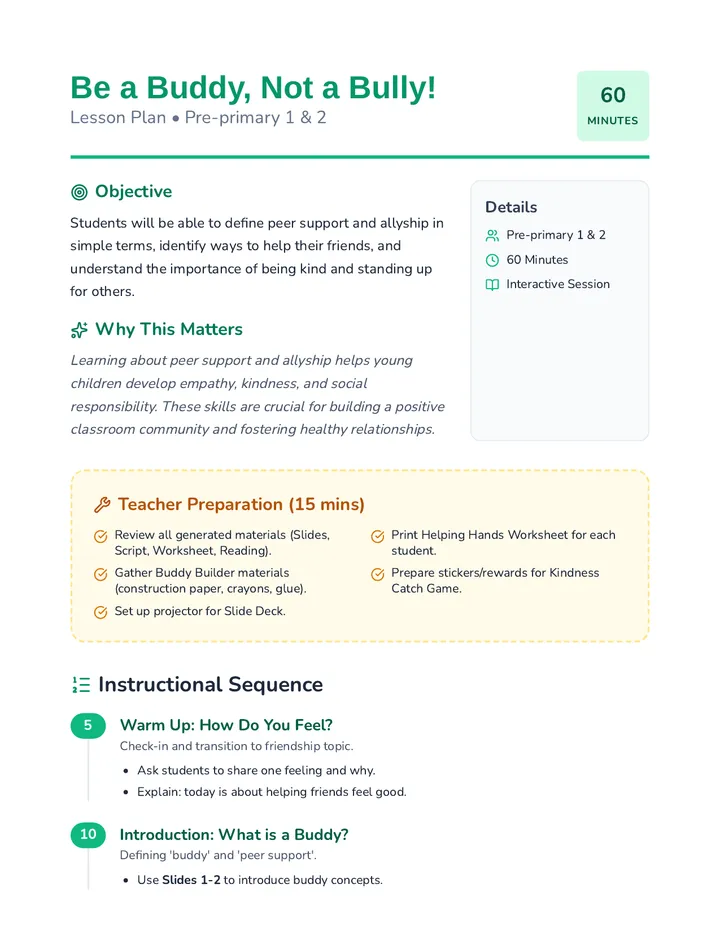
A highly interactive Lunch & Learn lesson for 1st-3rd graders focusing on growth mindset and 'The Power of Yet'. Includes a student worksheet, printable table discussion cards, a facilitator script, and a colorful classroom anchor chart.
A quick, high-impact SEL lesson designed for Grades 1–3 to introduce the concept of a growth mindset through the 'Superpower of Yet' using the TLC Gators school mascot.
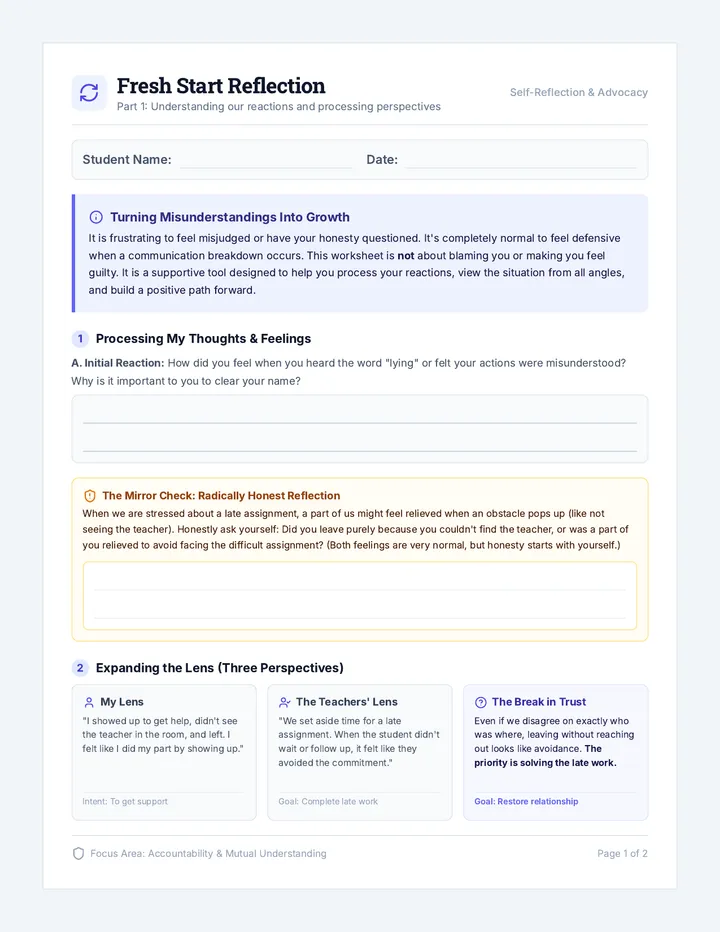
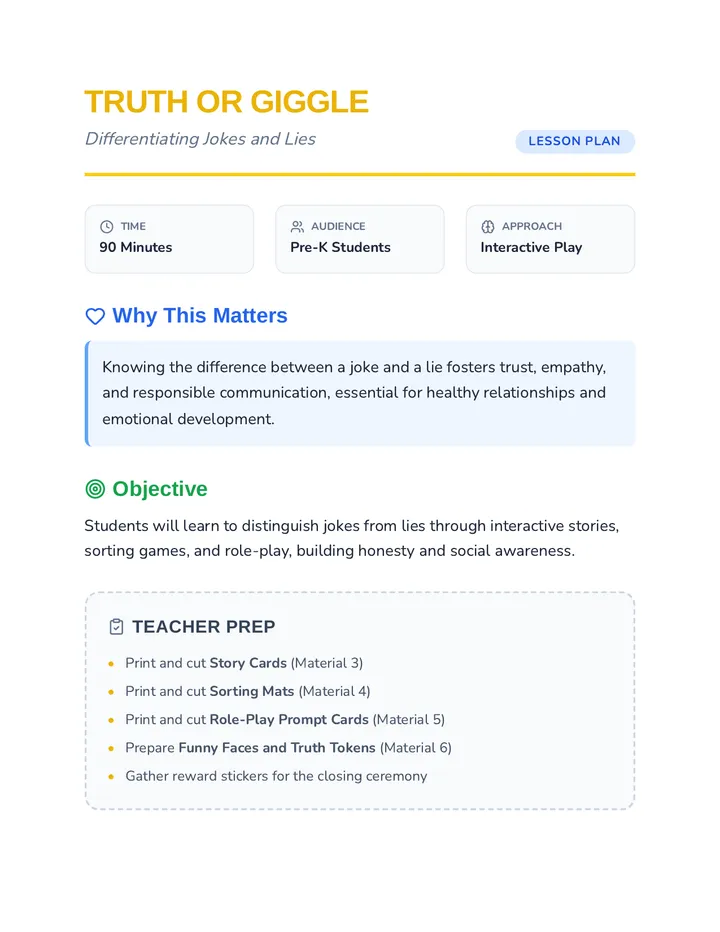
A 15-minute restorative social-emotional learning lesson for third graders struggling with lying to avoid consequences. It helps students understand that hiding mistakes with lies creates a heavy emotional burden, while speaking the truth—even when it requires great courage—brings relief, lightness, and restores trust.
An end-of-year reflective science lesson where 7th-grade students look back on their progress, share advice for incoming students, and celebrate achievements.
Students apply their deep listening and empathy skills to design a school-wide inclusion campaign or classroom standard, designing collaborative action items.
Students engage in active empathy and narrative exchange, analyzing how personal experiences and cultural backgrounds shape our perspectives of shared environments.
Students explore the concept of the cultural iceberg, distinguishing between visible elements of culture and deep, invisible values, to recognize the richness of identity.
Students learn to set healthy boundaries, navigate peer pressure, and establish what authentic trust looks like in real-world friendships.
Students analyze their digital footprint, discuss modern social media pressures, and learn how to align their online actions with their offline values.
Students explore their personal identity, core values, and what healthy masculinity looks like in their daily lives.
Focuses on creating a sustainable positive culture through daily small actions, prompting students to track their leadership and reflect on how positive behavior spreads. Features read-and-respond profiles of real student leaders.
Students explore what it means to be a 'shield' for peers in middle school rather than a passive bystander or an instigator. Features narrative read-and-respond case studies on standing up to social exclusion and rumors.
A testimony-based lesson exploring the journey of stepping out of one's comfort zone, overcoming fears through faith, and embracing God's mission in Thailand.
Una presentación de diapositivas en español diseñada para guiar a los estudiantes en su transición a cuarto grado, abordando el manejo de emociones, nuevas rutinas y estrategias de afrontamiento de manera visual y amigable.
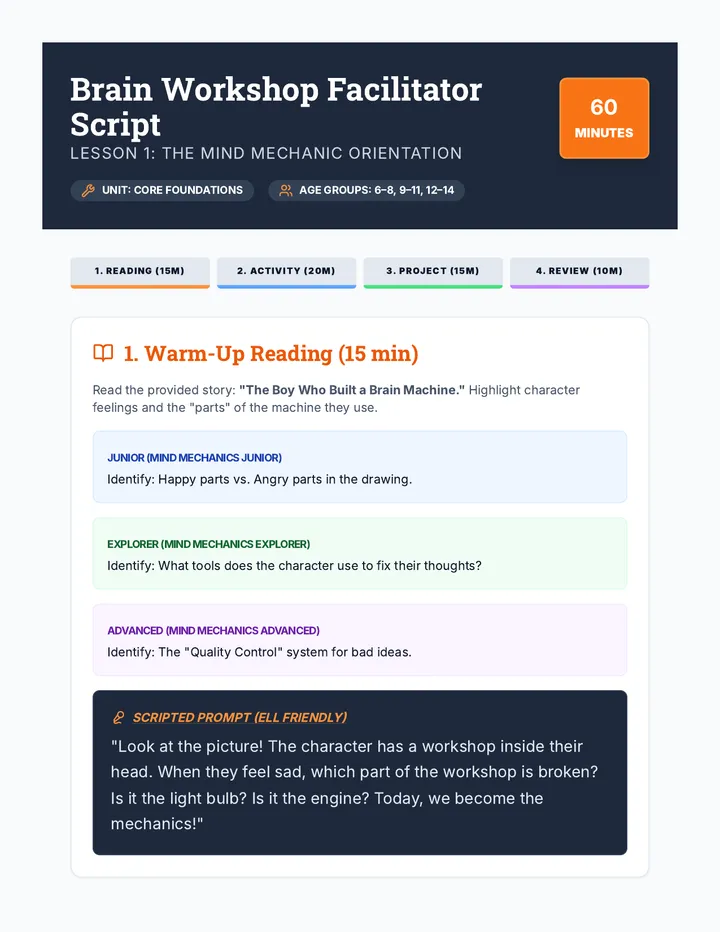
A comprehensive teacher-facing resource detailing the final session outline for the Friendship Garden small group. It provides pacing, structured discussion prompts, a closing circle ritual, and facilitation instructions for the keepsake posters.
An interactive, beautifully themed keepsake coloring poster for 2nd-3rd grade students. It combines garden-themed coloring illustrations with short, creative reflection prompts to celebrate their friendship journey.
A delightful, print-ready keepsake coloring poster designed for primary grades (K-1st). It features beautiful garden graphics with bold outlines for easy coloring, minimal writing, and an interactive drawing frame to celebrate friendship growth.
A 6-slide presentation deck designed for 16:9 projection to guide daily small group lessons. Features large, high-visibility typography (minimum 24px), dark clinical blueprint themes, and visual anchors to explain emotional mapping, guilt vs. shame, and cognitive reappraisal.
A professional 2-page teacher facilitation and curriculum guide outlining the 4-day, 20-minute daily small group intervention. Includes detailed step-by-step scripts, exact timestamps, CASEL framework alignment, common misconceptions, and facilitation techniques.
A 4-page student work booklet containing interactive physical mapping activities, cognitive reappraisal templates, guilt vs. shame scenario case files, and synthesis reflection sheets.
An identical pre- and post-test assessment for middle school students to evaluate their understanding of guilt vs. shame and excitement vs. anxiety before and after the 4-day intervention. Includes scenario-based multiple-choice and short-answer questions.
A comprehensive facilitation guide for counselors to run the 20-minute end-of-year transition lesson for grades K-2. Emphasizes somatic breathing, hands-on drawing prompts, co-regulation, helper circles, and active chanting to reduce transition anxiety.
An interactive EOY transition activity booklet for K-2 students, featuring friendly hiking-themed drawing frames, emoji check-ins, circle-the-answer coping tools, and a bold coloring 'Brave Motto' to process next-grade adjustments in a concrete, sensory-friendly way.
A comprehensive facilitation guide for counselors to run the 20-minute end-of-year transition lesson. Includes structured pacing, discussion prompts, active listening tips, and support strategies for upper elementary students.
An interactive transition booklet for upper elementary students (grades 3-5). Features reflective hiking-themed prompts to capture accomplishments, design a visual summer coping backpack, build a support network, and address next-grade anxieties.
A highly engaging 1-page student playbook for Lesson 3: Line in the Sand. Helps students audit friendships, draft personalized peer-pressure refusal scripts, and declare their non-negotiable boundaries.
An interactive 6-slide presentation to guide Lesson 3: Line in the Sand. Covers establishing peer boundaries, identifying toxic friendship traits, and practicing refusal scripts.
A comprehensive 2-page facilitator guide for Lesson 3: Line in the Sand. Covers establishing peer boundaries, identifying toxic friendship traits, and practicing refusal scripts.
A highly engaging 1-page student journal for Lesson 2: Digital Armor. Helps students audit screen time, contrast their digital mask with their true self, and lock in daily device boundaries.
An interactive 6-slide presentation to guide Lesson 2: Digital Armor. Covers daily screen averages, the digital mask vs true identity, group chat dynamics, and lock-in habits.
A comprehensive 2-page facilitator guide for Lesson 2: Digital Armor. Covers managing social media validation, group chat dynamics, digital footprint awareness, and phone boundary-setting.
A highly engaging, themed 1-page personal reflection log for students to declare their core values, inventory personal strengths, and draft their personal commitment statement.
An interactive 6-slide presentation to guide the first group session, featuring bold discussion prompts, deconstructing social expectations, and setting up the core values activity.
A comprehensive 2-page facilitator guide for Lesson 1: Own Your Code. Includes group guidelines, pacing, step-by-step instructions, discussion prompts, and debrief questions.
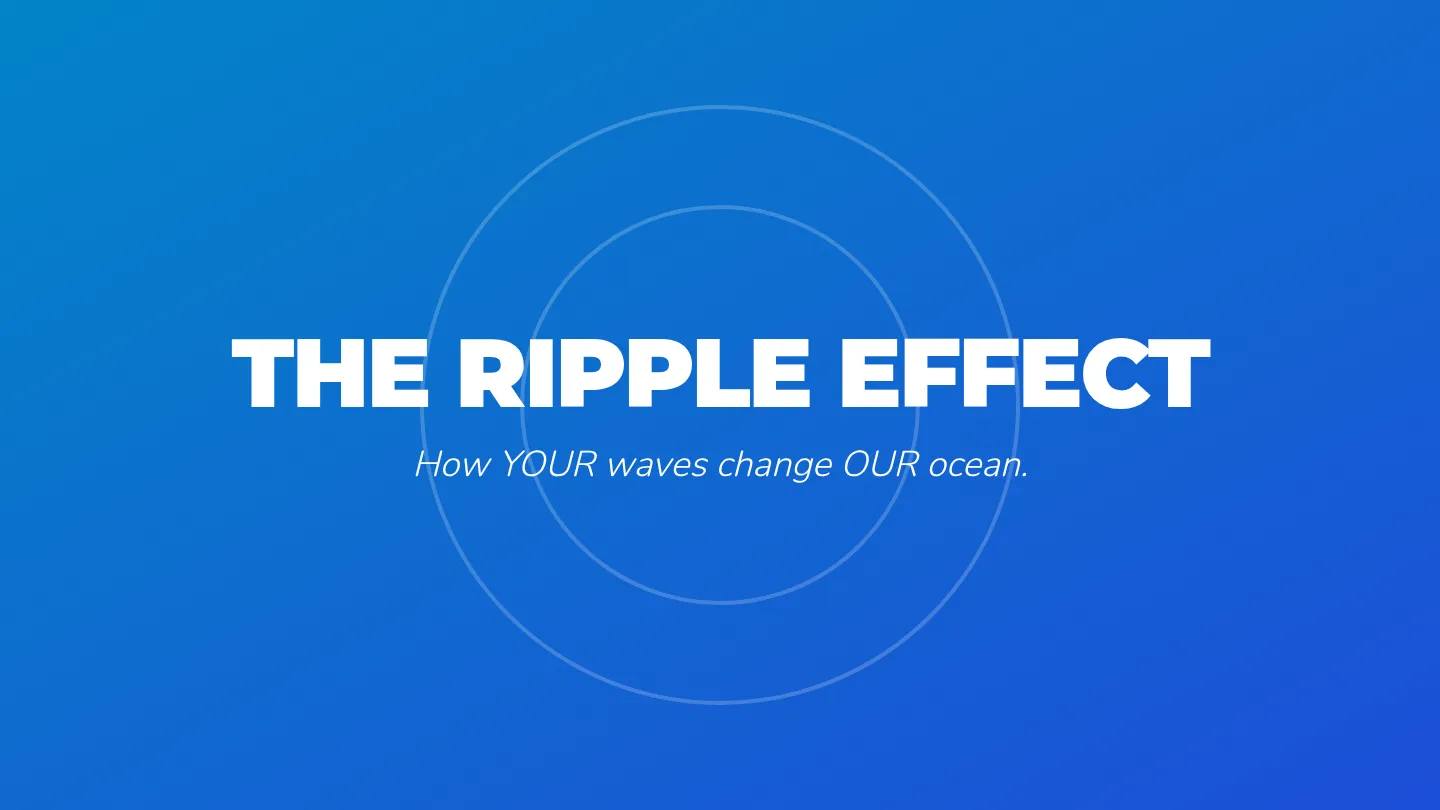
A 5-slide presentation matching the Ripple Effect lesson. It introduces students to the physics of school culture, walks through Maya's hallway story, and details the 5 leadership tracker actions.
A 2-page print-ready student-centered Read & Respond workbook detailing the physics of the ripple effect in school culture, featuring biographical vignettes of youth advocates and daily leadership tracking sheets.
A 5-slide presentation matching the Peer Shields lesson. It helps teachers guide a classroom debate on instigators vs. bystanders vs. shields, analyzing real-life lunchroom and digital chat situations.