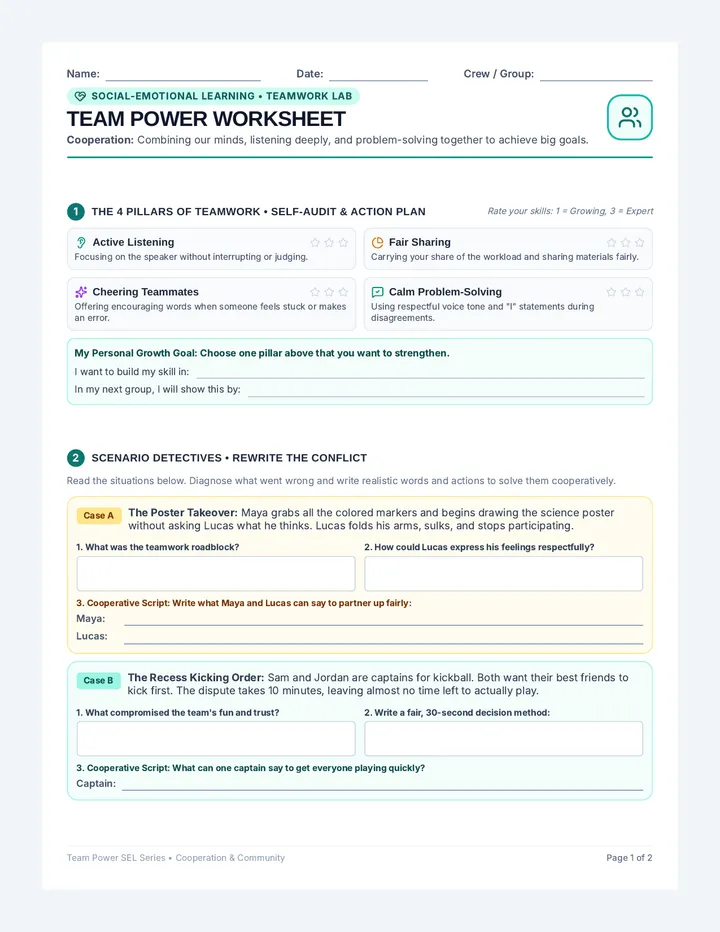
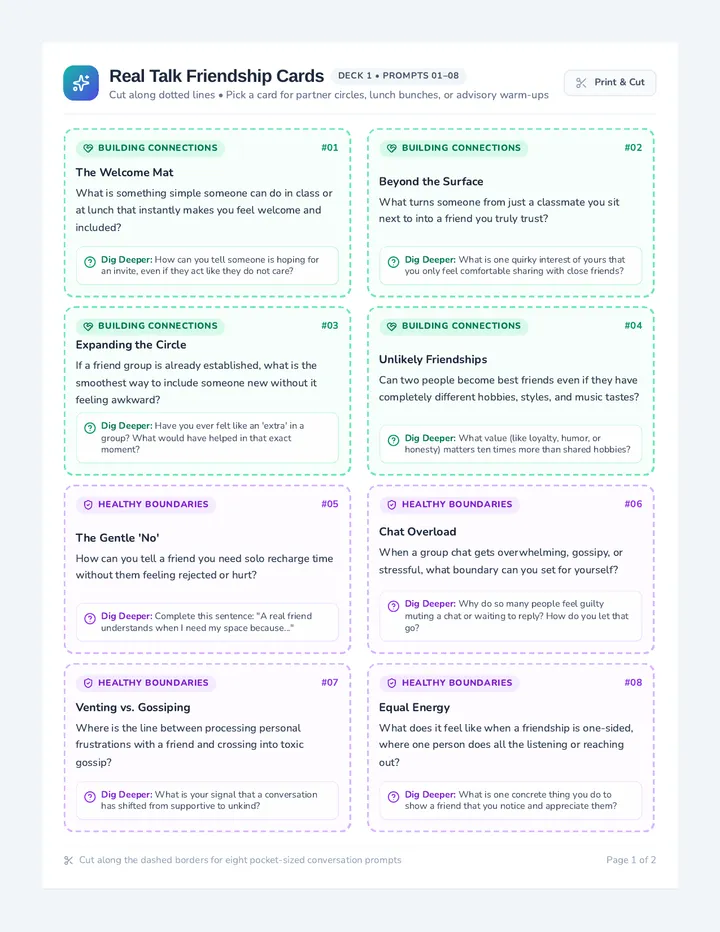
Conflict resolution, active listening, and healthy boundary-setting within social circles. Strengthens social-emotional intelligence and collaborative problem-solving through peer interaction.
A culminating event where students plan and execute a simple shared activity (like a dance party or snack share). They reflect on how doing things together feels different than doing them alone.
Students learn to identify when a friend does something good and how to celebrate them (clapping, cheering). This shifts focus from self-gratification to finding joy in others' success.
Students design and pitch a sustainable community care initiative tailored to their specific academic or professional cohort.
Develops skills for leading group stress check-ins, managing dynamics, and ensuring psychological safety in group settings.
Focuses on preventing compassion fatigue through emotional and temporal boundaries and professional referral protocols.
Practical workshop on active listening, validation, and holding space for peers without the pressure to provide immediate solutions.
Examines the buffering hypothesis and the psychological mechanics of how social connection mitigates stress, contrasting co-rumination with constructive disclosure.
Small groups work together to build something (block tower, art piece). The focus is on the positive feeling of achieving a goal together rather than the final product.
Students design a framework for a community care plan, producing a 'Community Charter' for peer support in a specific campus context.
A facilitated dialogue session focusing on common undergraduate stressors, practicing normalization and collective coping strategies.
Training on recognizing the limits of peer support and when to refer to professionals, with a focus on setting emotional boundaries to prevent burnout.
A skill-building session on non-judgmental listening, reflecting, and validating emotions, focusing on 'holding space' rather than problem-solving.
A graduate-level training sequence on facilitating peer support systems to mitigate stress and anxiety. Students learn the science of social support, micro-skills for active listening, boundary setting to prevent burnout, and group facilitation techniques to create sustainable communities of care.
A comprehensive sequence for undergraduate students exploring the social psychology of stress and the practical skills needed to build resilient peer support networks. Students move from theoretical understanding to practical facilitation and community planning.
A Pre-K sequence focused on moving from individual joy to shared happiness through social connection, invitations, collaboration, and celebration. Students learn how community and play amplify positive emotions and build resilience.
This advanced sequence prepares undergraduate students to design and facilitate psychoeducational groups focused on the DBT PLEASE skills (Physical illness, Eating, Altering substances, Sleep, Exercise). Students will progress from understanding group structures to leading mock sessions, focusing on communication, engagement, and managing clinical dynamics.
This sequence explores the psychology of group dynamics and community care. Students learn to recognize burnout, offer effective support, and advocate for cultures where requesting breaks is normalized and valued.
This sequence prepares undergraduate students to facilitate peer-led mental health support groups. It covers ethical boundaries, group safety, advanced communication skills, crisis protocols, and concludes with a practical facilitation session.
A professional workshop series for graduate students to master peer support, empathetic communication, and collective problem-solving within high-pressure academic cohorts.
A case-study-driven sequence for graduate students to analyze professional stressors and develop evidence-based resilience strategies through collective insight.
This sequence frames daily check-ins as a professional leadership and team management competency. Students explore psychological safety, real-world professional stand-ups, and facilitation techniques to design their own 'Readiness Protocols' for teams.
This sequence explores the role of structured daily check-ins in fostering psychological safety and collective productivity. Students move from understanding the psychological foundations of rapport to mastering professional frameworks like Agile Stand-Ups, eventually leading their own community circles.
A 5-lesson sequence for 1st Grade students focusing on the recovery phase after dysregulation. It teaches students how to 'reset' their day, check for emotional readiness, repair relationships, use positive self-talk, and build a supportive classroom culture for re-entry.
A comprehensive sequence for undergraduate students to master the art of creating psychological safety, fostering belonging, and designing inclusive community rituals through theoretical frameworks and practical facilitation skills.
An assessment rubric for the final Community Charter project, evaluating theory application, safety planning, and sustainability.
Final project rubric for evaluating the Community Care Initiative, focusing on rationale, boundaries, referral pathways, and sustainability.
Student design workbook for planning the Community Care initiative, covering problem definition, logistics, safety boundaries, and sustainability.
A design framework for a community care plan, producing a 'Community Charter' for peer support in a specific campus context.
Final project brief for the Community Care initiative, detailing requirements, core components, and the "Department Pitch" assessment.
Visual slide deck for Lesson 5, introducing the concepts of mutual aid, sustainable networks, and the "Community Charter" project.
Observation and feedback tool for students to use while observing peer-led group facilitation simulations, focusing on psychological safety and dynamic management.
A brainstorming worksheet for identifying collective coping strategies for common undergraduate stressors.
Practical script for students to lead a brief check-in circle, featuring opening ground rules, modeling prompts, and intervention strategies.
A sorting activity where students categorize shared stressors from an anonymous "drop box" into personal or systemic categories to facilitate normalization.
Facilitation Fundamentals Slides focusing on group dynamics, psychological safety, and managing difficult participants.
Visual slide deck for Lesson 4, introducing group facilitation skills, the power of normalization, and the distinction between individual and systemic stressors.