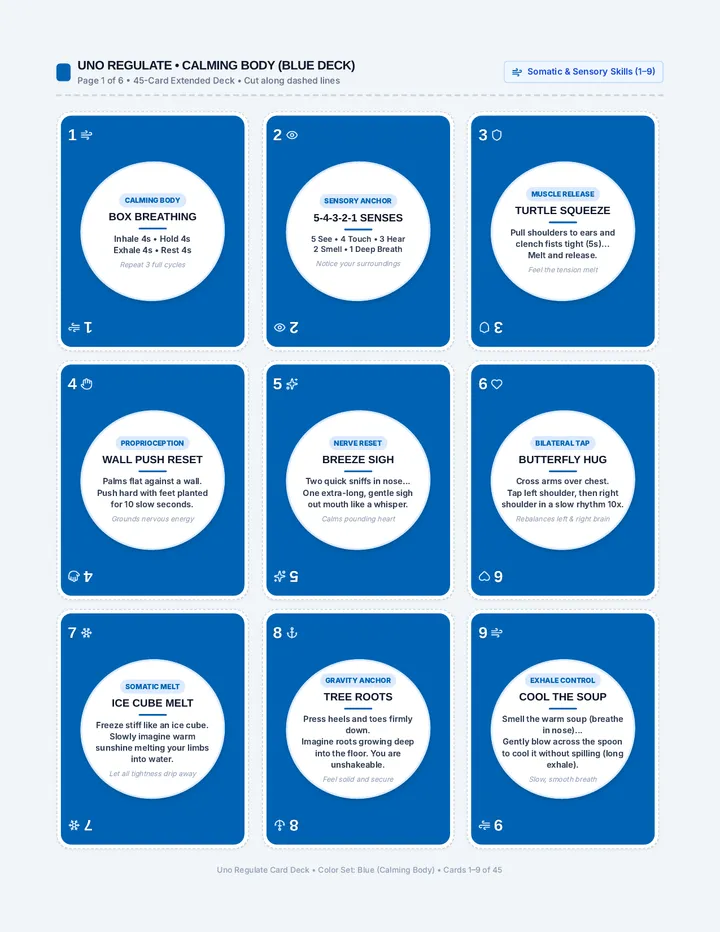
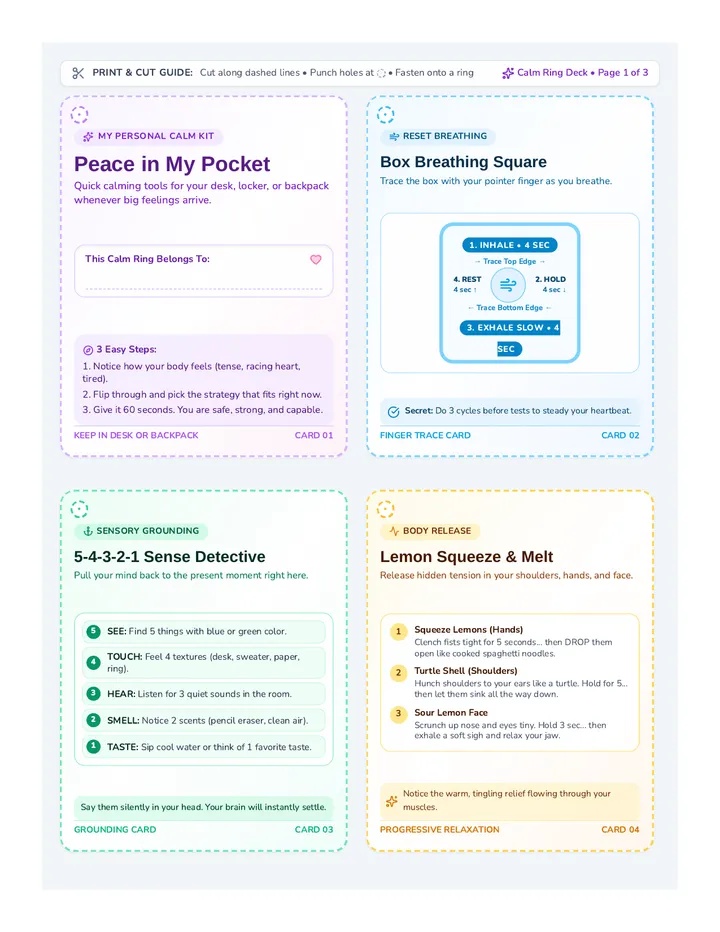
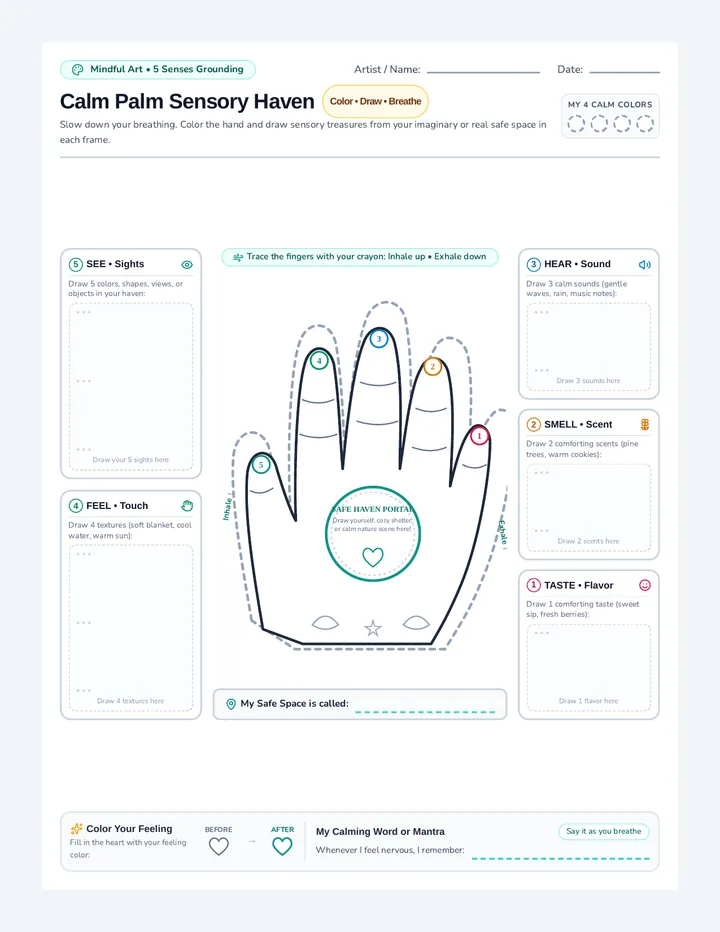
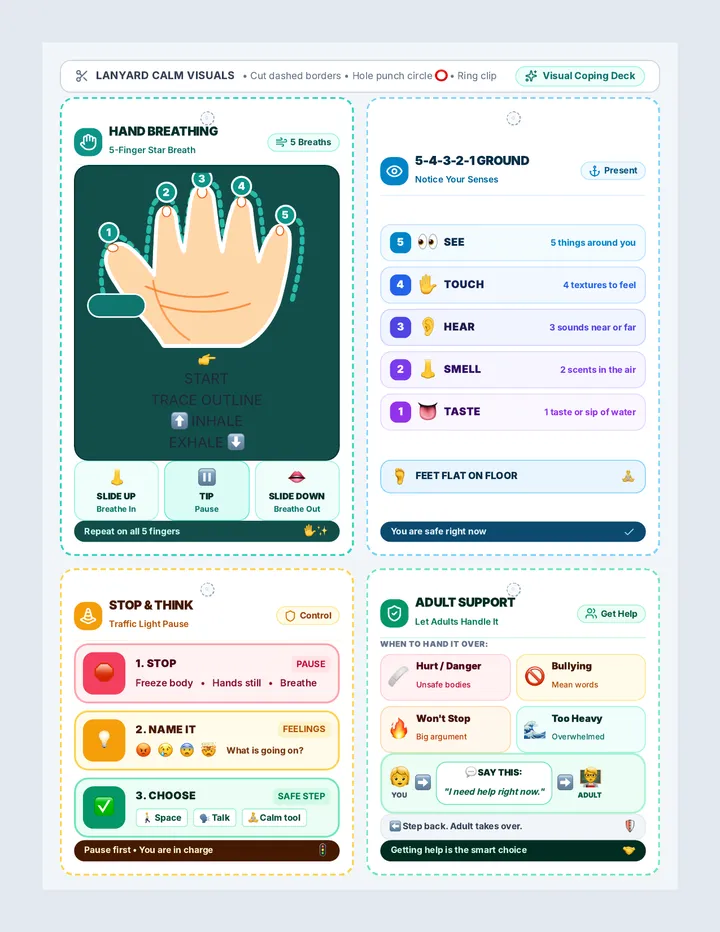
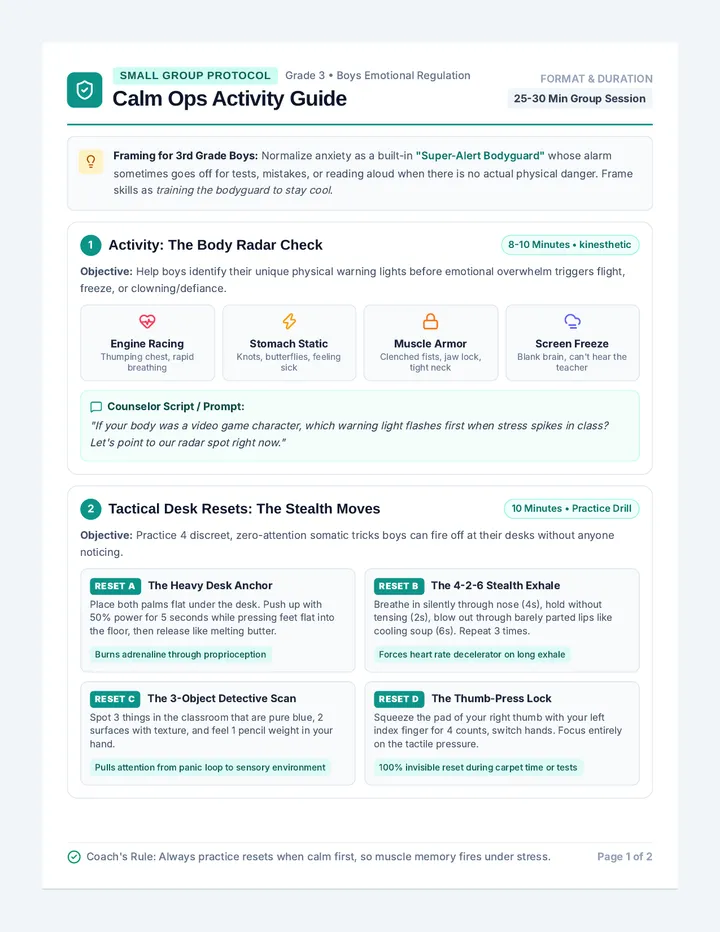
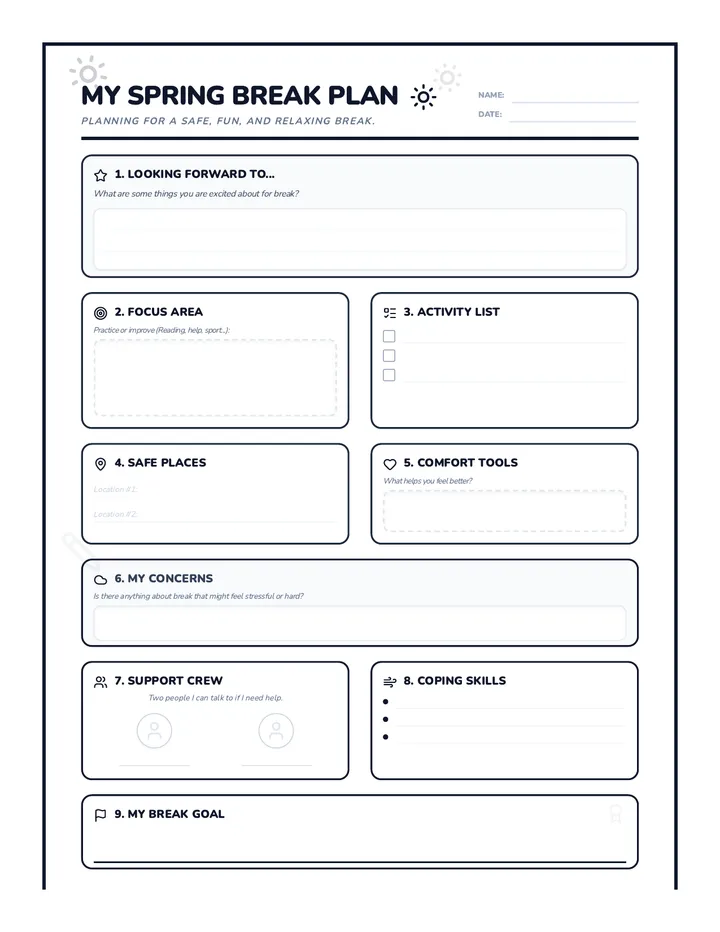
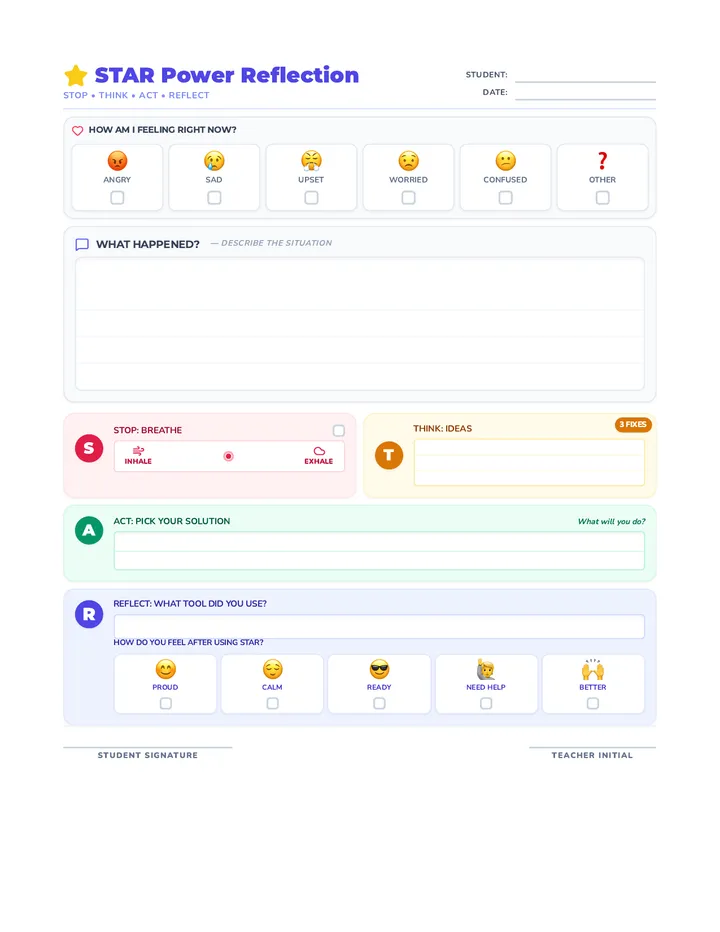
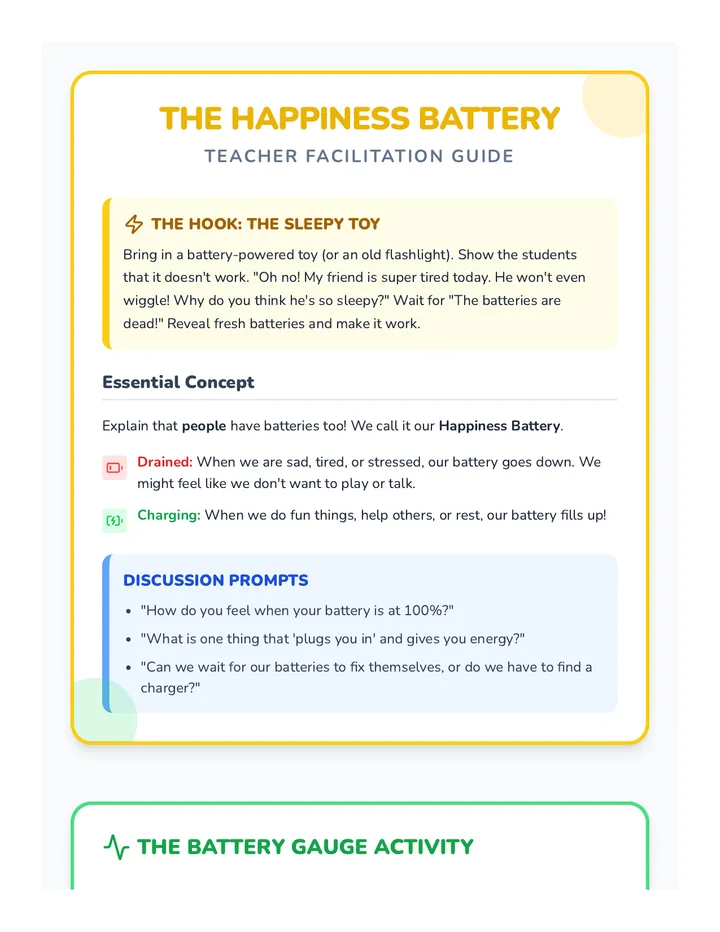
Mindful breathing and body scan meditation techniques integrated with daily self-care routines. Develops strategies for balancing life demands and advocating for personal wellness needs.
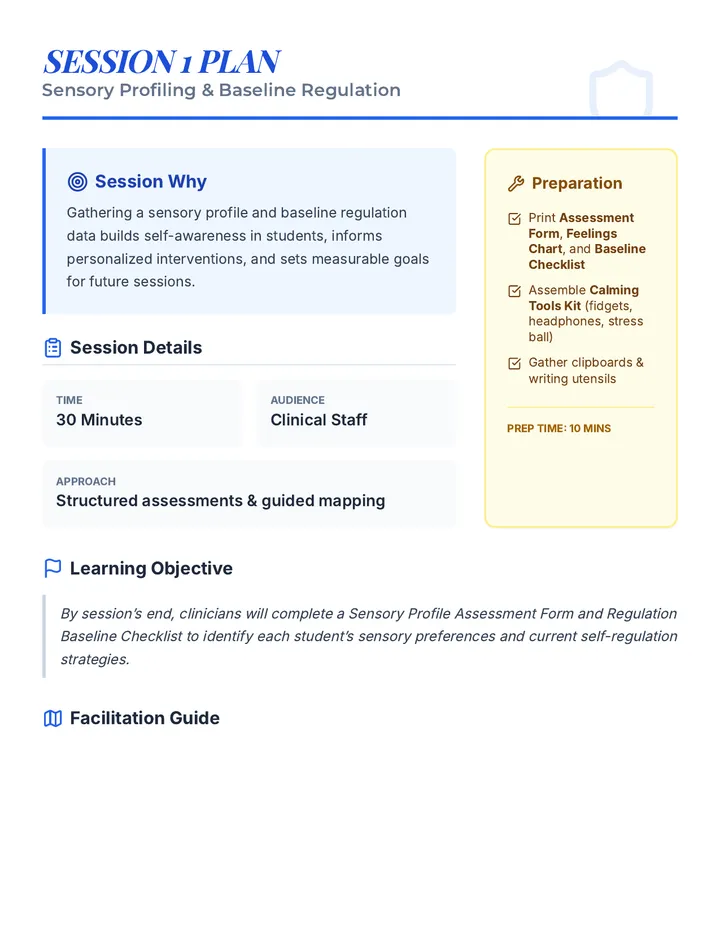
A comprehensive 14-session CBT and DBT skills curriculum designed for school counselors. Features structured session facilitation guides, student worksheets, and portable coping tool cards to build resilience, emotional regulation, and strong peer relationships across 14 complete lessons.
A comprehensive 6-lesson bilingual counseling curriculum designed for 6th and 7th graders to manage and overcome test anxiety. The sequence integrates cognitive, physical, and practical preparation strategies, offering side-by-side English and Spanish text for presentations and worksheets.
A comprehensive 6-week small group counseling curriculum for mid-elementary students focused on developing executive functioning skills through the lens of Impulsive Ninja and Focused Ninja. Includes weekly facilitator lesson guides, student activities, and teacher/parent collaboration tools.
An ocean-themed counseling bulletin board kit called 'Ride the Wave' designed for 5th-6th grade students. The kit helps students understand emotional regulation, coping skills, and the temporary nature of big feelings through calming blues, teals, and sandy neutrals.
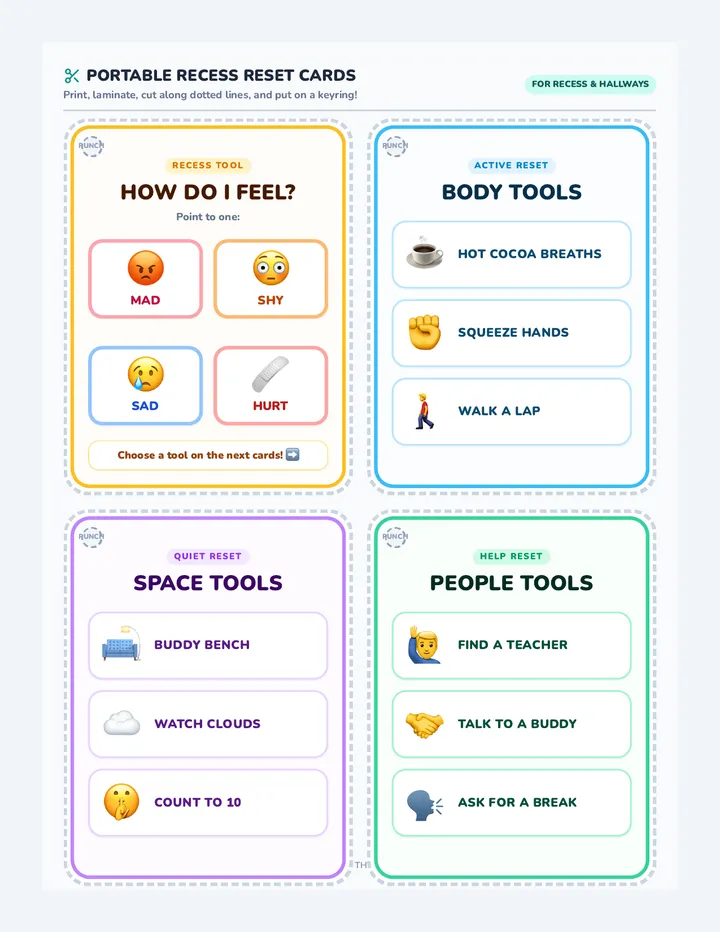
A social-emotional learning unit for K-1 students that uses the metaphor of weather to teach children how to recognize, accept, and manage difficult emotions using specific coping strategies.
A two-part series for young learners to master emotional regulation. Students learn specific calming techniques and then apply them through structured role-play scenarios to build "Calm Power."
A series of lessons focused on social-emotional learning for early elementary students, providing practical tools for self-regulation and emotional awareness.
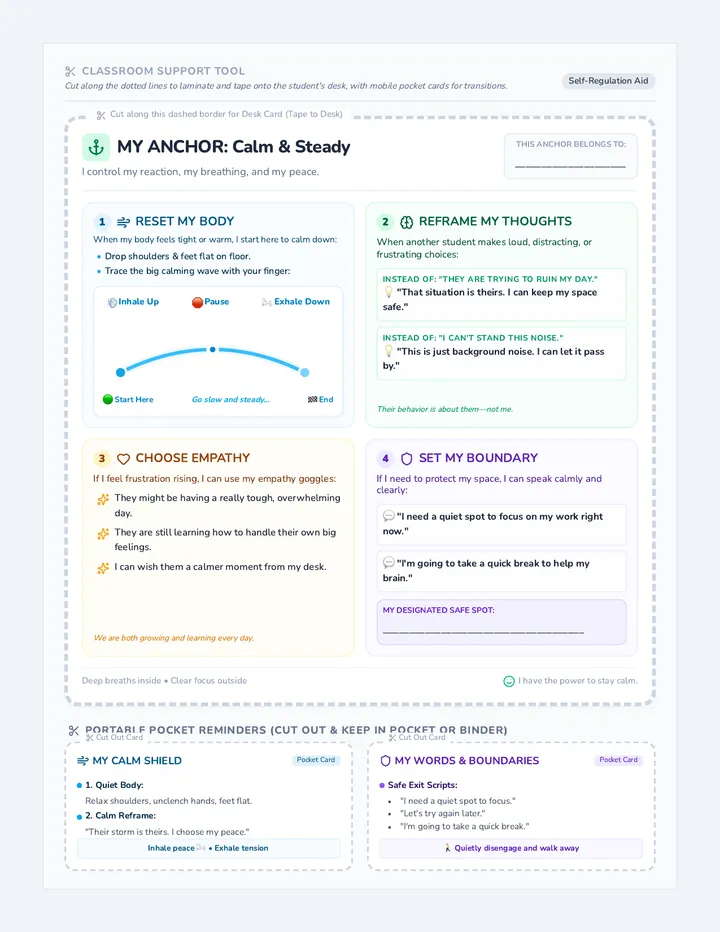
A comprehensive 4-lesson program for high school students in a behavior support setting, focusing on emotional regulation, physical impulse control, verbal professionalism, and managing environmental triggers. The sequence uses a 'Control Center' theme to empower students with agency over their own reactions and choices.
A 6-session counseling group for 4th-grade students focused on identifying anxiety triggers, understanding the body's response, and developing effective coping strategies through mindful practices and growth mindset.
A 12-week DBT-informed curriculum specifically designed for 5th-grade students struggling with depression. This sequence focuses on building a foundation in Mindfulness and Distress Tolerance to help students navigate intense emotions and find their 'Wise Mind'.
Um currículo abrangente de 13 semanas para alunos do ensino fundamental focado nos quatro módulos principais da Terapia Comportamental Dialética: Atenção Plena (Mindfulness), Eficácia Interpessoal, Regulação Emocional e Tolerância ao Mal-estar. Os alunos dominam habilidades de vida em um ambiente de grupo colaborativo.
A four-week social-emotional learning curriculum designed to help third graders understand, identify, and manage anxiety through a 'Super Hero Training' lens. Students learn about physical body signals, triggers, calming techniques, and positive self-talk.
A systemic approach to stress and burnout prevention for graduate students, reframing personal well-being as a design challenge. Students develop a personalized 'resilience architecture' through structural changes in time management, sleep hygiene, and boundary setting.
A graduate-level training sequence on facilitating peer support systems to mitigate stress and anxiety. Students learn the science of social support, micro-skills for active listening, boundary setting to prevent burnout, and group facilitation techniques to create sustainable communities of care.
A graduate-level exploration of the biological underpinnings of stress. Students move from theoretical understanding of the autonomic nervous system and Polyvagal Theory to practical application of somatic regulation and interoceptive awareness, culminating in a personalized physiological safety plan.
A comprehensive sequence for undergraduate students exploring the social psychology of stress and the practical skills needed to build resilient peer support networks. Students move from theoretical understanding to practical facilitation and community planning.
A technical and mastery-based sequence for undergraduate students to develop actionable emotional regulation and grounding strategies. Students move from physiological understanding to real-time application in high-pressure simulations.
A Pre-K sequence focused on building self-esteem and positive experiences through mastery, growth mindset, and persistence. Students learn to navigate challenges and celebrate their own progress.
A project-based sequence for Kindergarteners to build emotional resilience by designing and practicing daily routines that prioritize fun, rest, and connection. Students learn to sequence their day, brainstorm rewarding activities, and commit to 'Positive Pauses' for emotional well-being.
A 5-lesson unit for 3rd graders focused on building emotional resilience through habit formation. Students learn to audit their time, identify small 'micro-moments' of joy, and design balanced daily schedules that prioritize positive experiences.
A 1st-grade counseling sequence that uses game-based mechanics and metaphors to teach behavioral activation, emotional resilience, and the importance of daily positive routines.
A project-based sequence for 1st graders focused on emotional regulation through the creation of a 'Sunshine Kit'. Students explore sensory, physical, and social activities to build a personalized toolkit of positive experiences for use during challenging moments.
A mastery-focused sequence where undergraduate students audit their current stress responses and design a personalized, tiered emotional regulation protocol. Students use systems thinking to build resilient habits and prepare for future distress.
A comprehensive sequence for undergraduate students exploring the neurobiology of stress, the autonomic nervous system, and physiological self-regulation techniques. Students move from theoretical understanding of brain structures to practical mastery of interoception and vagal tone modulation.
A culminating simulation where students face timed cognitive challenges while practicing their chosen regulation techniques. This bridges the gap between knowing a technique and using it under pressure.
Learners identify personal sensory preferences that induce calm. They design and assemble a portable or digital 'kit' of resources to use during high-stress periods.
Students learn the sequence of tensing and releasing muscle groups to identify and release held physical tension. The lesson emphasizes the connection between physical relaxation and mental clarity.
A technical workshop on breathwork, focusing on Box Breathing and 4-7-8 breathing to stimulate the parasympathetic nervous system. Students use biofeedback tools to measure the efficacy of different ratios.
Students practice the 5-4-3-2-1 technique and other sensory-based orientation strategies to reconnect with the present moment. The lesson explains the science of how sensory input overrides ruminative thought loops.
Students synthesize their knowledge to create a personalized physiological safety plan for high-stress periods. They identify triggers, early warning signs, and pre-planned somatic interventions.
Students evaluate somatic bottom-up processing techniques like diaphragmatic breathing and thermal regulation. They learn to choose the right physical strategy for their specific physiological profile.
Learners practice interoception—the sense of the internal state of the body. They test their accuracy in detecting heart rate and tension, connecting poor awareness with high anxiety.
Dives into Polyvagal Theory to distinguish between fight/flight mobilization and dorsal vagal shutdown. Students analyze behaviors like procrastination and isolation as biological responses.
Students condense the full PMR session into 60-second and 10-second versions. They simulate high-stress environments to practice deploying these rapid techniques effectively.
Students present their Joy Menus to small groups, allowing peers to borrow ideas to add to their own lists. The lesson concludes with a commitment to try one menu item over the weekend.
The focus shifts to the legs and feet to establish a physical sense of stability. Students learn to use the floor for resistance and grounding during seated lectures or exams.
An elegant, welcoming visual announcement page introducing the Wellness Hub with Miss Panoam, designed for counseling psychology, art therapy, and somatic mindfulness support.
A 6th-grade Social-Emotional Learning (SEL) lesson introducing the DBT TIPP skills (Temperature, Intense exercise, Paced breathing, Paired muscle relaxation) as a physical 'body hack' to manage high emotional distress. Students learn how the autonomic nervous system works and build a personalized 'body reset' manual.
A comprehensive social emotional learning lesson designed to help children navigate fears of the outdoors, specifically focusing on sensory overload (loud noises, bright lights, weather) and unpredictable insects. Includes an interactive social story workbook, visual coping cards, and a teacher support guide.
An explicit teaching lesson for Upper Elementary (grades 3-5) that introduces mindfulness through brain science, explaining the roles of the amygdala and prefrontal cortex, and provides concrete self-regulation strategies.
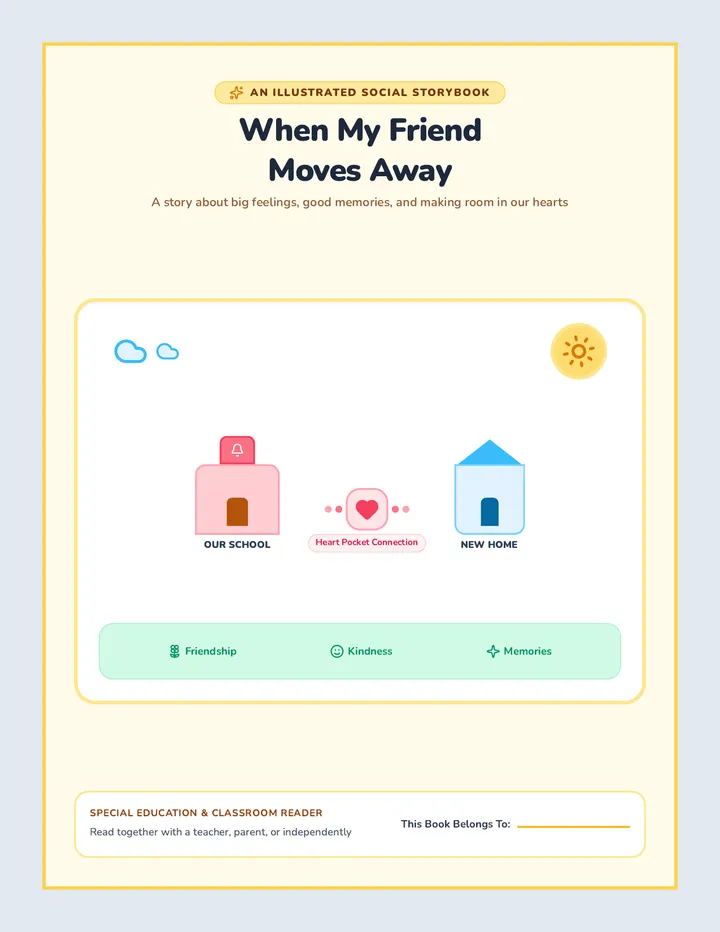
A transition support unit designed for rising 2nd graders entering a new school. Includes a social story presentation, a personal passport worksheet, and a counselor guidance document.
A growth mindset and emotional regulation lesson designed for 3rd and 4th-grade small groups. Students discover how the brain strengthens through challenge, identify their frustration 'heat level', and practice concrete self-regulation exercises like tactical breathing and constructive self-talk.
A comprehensive self-regulation lesson bundle designed for 5th graders to match the size of their reactions to the size of their problems, blending the 'Size of the Problem' scale with the 'Zones of Regulation' framework.
A nurturing and interactive social-emotional learning lesson for grades 2-3 designed to help students identify happy, sad, mad, and scared feelings. It focuses on physical body clues, facial expressions, and written reflection on coping strategies and self-regulation.
A interactive and engaging lesson designed to equip transitioning middle school students with coping strategies for handling sensory overload, rule-breaking peers, and group work frustrations. Includes an 10-slide presentation, a highly visual coping checklist, and a detailed facilitator guide.
A Tier 3 individual counseling intervention designed for 7th graders (ages 12-13) to map physical stress patterns, analyze neurological escalation, and construct customized coping matrices.
A powerful social-emotional learning lesson series designed for high school teachers to foster relationship-building, self-regulation, active communication, self-awareness, and integrity through quick daily classroom routines.
A comprehensive summer support packet for a third-grade student experiencing anxiety and worry due to parental conflict. Includes a child-friendly workbook, coping cards, a daily tracker, and a guide for supporting adults.
A performance tracking log for students to evaluate their use of regulation techniques during the final simulation under timed cognitive pressure.
Introductory slides for the Simulated Stress Response lesson, facilitating the final classroom simulation where students apply techniques under cognitive pressure.
A project guide and planning document for students to design their personalized physical or digital sensory soothing kits.
Introductory slides for the Sensory Soothing Kit project, covering the psychology of decision fatigue, sensory inputs, and physical vs. digital implementation formats.
A visual checklist and hotspot mapping tool for students to track their physical response to Progressive Muscle Relaxation.
Technical slides for the Progressive Muscle Relaxation lesson, teaching the tension-relaxation contrast and the full-body PMR protocol.
A technical biofeedback log for students to record heart rate data and subjective stress levels before and after practicing various breathing protocols.
Technical slides for the Controlled Breathing lesson, explaining vagal tone, the autonomic nervous system, and step-by-step protocols for Box and 4-7-8 breathing.
A structured lab report for undergraduate students to track and compare the efficacy of different sensory grounding techniques during a classroom simulation.
Introductory slides for the Sensory Grounding lesson, covering the science of ruminative loops, the ice cube challenge, and the 5-4-3-2-1 technique.
Final student synthesis materials for Lesson 5, including a comprehensive Resilience Architecture master plan and a portable, pocket-sized Crisis Card for immediate intervention.
Visual presentation for Lesson 5, synthesizing the sequence and introducing the Resilience Architecture plan and Crisis Card.
A student-facing self-assessment and strategy-matching questionnaire to help 4th-grade students explore, select, and evaluate their use of calming strategies like breathing, break cards, and drawing when feeling overwhelmed.
A student-facing print-ready workbook with structured spaces to explore personal emotions, plan three custom peer-connection pathways, and craft their own help-seeking script.
A comprehensive educator guide and progress monitoring rubric to assess a student's ability to identify emotions, list 3 social network expansion strategies, and recognize when to ask for help. Includes a print-ready data tracking sheet for ongoing assessment sessions.
A set of 8 realistic classroom and recess scenarios designed for 4th-grade students facing social anxiety and withdrawal. Each card contains targeted prompts to assess emotional recognition, peer network expansion, and help-seeking strategies.
A beautiful 6-page therapeutic workbook and anchor chart styled around a calming wave theme. It features interactive worksheets, tracing guides, emotions charts showing adaptive and normative focuses, progressive muscle relaxation exercises, 5-4-3-2-1 grounding, and help-seeking sentence stems, with a dedicated second page of positive affirmations.
A compact, 1-page professional facilitator guide for teachers or counselors running the Middle School Playbook lesson. Includes pacing, slide-by-slide guiding prompts, answers/discussion keys for the 4 scenarios, and checklist debrief directions.
A premium 10-slide presentation styled like a tactical sports/gaming playbook. Teaches middle school transition coping skills, size of problems, and specific tactics for chaotic hallways, rule-breaking peers, and group work, featuring 4 interactive scenarios with minimum 24px font sizes.
A clean, straightforward single-page printable coping skills checklist designed for middle schoolers. Features categorized, highly compliant, actionable coping strategies for handling sensory hallway chaos, group work struggles, and rule-breaking peers without non-permitted items like hoods or headphones.
A highly interactive, student-facing workbook designed for a 7th grader (ages 12-13). It includes tactical activities such as mapping physiological stress signals on an anatomical vector body outline, logging daily autonomic states, scaling triggers on a 1-5 escalation meter, and crafting printable coping matrix cards.
A comprehensive step-by-step facilitation guide for school counselors or clinical therapists. It provides clinical scripts, session structures, progress tracking, and professional strategies for individual Tier 3 anxiety intervention for middle schoolers (ages 12-14).
A simplified, less dense 2-page counselor session bundle for Temperature Reset. Page 1 contains a streamlined facilitation outline with bullet points. Page 2 contains a spacious somatic grounding worksheet and a cut-out portable coping card.
A simplified, less dense 2-page counselor session bundle for Check the Facts. Page 1 contains a streamlined facilitation outline with bullet points. Page 2 contains a student fact-checking ledger worksheet and a cut-out portable coping card.