Identification of trusted peers, community resources, and professional services to establish reliable safety nets. Develops communication strategies and outreach protocols for navigating personal or mental health crises.
Students design and pitch a sustainable community care initiative tailored to their specific academic or professional cohort.
Develops skills for leading group stress check-ins, managing dynamics, and ensuring psychological safety in group settings.
Focuses on preventing compassion fatigue through emotional and temporal boundaries and professional referral protocols.
Practical workshop on active listening, validation, and holding space for peers without the pressure to provide immediate solutions.
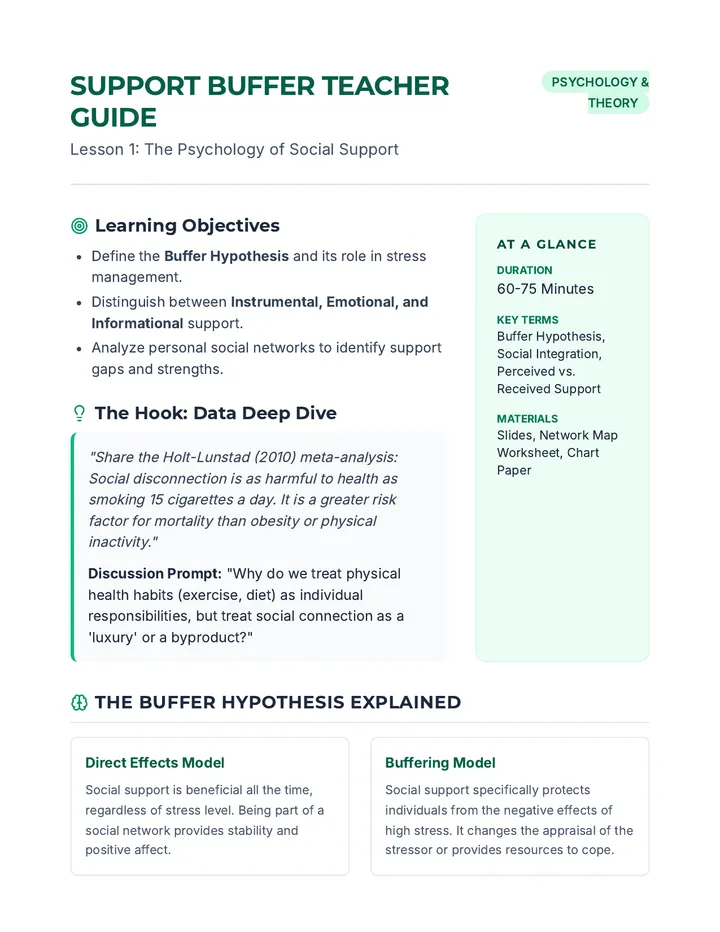
Examines the buffering hypothesis and the psychological mechanics of how social connection mitigates stress, contrasting co-rumination with constructive disclosure.
Students design a framework for a community care plan, producing a 'Community Charter' for peer support in a specific campus context.
A facilitated dialogue session focusing on common undergraduate stressors, practicing normalization and collective coping strategies.
Training on recognizing the limits of peer support and when to refer to professionals, with a focus on setting emotional boundaries to prevent burnout.
A skill-building session on non-judgmental listening, reflecting, and validating emotions, focusing on 'holding space' rather than problem-solving.
Students explore the 'Buffer Hypothesis' and how social connection mitigates the health impacts of stress, focusing on the difference between instrumental, emotional, and informational support.
Students synthesize their learning by creating a personal Digital Citizen Pledge and earning their Super Citizen badges.
Students practice the "Stop, Walk, and Tell" strategy to respond to unkind behavior or scary content online, focusing on seeking help from trusted adults.
A graduate-level training sequence on facilitating peer support systems to mitigate stress and anxiety. Students learn the science of social support, micro-skills for active listening, boundary setting to prevent burnout, and group facilitation techniques to create sustainable communities of care.
A comprehensive sequence for undergraduate students exploring the social psychology of stress and the practical skills needed to build resilient peer support networks. Students move from theoretical understanding to practical facilitation and community planning.
A Kindergarten sequence focused on making digital footprints concrete through physical analogies, promoting online kindness, and establishing safety protocols for young internet users.
This sequence explores the psychology of group dynamics and community care. Students learn to recognize burnout, offer effective support, and advocate for cultures where requesting breaks is normalized and valued.
A comprehensive sequence for undergraduate students focusing on executive function and proactive support-seeking. Students move from data-driven self-analysis of energy rhythms to the creation of a long-term 'Semester Sustainability Plan' that treats mental health and support as logistical necessities.
A comprehensive sequence for 10th-grade students focusing on the financial realities of student loan repayment, the impact of debt-to-income ratios, and evaluating the long-term ROI of post-secondary education choices. Students progress from basic math to strategic advisory, culminating in a complex case study analysis.
This sequence helps Pre-K students distinguish between past trauma reactions and present safety through environmental scanning, temporal sorting, identifying safe adults, and grounding techniques. Students learn to use their senses to confirm they are safe 'right here and right now'.
This sequence helps 8th-grade students distinguish between temporary sadness and clinical depression by analyzing behavioral, physical, and emotional indicators. It culminates in learning the ACT (Acknowledge, Care, Tell) strategy for seeking help from trusted adults.
This sequence teaches 4th-grade students how to identify and access external mental health resources and emergency protocols. It covers trusted community adults, the 988 Suicide & Crisis Lifeline, emergency communication skills, and distinguishing between types of crises, culminating in a personal safety plan.
A project-based unit for 4th graders focused on overcoming barriers to seeking mental health support, mastering assertive communication, and advocating for resources through a school-wide informational campaign.
A comprehensive sequence for 4th-grade students to identify, understand, and utilize school-based mental health resources. Students will learn about the roles of school staff, the concept of confidentiality, how to request help, and how to recognize when they need support.
A 5-lesson sequence designed for 5th-grade students to learn how to recognize signs of distress in peers, understand the ethical boundaries of friendship secrets, practice active listening, and safely connect friends to trusted adults through 'warm handoffs.' Students conclude by creating a school-wide advocacy campaign to promote mental health resources.
An assessment rubric for the final Community Charter project, evaluating theory application, safety planning, and sustainability.
Final project rubric for evaluating the Community Care Initiative, focusing on rationale, boundaries, referral pathways, and sustainability.
Student design workbook for planning the Community Care initiative, covering problem definition, logistics, safety boundaries, and sustainability.
A design framework for a community care plan, producing a 'Community Charter' for peer support in a specific campus context.
Final project brief for the Community Care initiative, detailing requirements, core components, and the "Department Pitch" assessment.
Visual slide deck for Lesson 5, introducing the concepts of mutual aid, sustainable networks, and the "Community Charter" project.
Observation and feedback tool for students to use while observing peer-led group facilitation simulations, focusing on psychological safety and dynamic management.
A brainstorming worksheet for identifying collective coping strategies for common undergraduate stressors.
Practical script for students to lead a brief check-in circle, featuring opening ground rules, modeling prompts, and intervention strategies.
A sorting activity where students categorize shared stressors from an anonymous "drop box" into personal or systemic categories to facilitate normalization.
Facilitation Fundamentals Slides focusing on group dynamics, psychological safety, and managing difficult participants.
Visual slide deck for Lesson 4, introducing group facilitation skills, the power of normalization, and the distinction between individual and systemic stressors.