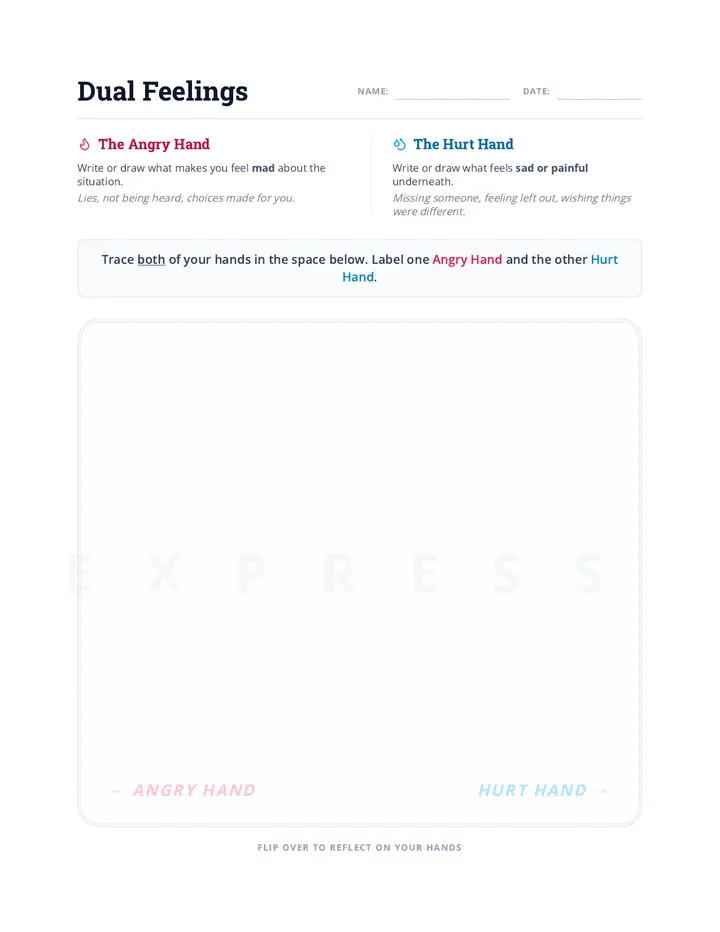
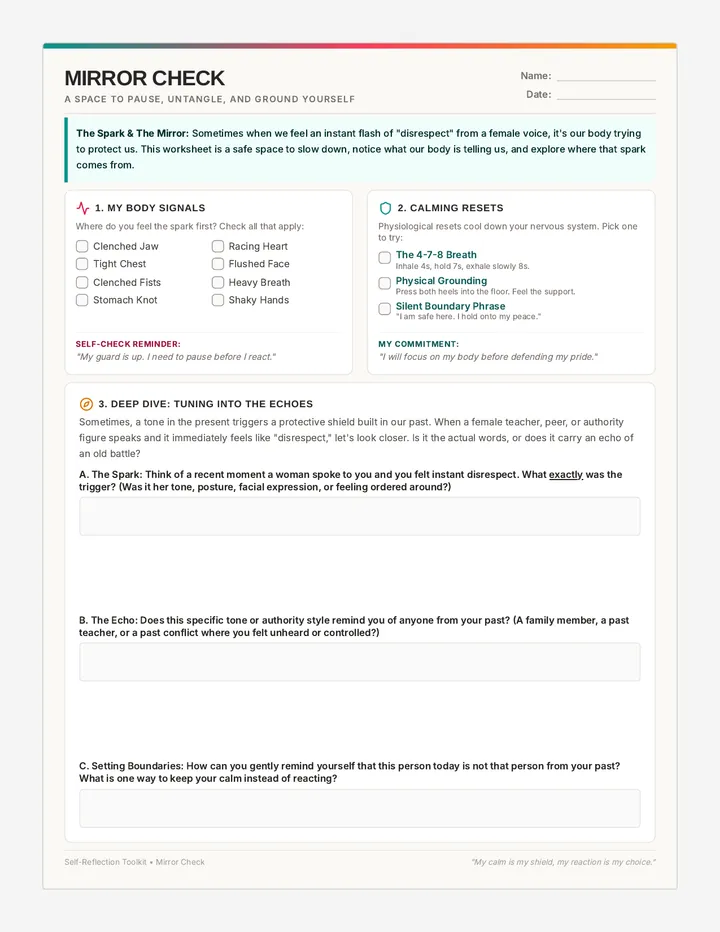
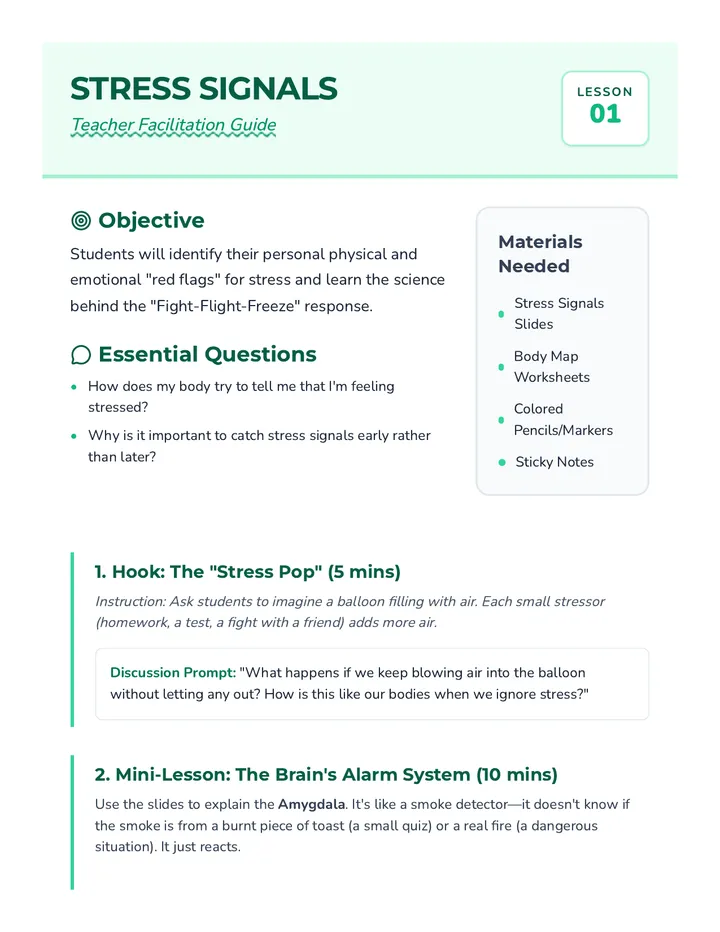
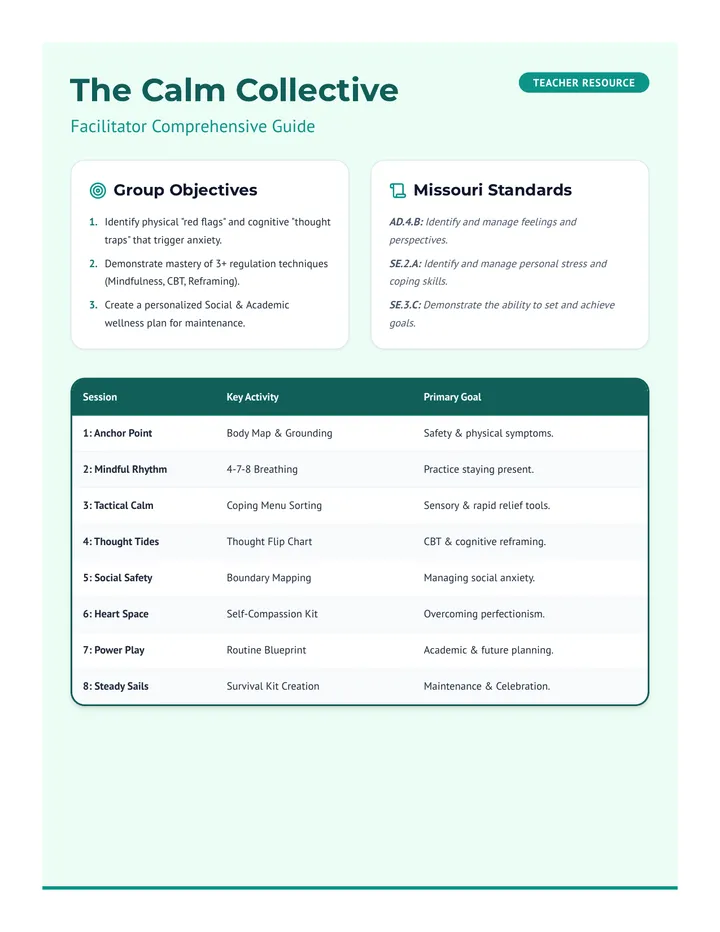
Recognition of emotional and physiological signatures associated with traumatic experiences. Targets awareness of triggers, somatic markers, and the distinction between past reactions and present safety.
A compassionate parent psychoeducation resource packet focusing on the neurobiology of early childhood trauma (ages 0-3). It translates complex brain science into accessible, low-jargon concepts like toxic stress and nervous system dysregulation, providing practical caregiver co-regulation strategies and a dedicated self-care checklist.
A comprehensive workshop and resource set designed to help students identify, understand, and navigate mental health triggers through self-reflection and grounding techniques.
A comprehensive final exam for a high school Relationships and Emotions course, covering emotional literacy, grief, power dynamics, boundaries, and communication. The lesson includes the 50-question traditional exam and a detailed answer key.
A trauma-informed training module for staff to build deep empathy for children in the foster care system by understanding the neurological and emotional impact of removal and placement.
A trauma-informed lesson designed to help students identify their emotional triggers and develop healthy conflict resolution strategies in a safe, supportive environment.
A CBT-informed middle school counseling lesson focused on anger management, identifying triggers, understanding the 'Anger Iceberg,' and developing healthy emotional regulation strategies. Aligned with TEKS Health Education standards for managing emotions and stress.
Mastering the four stages of emotional regulation: identifying triggers, choosing healthy distance, implementing coping skills, and resolving conflicts effectively.
A one-hour group session designed for clients in trauma recovery, SUD, and anger management to identify internal and external triggers and understand the 'alarm system' of the brain.
A lesson focused on identifying personal triggers (the 'wires') that activate the body's alarm system, using a coding-inspired visual theme to explore academic, social, and everyday stressors.
An introductory lesson that reframes anxiety as an over-sensitive internal security system, teaching students to audit their reactions and install new coping 'tools'.
This lesson focuses on teaching the student specific phrases and tools to communicate needs and feelings in the moment, reducing reliance on non-verbal or behavioral outbursts.
A celebratory final session to review growth, share favorite moments from the expedition, and award certificates.
An interactive, compassionate 1-page parent-child cooperative worksheet for age 4, focusing on daily safety routines, emotional mapping, and a shared connection ritual.
A gentle, practical 1-page self-care checklist and reflective planner designed for caregivers to regulate their own nervous system while parenting traumatized young children.
A compassionate 2-page parent guide explaining early brain development, toxic stress, and nervous system dysregulation in ages 0-3 with practical co-regulation strategies.
A 2-page reflection journal for students to map their physical sensations, identify triggers, and create a personalized safety plan.
A facilitator's guide for a 60-75 minute workshop on mental health triggers, including scripts, activity breakdowns, and safety considerations.
A 2-page informational handout explaining mental health triggers, the Window of Tolerance, physical warning signs, and immediate grounding techniques.
A comprehensive teacher answer key for the revised Relationships and Emotions Semester 2 Final Exam. It includes a detailed state standards alignment guide for all required D2 and D3 standards, correct answers for all 50 questions, and a high-level rubric for the DOK 3 application section.
A 50-question revised final exam for the Relationships and Emotions course. It ensures explicit compliance with state standards including definitions of loss, grief, mourning, and bereavement, and provides DOK 3 application scenarios for relationship repair and grief psychology. Question 43 phrasing has been corrected.
A reflection worksheet for staff to use during or after the Unseen Suitcases training, facilitating personal reflection on trauma narratives, empathy shifts, and self-care strategies.
A comprehensive facilitation guide for trainers, providing slide-by-slide talking points, discussion prompts, and pacing notes for the Unseen Suitcases training.
A 7-slide presentation deck designed for staff training, focusing on building trauma-informed empathy for children in foster care using the 'Unseen Suitcase' metaphor.
A comprehensive teacher's guide providing trauma-informed facilitation strategies, discussion prompts, and co-regulation techniques to support students during the Safety Signals lesson.
A supportive 3-week group for 6th graders to understand grief, debunk common myths, and create a meaningful project to honor someone they've lost.
A comprehensive toolkit for adults in mental health and substance abuse settings to master the 4-step practice of State-Shifting: Name It, Take Space, Shift State, and Deal with the Situation.
A comprehensive 6-week social-emotional learning program designed for 3rd-grade small groups, focusing on emotional regulation, self-esteem, and social skills.
A series of advanced counseling assignments covering Case Conceptualization and Theory/Intervention for CSL 686.
A 6-session curriculum designed to help students recognize stress, build coping mechanisms, and foster resilience through mindfulness and healthy routines.
A 6-session wellness curriculum designed for high school students experiencing housing instability. This sequence focuses on identifying stress triggers, developing portable coping mechanisms, and building resilience through trauma-informed and neurodivergent-friendly instruction.
An 8-week social-emotional learning program for 6th graders themed around computer systems and architecture. Students learn to manage anxiety by viewing their minds as a highly efficient system that needs specific tools for peak performance. They progress from 'Junior Coders' to 'Chief Systems Architects,' learning to identify hardware signals (body sensors), track bugs (triggers), and update their internal software (thoughts).
A targeted intervention sequence focusing on accountability, empathy, and the psychological roots of entitlement and anger for teenagers struggling with theft and confrontation.
A 4-week wellbeing intervention for a Year 3 student struggling with anger and academic frustration. Using a 'Workshop' theme, it provides practical, low-writing tools to manage a 'full bucket' and emotional regulation.
A therapeutic and educational sequence designed for an 11-year-old student with selective mutism to explore the history of her challenges with proximity and school attendance, while building a concrete, step-by-step plan for reintegration. The materials are bilingual (English/Spanish) and provided in a black-and-white format.
A 4-session small-group counseling program for high school students to process grief, loss, and major life transitions before the summer break. The program focuses on evidence-based grief-informed practices, coping strategies, and transition planning.
An 8-session small group counseling program for high school girls focused on identifying anxiety triggers, practicing mindfulness, cognitive reframing, and developing a personalized toolkit of coping strategies. The sequence emphasizes peer support, empowerment, and practical application within the school environment.