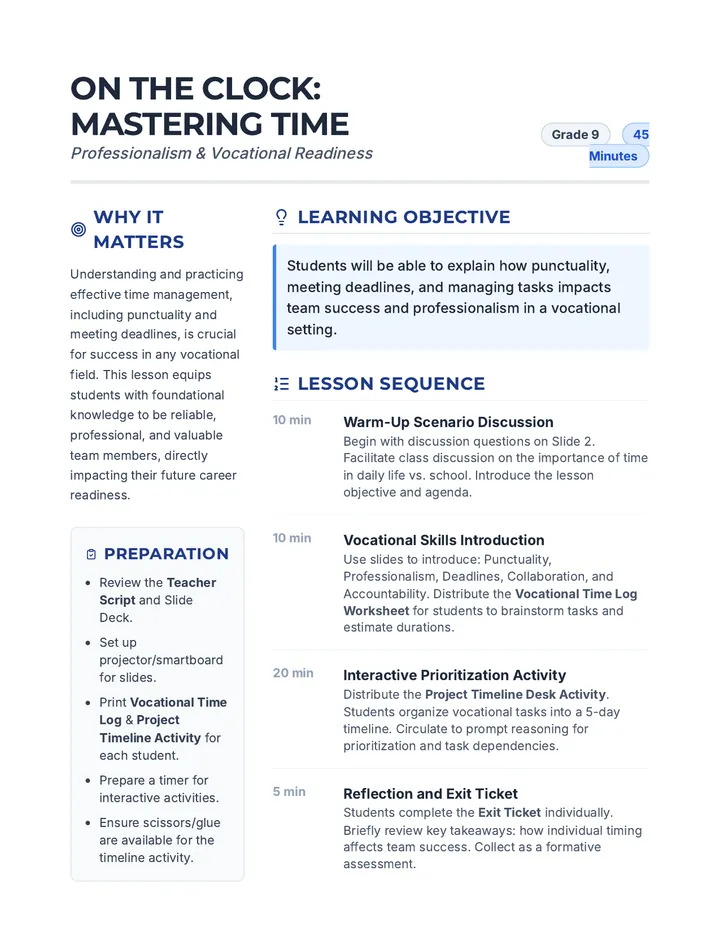
Strategies for prioritization, goal-setting, and overcoming procrastination. Develops proficiency in time-blocking, task delegation, and managing workflow efficiency within professional environments.
A systemic approach to stress and burnout prevention for graduate students, reframing personal well-being as a design challenge. Students develop a personalized 'resilience architecture' through structural changes in time management, sleep hygiene, and boundary setting.
A comprehensive workshop sequence for graduate students to address academic anxiety through cognitive restructuring. The sequence explores Impostor Phenomenon, cognitive distortions, perfectionism, and professional identity to build long-term resilience.
A 10th-grade sequence focused on building a digital ecosystem to manage multiple commitments. Students learn to use calendars, reminders, file management, and distraction-blocking tools to reduce cognitive load and improve organizational compliance.
A 5-lesson sequence for 10th-grade students focusing on project management skills like backward design, task deconstruction, and time estimation to balance multiple commitments.
A simulation-based sequence where 10th-grade students act as 'Student-Consultants' to master schedule management and adaptive resiliency. Students learn to handle 'Chaos Factors', negotiate deadlines, and manage energy levels to maintain balance amidst competing demands.
A comprehensive 5-lesson unit for 10th-grade students focusing on executive functioning skills to balance multiple commitments. Students learn time auditing, the Eisenhower Matrix, task batching, and weekly triage systems to develop a personalized priority protocol.
A 2nd-grade sequence on digital literacy focusing on file naming, folder organization, search retrieval, cloud storage, and digital collaboration. Students learn to maintain a clean digital workspace through a 'Cyber Space Station' theme.
A comprehensive sequence for 9th-grade students focusing on self-advocacy, communication skills, and boundary setting to manage schedule conflicts and prevent burnout. Students learn to recognize stress signals, draft professional requests, negotiate deadlines, and prioritize tasks during crises.
This sequence guides 8th-grade students through the engineering of their physical and digital environments to support executive function. Students move from understanding the neurological 'why' of organization to building a personalized operating manual for their own workflow optimization.
A comprehensive sequence where 8th-grade students act as 'organizational consultants' to diagnose and solve scheduling conflicts and executive functioning challenges through case studies. Students learn root cause analysis, professional self-advocacy, emotional regulation strategies for procrastination, and tool evaluation before creating a final consultancy report.
A specialized sequence for 8th-grade students focusing on executive functioning skills related to project management. Students learn to deconstruct complex assignments, plan backwards from deadlines, visualize overlapping tasks using Gantt charts, and adjust plans when setbacks occur.
A game-based simulation sequence for 8th-grade students to master time and energy management. Students treat time as a finite currency, navigate trade-offs through opportunity cost simulations, and design a sustainable weekly schedule.
Final synthesis where students integrate all learned modules into a personalized Resilience Architecture plan and a portable Crisis Card for emergency restoration.
Addresses the pressure to overcommit in academia by teaching the 'Strategic No' as a tool for protecting capacity and ensuring career longevity.
Explores the neurobiology of sleep and its role in emotional regulation, culminating in the design of a 'shutdown ritual' to combat revenge bedtime procrastination.
Reframes time management as a tool for reducing cognitive load and anxiety, teaching graduate students to design schedules based on energy levels and buffer capacity.
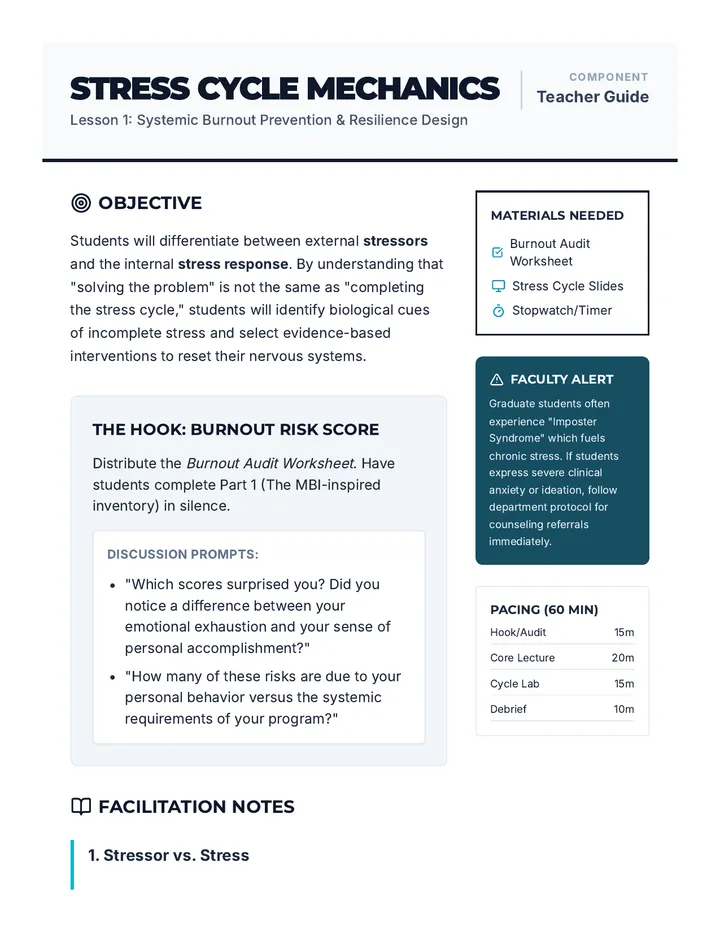
Students distinguish between stressors and the physiological stress response, auditing their current routines to ensure they are completing the stress cycle to prevent chronic burnout.
Students synthesize their learning by constructing a Professional Resilience Manifesto and practicing cognitive rehearsal to prepare for future academic challenges.
Participants distinguish between adaptive excellence and maladaptive perfectionism, exploring the 'law of diminishing returns' in academic work and its anxiety cost.
This lesson focuses on detaching self-worth from academic critique, practicing objective responses to harsh feedback and adopting a growth mindset toward evaluation.
Students learn to identify common cognitive distortions like catastrophizing and all-or-nothing thinking using CBT frameworks to provide a vocabulary for cognitive restructuring.
Students analyze the Impostor Phenomenon (IP) in higher education, identifying the five types of 'impostors' and normalizing their experiences within the academic community.
Visual presentation slides for Lesson 4, distinguishing between adaptive excellence and maladaptive perfectionism while introducing the law of diminishing returns.
Final student synthesis materials for Lesson 5, including a comprehensive Resilience Architecture master plan and a portable, pocket-sized Crisis Card for immediate intervention.
Visual presentation slides for Lesson 3, teaching students how to detach self-worth from academic critique and parse feedback for objective data.
Visual presentation for Lesson 5, synthesizing the sequence and introducing the Resilience Architecture plan and Crisis Card.
Visual presentation slides for Lesson 2, illustrating the ABC model of CBT and common academic cognitive distortions.
A student budgeting activity for Lesson 4 that teaches students how to evaluate opportunities and practice declining them to protect their academic capacity.
The summative student material for the sequence—a Professional Resilience Manifesto template where students synthesize their learning into core commitments and a resilient professional narrative.
Visual presentation for Lesson 4, addressing the economics of energy, role overload, and the "Yes/No/Negotiate" framework in academia.
Teacher facilitation guide for the final lesson, focusing on cognitive rehearsal and the construction of a Professional Resilience Manifesto.
A student handout for Lesson 4 that includes a perfectionism audit, effort allocation grid, and the "80% Rule Challenge" planning guide.
A student blueprint for Lesson 3 to design a personalized shutdown ritual and optimize their sleep environment.
Teacher facilitation guide for Lesson 4, exploring the difference between excellence and perfectionism and introducing the concept of strategic satisficing.