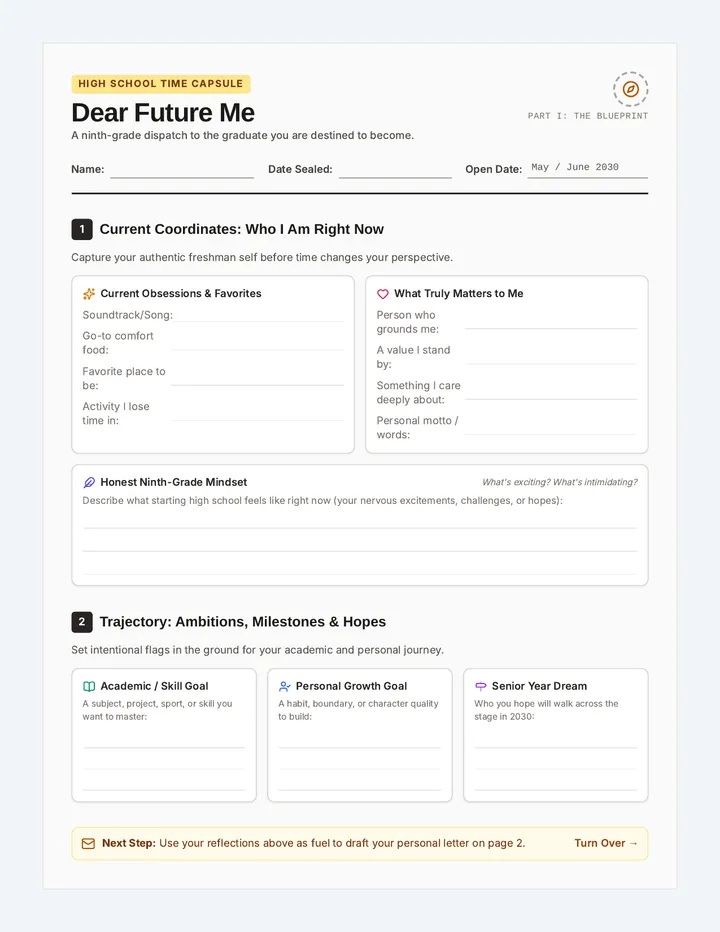
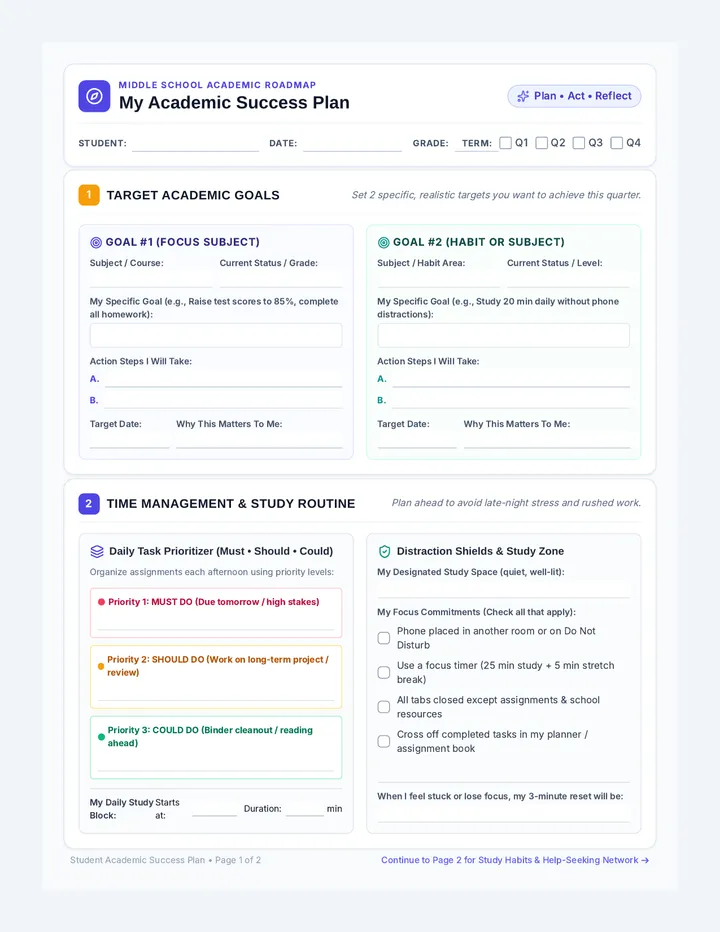
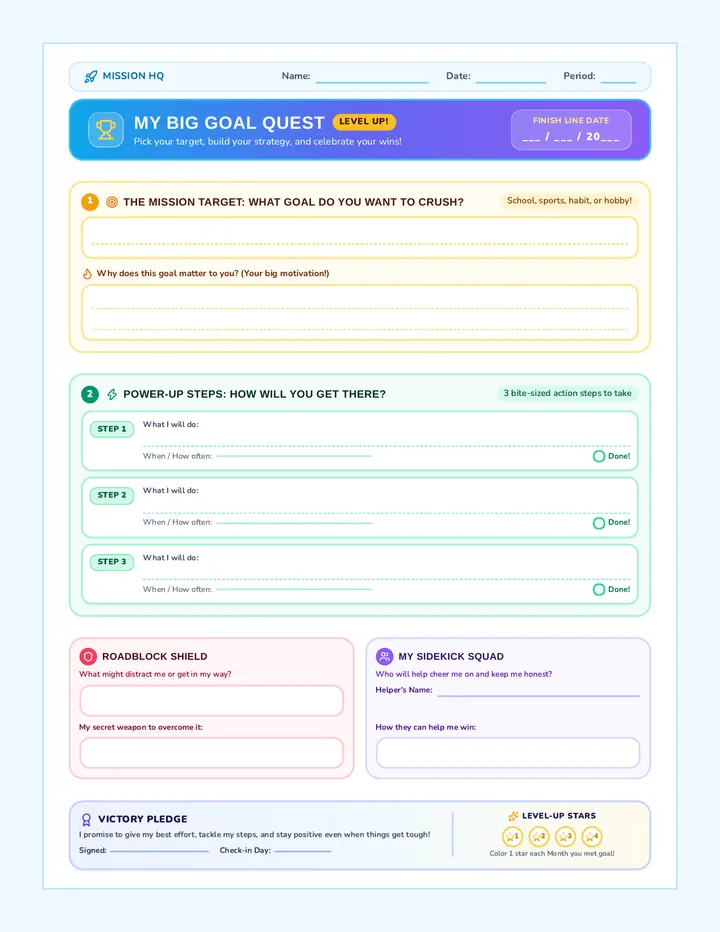
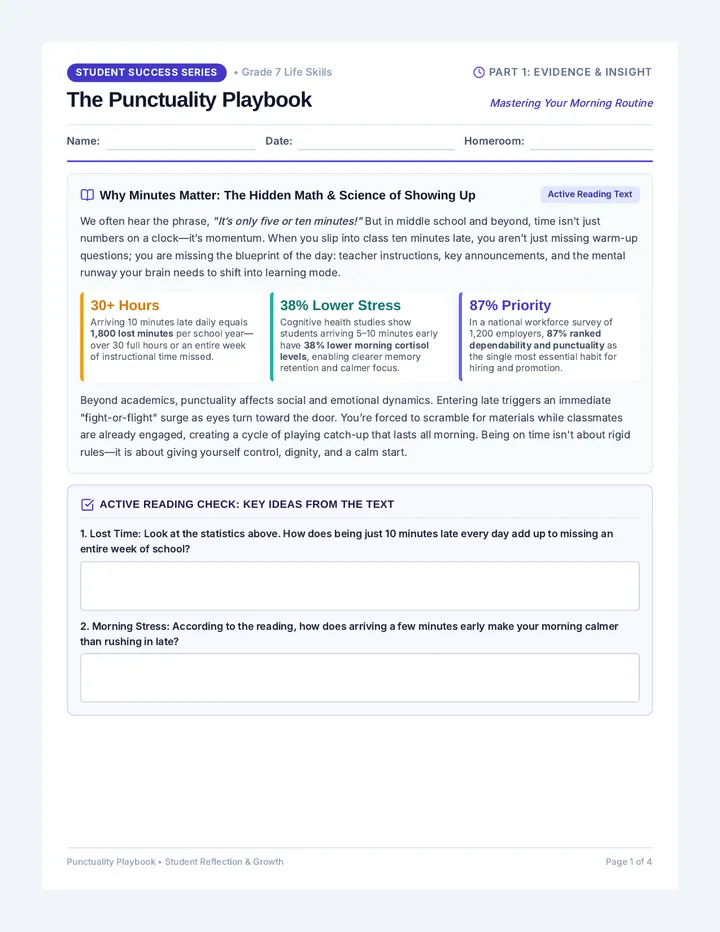
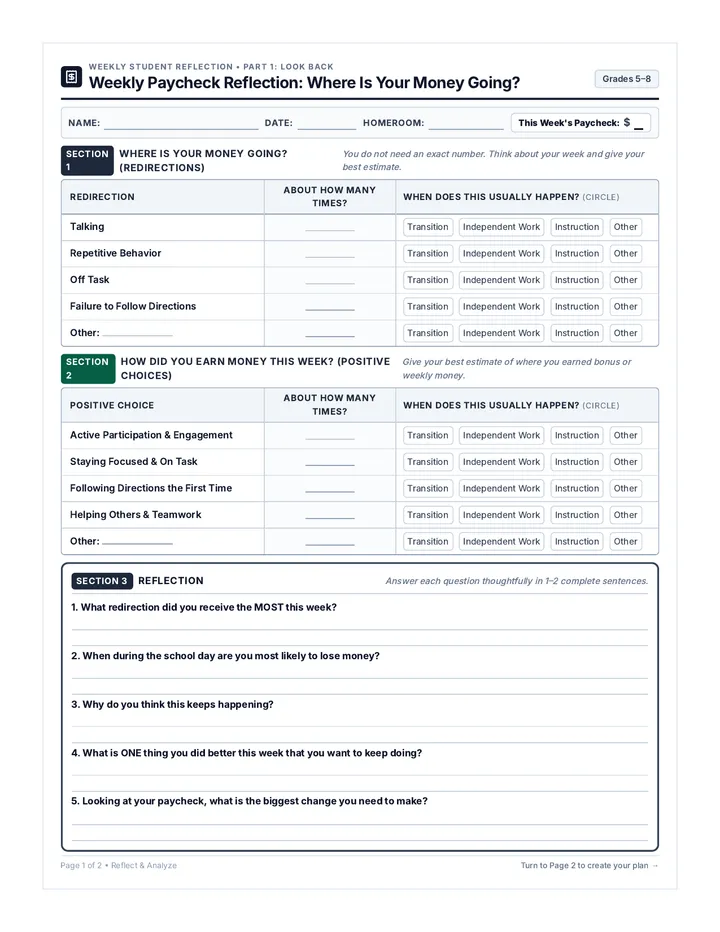
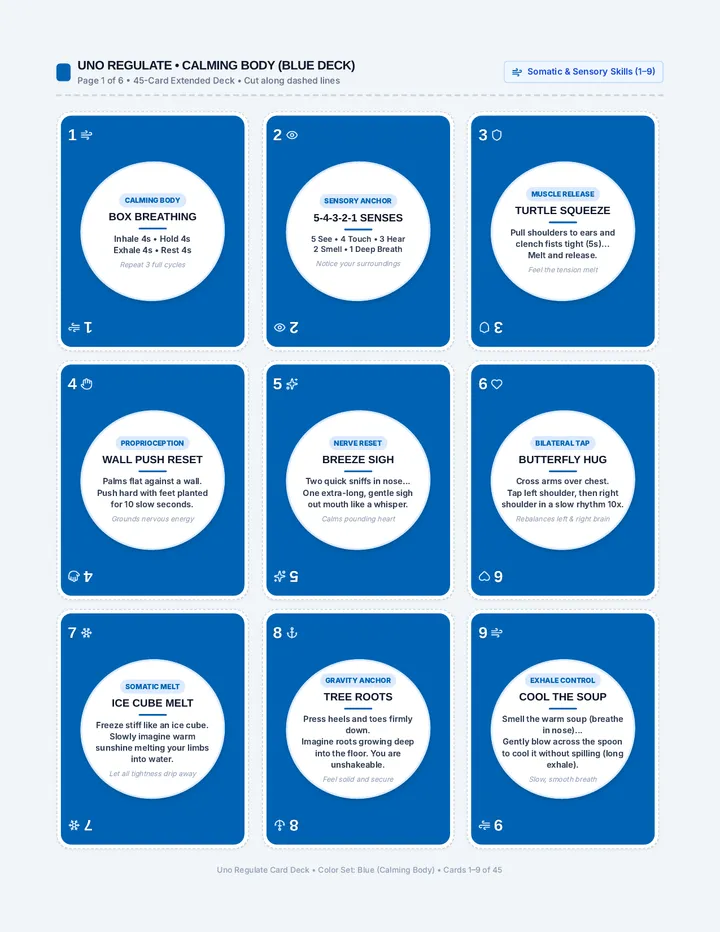
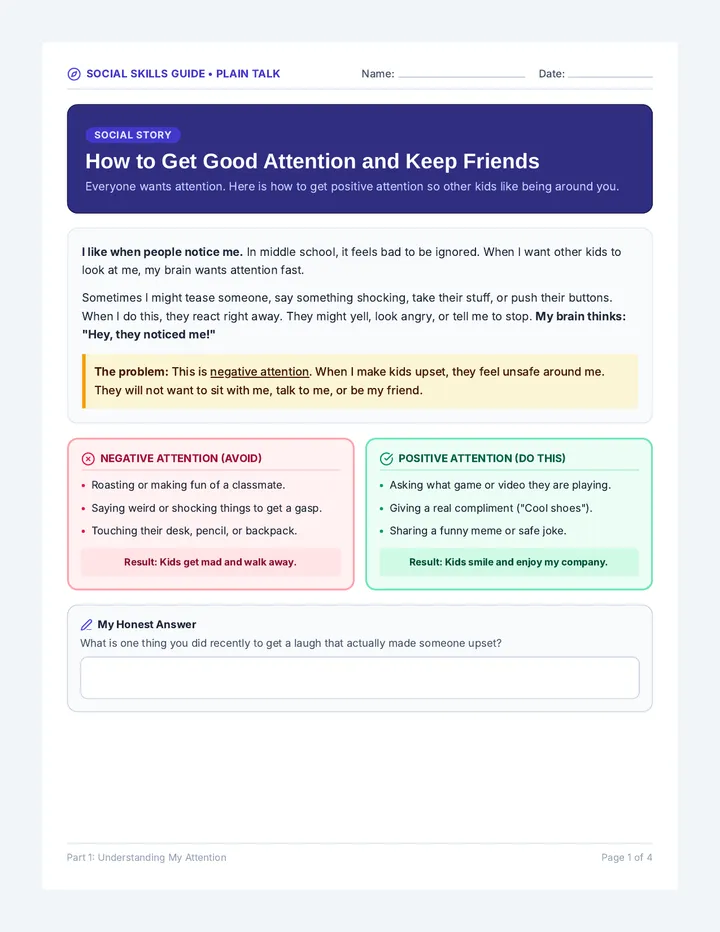
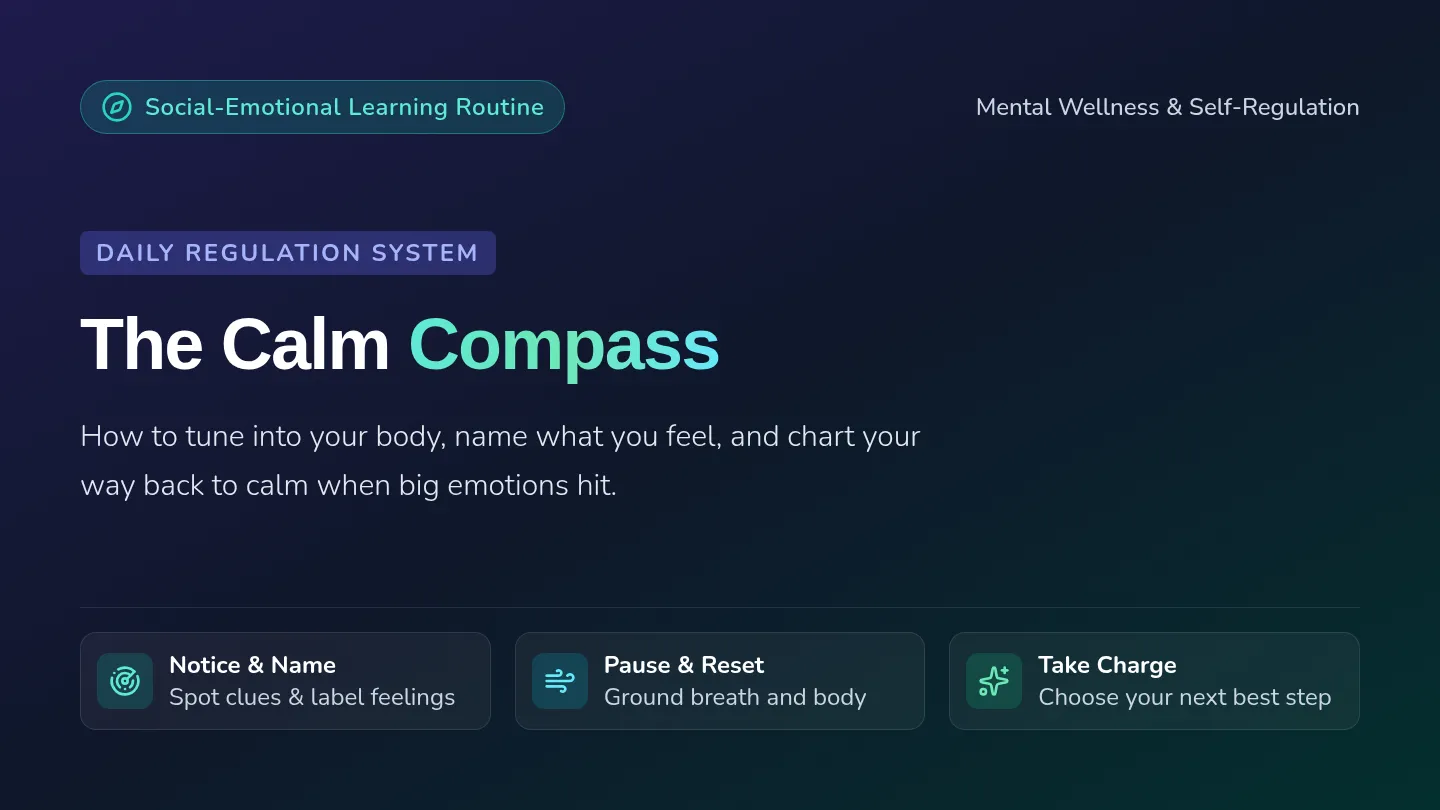
Stop-and-think strategies, impulse management, and SMART goal setting for personal growth. Develops internal motivation, stress reduction techniques, and resilience through proactive planning and monitoring.
A 5-lesson unit for 3rd graders focused on building emotional resilience through habit formation. Students learn to audit their time, identify small 'micro-moments' of joy, and design balanced daily schedules that prioritize positive experiences.
A comprehensive graduate-level sequence focused on the psychological and logistical aspects of high-stakes testing, including time management, anxiety reduction, and strategic decision-making.
A game-based simulation sequence for 8th-grade students to master time and energy management. Students treat time as a finite currency, navigate trade-offs through opportunity cost simulations, and design a sustainable weekly schedule.
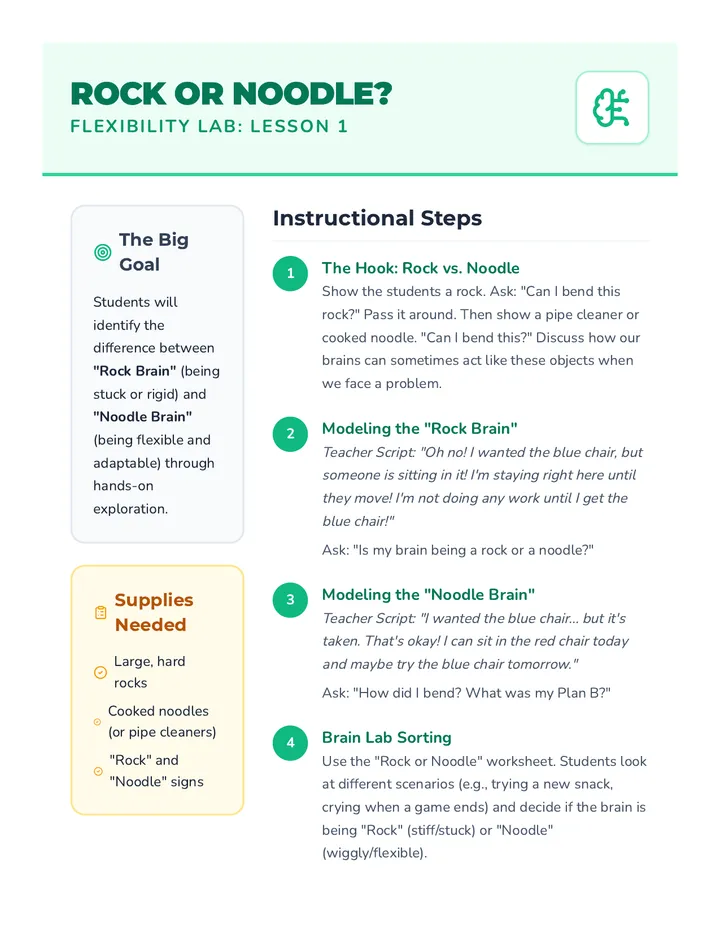
A 5-lesson unit for 1st-grade students focusing on cognitive flexibility. Students learn to navigate obstacles, tool breakage, schedule changes, and unavailability using the 'Rock Brain' vs. 'Noodle Brain' metaphor and the 'Plan B' framework.
A project-based sequence for 7th-grade students to master 'Backwards Planning' by breaking down complex projects into manageable milestones, estimating time accurately, and developing accountability strategies to overcome procrastination.
A Kindergarten sequence focused on building task persistence and management through visual supports, routines, and incremental stamina building. Students learn to use timers, First/Then boards, and self-monitoring tools to sustain attention.
A 5-lesson sequence for Kindergarten students focused on using visual schedules and symbols to support working memory, transitions, and independence. Students progress from symbol recognition to creating their own personal mini-schedules.
This sequence introduces Pre-K students to the foundational concepts of task persistence, utilizing visual supports and structured reinforcement to build attention stamina. Students learn to identify 'finished', use timers, manage frustration, follow 'First-Then' logic, and self-monitor their work.
A Pre-K sequence focused on working memory and auditory processing through single-step directions using table-top manipulatives. Students develop fine motor skills and inhibitory control while following specific verbal commands in a hands-on workshop environment.
This sequence helps 3rd-grade students overcome 'time blindness' and master task prioritization through the 'Now-Next-Later' framework. Students practice time estimation, distinguish between urgency and interest, and learn to adapt plans when unexpected changes occur.
A 5-lesson sequence designed to help 4th-grade students master task prioritization using visual matrices and executive functioning strategies. Students progress from defining urgency and importance to applying a 2x2 priority matrix to their own real-world schedules.
A 4th-grade sequence introducing the Leitner System for spaced repetition, helping students understand memory, build physical study tools, and develop effective long-term retention habits.
A Pre-K sequence introducing behavioral activation concepts by helping a puppet character navigate low moods through small, physical actions and kindness. Students learn that 'doing' can change 'feeling' in a developmentally appropriate, narrative-driven way.
A project-based sequence for Kindergarteners to build emotional resilience by designing and practicing daily routines that prioritize fun, rest, and connection. Students learn to sequence their day, brainstorm rewarding activities, and commit to 'Positive Pauses' for emotional well-being.
A 5-lesson sequence for 3rd grade students exploring behavioral activation. Students learn how their actions influence their emotions and develop strategies to initiate positive behaviors even when motivation is low.
A 1st-grade counseling sequence that uses game-based mechanics and metaphors to teach behavioral activation, emotional resilience, and the importance of daily positive routines.
This sequence introduces 2nd-grade students to behavioral activation by teaching them how to integrate positive activities into their daily routines to support emotional well-being. Students will create tools like a 'Happiness Jar' and a 'Positive Habit Tracker' to learn the connection between their actions and their mood.
This sequence introduces undergraduate students to the theoretical underpinnings and practical assessment tools of Behavioral Activation (BA). Students will learn to conceptualize depression as a cycle of avoidance and reduced reinforcement, mastering techniques like activity monitoring, values clarification, and functional analysis.
This sequence guides undergraduate students through the practical application of Behavioral Activation (BA) protocols. Moving from theoretical understanding to clinical implementation, students learn to design interventions, troubleshoot psychological barriers using the TRAP/TRAC model, and analyze data to refine therapeutic outcomes.
A 10th-grade sequence focused on building a digital ecosystem to manage multiple commitments. Students learn to use calendars, reminders, file management, and distraction-blocking tools to reduce cognitive load and improve organizational compliance.
A 5-lesson sequence for 10th-grade students focusing on project management skills like backward design, task deconstruction, and time estimation to balance multiple commitments.
A 5-lesson project-based sequence for 5th graders focusing on building positive experiences through routine design and habit formation. Students learn to categorize wellness activities, overcome barriers like inertia, use habit-stacking techniques, and create a sustainable weekly wellness schedule to build emotional resilience.
Synthesizing their learning, students create a 'Break the Glass' emergency plan for days when they feel low or anxious. They select their most effective pleasure and mastery activities and write specific implementation intentions (If I feel X, then I will do Y).
Students reflect on their routine changes and practice 'flexible thinking' for when plans go awry, building resilience and adaptability.
Students create personal trackers to monitor their consistency in engaging with positive habits, learning the power of 'streaks' and self-monitoring.
Students design a balanced afternoon routine using 'Grandma's Rule' to sequence chores and rewards, creating a sustainable and motivating schedule.
Students explore the concept of 'micro-moments' of joy and learn that frequency of positive experiences is more important than intensity for building long-term happiness.
Students audit their current daily schedules to distinguish between 'must-do' tasks and 'choose-to-do' activities, identifying gaps where positive experiences can be added.
Students review the results of their personal experiments or case study data to identify patterns in how specific activities impact mood. They discuss the variability of results (what works for one person may not work for another) and begin curating their personal 'top hits' for mood improvement.
A final reflection and celebration session where students share their progress, discuss the impact of their new habits, and receive recognition for their efforts.
Students become 'Time Detectives' to identify opportunities in their daily lives to fit in short, high-impact positive activities.
Students gamify their positive habits by creating and participating in a class-wide bingo challenge focused on daily small wins.
Teaches students how to overcome inertia and task initiation hurdles by personifying the 'I Don't Want To' feeling and using 'Super Moves' to get started.
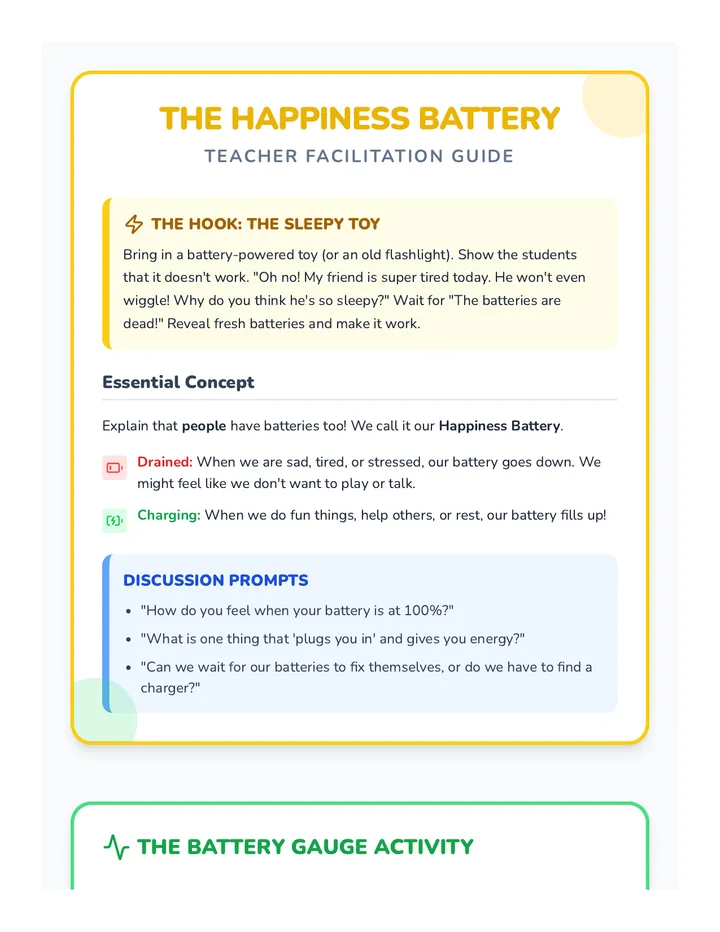
Introduces the battery metaphor for emotional energy, teaching students to monitor their own 'charge' and understand the need for recharging through positive activities.
A systemic approach to stress and burnout prevention for graduate students, reframing personal well-being as a design challenge. Students develop a personalized 'resilience architecture' through structural changes in time management, sleep hygiene, and boundary setting.
A graduate-level training sequence on facilitating peer support systems to mitigate stress and anxiety. Students learn the science of social support, micro-skills for active listening, boundary setting to prevent burnout, and group facilitation techniques to create sustainable communities of care.
A comprehensive workshop sequence for graduate students to address academic anxiety through cognitive restructuring. The sequence explores Impostor Phenomenon, cognitive distortions, perfectionism, and professional identity to build long-term resilience.
A graduate-level exploration of the biological underpinnings of stress. Students move from theoretical understanding of the autonomic nervous system and Polyvagal Theory to practical application of somatic regulation and interoceptive awareness, culminating in a personalized physiological safety plan.
A Pre-K sequence focused on building self-esteem and positive experiences through mastery, growth mindset, and persistence. Students learn to navigate challenges and celebrate their own progress.
This sequence introduces first-grade students to the fundamental connection between their actions and their emotions, serving as a foundational introduction to behavioral activation. Students explore how specific activities can shift their mood and create a personalized action plan for emotional regulation.
A mastery-focused sequence where undergraduate students audit their current stress responses and design a personalized, tiered emotional regulation protocol. Students use systems thinking to build resilient habits and prepare for future distress.
An applied sequence for undergraduate students to master self-regulation and de-escalation techniques in high-pressure academic and interpersonal contexts. Students move from identifying personal physiological triggers to practicing real-time regulation during active conflict and performance.
A culminating simulation where students face timed cognitive challenges while practicing their chosen regulation techniques. This bridges the gap between knowing a technique and using it under pressure.
Learners identify personal sensory preferences that induce calm. They design and assemble a portable or digital 'kit' of resources to use during high-stress periods.
Students learn the sequence of tensing and releasing muscle groups to identify and release held physical tension. The lesson emphasizes the connection between physical relaxation and mental clarity.
A technical workshop on breathwork, focusing on Box Breathing and 4-7-8 breathing to stimulate the parasympathetic nervous system. Students use biofeedback tools to measure the efficacy of different ratios.
Students practice the 5-4-3-2-1 technique and other sensory-based orientation strategies to reconnect with the present moment. The lesson explains the science of how sensory input overrides ruminative thought loops.
Students synthesize their knowledge to create a personalized physiological safety plan for high-stress periods. They identify triggers, early warning signs, and pre-planned somatic interventions.
Students evaluate somatic bottom-up processing techniques like diaphragmatic breathing and thermal regulation. They learn to choose the right physical strategy for their specific physiological profile.
Learners practice interoception—the sense of the internal state of the body. They test their accuracy in detecting heart rate and tension, connecting poor awareness with high anxiety.
Dives into Polyvagal Theory to distinguish between fight/flight mobilization and dorsal vagal shutdown. Students analyze behaviors like procrastination and isolation as biological responses.
Students present their collages to small groups, articulating why they chose specific activities. Peer listeners practice affirming others' choices.
Students present their Joy Menus to small groups, allowing peers to borrow ideas to add to their own lists. The lesson concludes with a commitment to try one menu item over the weekend.
Students integrate their knowledge to create a personal 'bio-map' of their stress escalation cycle. They present how specific physiological interventions can interrupt this cycle at various stages.
A teacher implementation guide for the Strategic Prioritization sequence. Includes an instructional arc, facilitation tips, common misconceptions, Special Education accommodation strategies, and answer keys.
A culminating project worksheet where students synthesize their time audit data, non-negotiables, and triage routines into a personalized "User Manual" for managing their time and commitments.
An 6-slide presentation on the Personal Priority Protocol. Synthesizes all previously learned tools into a final "Decision Tree" system and introduces the "User Manual for My Time" project.
Teacher guide for Lesson 5 focusing on plan adjustments, the Stand-Up protocol, and peer project audits.
A student worksheet for conducting a 'Status Report' and a peer project plan audit to identify and adjust unrealistic plans.
A worksheet for students to perform a Sunday night "Brain Dump" and categorize tasks into a weekly triage system. Includes a stabilization checklist to reduce morning anxiety.
A visual presentation for Lesson 5 introducing the concept of the 'Stand-Up' meeting, plan flexibility, and peer audits.
An 6-slide presentation on the Weekly Triage system. Uses an emergency room metaphor to teach students how to clear mental clutter, distinguish actionable tasks, and establish a Sunday night routine.
Teacher guide for Lesson 4 focusing on visual tools like Kanban and Gantt charts for project tracking.
Slide presentation for Lesson 5 focusing on the transition from acute therapy to long-term habit formation and relapse prevention strategies.
A student worksheet with templates for creating a personal Kanban board and a project Gantt chart.
Final project worksheet for Lesson 5, helping students design a habit architecture and a comprehensive relapse prevention plan for clinical maintenance.
Students condense the full PMR session into 60-second and 10-second versions. They simulate high-stress environments to practice deploying these rapid techniques effectively.
The focus shifts to the legs and feet to establish a physical sense of stability. Students learn to use the floor for resistance and grounding during seated lectures or exams.
A celebratory completion certificate for students who have finished the 'Mood Makers' sequence, recognizing them as 'official Mood Makers and Reset Heroes'.
The final instructional slide deck for Lesson 5, guiding students through synthesizing their research into a "Joy Menu" and practicing their new skills through role-play.
A student worksheet for reflecting on emotional change by creating a visual comic story of identifying a problem, choosing a tool, and achieving a positive mood shift.
Facilitator guide for Lesson 5, outlining the instructional flow, discussion prompts, and key concepts for the maintenance contract and habit formation.
Teacher-facing guide for facilitating the end-of-day "Best Part" reflection circle with Pre-K students.
Instructional slides for Lesson 5, reviewing the key concepts of internal weather, movement experiments, and the coping toolbox.
A student-facing restaurant-style menu template for synthesizing and illustrating personal mood-lifting activities and coping strategies.
A formal maintenance contract for students to commit to their regulation protocols, establishing maintenance schedules and accountability partners.
A student activity sheet where Pre-K children color and decorate their own "Magic Mover" medal for mastering classroom transitions.
Final slide deck for Lesson 5, focusing on habit formation, maintenance schedules, and the commitment to protocol adherence.
A teacher guide with scripted scenarios and facilitation prompts for role-playing emotional resets and building empathy.
A teacher guide for Lesson 5, focusing on synthesis of learned coping strategies into a personalized "Joy Menu" and providing instructions for role-play scenarios.