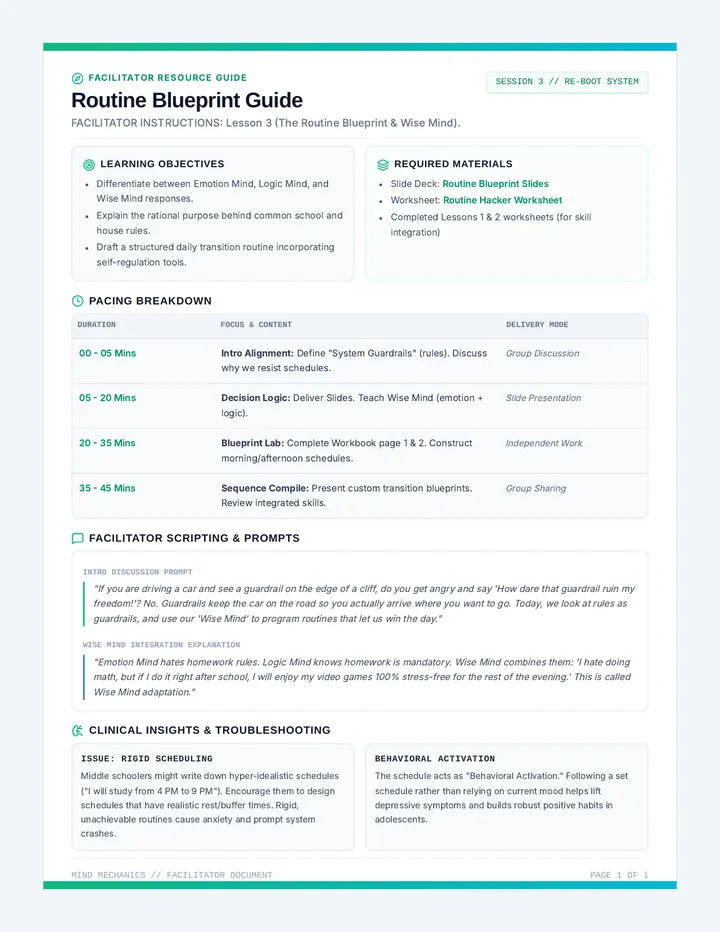
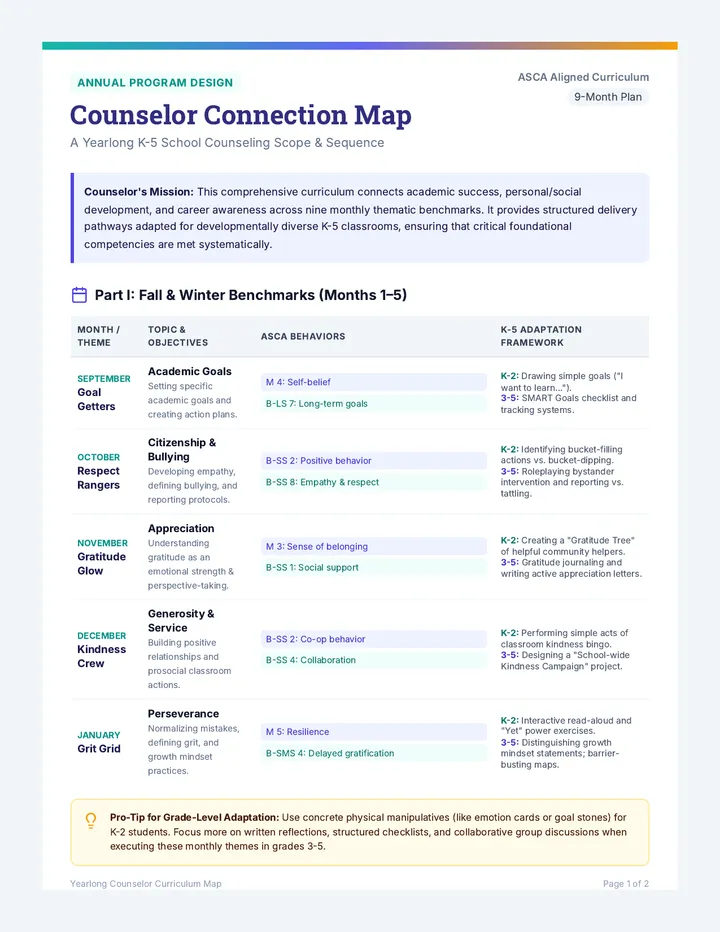
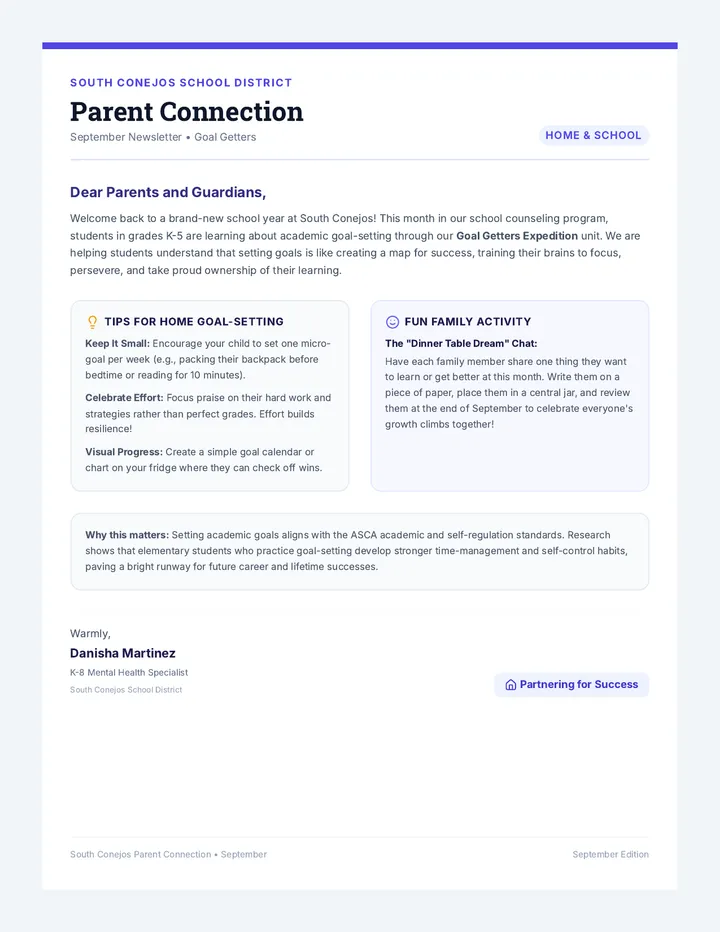
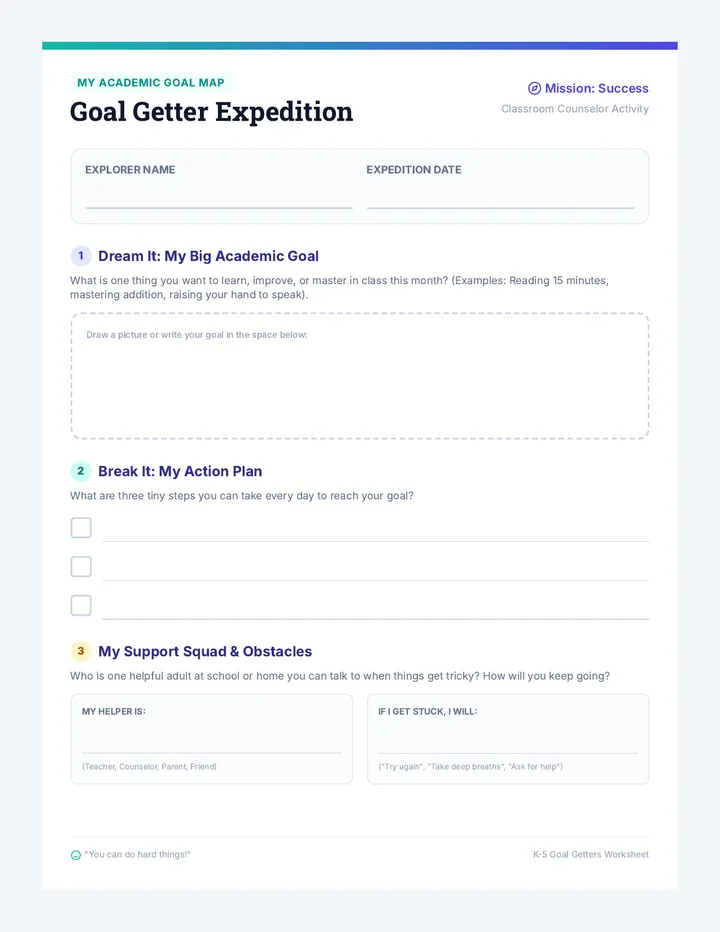
Project Blueprint Slides Deconstructing
the Mountain
Lesson 1: Mastering Task Decomposition
v1.0 // PROJECT ARCHITECT
The Big Question
"How do you eat an elephant?"
The answer is simple: One bite at a time.
Task
Decomposition
The process of breaking a complex task into smaller, manageable parts.
Stops Overwhelm
Creates Clarity
Builds a Roadmap
Giant Goal
Many Small Steps
Case Study
The Mars Habitat Model
Phase 1: Research
Find 3 sources on Mars
Take notes on atmosphere
Sketch 2 design ideas
Phase 2: Building
Buy cardboard & glue
Cut base pieces
Assemble airlock dome
Phase 3: Finalizing
Paint habitat red/white
Write 2-page report
Print photos of model
"Building a model" isn't one task. It's actually nine separate tasks!
Your Mission
You will receive a project rubric. Your goal is to find the hidden tasks inside.
Ask yourself:
"What exactly do I need to do to get this done?"
Task Cracker Worksheet Task Cracker
Project Decomposition Lab
Name:
Date:
Objective
Take the "The Great Invention Challenge" project and crack it into at least 10 specific, actionable steps.
The Project Description
"The Great Invention Challenge"
For this social studies project, students must design a modern invention that solves a real-world environmental problem. You will need to submit a drawn blueprint of the invention with labels, a 3-minute presentation explaining how it works, and a bibliography showing at least three different sources of research used to prove your invention is scientifically possible.
Cracked Task List
Actionable Steps Only
No. Specific Action Item Phase 01 02 03 04 05 06 07 08 09 10
Check Your Work
Are any of these tasks too big? If a task takes more than 30 minutes, it probably needs to be cracked into two smaller ones!
Deconstruction Teacher Guide Teacher Guide L1 // DECONSTRUCTION
Deconstruction Guide
Facilitating the "Task Cracker" Lab
Concept Overview
Many students with executive function challenges see a project as a single, overwhelming block of wood rather than a set of parts. **Task Decomposition** is the physical and mental act of breaking that block into specific "bites" that can be completed in under 45 minutes.
Facilitation Prompts
"If you had to start this project in exactly 5 minutes, what is the very first thing your hands would touch?"
"Look at the word 'Research'. That's a huge word. What are the 3 mini-tasks hidden inside it?"
"Does this task require you to buy or find materials first? If so, that's Step #1!"
Common Hurdles
The "Vague Task" Trap
Student writes: "Do the project." Correction: Push them to identify a physical action (e.g., "Open a Google Doc").
The "Missing Prep" Step
Student skips straight to building. Correction: Ask them what supplies they need and when they will get them.
For Support
Provide a pre-filled list of 5 tasks; student finds the remaining 5.
Use physical cards to sort tasks into "Beginning, Middle, End" phases.
For Challenge
Ask students to identify "bottleneck" tasks (tasks that must happen before others).
Categorize tasks by "Energy Level Needed" (High vs Low).
Time Reality Slides Time Estimation
& Reality Checks
Lesson 2: Defeating the Planning Fallacy
v1.0 // THE REALITY CHECK
The Big Lie
"I'll just do this real quick. It should take like 10 minutes."
Actual time elapsed: 45 Minutes.
The Planning
Fallacy
A psychological bias where we underestimate how much time a task will take, even if we've done it before.
Why does it happen?
We ignore potential problems.
We imagine the "perfect" version of the day.
We forget about small steps (like finding a pen).
EXPECTATION
REALITY
The Pro Strategy
The "Buffer Time" Secret
Step 1
Estimate
Think: "I think this will take 20 minutes."
Step 2
Add 50%
Add 10 minutes for safety.
20m + 10m = 30m
New Schedule Time
Stress level: Low
Peer Reality Check
Sometimes we are blind to our own time lies. We need a Partner's Perspective.
The Mission:
Compare your estimates with a peer. Are you being too optimistic?
Time Tracker Worksheet Time Tracker
Estimation vs. Reality Lab
Name:
Date:
The Goal
Practice honest time estimation. We will estimate, add buffer, and then compare with classmates to see if we are "Planning Fallacy" victims.
The Math:
Estimation × 1.5 = Reality Time
Common Tasks My Estimate Buffer Time (+50%) Peer's View Finding 3 Sources Writing Introduction Cleaning Your Desk Drawing the Poster Printing Final Draft
Reality Check Reflections
1. Which task was hardest to estimate? Why?
2. What did your peer say about your estimates? (Were you too fast or too slow?)
3. Why is "Printing Final Draft" often estimated poorly? Think about hidden steps.
Over-estimating is better than under-estimating!
Buffer Zone Guide Teacher Guide L2 // BUFFER ZONE
The Buffer Zone
Fighting the Planning Fallacy with Buffer Time
The Strategy
The goal of this lesson isn't just to be "faster." It's to be **accurate.** Students often feel shame when a task takes longer than planned. By teaching the "Buffer Time" (Estimation + 50%), we normalize the fact that life is unpredictable.
Discussion: The "Hidden" Time Suckers
Help students see why "Printing a paper" isn't a 1-minute task. Ask: "What happens if..."
The printer is out of ink? (15 min trip to store)
The Wi-Fi goes down? (10 min troubleshooting)
You can't find your charger? (5 min searching)
Coaching Questions
"Is that estimate based on you working perfectly without checking your phone once?"
"Have you done this task before? How long did it take last Tuesday?"
"What is the 'Best Case' time vs. the 'Worst Case' time?"
Success Indicators
Student can explain *why* they added buffer.
Student is comfortable increasing an estimate after peer feedback.
Common Misconception
Students think a high estimate means they are "slow" or "bad." Reframe it: **A high estimate means you are a "Master Planner."**
Time Travel Slides The Art of
Backwards Planning
Lesson 3: The Time Travel Method
v1.0 // REVERSE ENGINEER
Two Ways to Plan
Forward
"I'll start today..."
You look at what you can do now, and hope you finish by the due date.
Leads to cramming!
Backwards
"It's due Friday..."
You start at the deadline and walk backward to find the start date.
The Pro Method!
The 4 Steps of Time Travel
01
Pin the Date
Mark the final due date on your calendar.
02
List the Bites
Grab your list of small tasks from Lesson 1.
03
Jump Back
Schedule the *last* task one day before the due date.
04
Reverse Fill
Keep walking backward until all tasks are assigned.
Backwards Planning Visualization
TODAY
DUE DATE
Plan this way! (Right to Left)
The Reverse Challenge
Grab your Task List. Grab your Buffer Times. We are going to build a Timeline from the Future.
"If it's due Friday, what MUST be done by Thursday?"
Reverse Calendar Worksheet Reverse Calendar
Planning from Future to Present
Project:
Due Date:
Instructions
Write your Due Date in the final box on the timeline.
Look at your Task List (from Lesson 1 & 2).
Place the *last* task one day before the due date.
Continue working backwards until today!
Remember:
Don't forget the Buffer Time!
Work This Way
End FRIDAY
FINAL SUBMISSION DUE
Phase 4 THURS
Phase 3 WED
Phase 2 TUES
Phase 1 MON
Start TODAY
ACTION: First Tiny Bite!
Did you run out of days? If so, you need to combine tasks or start earlier next time!
Self-Check Complete
Master Plan Key Reference Master Plan Key
Model: Backwards Plan for Research Project
Reference Only
Scenario:
"Students have a 5-page research paper due on Friday. Today is Monday. They have 5 days."
DUE DATE FRIDAY
Final Turn-In
Submit via Google Classroom by 11:59 PM.
1 DAY LEFT THURSDAY
Proofread for spelling errors (15m)
Format bibliography/citations (30m)
2 DAYS LEFT WEDNESDAY
Write Body Paragraphs 2 & 3 (45m)
Write Conclusion (15m)
3 DAYS LEFT TUESDAY
Finish Research & Notes (30m)
Draft Introduction & Body #1 (40m)
START MONDAY
Find 3 Research Sources (20m)
Create Basic Outline (10m)
Teacher Note: Why this works
Notice how the workload is balanced. No single day has more than 1 hour of work. This prevents the "All-Nighter" Thursday panic.
Goal Guardian Slides Creating
Accountability
Lesson 4: Setting Traps for Success
v1.0 // GOAL GUARDIAN
The Morning Brain Lie
"I'll definitely do this when I get home at 4:00 PM."
Then 4:00 PM hits, and you are tired, hungry, and distracted.
The "Soft"
Deadline
A personal deadline before the real one.
Creates Checkpoints
Reduces Final Pressure
Hard vs Soft
Hard Deadline
Friday @ 8:00 AM
Soft Deadline
Wednesday @ 4:00 PM
Success Traps
The Peer Check
Tell a friend: "Text me at 5:00 PM and ask if I'm done."
The Reward
"No video games until I finish Step 3 on my list."
The Alarm
Set a "Start Alarm" on your phone for a specific task.
Sign the Contract
Today, you will design your own Success Trap. What is one promise you will make to yourself?
"I will establish my Soft Deadline by..."
Success Contract Worksheet Success Contract
Personal Accountability Blueprint
Architect:
Witness:
The Soft Deadline Checkpoint
Hard Deadline (The Real One)
Friday @ 3:00 PM
My Soft Deadline (The Goal)
Note: Your soft deadline should be at least 24 hours BEFORE the hard deadline to allow for "Emergency Brain Fogs" or printer issues!
My Success Traps (Choose 2)
The Social Trap (The Peer Check)
I will tell ___________________ (Name) to check in with me at ________ (Time) on ________ (Day).
The Reward Trap (The Carrot)
I will not do ____________________________ (Activity) until I have finished ____________________________ (Task).
The Digital Trap (The Alarm)
I will set a "Start Alarm" on my phone or computer for ________ (Time) to remind me to begin my work.
Official Commitment
"I, the undersigned, acknowledge that my 'Future Brain' is often tired and distracted. I commit to these Success Traps to protect my goals and reduce my stress levels."
Student Signature
Teacher/Peer Witness
Checkpoint Teacher Guide Teacher Guide L4 // CHECKPOINTS
Checkpoint Mastery
Building Sustainable Accountability Systems
The "No-Shame" Approach
Accountability is often associated with punishment. In this lesson, we reframe it as **self-kindness.** Setting an alarm or asking a friend for a check-in isn't a sign of weakness; it's a sign of a high-functioning student who understands how their brain works.
How to Guide "Peer Check-ins"
Peer accountability only works if it's specific. Help students script their check-ins:
Bad: "Did you do your homework?"
Good: "Hey, did you finish that '3 sources' task we talked about?"
Mini-Workshop Ideas
The "Alarm Demo"
Have students physically take out their phones (if allowed) and set one alarm for a task they have today. Walk them through labeling the alarm with the specific task name.
The "Carrot vs Stick" Discussion
Ask students which motivates them more: A reward (video games) or avoiding a consequence (losing points). Tailor their "Success Contract" based on their answer.
Common Pitfall
Students set the Soft Deadline only 10 minutes before the Hard Deadline. **Teacher Fix:** Mandate a "24-hour buffer" for this specific activity to prove the value of breathing room.
Extension
Ask students to identify a "Project Mentor" (a parent, teacher, or older sibling) and explain their Success Contract to them.
Brain Hack Slides The Procrastination
Plan
Lesson 5: Hacking Your Own Brain
Emergency brake // v1.0
The stalling truth
It's not laziness
Procrastination is often about Emotions, not time management. We avoid things that make us feel anxious or bored.
The dopamine trap
Your brain wants the "Quick Win" of TikTok or Video Games instead of the "Long Win" of the project.
The Trigger List
The Perfectionist
"I'm afraid I won't do it perfectly, so I won't do it at all."
The Overwhelmed
"There's so much to do, I don't know where to start."
The Boredom King
"This is so boring, literally anything else is better."
Which one are you? Knowing is the first step.
Brain Hacks
The 5-Minute Rule
Tell yourself: "I will only work for 5 minutes." (It's easier to start!)
Micro-Tasks
Break the task down into something stupidly small.
"Break Glass"
Emergency Plan
When you fall behind, don't panic. You need a pre-written plan to get back on track.
Mission Ready
You've broken the tasks. You've estimated the time. You've set the schedule. Now, let's build your Emergency Brake.
"If I miss a deadline, the first thing I will do is..."
Emergency Brake Worksheet Emergency Brake
The "Break Glass in Case of Delay" Plan
Operator:
Step 1: Diagnose the Stall
Anxiety
"I'm worried I'll do a bad job."
Boredom
"This is not fun/interesting."
Overwhelm
"There's just too much."
Step 2: The Toolbelt
Pick 3 "Brain Hacks" you will use when you feel yourself stalling:
The 5-Minute Dash
"Phone in Another Room"
Study Focus Playlist
Make a "Micro-Task" list
Change My Location
The "One Bite" Reward
Step 3: Protocol
Protocol A: The "I Missed My Soft Deadline" Move
The first thing I will do is: __________________________________________
Protocol B: The "I'm 100% Stuck" Move
The person I will email/text for help is: __________________________________________
Protocol C: The "Focus Filter"
To get back on track, I will remove these 3 distractions from my desk:
Be prepared, not perfect
Stalling Signs Guide Teacher Resource Teacher Guide L5 // STALLING SIGNS
Stalling Signs
Identifying and Neutralizing Procrastination
The "Emotion Regulation" Lens
"Procrastination is an emotion regulation problem, not a time management problem." — Dr. Tim Pychyl.
Remind students that feeling bored or scared of a project is **normal.** The goal of this final lesson is to move from "feeling" to "doing" using low-friction hacks.
Observation: Is the Student Stalling?
The "Productive" Procrastinator
Student is sharpening every pencil, cleaning their desk, or organizing their backpack instead of starting the project. They are doing "work" but not THE work.
The "Research" Rabbit Hole
Student is browsing Wikipedia for 45 minutes on related but unnecessary topics. Re-focus them: "What is the one sentence you need to write right now?"
The "5-Minute Dash" Facilitation
This is the most effective tool for students with ADHD/Executive Function needs. Tell the student:
"Set a timer for 5 minutes. You only have to work until it beeps. After that, you can choose to keep going or stop. Just 5 minutes. Ready?"
Teacher Note: 90% of students will keep going once the timer beeps because the "friction of starting" has been overcome.
Final Reflection Prompt
"What is one physical thing you can do to signal to your brain that 'Focus Mode' has started? (Putting on headphones, drinking a specific tea, clearing the desk surface?)"
Closing the Sequence
Congratulate students. They now have a full Blueprint, a Reality-Checked Timeline, a Success Contract, and an Emergency Brake. They are project-ready.