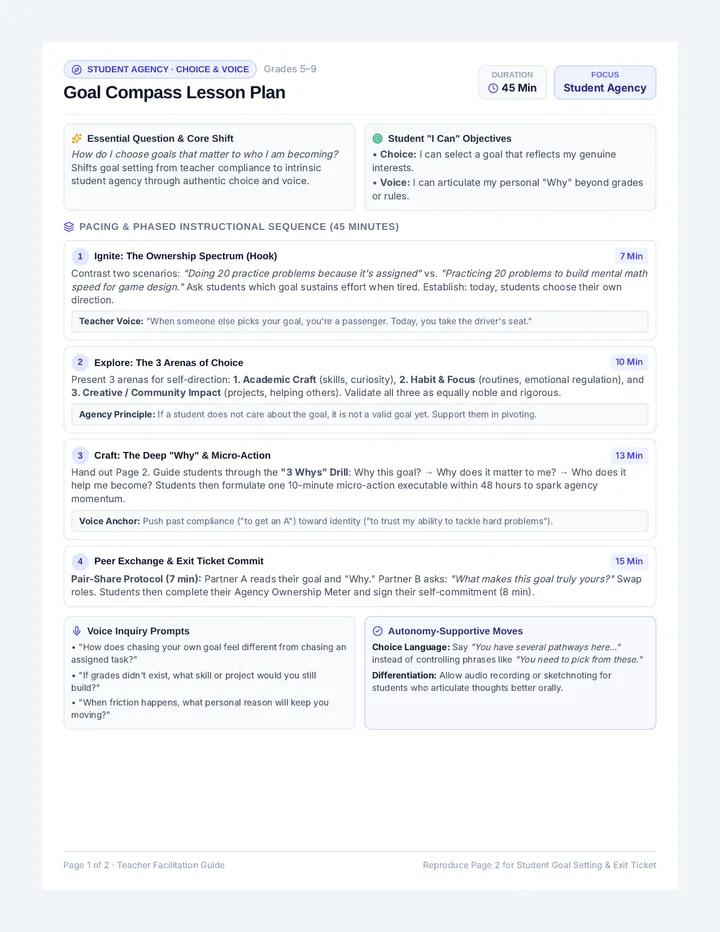
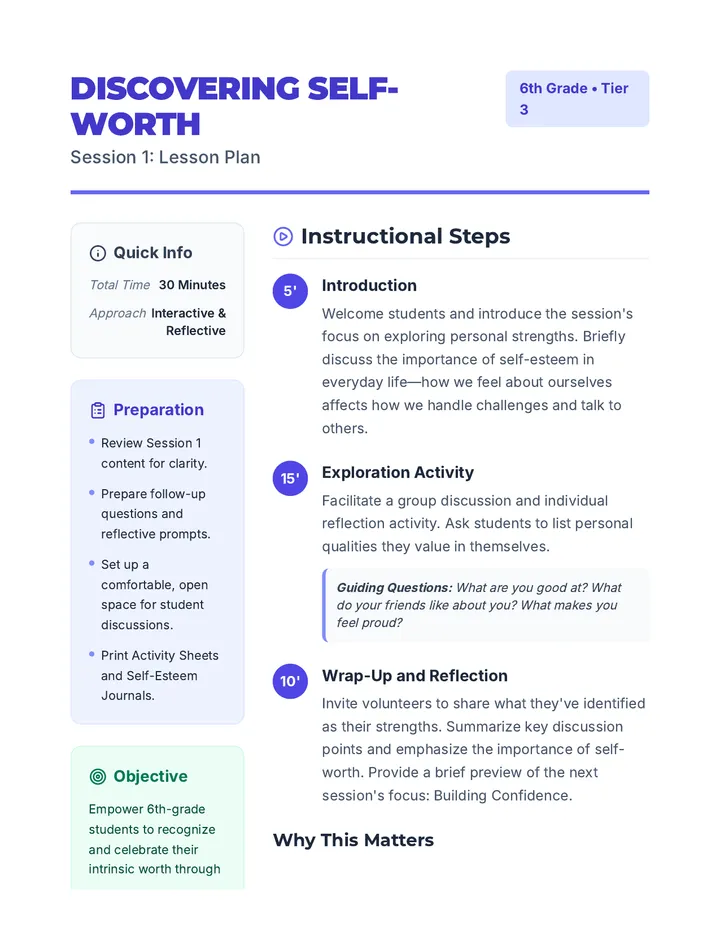
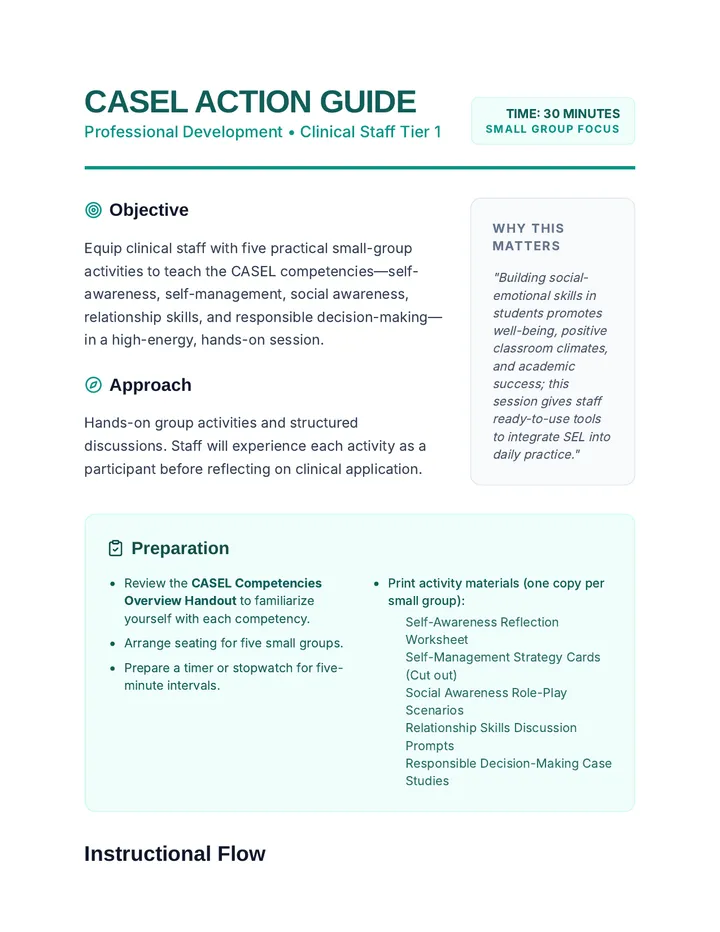
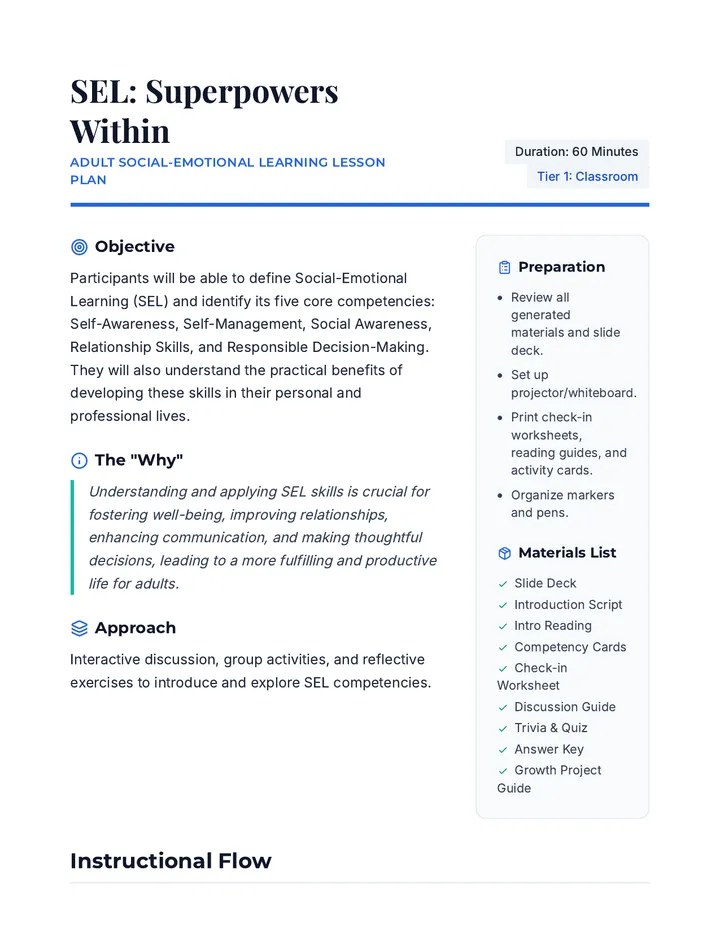
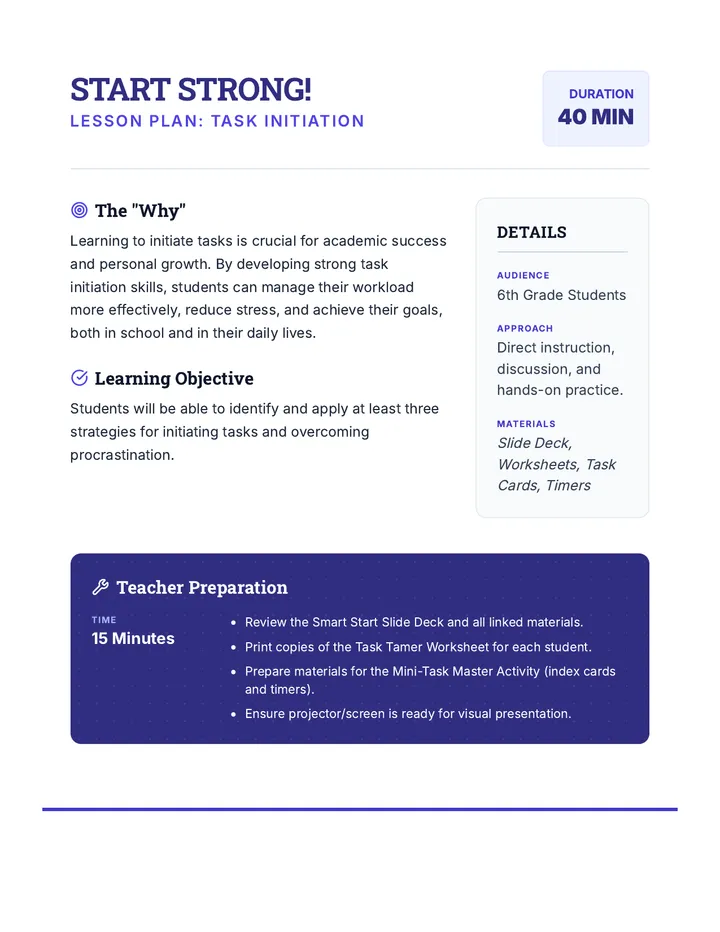
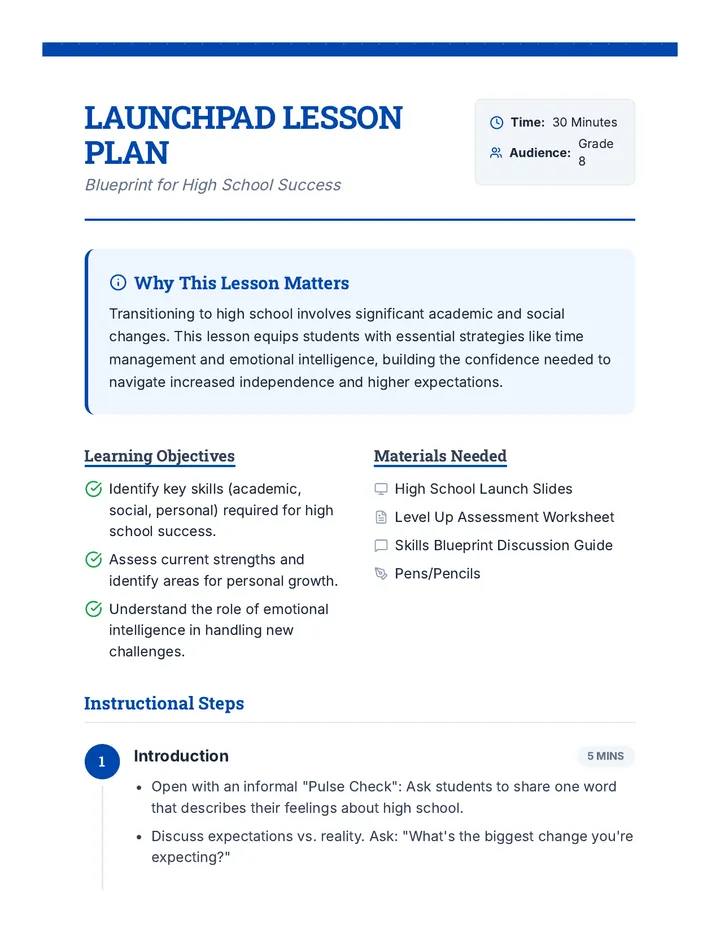
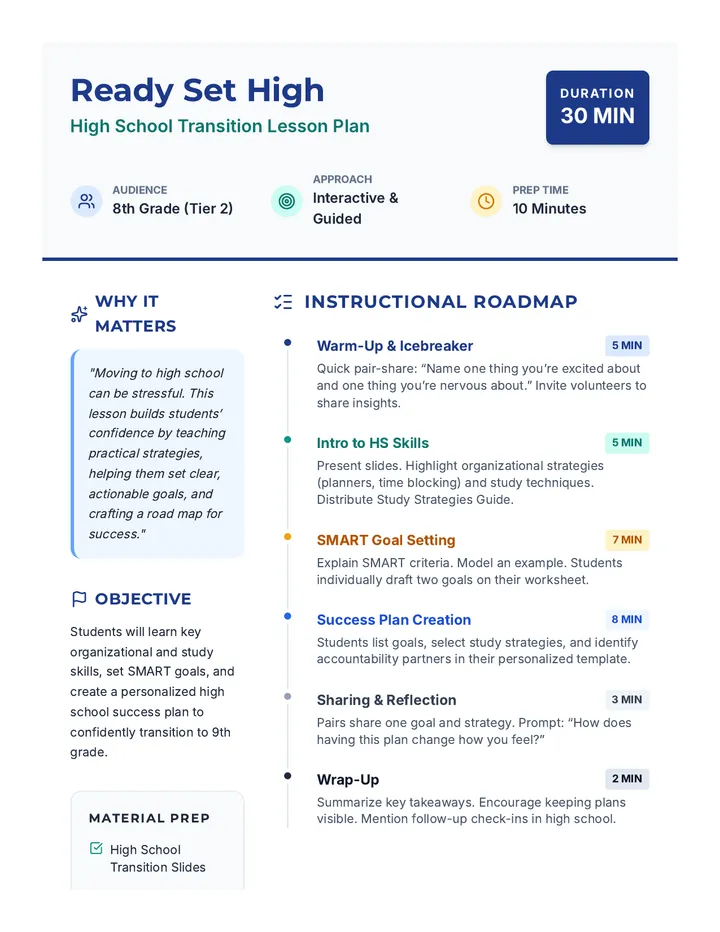
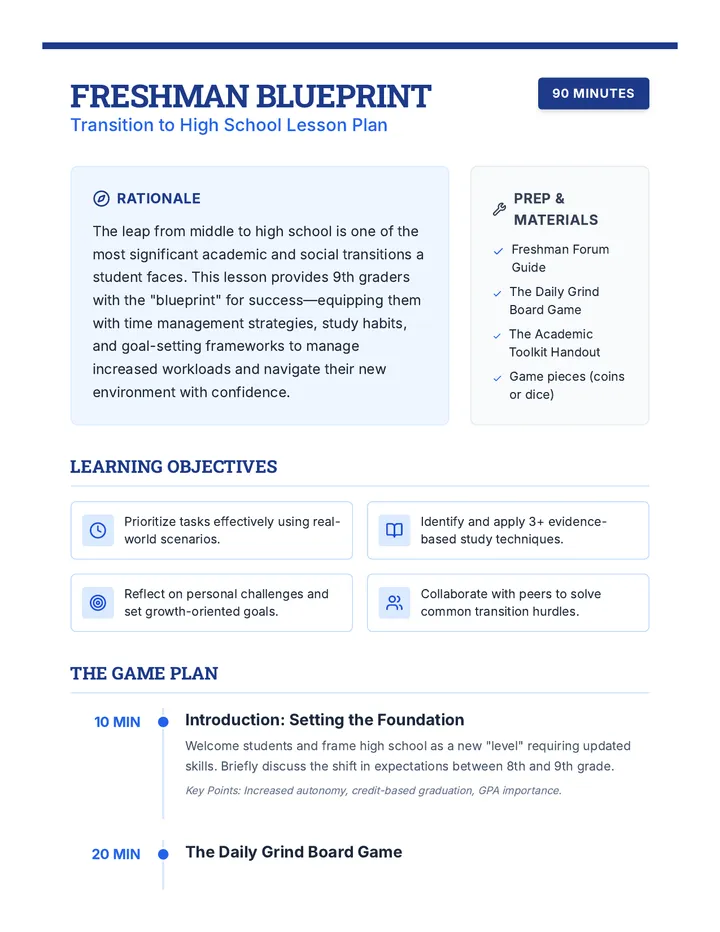
Specific, measurable, and time-bound goal-setting frameworks for personal and academic development. Builds skills in action planning, progress monitoring, and objective evaluation.
This sequence guides undergraduate students through the practical application of Behavioral Activation (BA) protocols. Moving from theoretical understanding to clinical implementation, students learn to design interventions, troubleshoot psychological barriers using the TRAP/TRAC model, and analyze data to refine therapeutic outcomes.
A 5-lesson sequence for 10th-grade students focusing on project management skills like backward design, task deconstruction, and time estimation to balance multiple commitments.
A comprehensive 5-lesson unit for 10th-grade students focusing on executive functioning skills to balance multiple commitments. Students learn time auditing, the Eisenhower Matrix, task batching, and weekly triage systems to develop a personalized priority protocol.
A comprehensive 5-lesson series designed to help 9th-grade students in academic support settings transform their passive highlights and annotations into active retrieval-based study tools. Through a 'Study Blueprint' theme, students move from auditing their existing notes to building outlines, concept maps, and flashcards, culminating in a personalized study guide for an external subject.
This sequence teaches 9th-grade students the foundational skills of time management and prioritization. Students will transition from tracking their current habits to designing a proactive, balanced schedule that aligns with their personal and academic goals.
A comprehensive sequence where 8th-grade students act as 'organizational consultants' to diagnose and solve scheduling conflicts and executive functioning challenges through case studies. Students learn root cause analysis, professional self-advocacy, emotional regulation strategies for procrastination, and tool evaluation before creating a final consultancy report.
A specialized sequence for 8th-grade students focusing on executive functioning skills related to project management. Students learn to deconstruct complex assignments, plan backwards from deadlines, visualize overlapping tasks using Gantt charts, and adjust plans when setbacks occur.
A game-based simulation sequence for 8th-grade students to master time and energy management. Students treat time as a finite currency, navigate trade-offs through opportunity cost simulations, and design a sustainable weekly schedule.
A comprehensive unit for 8th graders to master time management, prioritization using the Eisenhower Matrix, and time-blocking techniques to balance school and life.
A 5-lesson sequence for 7th-grade students focused on strategic prioritization and time management. Students learn to use the Eisenhower Matrix, identify 'Big Rocks', and create sustainable weekly schedules through a 'Time Architect' theme.
A project-based sequence for 7th-grade students to master 'Backwards Planning' by breaking down complex projects into manageable milestones, estimating time accurately, and developing accountability strategies to overcome procrastination.
This sequence guides 7th-grade students through discovering, selecting, and maintaining organizational systems. It focuses on the 'tools of the trade'—from paper planners to digital apps—and helps students build personalized workflows to balance multiple school and personal commitments.
Transitions from acute intervention to long-term maintenance, applying habit formation principles and creating relapse prevention plans to ensure sustainable lifestyle changes.
Students analyze mood and activity data to evaluate intervention effectiveness, practicing the role of the scientist-practitioner in a clinical setting.
Introduces the TRAP/TRAC framework for identifying avoidance patterns and implementing alternative coping strategies when clients face internal or external barriers.
Focuses on the technique of breaking down overwhelming tasks into manageable micro-steps to build self-efficacy and momentum in clients.
Students bridge the gap between abstract values and concrete behaviors by creating structured schedules. The focus is on identifying activities that provide 'Mastery' and 'Pleasure' to counteract depressive withdrawal.
Students learn to treat plans as living documents, conducting weekly audits to adjust their timelines based on actual progress.
Students explore visual tools like Gantt charts and Kanban boards to track project progress visually.
Students practice estimating task duration and learn to add buffer zones to account for the planning fallacy.
Students use backward planning to set interim milestones on a calendar, accounting for non-school days and other commitments.
Students learn to analyze a complex assignment rubric to identify hidden tasks, turning a single sentence into a detailed checklist.
Students synthesize the tools learned to create a personal decision-tree for handling new commitments, presented as a 'User Manual for My Time'.
Students create a Sunday Night Triage routine to review upcoming deadlines and sort them by priority, clearing mental clutter before the week begins.
A teacher implementation guide for the Strategic Prioritization sequence. Includes an instructional arc, facilitation tips, common misconceptions, Special Education accommodation strategies, and answer keys.
A culminating project worksheet where students synthesize their time audit data, non-negotiables, and triage routines into a personalized "User Manual" for managing their time and commitments.
An 6-slide presentation on the Personal Priority Protocol. Synthesizes all previously learned tools into a final "Decision Tree" system and introduces the "User Manual for My Time" project.
Teacher guide for Lesson 5 focusing on plan adjustments, the Stand-Up protocol, and peer project audits.
A student worksheet for conducting a 'Status Report' and a peer project plan audit to identify and adjust unrealistic plans.
A worksheet for students to perform a Sunday night "Brain Dump" and categorize tasks into a weekly triage system. Includes a stabilization checklist to reduce morning anxiety.
A visual presentation for Lesson 5 introducing the concept of the 'Stand-Up' meeting, plan flexibility, and peer audits.
An 6-slide presentation on the Weekly Triage system. Uses an emergency room metaphor to teach students how to clear mental clutter, distinguish actionable tasks, and establish a Sunday night routine.
Teacher guide for Lesson 4 focusing on visual tools like Kanban and Gantt charts for project tracking.
Slide presentation for Lesson 5 focusing on the transition from acute therapy to long-term habit formation and relapse prevention strategies.
A student worksheet with templates for creating a personal Kanban board and a project Gantt chart.
Final project worksheet for Lesson 5, helping students design a habit architecture and a comprehensive relapse prevention plan for clinical maintenance.