OSHA standards, hazard identification, and emergency response protocols for professional environments. Strengthens understanding of employee rights regarding protective equipment and incident reporting.
A hands-on activity sheet for practicing procedural annotation by highlighting verbs and cautions in an origami instruction manual.
A slide deck introducing strategies for annotating technical manuals and 'how-to' guides, focusing on sequence, warnings, and decision trees.
A worksheet that simulates a shared digital document where students respond to colleague comments using professional workplace etiquette.
An instructional guide for teachers to lead the Tech Trouble Detectives lesson, including demonstrations of OCR tools and facilitation for the scavenger hunt.
A slide deck introducing strategies for collaborative digital annotation and workplace communication etiquette.
A teacher resource providing guidance for the final 'Transition Profile' project, instructions for a gallery walk activity, and a mastery rubric.
A case study worksheet where students analyze a simplified lease agreement to solve a deposit dispute using color-coded annotation.
A slide deck introducing strategies for annotating legal leases, focusing on color-coding rights, obligations, and deadlines.
A student template for creating a professional 'Transition Profile' that summarizes their assistive technology needs, legal rights, and self-advocacy scripts.
A student worksheet for identifying digital barriers on websites and practicing finding technical workarounds or appropriate contact persons for accessibility support.
A graphic organizer to help students track the 'Main Thread' of a digital text while 'queuing' hyperlinks to avoid distractions.
A student worksheet for drafting professional emails and verbal scripts to request Text-to-Speech accommodations in post-secondary and workplace environments.
A comprehensive unit for 12th-grade students focusing on translating traditional annotation skills to digital interfaces and professional documents. Students will learn to navigate digital tools, manage non-linear web texts, analyze legal leases, collaborate in shared documents, and troubleshoot using technical manuals to prepare for post-secondary life.
A comprehensive sequence for 11th-grade students focusing on the metacognitive and self-advocacy skills needed for using Text-to-Speech (TTS) technology in post-secondary environments. Students investigate cognitive science, legal frameworks, and practical communication strategies to ensure accessibility in college and career.
An advanced graduate-level exploration of the intersection between organizational psychology and workplace safety, focusing on Behavioral Based Safety, whistleblower protections, and the cultivation of a 'Just Culture' that encourages transparent incident reporting.
A comprehensive graduate-level simulation-based course on handling workplace harassment and discrimination complaints. Students progress from initial intake to final report writing, focusing on procedural fairness, neutrality, and evidence-based determination.
This sequence trains 9th-grade students in bystander intervention techniques and active allyship within a workplace context. Students explore the psychological barriers to action (the bystander effect) and master the '4 Ds'—Direct, Distract, Delegate, and Delay—to safely interrupt harassment and support colleagues.
A comprehensive sequence focused on professional clerical skills, teaching students to master alphabetical, numerical, and color-coded filing systems, alongside data tracking and confidentiality protocols.
This sequence focuses on vocational and executive function skills, treating organization as a professional competency. Students simulate roles like office managers or resource coordinators to learn sorting, filing, ergonomics, and hybrid digital-physical tracking.
This sequence guides 10th-grade students through the complex world of employee benefits, shifting focus from hourly wages to total compensation. Students learn to value health insurance, retirement matches, and paid leave to make informed career decisions.
An advanced graduate-level sequence focused on the synthesis and application of federal employment laws (FLSA, Title VII, ADA, FMLA) in organizational leadership. Students act as consultants to audit policies, resolve complex personnel disputes, and design strategic compliance frameworks that balance legal risk with ethical culture.
A graduate-level professional development sequence focused on the legal, ethical, and logistical complexities of trafficking intervention, mandatory reporting, and multi-disciplinary team collaboration.
A career-readiness sequence for 12th-grade students focusing on information chunking and working memory strategies to manage complex workplace protocols and verbal instructions.
Annotation of technical manuals and 'how-to' guides, focusing on identifying sequence, warnings, and decision trees to follow complex procedures.
Developing professional communication skills through collaborative digital annotation, focusing on commenting etiquette and consensus-building in shared documents.
Application of color-coded annotation to identify legal rights and obligations within a rental lease agreement, translating boilerplate text into actionable information.
Strategies for maintaining focus and comprehension when reading hyperlinked or non-linear digital texts, including managing sidebars and multimedia distractions.
Introduction to digital annotation tools, focusing on managing layers of notes, exporting summaries, and using digital search/tagging functions effectively.
Students synthesize their learning into a professional transition one-pager that summarizes their specific assistive technology needs and legal rights.
Practical troubleshooting for digital barriers, including identifying inaccessible files and finding technical workarounds or contact persons.
Students practice professional communication and self-advocacy by simulating requests for accommodations in college and workplace settings.
A deep dive into the legal frameworks of the ADA and Section 504 as they apply to digital accessibility in higher education and the workplace.
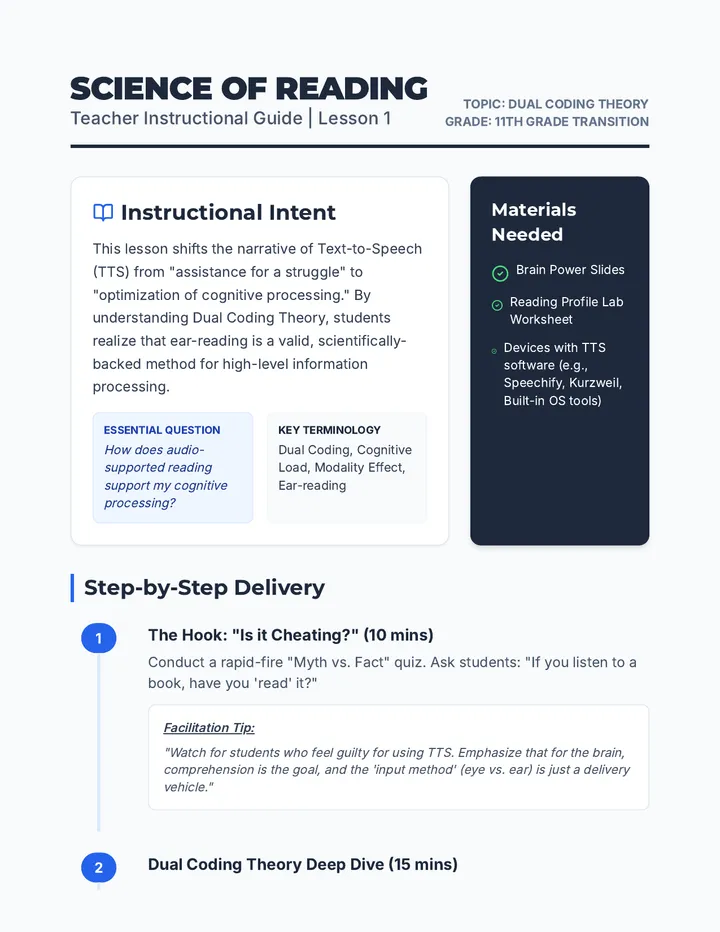
Students explore Dual Coding Theory and analyze their personal reading data to understand how eye-reading and ear-reading interact to improve comprehension and reduce fatigue.
Synthesize learning to create a roadmap for 'Just Culture,' integrating physical and psychological safety as core organizational values.
Explore the impact of leadership communication and behavior on safety culture, including practical techniques for management-led safety walks and trust-building.