ADA Power-Up Lesson Plan Your ADA Power-Up
Empowering workplace self-advocacy and legal literacy.
30 Minutes
Adult Tier 1 Support
Why This Lesson?
This lesson will empower you to confidently navigate your workplace, understand your rights, and effectively advocate for the accommodations you need to thrive professionally.
Preparation
1 Review the Slide Deck to familiarize yourself with content.
2 Print or prepare to display the ADA & Me Worksheet .
3 Prepare Advocacy Scenario Cards for role-play.
4 Ensure the environment is accessible for a wheelchair user.
Materials Needed
Slide Deck ADA & Me Worksheet Advocacy Scenario Cards Workplace Solutions Activity
Objective: Understand key ADA provisions (Title I) and develop practical self-advocacy skills for the workplace.
Instructional Steps
5m
Warm-Up: My Workplace
Begin by asking the student to briefly describe aspects of their workplace environment, focusing on daily routine and physical considerations. Use the Script for prompts.
7m
Introduction to ADA
Use the Slide Deck to introduce ADA Title I (Employment). Discuss "reasonable accommodation" and "essential job functions". Refer to Script for legal nuances.
8m
ADA & Me: Activity
Distribute the ADA & Me Worksheet . Guide reflection on personal workplace needs and potential accommodations. Facilitate a brief discussion on findings.
8m
Self-Advocacy Practice
Introduce self-advocacy concepts. Use Scenario Cards for discussion and role-play. Emphasize clear communication and knowing legal rights.
2m
Wrap-Up & Next Steps
Summarize key takeaways. Reiterate the importance of confidence in advocacy. Address any lingering questions using the Script .
ADA Power-Up Presentation Workplace Excellence
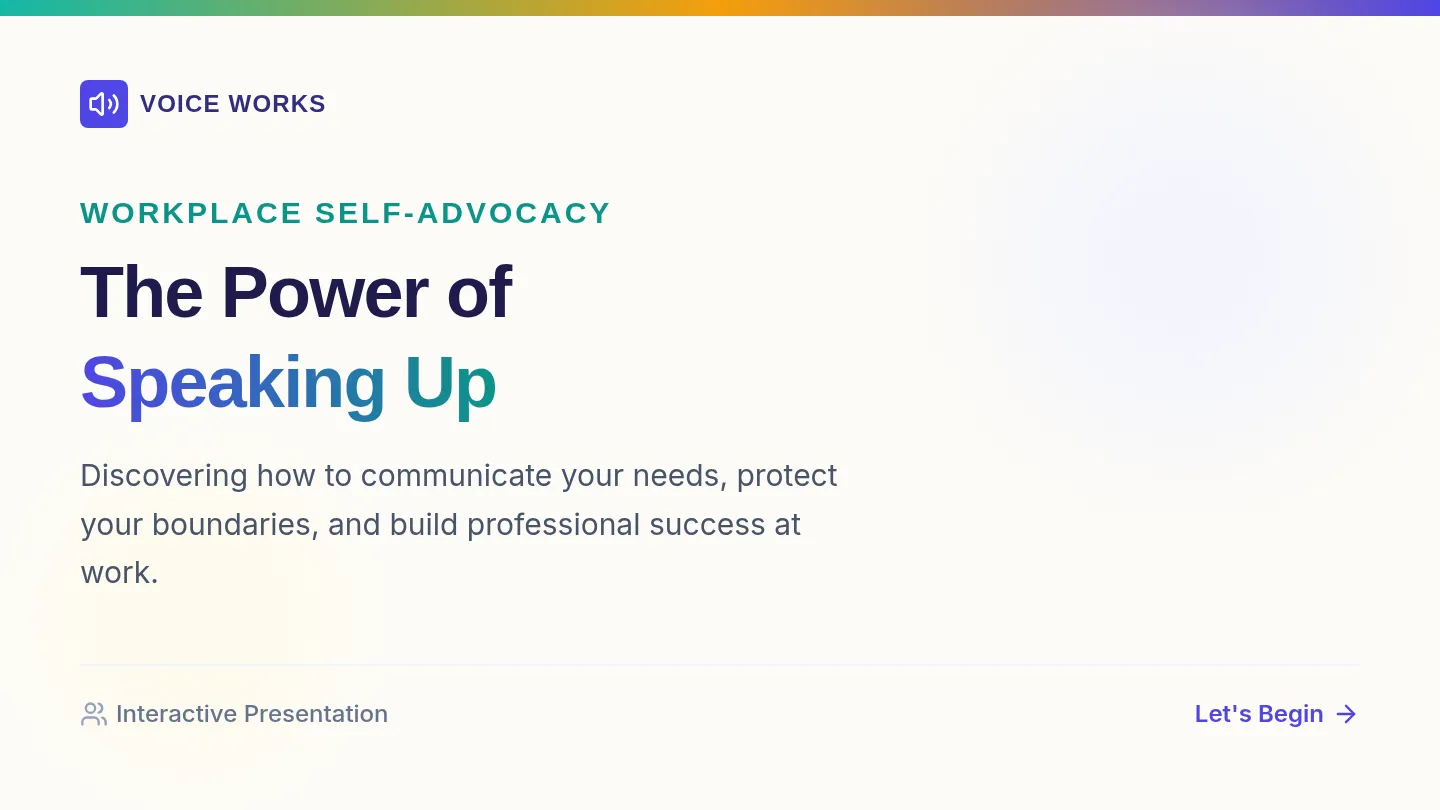
Your ADA
Power-Up
Understanding Your Rights, Advocating for Yourself,
and Thriving at Work!
Teacher Notes: Welcome the student and set a positive, empowering tone. Briefly explain the purpose of the session – to empower them in the workplace.
My Workplace Landscape
What does a typical day look like for you at work?
Are there any specific areas or tasks that come to mind regarding physical space or movement?
Think about your daily flow...
Teacher Notes: Ask the student to share a bit about their workplace and any daily routines or physical aspects that come to mind. This helps personalize the session.
What is the ADA?
The Americans with Disabilities Act (ADA) is a civil rights law that protects people with disabilities from discrimination.
Schools
Public Spaces
Workplaces
Teacher Notes: Introduce the ADA as a civil rights law. Emphasize that it's designed to ensure equal opportunity.
ADA Title I: Employment
This part of the ADA focuses on jobs and employment .
Employers cannot discriminate against qualified individuals with disabilities.
HIRING
PROMOTIONS
PAY
TRAINING
Teacher Notes: Focus on Title I specifically, as it pertains directly to employment. Explain that this is what protects them in their job.
What is a "Reasonable Accommodation"?
Any change to the work environment or the way things are done that allows a person with a disability to enjoy equal opportunities.
Ramps & Doorways
Modified Schedules
Adjustable Desks
Interpreters
Teacher Notes: Define 'reasonable accommodation' with clear, relatable examples that might apply to a wheelchair user.
Essential Job Functions
These are the fundamental duties of a job – the main reasons the job exists.
Accommodations enable you to perform these core tasks effectively. It’s about making sure you can excel in your role.
CORE DUTIES
Teacher Notes: Explain 'essential job functions' so the student understands that accommodations are about enabling them to do the core parts of their job.
Why Self-Advocacy Matters
Self-advocacy means understanding your rights and effectively communicating your needs.
Speaking up for yourself
Making your own choices
Standing up for your rights
The Power of Your Voice
"In the workplace, it helps ensure you get the support you need to do your best work."
Teacher Notes: Transition to self-advocacy. Explain why it's crucial to speak up for oneself in a professional manner.
How to Ask for Accommodations
01
Communicate Clearly
Talk to your employer or HR early.
02
Be Specific
Describe exactly what you need and why.
03
Offer Solutions
Suggest ideas that might work.
04
Follow Up
Ensure your request is processed.
Teacher Notes: Explain the process for requesting accommodations. Emphasize open communication.
Advocacy in Practice
Let's look at some real-life situations and think about how you might advocate for yourself!
Activity Time
Teacher Notes: This slide sets up the interactive activity using the scenario cards. Encourage active participation.
You're Empowered!
You know your rights.
You have the power.
Your voice is important.
You are a valuable asset!
Teacher Notes: Summarize the key takeaways and reiterate the message of empowerment. Encourage questions.
ADA Power-Up Script Your ADA Power-Up: Facilitator Script
Instructional guide for the 30-minute empowerment session.
Slide 01
Introduction
"Hello! I'm really glad you're here today. We're going to spend about 30 minutes talking about something super important for your professional life: understanding your rights at work and how to speak up for yourself. We call that 'self-advocacy'. My goal is that by the end of this session, you'll feel even more confident and empowered in your workplace."
Slide 02
My Workplace Landscape
"To get started, I'd love for you to tell me a little bit about your workplace. Think about a typical day – what does it look like for you? Are there any specific areas or tasks that come to mind when you think about your physical space or how you move around? No need for specific details if you don't want to share, just general thoughts."
FACILITATION NOTE:
Allow 2-3 minutes for the student to share. Listen for specific physical barriers they might mention to reference later.
"Thank you for sharing that. It helps us think about real-world situations as we go through today's topic."
Slide 03-04
Legal Foundations
"Have you ever heard of the Americans with Disabilities Act , or ADA? (Pause for response)
The ADA is a really important civil rights law. Think of it as a shield that protects people with disabilities from unfair treatment. It helps make sure everyone has equal opportunities, whether it's in public places, schools, or most importantly for our conversation today, at work .
Now, the ADA has several parts, but for you, the most relevant part is called Title I: Employment . This title specifically covers jobs and employment. It means your employer can't treat you differently because of your disability when it comes to things like hiring, promotions, pay, or job training. It's all about fairness and equal opportunity."
Slide 05-06
Accommodations & Functions
"Let's talk about a key phrase in the ADA: 'reasonable accommodation.' This isn't just a fancy legal term; it's something that can directly impact your daily work life.
A reasonable accommodation is basically any change to your work environment, or to how things are usually done, that helps you do your job and have the same opportunities as everyone else. It's about making work work for you .
For someone who uses a wheelchair, like yourself, this could mean many things. Can you think of any examples of what a 'reasonable accommodation' might look like in a workplace for someone in a wheelchair?" (Pause for brainstorm)
"Those are great examples! Yes, it could be something like a ramp, an accessible restroom, an adjustable desk, or even a modified work schedule if it helps you manage your day better. It's about finding practical solutions."
ADA & Me Worksheet ADA & Me: Workplace Reflection
Reflecting on your rights and your workplace environment.
Name
Date
1
Part 1: Your Workplace Challenges
1. Think about your current job or a past job. Are there any tasks or aspects of your workplace environment that are challenging due to your disability?
Example: The breakroom microwave is too high to comfortably reach.
2. Describe these challenges in more detail. How do they impact your ability to perform your work or participate fully in workplace activities?
2
Part 2: Exploring Accommodations
3. Based on what we discussed about "reasonable accommodations," what are some specific accommodations that might help you overcome these challenges or make your work easier?
Example: A lower table for the microwave, or a height-adjustable desk.
4. Which of these accommodations do you think would have the most significant positive impact on your work experience?
3
Part 3: Thinking Ahead
5. If you were to approach your employer or HR about one of these accommodations, what is one key point you would want them to understand?
Advocacy Scenario Cards Scenario 1
Inaccessible Pathway
You've noticed that the main path to the new meeting room, which you need to access frequently, is often blocked by deliveries or storage boxes, making it very difficult for your wheelchair to pass safely.
Discussion Points:
• What would you do first?
• Who is the best person to talk to?
• What exactly would you say to be clear?
Scenario 2
The High Time Clock
Your company recently installed a new electronic time clock. You find that it's positioned too high for you to comfortably and independently reach from your wheelchair to clock in and out.
Discussion Points:
• What steps would you take to address this?
• How would you explain your need for an accommodation?
Scenario 3
Flex Schedule Request
Due to physical therapy appointments, you would benefit from a modified work schedule (e.g., starting an hour later three times a week). Your company has a standard 9-5 policy.
Discussion Points:
• How would you initiate this conversation?
• What information would you prepare to support your request?
Scenario 4
Software Training
Your team is training on new software, but the training room's tables are fixed and too low for your wheelchair to fit comfortably underneath.
Discussion Points:
• What immediate action would you take?
• What long-term solution could you suggest for future trainings?
Scenario 5
Social Event Location
Your team plans a social outing to a restaurant with steps at the entrance and no ramp, meaning you wouldn't be able to easily join.
Discussion Points:
• How would you approach this situation ensuring inclusivity?
• What alternative solutions might you suggest?
Workplace Solutions Activity ADA Workplace Solutions
Practical brainstorming and advocacy planning.
Name
Date
1
Identify the Challenge
Imagine a common physical challenge someone using a wheelchair might face in a typical office environment (e.g., reaching a high shelf, navigating crowded aisles, opening a heavy door). Describe this challenge in detail below.
Challenge Details
2
Brainstorm Solutions
Think like an ADA expert and a self-advocate! Brainstorm two different reasonable accommodations that could address the challenge you identified.
Solution 1: Physical Change
Solution 2: Procedural Change
3
Plan Your Advocacy
Choose the solution you think is most effective. If you were to advocate for this solution, outline the steps you would take. Who would you talk to? What specific points would you make?
My Advocacy Plan
4
Final Reflection
How does planning out these solutions and advocacy steps make you feel about addressing real challenges in your workplace?