Reauthoring techniques and externalizing conversations to help clients reconstruct personal identities. Examines how dominant narratives shape meaning and supports the development of alternative life stories.
Session 6 targets Worden's Fourth Task of Mourning: finding an enduring connection with the deceased while embarking on a new life. Students engage in a closing ritual, evaluate their progress, and look forward.
Session 5 employs Narrative Therapy and memories to celebrate and honor the life of the person who died. Students share stories, map memories, and create physical or written symbols of remembrance.
Session 4 focuses on Worden's Third Task of Mourning: adjusting to an environment in which the deceased is missing. Students identify new roles, external shifts, and internal shifts, and build coping strategies.
Session 3 introduces the Dual Process Model, helping students understand the healthy oscillation between processing grief (loss-orientation) and participating in regular life/restoration (restoration-orientation).
Session 2 utilizes Cognitive Behavioral Therapy (CBT) to help students identify, label, and express their intense feelings, aligning with Worden's Second Task of Mourning: processing the pain of grief.
Session 1 introduces group norms, accepts the reality of loss, and conceptualizes grief as waves on an ocean, aligning with Worden's First Task of Mourning. Students explore grief basics in both English and Spanish.
A therapeutic middle school closure activity designed to help students reflect on the emotional baggage of the school year. Students identify challenges to leave behind and strengths to carry forward into the summer.
A narrative-therapy-inspired workshop where middle and high school students map out their school year as a book with chapters to synthesize challenges, victories, and closures.
A specialized therapeutic toolkit for school social workers and counselors introducing bibliotherapy. The toolkit contains an instructional slide on clinical storytelling, a comparative age guide, and a step-by-step facilitation handout with discussion prompts.
A therapeutic toolkit for school social workers and counselors introducing Non-Directive (child-centered) and Directive play therapy modalities. The toolkit includes visual instructional slides, a clinical practitioner cheat sheet, a techniques playbook with dialogue scripts, and a structured session tracker.
An essential professional development toolkit for middle and high school educators to master Motivational Interviewing (MI). The toolkit includes visual instructional slides, a quick-reference cheat sheet, a detailed scenario guide with dialogue scripts, and a step-by-step intervention checklist.
A creative art therapy lesson designed to help teens in recovery visualize their sober future through structured drawing prompts and reflective journaling. The lesson bridges independent creative work with a collaborative group session.
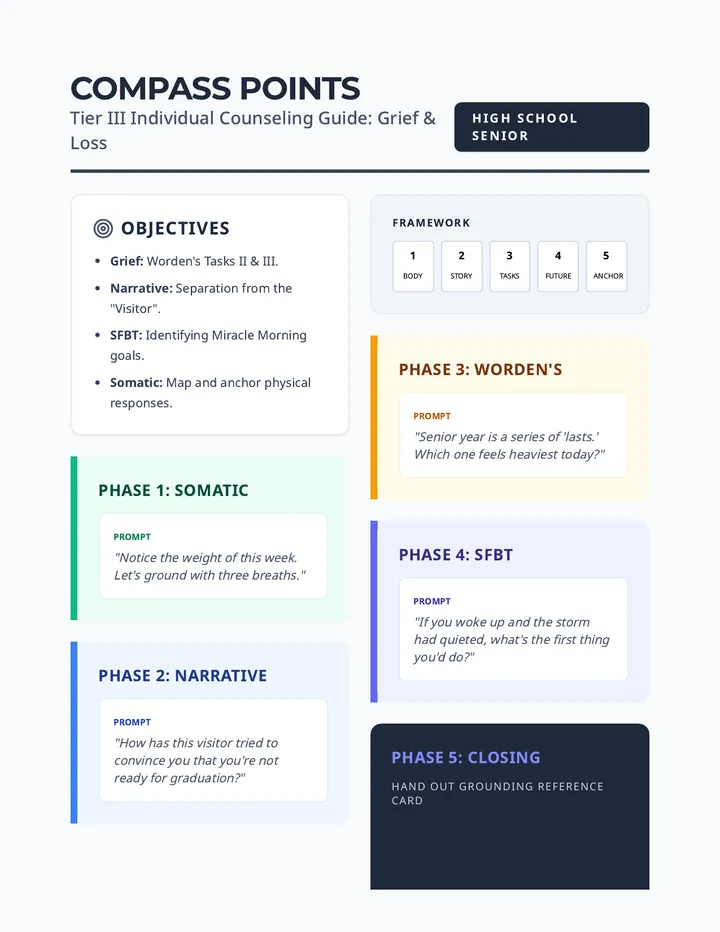
A 6-session bilingual school counseling curriculum for 6th and 7th graders navigating grief. Built on Worden's Tasks of Mourning, CBT, the Dual Process Model, and Narrative Therapy, it offers gentle, creative, and structured spaces for healing.
A comprehensive collection of evidence-based intervention toolkits for school social workers and counselors. Toolkits include ready-to-use visual instructional slide decks, practitioner cheat sheets, clinical dialogue scripts, and tracking tools.
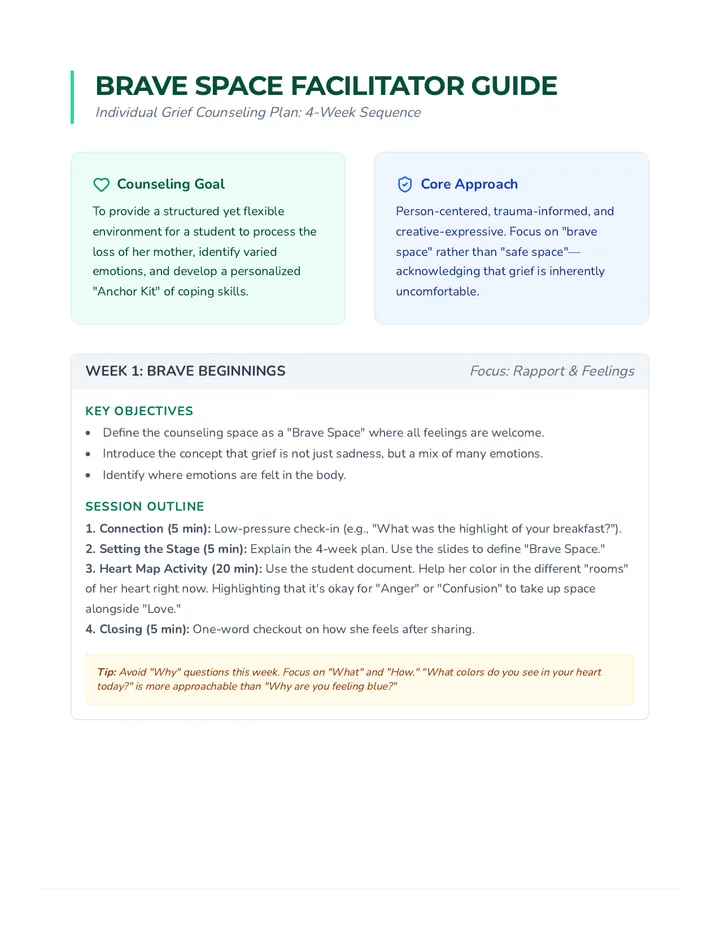
A gentle 4-week individual counseling program designed to help a student process the loss of her mother, focusing on identifying complex emotions, honoring memories, and building a sustainable toolkit of coping strategies.
A therapeutic and educational sequence designed for an 11-year-old student with selective mutism to explore the history of her challenges with proximity and school attendance, while building a concrete, step-by-step plan for reintegration. The materials are bilingual (English/Spanish) and provided in a black-and-white format.
A 3-week curriculum for 4th-grade girls focused on friendship, self-regulation, and conflict resolution using Solution-Focused Brief Therapy (SFBT) techniques. The program emphasizes strengths, visioning, and small-step problem solving through art and role-play.
A comprehensive 10-week group counseling curriculum designed for newcomer high school students to build resilience, coping skills, and cultural adjustment.
A comprehensive DBT skills training sequence for elementary schools, split into K-2 and 3-5 curricula. This program covers Mindfulness, Distress Tolerance, Emotion Regulation, and Interpersonal Effectiveness using age-appropriate activities and narratives.
A four-part therapeutic series designed for a 7th-grade student navigating the complex grief of losing a sibling. The sequence uses a music-inspired 'Healing Harmony' theme to explore the non-linear nature of loss, manage intense emotions, improve communication with caregivers, and find meaningful ways to remember and heal.
A comprehensive series for parents to navigate children's emotional meltdowns through the lens of interpersonal neurobiology, providing tools for communication, regulation, and prevention.
A ten-week small group curriculum for adolescents navigating grief, focusing on coping skills, narrative processing, identity, and moving forward through journaling, art, and discussion.
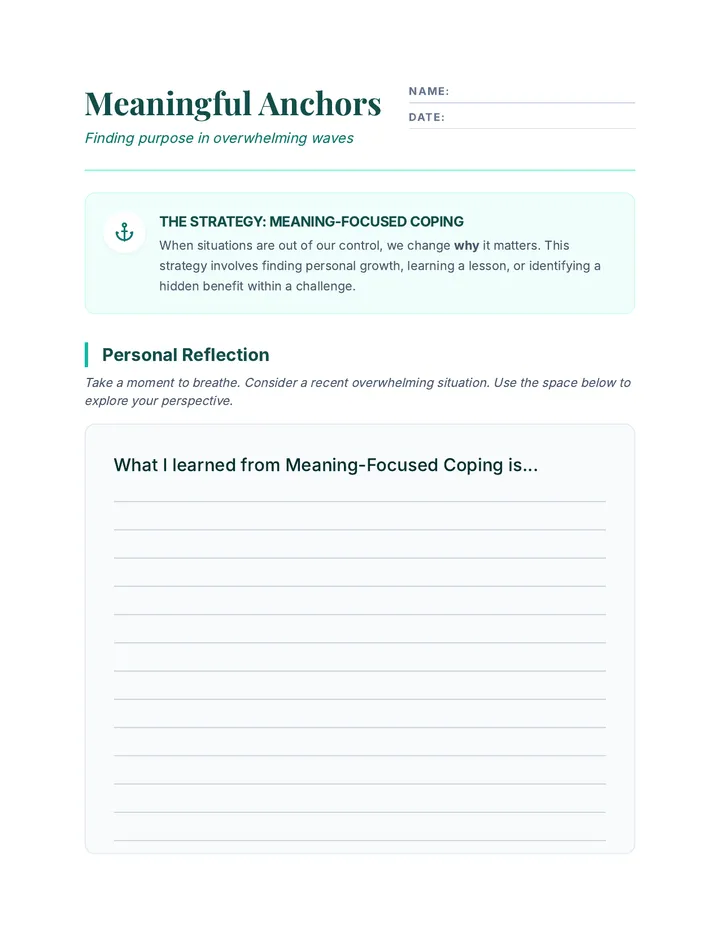
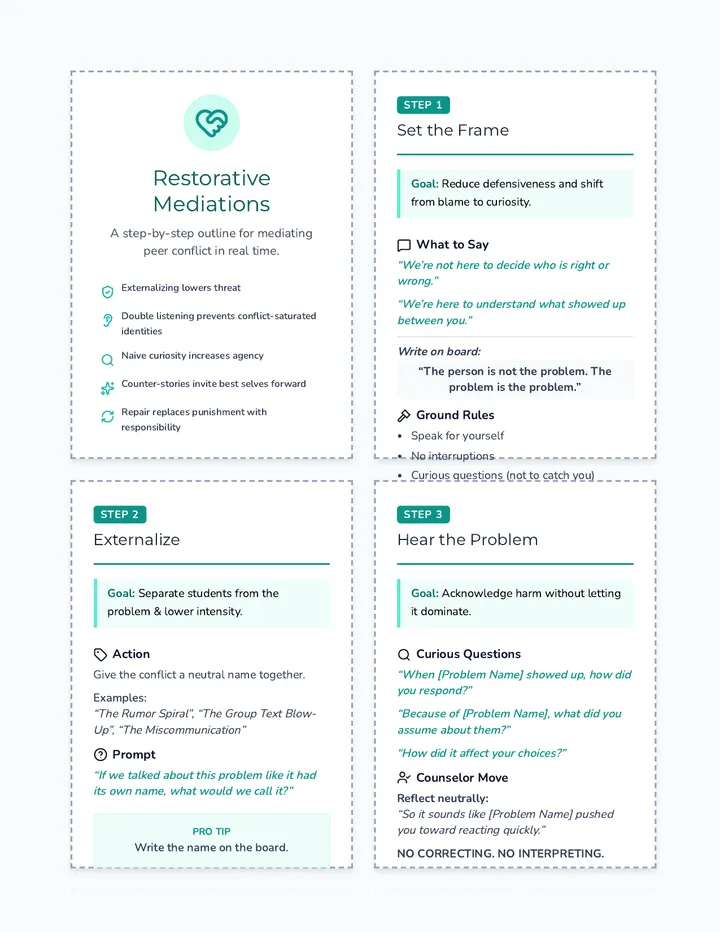
A series of lessons using Narrative Therapy techniques to empower students to externalize problems and reclaim their personal stories.
A therapeutic and educational exploration of Native Alaskan history and traditions, specifically adapted for middle school students in foster care. This sequence uses cultural resilience and traditional ingenuity as metaphors for personal healing, identity building, and navigating life's transitions.
Bilingual student worksheet for Lesson 6 where students list their continuing coping anchors, identify key members of their support network, and write a closing gratitude prompt.
Slide presentation for Lesson 6 focusing on continuing bonds, commemorating our group journey, and looking forward to the future with strength and hope.
Bilingual student worksheet for Lesson 5 where students design a memorial tapestry patch and answer a reflective narrative prompt from their loved one's perspective.
Slide presentation for Session 5 using Narrative Therapy, highlighting the power of sharing stories and keeping memories alive as a step to honor loved ones.
Bilingual student worksheet for Lesson 4 where students identify the external and internal changes in their lives since their loss, and list active coping behaviors.
Slide presentation for Lesson 4, explaining Worden's Third Task of Mourning: adjusting to external, internal, and spiritual changes when a loved one is missing.
Bilingual student worksheet for Lesson 3 based on the Dual Process Model, providing a balance scale layout for students to detail their loss and restoration behaviors.
Slide presentation for Lesson 3 focusing on the Dual Process Model, explaining the healthy oscillation between loss-orientation (processing grief) and restoration-orientation (adapting to life).
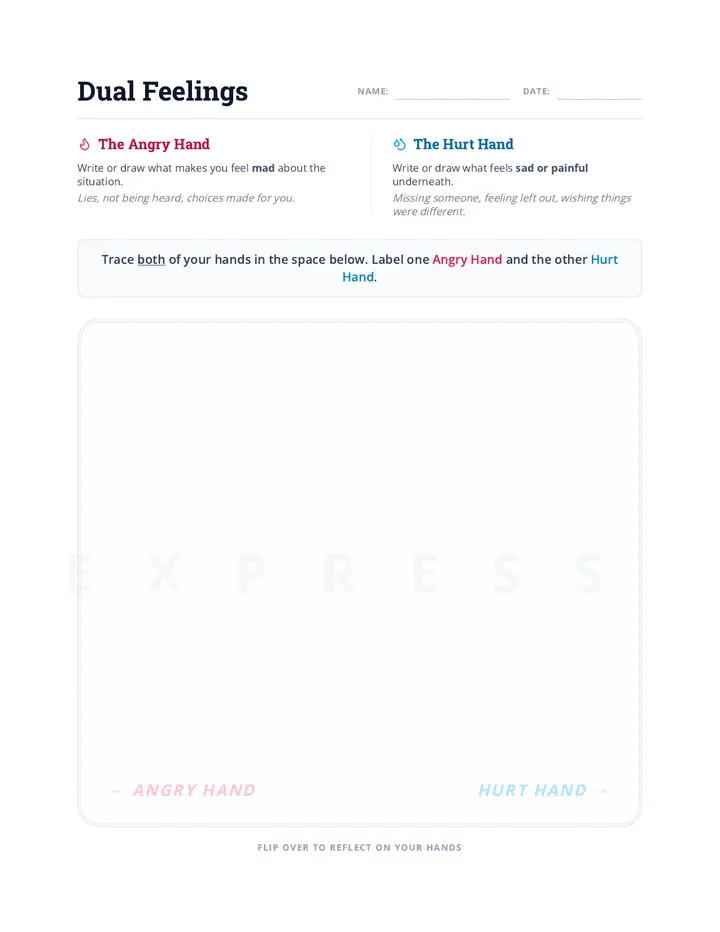
Bilingual student worksheet for Lesson 2 that uses a weather radar drawing area and CBT forecast blocks to help students identify and reframe unhelpful grief thoughts.
Slide presentation for Lesson 2 focusing on Cognitive Behavioral Therapy (CBT), help students map their complex emotions using weather as a bilingual metaphor, and connect thoughts and feelings.
Bilingual student activity worksheet for Lesson 1 where students draw and describe their grief waves and identify calming anchors.
Slide presentation for Lesson 1, introducing group norms, the bilingual curriculum, and the concept of grief as unpredictable ocean waves.