Canvas and Calm Facilitator Guide Canvas & Calm
Art as Therapy: Expressing Emotions
Audience: 11th Grade
Duration: 1 Hour 30 Mins
Approach: Therapeutic Expression
Objective
Students will explore the concept of art as a therapeutic tool to express grief and complex emotions through guided creation and personal reflection.
Why It Matters
Providing a creative outlet to process emotions enhances emotional well-being and builds resilience, offering students a healthy method for navigating grief.
Materials & Setup
Art supplies (paper, paints, brushes, markers)
Discussion cards/guide
Reflection worksheets
Calm background music (optional)
Instructional Sequence
15 mins
1. Introduction to Art Therapy
Define art therapy: using the creative process to improve physical, mental, and emotional well-being.
Discuss how abstract art can bypass language to express "unspeakable" grief.
Opening Prompt: "When you have a feeling that words can't quite capture, where does it go in your body?"
45 mins
2. Guided Art Activity
Encourage students to focus on process over product. There is no "good" or "bad" art here.
Prompt: Create a piece representing current emotions or a past experience of grief.
Guidance: Use colors to represent the weight of a feeling and shapes to represent its edges.
Circulate silently, offering materials or encouragement without critiquing work.
20 mins
3. Group Discussion
Gather in a circle (voluntary sharing only).
Use the Art Therapy Discussion Guide to facilitate sharing.
Focus on the connection between the visual choices (color, stroke, shape) and the emotion.
10 mins
4. Reflection and Closure
Distribute Reflection Worksheets .
Allow quiet time for students to internalize what they discovered during the session.
Closing thought: "Art is a safe container for big feelings. This tool is always available to you." Art Therapy Discussion Guide Discussion Guide
Facilitating Meaningful Dialogue through Creative Expression
Facilitator's Note
Art-based discussions can be vulnerable. Remind students that they are only expected to share what they feel comfortable with. Validate all responses—there are no wrong interpretations of one's own art.
01 The Experience of Expression
"How did it feel to express your emotions through art today?"
Facilitator Focus: Encourage students to think about the physical and emotional release. Was it difficult to start? Did the feeling change as they created?
02 Visual Language
"What colors or shapes did you use to represent your emotions, and why?"
Facilitator Focus: Guide students to connect specific artistic choices with their emotional states. (e.g., "The jagged red lines represent the sharp feeling of anger.")
03 Art as a Tool for Healing
"How can art be a tool for processing grief or heavy emotions?"
Facilitator Focus: Discuss the therapeutic benefits of externalizing feelings. How does seeing the emotion on paper change their relationship to it?
Canvas & Calm • Art as Therapy Sequence • Grade 11
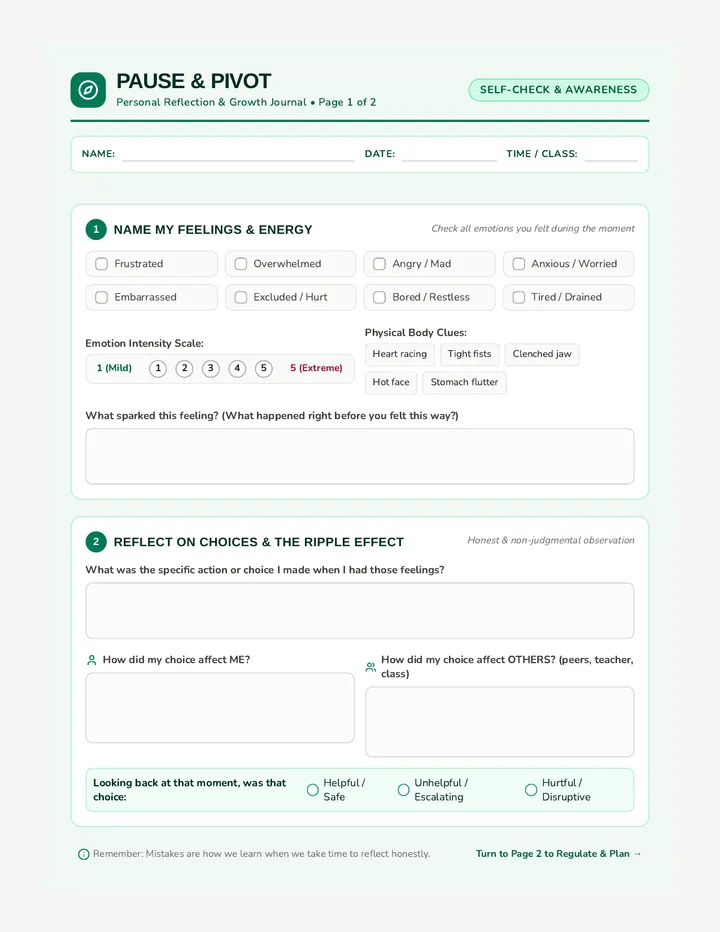
Canvas and Calm Reflection Worksheet Canvas & Calm
Personal Reflection Journal
Name:
Date:
Take a few quiet moments to look at the art you created today. Reflect on the process and the feelings you've externalized onto the page. There are no right or wrong answers—only your personal truth.
1. Describe the emotions you chose to express in your art piece.
Consider if these feelings were heavy, sharp, flowing, or perhaps a mixture of many things.
2. What did you learn about yourself through this art activity?
Did anything surprise you about the colors you chose or the way it felt to create without words?
3. How might you use art in the future to help process emotions?
Think about how this tool could support you during times of stress, change, or grief.
Your art is a safe container for your story
Canvas and Calm Slides Canvas & Calm
Art as a Tool for Emotional Expression
Beyond Words
Sometimes, our feelings are too big, too sharp, or too complex for language to capture.
Where does that emotion go if we don't have words for it?
Art Therapy is...
Expression
Externalizing internal feelings into a physical form.
Safety
Creating a safe container for difficult or messy emotions.
Process
Focusing on the act of creating, not the final product.
Your Canvas
1
Think of a current emotion or a past experience of grief.
2
Choose colors that represent the weight and mood of that feeling.
3
Use shapes and strokes to show the texture—is it sharp, soft, jagged, or smooth?
Reminder: There is no such thing as "bad art" here.
In the Flow
The next 45 minutes are yours.
Quiet music will play while you create.
Reflecting Together
"Art is the only way to run away without leaving home."
Norms
Sharing is voluntary
We listen with empathy
No judgment of the work
Respect privacy
Take a moment to look at your piece one more time before we begin.
Your Journey
Please complete your reflection worksheet. This is for your eyes only—a way to anchor what you learned today.
"Art washes away from the soul the dust of everyday life."
— Pablo Picasso