Meeting Execution Analysis Worksheet
Business Communication Case Debrief
MEETING EXECUTION ANALYSIS
Bridging Verbal Collaboration to Formal Business Documentation
Student Name
Date
Section / Period
Score / Level
Core Analytical Prompt
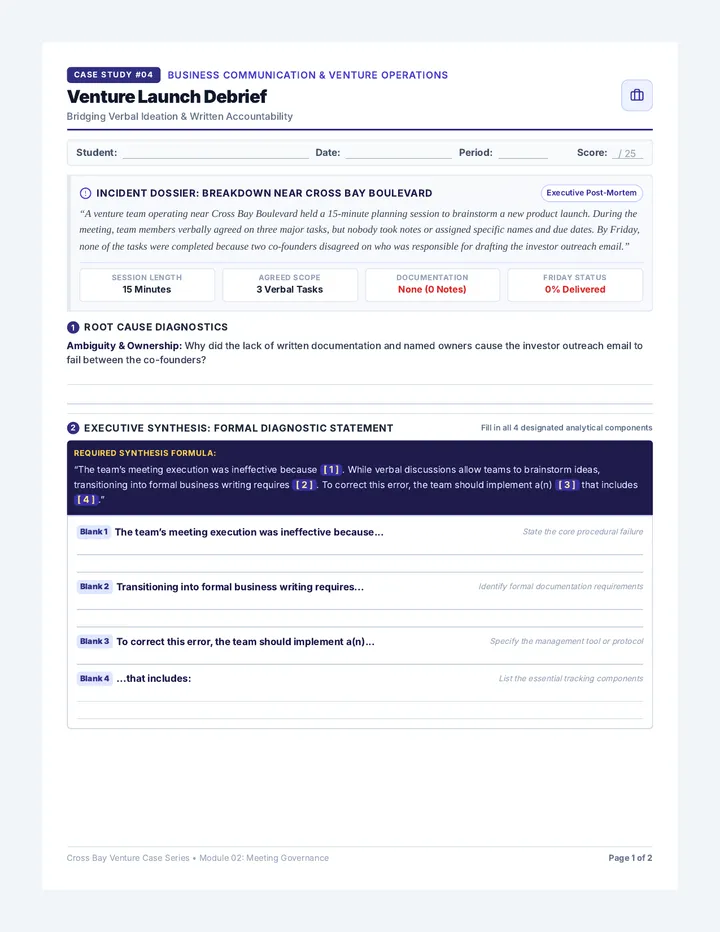
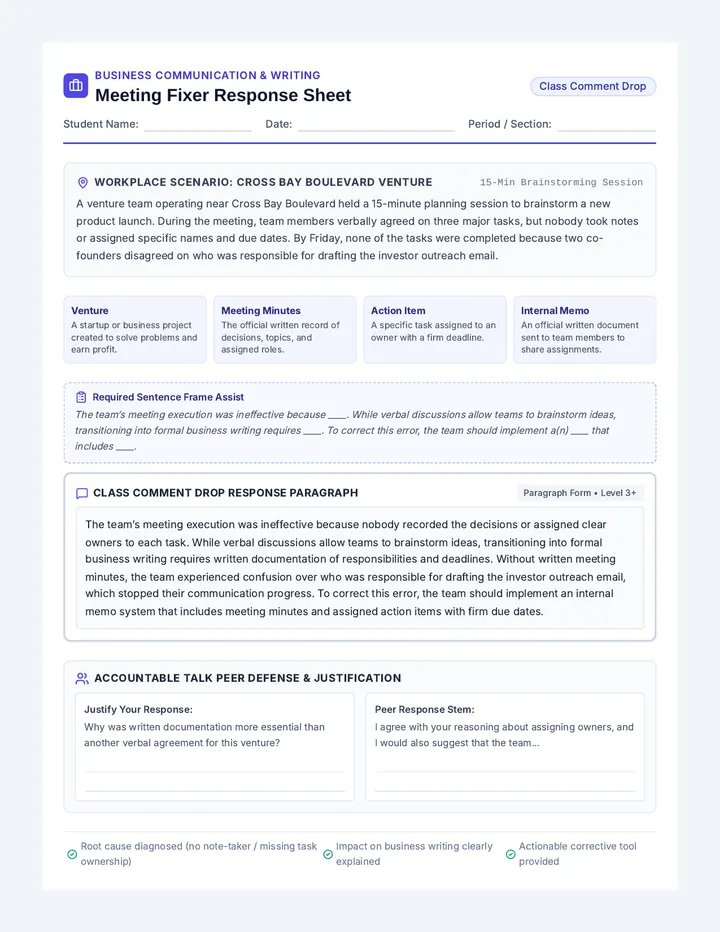
Analyze the team’s meeting execution: What critical meeting process was missing, and how did this failure impact their transition into business writing? How should the team adjust their meeting management to prevent this issue in the future?
Sentence Frame Scaffold Template
“The team’s meeting execution was ineffective because ________. While verbal discussions allow teams to brainstorm ideas, transitioning into formal business writing requires ________. To correct this error, the team should implement a(n) ________ that includes ________.”
3-Part Structure: Cause → Transition → Policy Fix
Teacher's Answer (Using Frame Assist) Model Level 3+
“The team’s meeting execution was ineffective because they failed to assign a Scribe to record official Meeting Minutes and create an Action Item Table. While verbal discussions allow teams to brainstorm ideas, transitioning into formal business writing requires clear documentation of assigned owners, specific tasks, and target due dates. To correct this error, the team should implement a(n) structured meeting agenda that includes designated roles and an Action Item Table to ensure accountability for all upcoming written deliverables.”
• Highlighted = Completed Frame Fill-Ins
Student Analytical Response
Apply the sentence frame assist to draft your complete analysis
1
2
3
4
5
6
7
Level 3+ Criteria Audit (Self / Peer Check) Verify before submission
Missing Role: Explicitly names Scribe & Meeting Minutes.
Writing Disconnect: Explains transition failure into written deliverables.
Action Item Table: Requires owner, task, and due dates.
Accountability: Outlines clear management protocol for future.
Meeting Execution Answer Key
Teacher Answer Key & Facilitation Guide
MEETING EXECUTION ANALYSIS
Master Response • Sentence Frame Integration • Scoring Rubric
Target Proficiency
Level 3+ (Exemplary)
Business Comm Standard 4.2
Investigative Prompt
Prompt: Analyze the team’s meeting execution. What critical meeting process was missing, and how did this failure impact their transition into business writing? How should the team adjust their meeting management to prevent this issue in the future?
Sentence Frame Scaffold Mapping Three Core Analytical Moves
1. Root Cause Identification “...ineffective because [X]”
Must identify absence of Scribe and omission of Meeting Minutes.
2. Transition to Writing Gap “...formal business writing requires [Y]”
Must cite documentation of Owners, Tasks, and firm Due Dates.
3. Preventative System Fix “...implement a [Z] that includes [W]”
Must propose a Structured Agenda with an Action Item Table.
Teacher's Completed Response (Using Frame Assist)
Full Exemplar Solution
“The team’s meeting execution was ineffective because they failed to assign a Scribe to record official Meeting Minutes and create an Action Item Table.
While verbal discussions allow teams to brainstorm ideas, transitioning into formal business writing requires clear documentation of assigned owners, specific tasks, and target due dates.
To correct this error, the team should implement a(n) structured meeting agenda that includes designated roles and an Action Item Table to ensure accountability for all upcoming written deliverables.”
Key Vocabulary: Scribe Meeting Minutes Action Item Table Deliverables
100% Alignment to Frame
Scoring Criteria Audit (Level 3+)
Missing Role: Specifically names Scribe & Meeting Minutes.
Writing Bridge: Explains need for owner/task/due date data.
Operational Fix: Structured agenda + Action Item Table.
Common Pitfalls & Facilitation Notes
- Vague Blame: Students often say "communication was poor" rather than identifying the missing Scribe role and Minutes.
- Incomplete Fix: Remind students that an agenda alone is insufficient without an Action Item Table to track deliverables.