Initiation Hurdles Slides Execution Lab // Lesson 01
Gifted Cognitive Strategies
Executive Function & Cognitive Friction
Spark the Start:
The Science of Task Initiation
Why brilliant minds freeze at the starting line—and how to engineer instant momentum without willpower battles.
Focus: Overcoming Perfectionism & Cognitive Inertia 01 / 06
The Diagnosis 02 / 06
The Paradox of High Ability
When complex thinking comes easily, mundane or open-ended tasks trigger surprising mental friction.
The Perfectionism Trap
Your brain envisions a flawless end product. Starting feels risky because the blank page threatens that ideal standard.
Internal monologue: "If it isn't exceptional immediately, why begin?"
The Dopamine Deficit
If a task feels repetitive or lacking deep novelty, your executive system refuses to release the chemical focus to start.
Internal monologue: "I know how this ends already; doing it is torture."
Key Insight: Delaying is not a character flaw—it is a predictable neural response to perceived risk or boredom.
Cognitive Physics 03 / 06
The Law of Activation Energy
Starting requires 80% of your total energy; sustaining only requires 20%.
1. The Perceived Mountain
Your mind bundles the entire 5-page paper into one massive cognitive block. It feels overwhelming.
High Friction
2. The Zeigarnik Effect
Unfinished tasks create psychological tension. Once a task is started, your brain naturally seeks closure.
Mental Momentum
3. The Real Goal
Never aim to complete the project today. Aim only to ignite the Zeigarnik Effect by opening the file.
Low Barrier Entry
Rule of Thumb: Shrink the task until your brain can no longer justify saying "no."
Tactical Method 04 / 06
Strategy: The 5-Minute Entry Ramp
A binding psychological agreement that completely dismantles the initiation barrier.
STEP 01
Micro-Stepping
Define a step so ridiculously small it requires zero cognitive courage.
Not: "Write intro"Yes: "Type document title & date"
STEP 02
The 300-Second Timer
Set a visual timer for exactly 5 minutes. Commit to working strictly for those 300 seconds.
Contract: You have full permission to walk away when the alarm rings.
STEP 03
The Momentum Choice
When the timer sounds, 85% of students choose to keep going because activation energy is paid.
Friction is gone; flow takes over.
You are not completing the task. You are merely crossing the threshold.
Mindset Shift 05 / 06
The "Junk Draft" Protocol
Disarm your internal critic by purposefully lowering initial output quality.
The Perfectionist Trap
• Writing a sentence, deleting it 6 times.
• Demanding thesis perfection before outline exists.
• Result: 45 minutes spent, blank screen, high shame.
The Junk Draft Rule
• Intentionally write the messiest, bullet-point version.
• Use placeholders like "[insert smart quote here]".
• Result: You have raw clay to sculpt into brilliance.
"You can edit bad writing. You cannot edit a blank page."
Immediate Application 06 / 06
Your 30-Second Launch Ritual
Before opening any assignment today, execute these three physical steps:
1
Clear the Field
Close every unrelated tab. Leave exactly ONE workspace window visible.
2
Set 5-Min Timer
Say aloud: "I am only doing 5 minutes. When it rings, I can stop."
3
Deposit 10 Words
Type name, header, and 10 ugly words without stopping or hitting backspace.
Ready to build your personal start engine?
Open: Start Engine Blueprint →
Start Engine Blueprint EXECUTION LAB: START ENGINE BLUEPRINT
Lesson 1 • Diagnostic & Activation Ramp
Name:
Date:
Period:
The Initiation Truth: High-ability brains do not avoid work because they are lazy; they avoid work when the perceived friction (perfectionism, ambiguity, or cognitive boredom) exceeds immediate dopamine. Use this blueprint to de-escalate brain friction and ignite forward motion.
1
Friction Diagnostic: Why Is Your Brain Stalling?
Identify a real assignment you are currently postponing. Check all cognitive triggers that apply:
The Masterpiece Trap
Fear that the real-world output won't match the brilliant concept inside your head.
The Void (Low Stimulation)
The task feels repetitive or simplistic, triggering painful under-stimulation.
The Foggy Path (Ambiguity)
The instructions feel loose or subjective; you are unsure what "done" actually looks like.
The Mountain Delusion
Viewing the entire multi-hour project as one giant single action you must do right now.
2
Target Assignment Profile
Assignment Name:
Subject / Teacher:
Original Due Date:
What is the exact cognitive excuse your brain is using to delay starting?
3
The "Junk Draft" Sandbox
Goal: Intentional Imperfection
Perfectionism breaks when you purposely produce low-quality draft material. In 3 minutes, write the roughest, most fragmented initial ideas, fragments, or ugly sentences for your target assignment below. No erasing or backspacing allowed.
EXECUTION LAB • PROTOCOL 1.1 PAGE 1 OF 2
Execution Lab // Spark the Start
Document 1.1 • Practical Activation
4
The 5-Minute Micro-Step Deconstruction
Break the opening of your assignment down into three micro-steps so small your brain feels silly avoiding them:
Step 1: The Zero-Cognition Action (Time: 30 Seconds) e.g., Open the Google Doc, title it, set font to 12pt
Step 2: The Skeleton Scaffold (Time: 90 Seconds) e.g., Paste rubric questions or create 3 blank bullet points
Step 3: The 3-Minute Ugly Velocity Sprint (Time: 180 Seconds) e.g., Write the first 25 words without evaluating quality
5
Friction Busters: Physical & Digital Prep
Digital Tab Declutter:
How many browser tabs are currently open? Close all except assignment & rubric.
Current tab count: → Target:
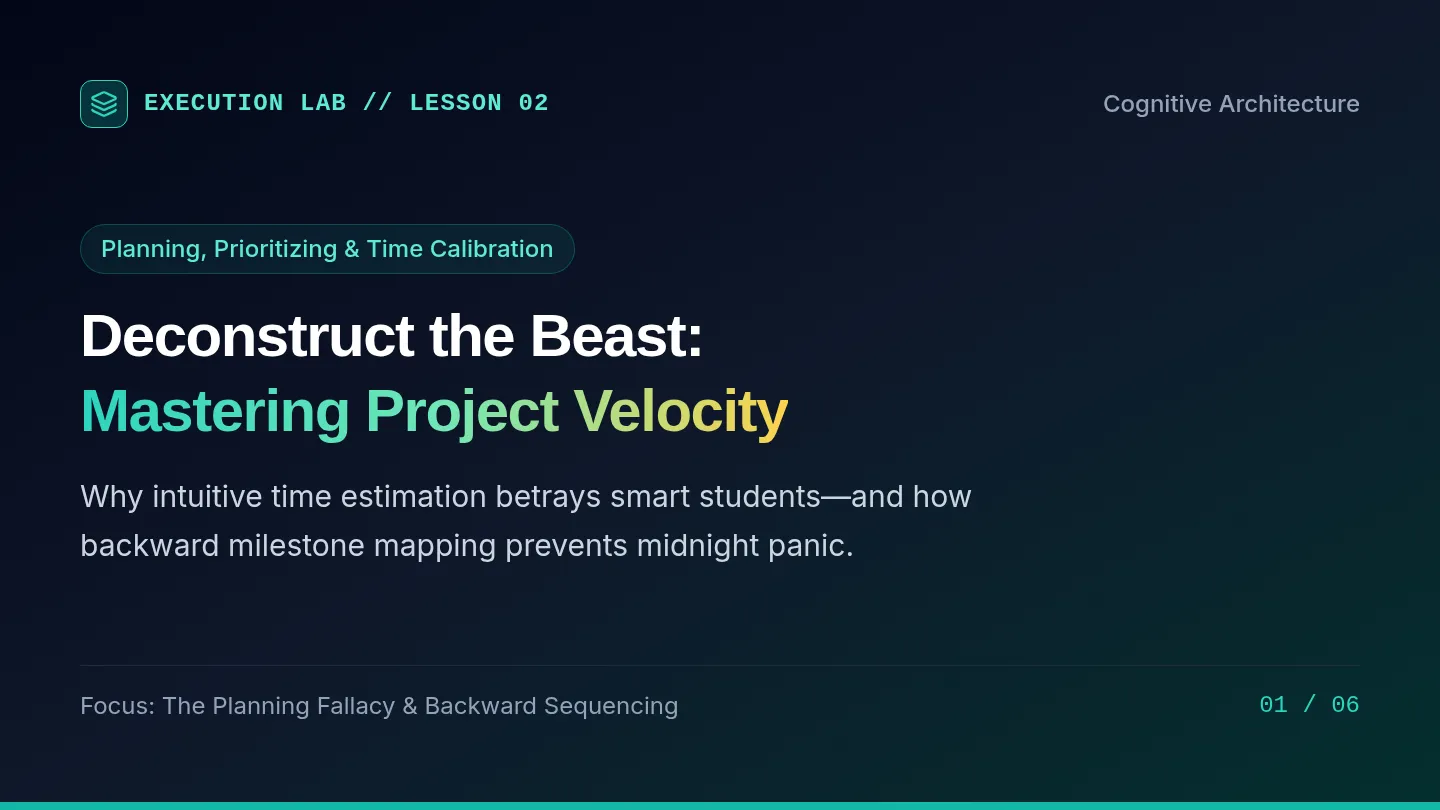
Project Deconstruction Slides Execution Lab // Lesson 02
Cognitive Architecture
Planning, Prioritizing & Time Calibration
Deconstruct the Beast:
Mastering Project Velocity
Why intuitive time estimation betrays smart students—and how backward milestone mapping prevents midnight panic.
Focus: The Planning Fallacy & Backward Sequencing 01 / 06
The Cognitive Flaw 02 / 06
The Intuitive Estimation Trap
In elementary school, you could complete most tasks in one burst. Middle school projects break this illusion.
The "I'll Just Wing It" Myth
Your brain imagines doing the task under flawless conditions : zero interruptions, instantaneous ideas, and infinite energy.
Estimated: 45 Minutes • Actual: 3.5 Hours
The Hidden Micro-Tasks
Big assignments conceal unseen friction: locating sources, reformatting citations, printer jams, and digital file conversions.
Hidden friction devours 60% of total project time.
Cognitive Law: Tasks always expand to consume unexpected cognitive roadblocks unless explicitly mapped.
Calibration Rule 03 / 06
The 2.5× Buffer Multiplier
Psychological research proves humans consistently suffer from the Planning Fallacy. Here is the mathematical antidote:
YOUR GUT GUESS
30 min
Assumes perfect flow, instant insight, and zero friction.
APPLY MULTIPLIER
× 2.5
Accounts for research rabbit holes, editing, and mental fatigue.
REAL BUDGET
75 min
Finish early with zero anxiety, or comfortably use the full window.
Pro-Tip: If you finish in 45 minutes, you bank 30 minutes of guilt-free downtime.
Sequencing Framework 04 / 06
Backward Milestone Mapping
Never plan from Day 1 moving forward. Plan from the Due Date moving backward.
DUE DATE − 0
Submission
Hit submit 24 hours early. Verify upload receipt and file integrity.
DUE DATE − 1
Polish & Proof
Rubric audit, citations, grammar pass, peer check. Zero writing here.
DUE DATE − 3
Core Assembly
Drafting body paragraphs, building slide visuals, assembling model.
DUE DATE − 5
Raw Intake
Gather 3 key sources, outline skeleton, draft thesis statement.
Each milestone is a distinct physical deliverable, not a vague mental intention.
Milestone Breakdown Planner EXECUTION LAB: MILESTONE BREAKDOWN PLANNER
Lesson 2 • Time Calibration & Backward Sequencing
Name:
Date:
Period:
Complex Assignment / Project:
Hard Due Date & Time:
Submission Format (Doc/Slides/LMS):
The Planning Rule: A project is not "one assignment." It is an interconnected series of small, concrete deliverables. Never begin work until your milestones are locked.
1
The 2.5× Time Calibration Calculator
Estimate three primary work components. Multiply by 2.5 to counteract the gifted planning fallacy.
Sub-Task / Phase
Your Gut Guess
Multiplier
Calibrated Budget
A. Research & Source Gathering
× 2.5 =
B. Core Drafting / Production
× 2.5 =
C. Polishing, Citations & Upload
× 2.5 =
2
Backward Milestone Map (The 4 Gates)
Work Backwards From Due Date
GATE 4 • FINAL SUBMISSION (Target: Due Date − 24 Hours) Target Date:
Deliverable: Submitted on LMS with file verification screenshot.
GATE 3 • THE EDIT & RUBRIC AUDIT (Target: Due Date − 48 Hours) Target Date:
Deliverable: Complete draft checked against every line of teacher rubric.
GATE 2 • FULL CORE CONTENT ASSEMBLED (Target: Midpoint) Target Date:
Deliverable: All body sections/slides written (unpolished rough version).
GATE 1 • INTAKE, THESIS & SKELETON (Target: Day 1-2) Target Date:
Deliverable: Prompt unpacked, 3 core sources identified, blank outline set.
EXECUTION LAB • PROTOCOL 2.1 PAGE 1 OF 2
Execution Lab // Deconstruct the Beast
Document 2.1 • Sprint Sequencing
3
The 25-Minute Focus Sprint Roadmap
Convert your Milestones into concrete 25-minute sprints. Each sprint must result in a tangible, verifiable artifact:
Sprint 1 (Gate 1 Focus) • 25 Minutes Planned Date:
Specific tangible artifact produced during this sprint:
Sprint 2 (Gate 2 Focus) • 25 Minutes Planned Date:
Specific tangible artifact produced during this sprint:
Sprint 3 (Gate 2 Focus) • 25 Minutes Planned Date:
Specific tangible artifact produced during this sprint:
Sprint 4 (Gate 3/4 Focus) • 25 Minutes Planned Date:
Specific tangible artifact produced during this sprint:
4
Perfection Rabbit-Hole Protection
Finish Line Slides Execution Lab // Lesson 03
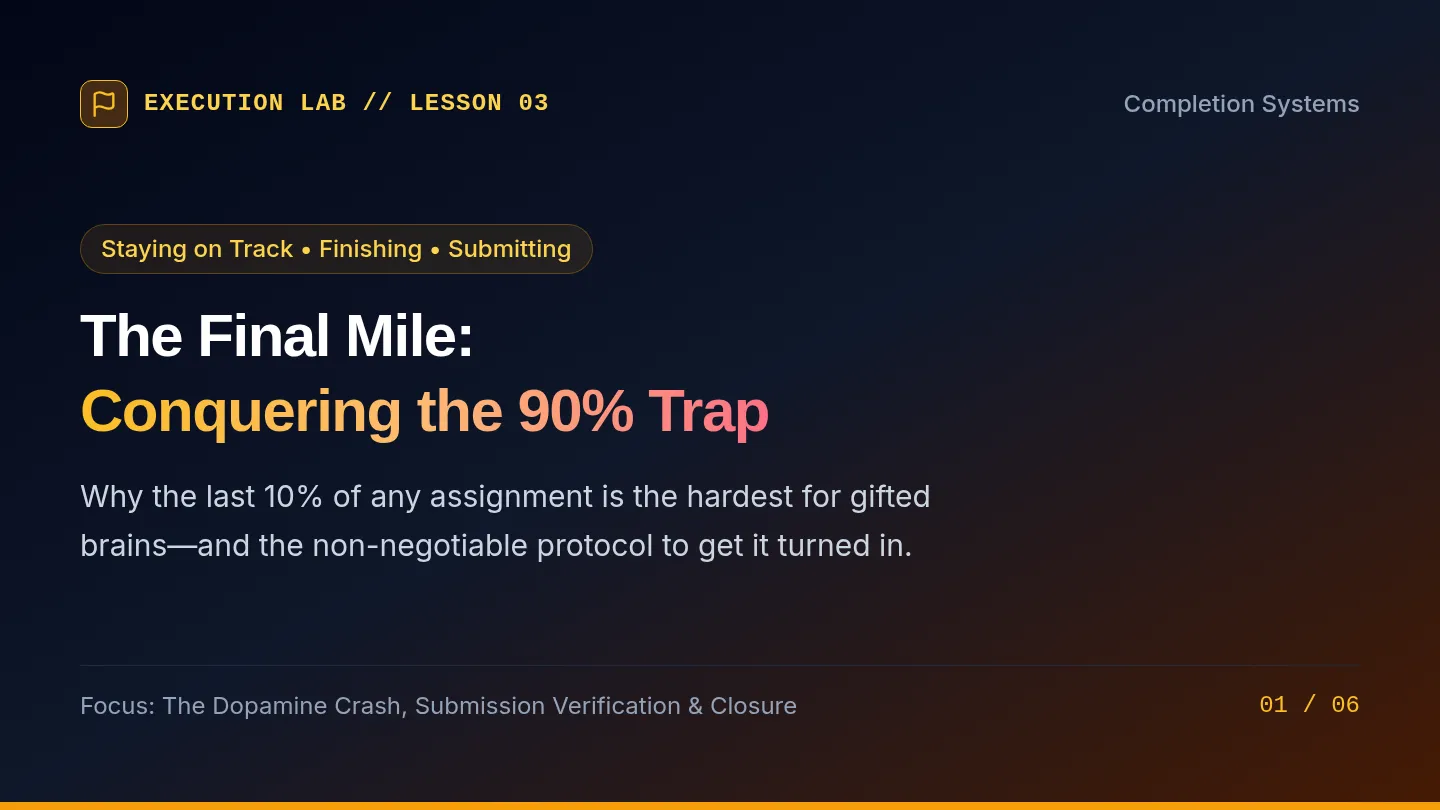
Completion Systems
Staying on Track • Finishing • Submitting
The Final Mile:
Conquering the 90% Trap
Why the last 10% of any assignment is the hardest for gifted brains—and the non-negotiable protocol to get it turned in.
Focus: The Dopamine Crash, Submission Verification & Closure 01 / 06
The Neurochemistry 02 / 06
The 90% Trap Explained
Ever do almost an entire project, only to let it sit unfinished on your desk for a week?
The Brain Solved the Puzzle
For gifted minds, the reward is in figuring it out. Once your brain understands how to solve the prompt, the novelty evaporates.
Mental verdict: "I proved I could do it; the rest is just typing."
The Dopamine Cliff
The remaining 10% (proofreading, file conversion, rubric checking, hitting upload) offers zero intellectual thrill.
Result: High resistance right at the finish line.
Core Reality: The world evaluates you on what is delivered, not what is mentally solved in your head.
The Danger Zone 03 / 06
Beware the "Ghost Assignment"
The tragic fate of middle school executive functioning: Work that exists, but earns a zero.
The Backpack Abyss
Completed on paper, shoved into the bottom of a binder, forgotten when the teacher collects it.
The Unsubmitted Draft
Saved in your Google Drive or tablet, but the "Turn In" button was never clicked on the LMS.
The Missing Share Perms
File turned in, but access is locked: "You need permission to access this document."
You expended 100% of the effort, but received 0% of the credit. We eliminate this today.
Systematic Quality 04 / 06
The 3-Point Launch Protocol
Before closing the laptop, execute these three non-negotiable verification gates:
GATE 01
1. Polish
Read aloud your introduction and conclusion. Check headings, formatting consistency, and spellcheck flags.
Time: 4 Minutes
GATE 02
2. Package
Check export format (.pdf or .docx). Verify file naming convention (e.g., LastName_Project.pdf ). Check sharing access.
Time: 2 Minutes
GATE 03
3. Prove
Hit submit. Refresh the browser page. Confirm the green "Submitted" banner with timestamp.
Time: 1 Minute
Total Launch Protocol Time: Exactly 7 minutes. It saves hours of regret.
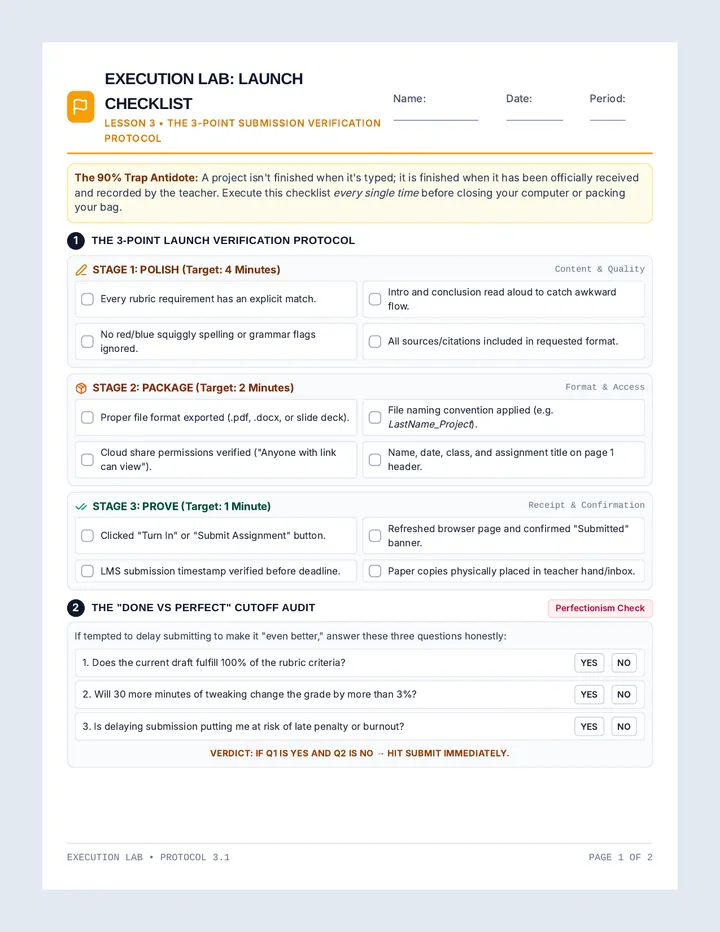
Launch Checklist Handout EXECUTION LAB: LAUNCH CHECKLIST
Lesson 3 • The 3-Point Submission Verification Protocol
Name:
Date:
Period:
The 90% Trap Antidote: A project isn't finished when it's typed; it is finished when it has been officially received and recorded by the teacher. Execute this checklist every single time before closing your computer or packing your bag.
1
The 3-Point Launch Verification Protocol
STAGE 1: POLISH (Target: 4 Minutes) Content & Quality
Every rubric requirement has an explicit match.
Intro and conclusion read aloud to catch awkward flow.
No red/blue squiggly spelling or grammar flags ignored.
All sources/citations included in requested format.
STAGE 2: PACKAGE (Target: 2 Minutes) Format & Access
Proper file format exported (.pdf, .docx, or slide deck).
File naming convention applied (e.g. LastName_Project ).
Cloud share permissions verified ("Anyone with link can view").
Name, date, class, and assignment title on page 1 header.
STAGE 3: PROVE (Target: 1 Minute) Receipt & Confirmation
Clicked "Turn In" or "Submit Assignment" button.
Refreshed browser page and confirmed "Submitted" banner.
LMS submission timestamp verified before deadline.
Paper copies physically placed in teacher hand/inbox.
2
The "Done vs Perfect" Cutoff Audit
Perfectionism Check
If tempted to delay submitting to make it "even better," answer these three questions honestly:
1. Does the current draft fulfill 100% of the rubric criteria?
YES NO
2. Will 30 more minutes of tweaking change the grade by more than 3%?
YES NO
3. Is delaying submission putting me at risk of late penalty or burnout?
YES NO
Verdict: If Q1 is YES and Q2 is NO → Hit SUBMIT immediately.
EXECUTION LAB • PROTOCOL 3.1 PAGE 1 OF 2
Execution Lab // The Final Mile
Document 3.1 • Submission Log & Closure
3
Ghost Assignment Prevention Protocol
For Physical / Paper Work:
Paper placed in the designated front binder pocket.
Never left loose in backpack bottom or locker.
Turned into class inbox the first 2 minutes of period.
For Digital LMS Submissions:
Attachment link opened in incognito window to test.