Sensory regulation strategies, grounding techniques, and progressive muscle relaxation to manage acute emotional distress. Develops self-awareness of physiological triggers to facilitate independent de-escalation.
Students demonstrate the complete cycle from identifying a need to returning to work independently.
Students practice the routine for ending a break and transitioning back to work smoothly.
Students learn the expectations for the classroom Break Zone, differentiating between 'reset time' and 'play time'.
Students learn and practice the 'Stop, Grab, Show' method for non-verbally requesting a break using visual cards.
Students identify physical sensations associated with dysregulation using a body scan and create a Body Thermometer visual.
Students set up a classroom mirror station where they can check their own faces and bodies. They role-play noticing a warning sign (like pacing) and choosing to go to the 'calm corner' before a meltdown occurs.
Students create a timeline or flowchart that correlates the seven stages of behavior escalation (Calm, Trigger, Agitation, Acceleration, Peak, De-escalation, Recovery) with specific physiological markers.
Children contrast 'tiptoe' and 'walking feet' with 'stomping feet.' They identify that heavy, loud footsteps often happen when feelings are growing from small to medium.
Students investigate how environmental factors (noise, light, crowding) can trigger physiological escalation. They conduct an audit of a classroom or common area to identify potential sensory triggers.
Synthesizes learning into a visual map connecting internal biology to external behavior for proactive intervention planning.
Identifies the 'freeze' response and dissociation, differentiating between intentional defiance and neurobiological shutdown.
Analyzes changes in breathing patterns and muscle tension as signs of the body preparing for physical defense or flight.
A 5-lesson sequence for Kindergarten students focusing on interoception and the procedural steps of requesting and returning from a break to support self-regulation.
This sequence explores the neurobiological foundations of student escalation, connecting internal physiological stress responses (the 'amygdala hijack') to observable external warning signs. Students will learn to depersonalize behavior by understanding it as a biological survival mechanism, training them to recognize subtle somatic, respiratory, and muscular cues before a full behavioral outburst occurs.
A high-intensity, simulation-based training sequence for graduate students to master real-time identification of behavioral escalation cues. Students move from identifying subtle micro-behaviors to managing their own physiological responses during high-fidelity crisis simulations.
This sequence connects behavioral observation to the biological science of the stress response. Students investigate the 'why' behind warning signs by studying the sympathetic nervous system and the 'fight, flight, or freeze' response, culminating in a biological profile of behavioral escalation.
A 5-lesson workshop-style sequence for 9th-grade students on recognizing escalation warning signs and applying de-escalation strategies. Students learn situational assessment, verbal techniques, non-verbal communication, and active listening through simulations and mastery-based role-plays.
A 5-lesson sequence for 9th-grade students focusing on the physiological and cognitive aspects of emotional escalation. Students learn to identify early warning signs in their bodies and minds to prevent crises through self-awareness and personalized monitoring protocols.
A Pre-K sequence focused on identifying early warning signs of behavioral escalation through animal metaphors, movement, and social-emotional awareness. Students learn to recognize pacing, hiding, impulsive hands, and loud footsteps as signals for needing support.
A color-coded behavioral support sequence for Pre-K students focused on identifying emotional intensity. Students learn to distinguish between 'Green' (calm), 'Yellow' (warning), and 'Red' (crisis) zones, with a heavy emphasis on recognizing the 'Yellow Zone' signs before escalation occurs.
This sequence introduces Pre-K students to the foundational concepts of task persistence, utilizing visual supports and structured reinforcement to build attention stamina. Students learn to identify 'finished', use timers, manage frustration, follow 'First-Then' logic, and self-monitor their work.
A 5-lesson sequence designed for 1st-grade students, particularly those in special education, to develop internal scripts for overcoming task initiation hurdles. Students learn to identify 'stuck' feelings, introduce an 'inner coach,' and master a simple 'First I will... then I will...' formula to get started on tasks independently.
A sequence for 3rd graders to master self-talk strategies for task initiation. Students take on the role of 'Brain Coaches' to externalize executive function challenges and build a toolkit for overcoming procrastination through role-play, games, and simulations.
A comprehensive 5-lesson unit for 7th-grade students to identify internal and external signals of emotional escalation. Students move from establishing baseline behaviors to creating a personalized 'Escalation Map' to help them recognize when to engage coping strategies before a crisis occurs.
A comprehensive teacher assessment tool for tracking student mastery across all four stages of the regulation loop during the final simulation challenge.
A commemorative certificate for Kindergarten students who have demonstrated mastery of the full regulation loop (Identify, Request, Reset, Return).
A slide deck reviewing the entire four-step regulation loop (Identify, Request, Reset, Return) and setting up a final mastery-based challenge for students.
A teacher observation tool for tracking student mastery of the 3-step return routine (Breath, Clean Up, Soft Walk) during practice drills.
A slide deck focused on the transition from a break back to classroom activities, introducing a structured 3-step return routine.
An anchor chart visual for the classroom Break Zone, clearly outlining the four main behavioral expectations for students while they are resetting.
A sorting activity for Kindergarten students to differentiate between appropriate 'Calm Body' actions and inappropriate 'Busy Body' actions in the Reset Zone.
A visual guide for Kindergarten students on the expectations and rules for the classroom Reset Zone, including the distinction between reset time and play time.
Role-play scenario cards for practicing the use of break cards in various classroom situations, helping students differentiate between needing a break and wanting to change activities.
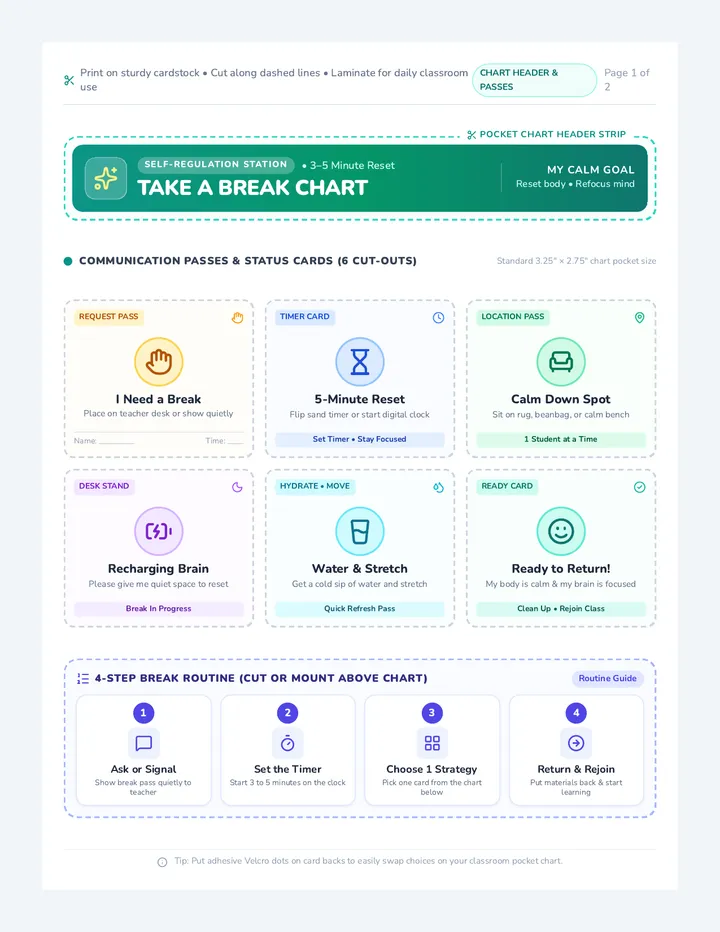
Printable visual break cards for students to use as part of the 'Stop, Grab, Show' protocol. Includes multiple cards for desk or portable use.
A slide deck introducing the 'Stop, Grab, Show' procedure for requesting a break using visual communication cards.
A teacher-facing guide for Lesson 1, including a guided body scan script, key terminology, and differentiation strategies for Kindergarten students.