Behavioral activation strategies and techniques for identifying rewarding activities to combat depression and anxiety. Develops emotional resilience through consistent engagement in positive routines and habit-building.
A weekend homework log for students to track their mood-boosting activity and reflect on their emotional state.
Printable 'Go-To' cards for students to list three simple actions they can take to boost their mood. Designed for cutting and laminating.
Introductory presentation for Lesson 5, focusing on creating a personal 'Sunshine Plan' and sharing mood-boosting strategies with peers.
Student worksheet for suggesting mood-boosting activities to the character Blue Bear through drawing and message writing.
Introductory presentation for Lesson 4, using a story about Blue Bear to practice suggesting mood-boosting activities for others.
Final teacher guide for the sequence, providing grading rubrics for the Marcus case project and tips for facilitating collaborative psychoeducation.
A final project worksheet for students to synthesize all course concepts into a case formulation for a fictional client, Marcus, including a treatment rationale and psychoeducation script.
Brainstorming worksheet for students to identify their personal 'Spark Activities' and categorize them as active or quiet.
A teacher facilitation guide for the 'Mood Lab Experiment' sequence, providing therapeutic context, hook instructions, and tips for each lesson.
Final slides for Lesson 5, focusing on synthesizing assessment data into a case conceptualization and delivering collaborative feedback to clients.
Introductory presentation for Lesson 3, identifying personal 'Spark Activities' and distinguishing between active and quiet joy.
Teacher guide for Lesson 4, focusing on facilitating the "Relief vs. Reward" hook and deconstructing the "Sarah" case study to identify complex avoidance patterns.
This sequence introduces first-grade students to the fundamental connection between their actions and their emotions, serving as a foundational introduction to behavioral activation. Students explore how specific activities can shift their mood and create a personalized action plan for emotional regulation.
This sequence introduces undergraduate students to the theoretical underpinnings and practical assessment tools of Behavioral Activation (BA). Students will learn to conceptualize depression as a cycle of avoidance and reduced reinforcement, mastering techniques like activity monitoring, values clarification, and functional analysis.
This sequence guides undergraduate students through the practical application of Behavioral Activation (BA) protocols. Moving from theoretical understanding to clinical implementation, students learn to design interventions, troubleshoot psychological barriers using the TRAP/TRAC model, and analyze data to refine therapeutic outcomes.
In this inquiry-driven sequence, students explore behavioral activation, investigating how their actions influence their emotions. They learn to distinguish between pleasure and mastery activities, conduct personal experiments to track mood changes, and create a personalized evidence-based plan for mood regulation.
A comprehensive sequence for 8th-grade students on behavioral activation, focusing on the cyclical relationship between actions and mood, habit tracking, and aligning behaviors with personal values.
A 5-lesson series for 8th graders to design personalized behavioral activation plans. Students learn to balance pleasure and mastery, create activity menus, set micro-goals, and troubleshoot barriers to build a sustainable mood-boosting routine.
A comprehensive 12th-grade sequence on Behavioral Activation (BA), teaching students how to interrupt negative mood cycles through values-aligned activity scheduling and barrier management.
This sequence guides 11th-grade students through Behavioral Activation, teaching them to audit their routines, categorize activities by mastery and pleasure, and design a personalized schedule to proactively manage their mood and mental well-being.
This 7th-grade sequence teaches the principles of behavioral activation, helping students understand how their actions influence their moods. Through self-monitoring, activity categorization, and strategic planning, students develop a toolkit for proactively managing their mental well-being.
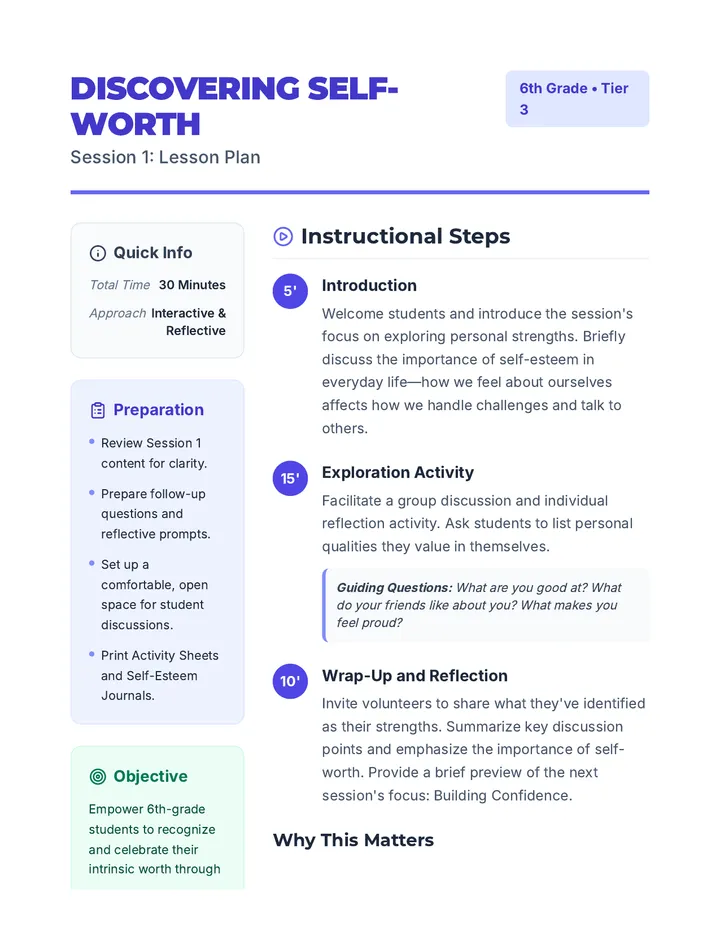
A comprehensive sequence for 6th graders to understand and apply behavioral activation. Students learn how their actions impact their emotions, track their energy levels, brainstorm nourishing activities, and create a sustainable weekly schedule to improve their mental well-being.
A comprehensive clinical training sequence for undergraduate students focusing on the application of Behavioral Activation (BA). Students learn to conduct functional analyses using the TRAP and TRAC models, deliver treatment rationales through collaborative empiricism, navigate client resistance, and design relapse prevention plans.
This sequence introduces undergraduate students to Behavioral Activation (BA), focusing on the theoretical cycle of depression, activity monitoring, values-based goal setting, and intervention planning. Students move from understanding the 'vicious cycle' of withdrawal to designing structured, values-aligned activity schedules.
Synthesizing their learning, students create a 'Break the Glass' emergency plan for days when they feel low or anxious. They select their most effective pleasure and mastery activities and write specific implementation intentions (If I feel X, then I will do Y).
Students review the results of their personal experiments or case study data to identify patterns in how specific activities impact mood. They discuss the variability of results (what works for one person may not work for another) and begin curating their personal 'top hits' for mood improvement.
Students create a 'Go-To' card listing three simple actions they can take when they feel down and share their strategies with a partner.
Using a story about a character having a bad day, students role-play giving advice and suggest specific actions to help the character feel better.
Students identify their personal 'Spark Activities'—things that light them up inside—and distinguish between active play and quiet relaxation.
Students analyze how different activities lead to specific feelings, mapping 'action' cards to 'feeling' cards to see cause-and-effect.
Students engage in a card sorting activity to distinguish between comfortable and uncomfortable feelings and practice using 'I feel' statements using a feelings chart.
This lesson introduces the concept of 'acting opposite' to an emotion. Students design a short experiment to test the hypothesis that engaging in a positive activity—even when they don't feel like it—can improve their mood rating on a 1-10 scale. They prepare a data collection sheet for a homework experiment.
Synthesize assessment data into a coherent case conceptualization and practice delivering feedback to clients.
Transitions from acute intervention to long-term maintenance, applying habit formation principles and creating relapse prevention plans to ensure sustainable lifestyle changes.
Students analyze mood and activity data to evaluate intervention effectiveness, practicing the role of the scientist-practitioner in a clinical setting.
Utilize the ABC model to conduct a functional analysis of avoidance behaviors and understand their reinforcing contingencies.