Integrates meditative techniques into routine activities to improve focus and emotional regulation. Strengthens the habit of presence through practical exercises for managing stress during daily transitions.
A systemic approach to stress and burnout prevention for graduate students, reframing personal well-being as a design challenge. Students develop a personalized 'resilience architecture' through structural changes in time management, sleep hygiene, and boundary setting.
A technical and mastery-based sequence for undergraduate students to develop actionable emotional regulation and grounding strategies. Students move from physiological understanding to real-time application in high-pressure simulations.
A Pre-K sequence focused on building self-esteem and positive experiences through mastery, growth mindset, and persistence. Students learn to navigate challenges and celebrate their own progress.
A sequence for Pre-K students focused on building emotional resilience through predictable, positive daily routines. Students explore greetings, reframing chores, managing transitions, finding peace in quiet time, and practicing daily gratitude.
A project-based sequence for Kindergarteners to build emotional resilience by designing and practicing daily routines that prioritize fun, rest, and connection. Students learn to sequence their day, brainstorm rewarding activities, and commit to 'Positive Pauses' for emotional well-being.
A Kindergarten sequence focused on teaching emotional regulation through positive actions. Students learn to use activities like physical movement, deep breathing, and creative expression to 'switch the channel' from negative to positive emotions, building a toolkit of coping strategies.
A 5-lesson unit for 3rd graders focused on building emotional resilience through habit formation. Students learn to audit their time, identify small 'micro-moments' of joy, and design balanced daily schedules that prioritize positive experiences.
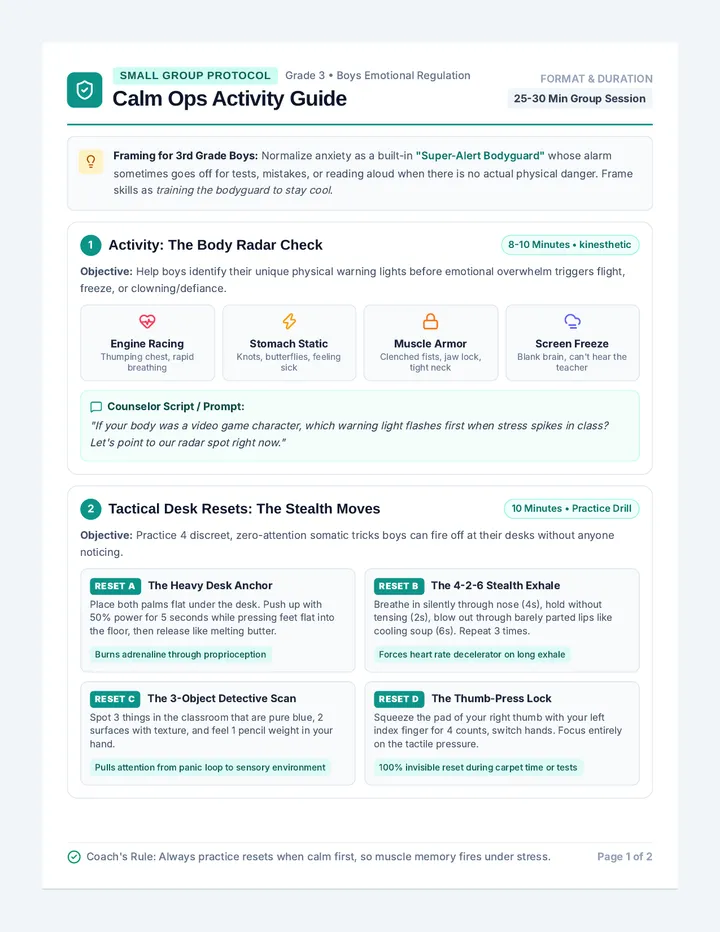
A 1st-grade counseling sequence that uses game-based mechanics and metaphors to teach behavioral activation, emotional resilience, and the importance of daily positive routines.
A project-based sequence for 1st graders focused on emotional regulation through the creation of a 'Sunshine Kit'. Students explore sensory, physical, and social activities to build a personalized toolkit of positive experiences for use during challenging moments.
A mastery-focused sequence where undergraduate students audit their current stress responses and design a personalized, tiered emotional regulation protocol. Students use systems thinking to build resilient habits and prepare for future distress.
A comprehensive 5-lesson sequence on somatic regulation and Progressive Muscle Relaxation (PMR) for undergraduate students. It covers anatomical breath mechanics, systematic muscle group isolation, and rapid relaxation protocols for real-world stress management.
A comprehensive sequence for undergraduate students exploring the neurobiology of stress, the autonomic nervous system, and physiological self-regulation techniques. Students move from theoretical understanding of brain structures to practical mastery of interoception and vagal tone modulation.
A culminating simulation where students face timed cognitive challenges while practicing their chosen regulation techniques. This bridges the gap between knowing a technique and using it under pressure.
Learners identify personal sensory preferences that induce calm. They design and assemble a portable or digital 'kit' of resources to use during high-stress periods.
Students learn the sequence of tensing and releasing muscle groups to identify and release held physical tension. The lesson emphasizes the connection between physical relaxation and mental clarity.
A technical workshop on breathwork, focusing on Box Breathing and 4-7-8 breathing to stimulate the parasympathetic nervous system. Students use biofeedback tools to measure the efficacy of different ratios.
Students practice the 5-4-3-2-1 technique and other sensory-based orientation strategies to reconnect with the present moment. The lesson explains the science of how sensory input overrides ruminative thought loops.
Students condense the full PMR session into 60-second and 10-second versions. They simulate high-stress environments to practice deploying these rapid techniques effectively.
Students present their Joy Menus to small groups, allowing peers to borrow ideas to add to their own lists. The lesson concludes with a commitment to try one menu item over the weekend.
Students integrate their knowledge to create a personal 'bio-map' of their stress escalation cycle. They present how specific physiological interventions can interrupt this cycle at various stages.
The focus shifts to the legs and feet to establish a physical sense of stability. Students learn to use the floor for resistance and grounding during seated lectures or exams.
Final synthesis where students integrate all learned modules into a personalized Resilience Architecture plan and a portable Crisis Card for emergency restoration.
Addresses the pressure to overcommit in academia by teaching the 'Strategic No' as a tool for protecting capacity and ensuring career longevity.
Explores the neurobiology of sleep and its role in emotional regulation, culminating in the design of a 'shutdown ritual' to combat revenge bedtime procrastination.
A performance tracking log for students to evaluate their use of regulation techniques during the final simulation under timed cognitive pressure.
Introductory slides for the Simulated Stress Response lesson, facilitating the final classroom simulation where students apply techniques under cognitive pressure.
A project guide and planning document for students to design their personalized physical or digital sensory soothing kits.
Introductory slides for the Sensory Soothing Kit project, covering the psychology of decision fatigue, sensory inputs, and physical vs. digital implementation formats.
A visual checklist and hotspot mapping tool for students to track their physical response to Progressive Muscle Relaxation.
Technical slides for the Progressive Muscle Relaxation lesson, teaching the tension-relaxation contrast and the full-body PMR protocol.
A technical biofeedback log for students to record heart rate data and subjective stress levels before and after practicing various breathing protocols.
Technical slides for the Controlled Breathing lesson, explaining vagal tone, the autonomic nervous system, and step-by-step protocols for Box and 4-7-8 breathing.
A structured lab report for undergraduate students to track and compare the efficacy of different sensory grounding techniques during a classroom simulation.
Introductory slides for the Sensory Grounding lesson, covering the science of ruminative loops, the ice cube challenge, and the 5-4-3-2-1 technique.
Final student synthesis materials for Lesson 5, including a comprehensive Resilience Architecture master plan and a portable, pocket-sized Crisis Card for immediate intervention.
Visual presentation for Lesson 5, synthesizing the sequence and introducing the Resilience Architecture plan and Crisis Card.