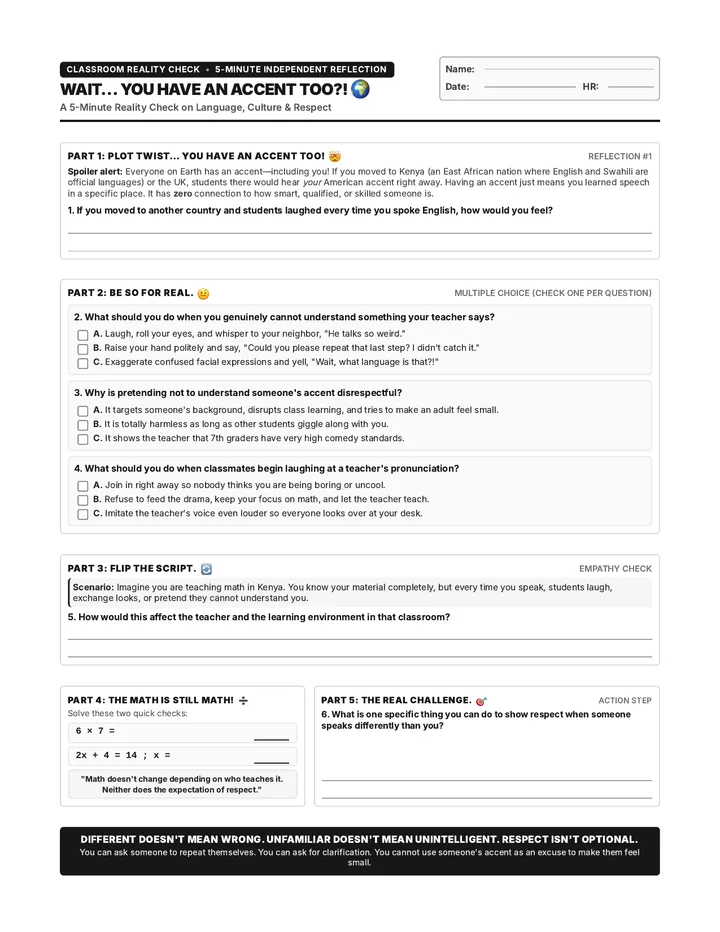
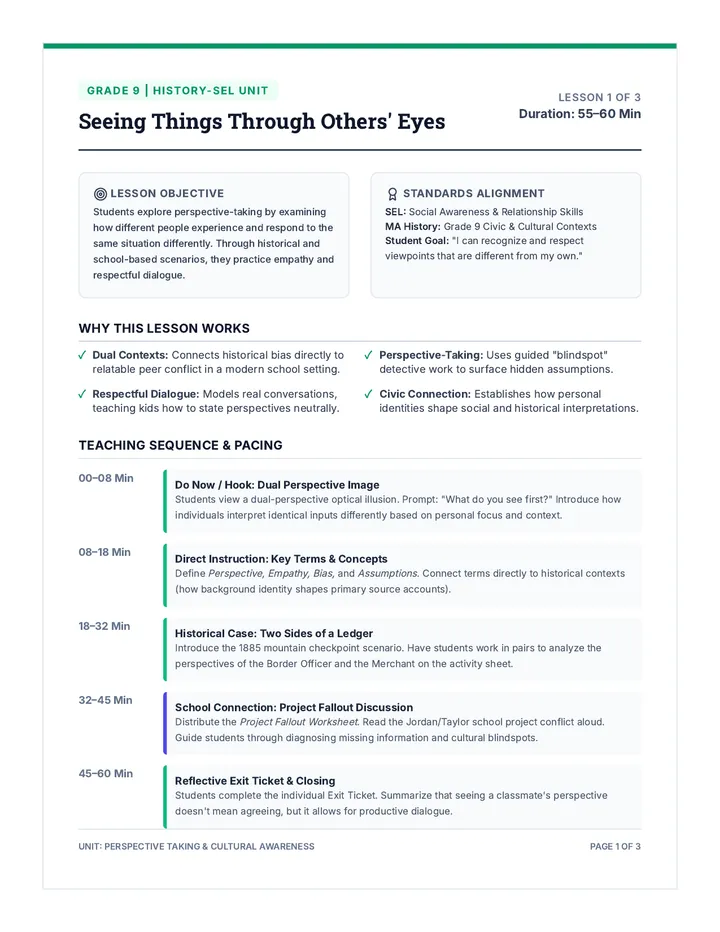
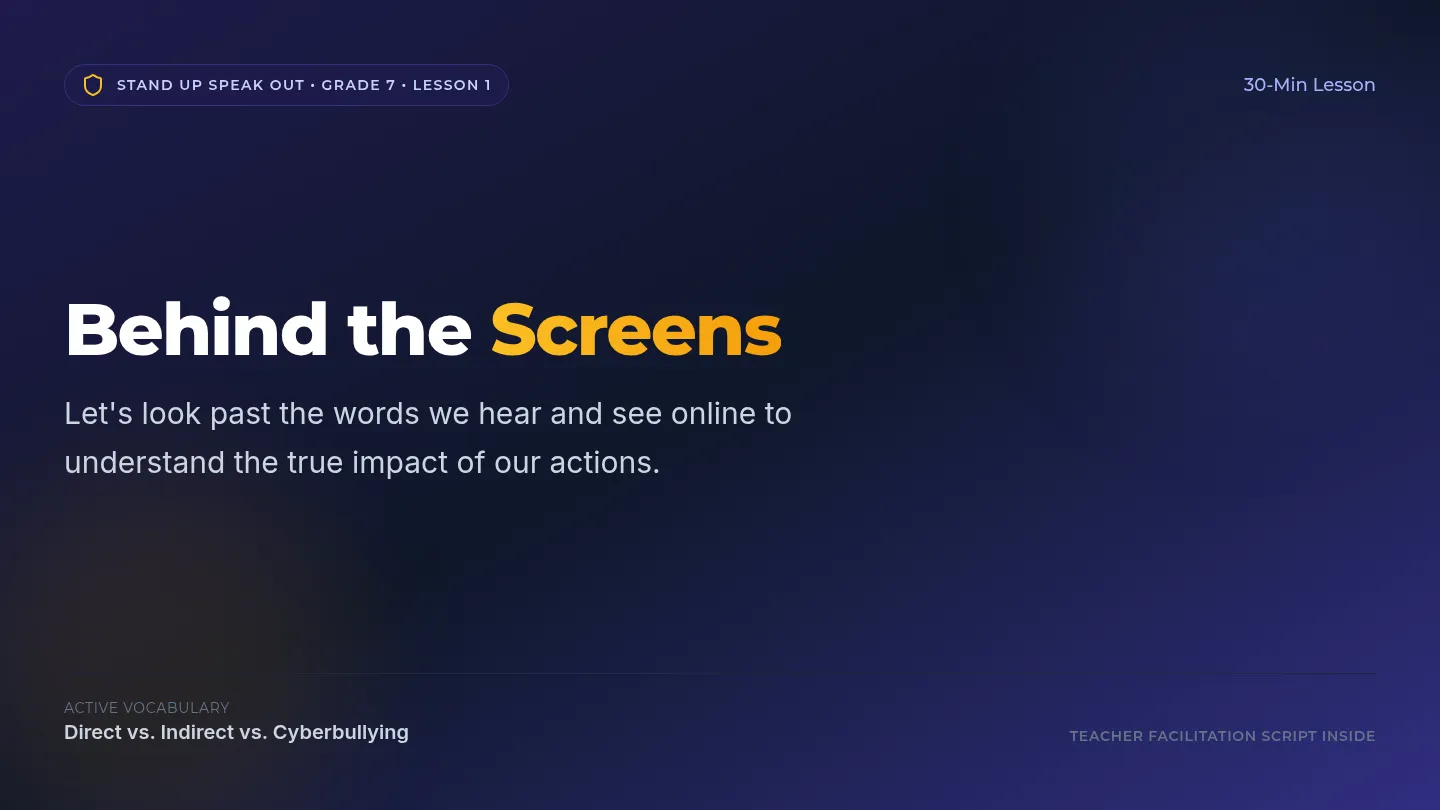
Critical analysis of unconscious bias and the social impact of harmful stereotypes. Equips learners with strategies for perspective-taking and promoting inclusive environments.
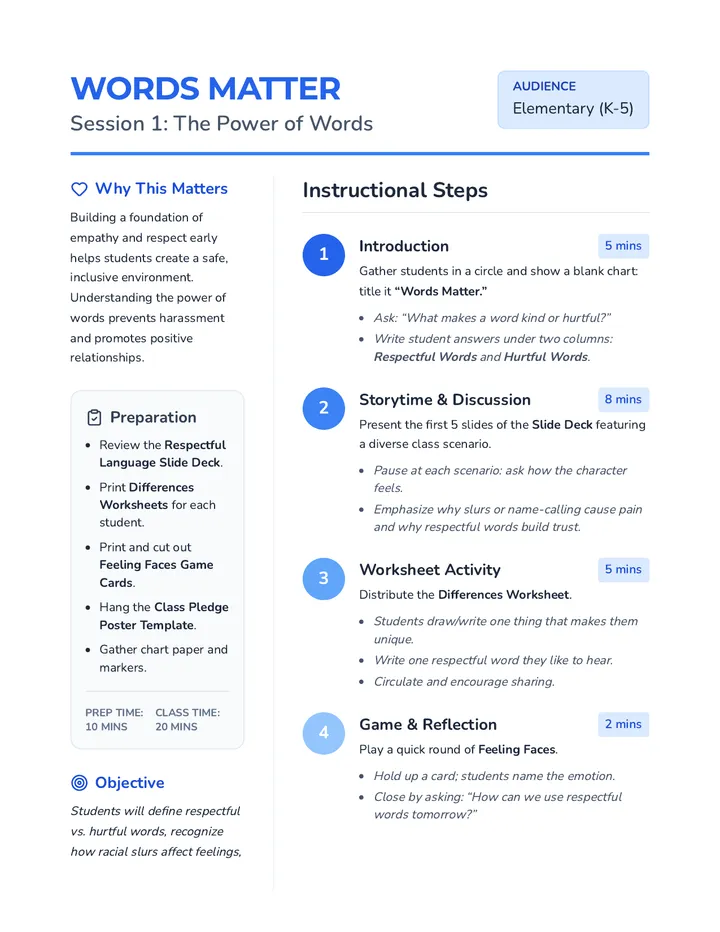
A social-emotional learning sequence for 1st graders focused on empathy, perspective-taking, and challenging exclusion. Students experience simulations, role-play, and creative projects to build an inclusive classroom community.
This 5-lesson sequence for 1st-grade students explores social awareness through the lens of challenging stereotypes and bias. Students move from understanding basic assumptions via object lessons to identifying and debunking gender-based and role-based stereotypes in play and careers, ultimately celebrating individual uniqueness.
This sequence trains 9th-grade students in bystander intervention techniques and active allyship within a workplace context. Students explore the psychological barriers to action (the bystander effect) and master the '4 Ds'—Direct, Distract, Delegate, and Delay—to safely interrupt harassment and support colleagues.
A comprehensive sequence for 9th-grade students exploring the legal definitions, impacts, and identification of sexual harassment and hostile work environments in the professional world. Students move from basic legal definitions to nuanced evaluations of intent versus impact and digital professional conduct.
A comprehensive unit for 10th graders on identifying, distinguishing, and responding to workplace harassment. Students explore the legal definitions of 'quid pro quo' and 'hostile work environment' while investigating the nuances of intent versus impact.
This sequence shifts from identification to action, equipping students with the tools to report misconduct and intervene safely. Students learn the formal mechanisms for reporting discrimination, protections against retaliation, and the '4 Ds' of bystander intervention.
This sequence immerses undergraduate students in the federal legal frameworks of workplace discrimination and harassment, focusing on Title VII, the ADA, and the ADEA. Students learn to distinguish between general conflict and legally actionable harassment through case law analysis and real-world simulation.
This sequence empowers students to act as third-party neutrals, introducing the specific structure and skills of Peer Mediation. Students learn the distinct phases of a mediation session, the importance of neutrality, and how to facilitate dialogue without taking sides.
This simulation-heavy sequence trains 8th-grade students to act as neutral peer mediators. Students move from establishing ground rules and neutrality to mastering advanced communication skills like reframing and open-ended questioning, culminating in a full mock mediation of complex social conflicts.
An advanced clinical sequence for graduate-level counseling students focused on the nuances, cultural adaptations, and schema-level applications of thought record tracking in cognitive-behavioral therapy.
This graduate-level sequence critically examines the DBT FAST skills (Fair, Apology-free, Stick to values, Truthful) through the lenses of cultural humility, intersectionality, and systemic power dynamics. Students will move beyond a Eurocentric assertiveness model to develop nuanced, safe, and culturally responsive clinical interventions.
A graduate-level inquiry into the role of quantitative metrics in admissions, exploring the technical mechanics of GPA recalculation and the ethical implications of standardized testing through an equity lens.
A teacher guide for the classroom inclusion pledge ceremony. Includes preparation tips and a script to make the event feel formal and significant for 1st graders.
A classroom inclusion pledge for students to 'sign' with a handprint or name. It formalizes their commitment to the inclusive behaviors learned throughout the sequence.
A slide deck for Lesson 5 summarizing the sequence and guiding the co-creation of the classroom inclusion pledge.
Teacher facilitation guide for the final celebration. Includes presentation sentence starters, a reflection checklist for learning outcomes, and closing discussion prompts.
A checklist for students to self-assess their inclusive playground designs, ensuring features for different social and physical needs are included.
Student worksheet/project template for Lesson 5. Students showcase their personal identity, interests, and talents on a "This is Me" poster.
A student design sheet for creating an inclusive playground model. Includes prompts for explaining accessibility and social inclusion features.
Visual presentation for Lesson 5 about celebrating individual uniqueness. Introduces the "This is Me" final project and public speaking tips.
A slide deck for Lesson 4 about designing inclusive playgrounds. It introduces the metaphor of the 'Great Wall' of exclusion and challenges students to build accessible spaces.
Student worksheet for Lesson 4. Partners find shared interests across outward differences using a simplified Venn diagram approach to build empathy and connection.
A teacher guide for the 'Freeze Frame' role-play activity, including game rules, scenario prompts, and tips for facilitating assertive communication.
Visual presentation for Lesson 4 about finding common ground. Introduces the simplified Venn diagram (Treasure Map) and active listening skills.
The class formalizes their commitment to inclusion by co-creating and signing a classroom pledge.
Students design inclusive playground models to visualize a world where everyone can play together regardless of differences.
Students learn and practice specific upstander phrases to respond to unfair comments and stereotypes in a safe, structured environment.
Using puppets, students practice perspective-taking by identifying how characters feel when they are excluded based on stereotypes.
Students experience a structured simulation of unfairness to identify feelings associated with exclusion and define the concept of fairness.
Students create and present posters that showcase their unique mix of interests, celebrating their individual identities beyond stereotypes.
Partners find shared interests across outward differences using a simplified Venn diagram approach to build empathy and connection.
Students engage with community helper roles to see that skills and hard work determine career paths, regardless of appearance or gender.
Class examines toys and marketing to discuss why some are labeled for boys or girls, concluding that play and interests should not be limited by gender.
Students learn the difference between a fact (what we know for sure) and a guess (an assumption) using a Mystery Box activity. They connect this to how looking at someone's outside doesn't tell us everything about their inside.
Moving from reactive to proactive, students design workplace norms and pledges that foster a culture of mutual support and accountability.
A hands-on workshop where students rotate through roles to practice applying the 4 Ds in realistic workplace scenarios, from breakrooms to boardrooms.