Identifies mental health crises and suicide warning signs while developing personal safety plans and grounding techniques. Equips users with peer gatekeeper skills and direct pathways to professional crisis resources and hotlines.
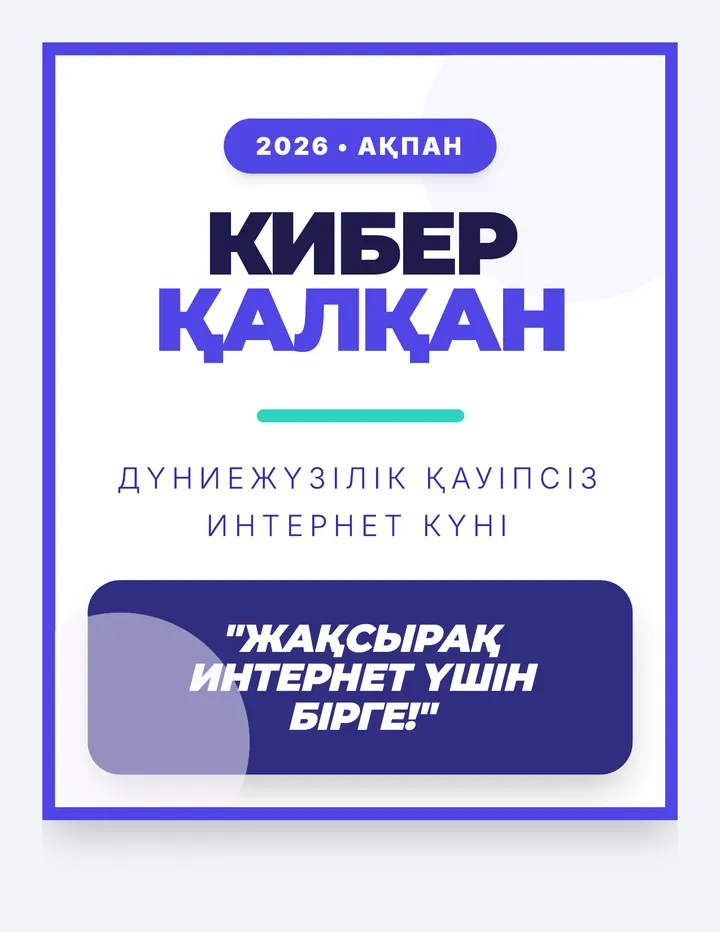
Set of 5 individual large-format posters for a school wall newspaper. Includes: Title Poster, Primary School Guide (1-4), Middle School Guide (5-9), Video/QR Poster, and an Interactive Quiz/Sticker Zone. Each page is designed as a high-visibility, standalone piece for World Safer Internet Day.
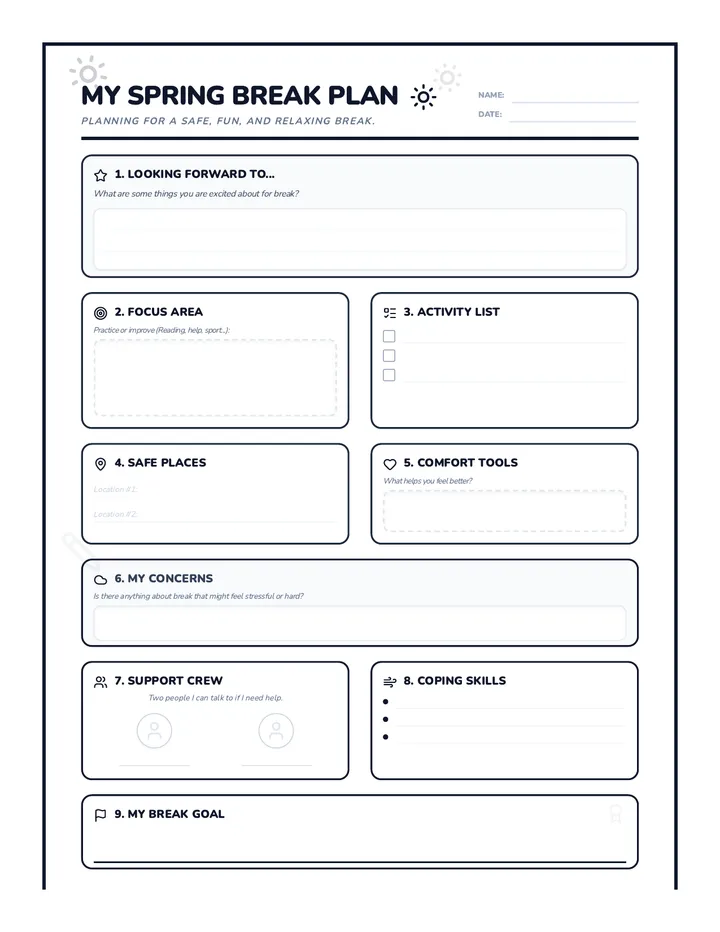
A finalized, single-page Spring Break Planner for middle school counseling. It features 9 journal-style sections optimized for black and white printing with a sun-themed aesthetic and explicitly listed crisis resources in a discrete footer.
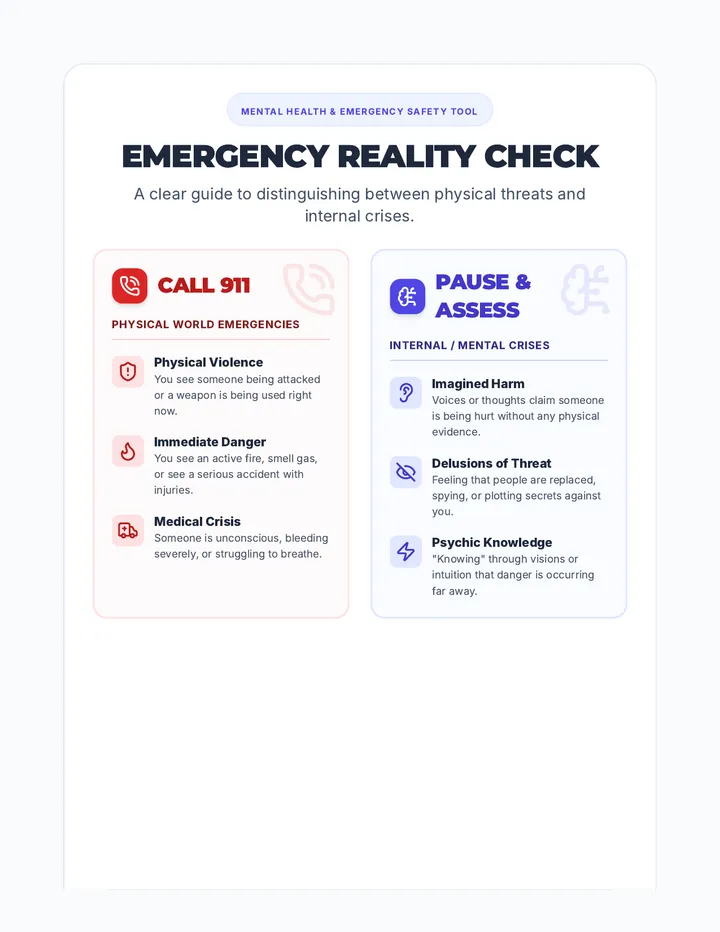
A refined, high-contrast one-page infographic for adults in mental health contexts. Optimized with page-break protection (break-inside-avoid) on all major objects to ensure clean printing on standard or legal sized paper. Includes actionable reality-checking steps and a personalized support network area.
An elegant, highly professional single-page outreach and resources flyer for the District School Social Worker of Fostoria City Schools. It utilizes clean grids, custom program cards, clear visual cues, and a modern color scheme to ensure absolute legibility and optimal use of space.
An updated visually striking school district informational flyer for Fostoria City Schools. It removes any 'we' pronouns, features the custom FCS logo, explicitly details the Social Worker's role as the Caring Closet Coordinator, uses decreased margins to fill the 8.5x11 page size, and expands the original text details while retaining large, accessible text.
A redesigned front-and-back school counseling report for Kitley Intermediate School, optimized for print with tight layouts ensuring all Tier 1-3 data, outcome goals, and student growth metrics fit onto two pages. Includes placeholder boxes for school logos.
A high-density 2-sided guide that packs all resources from the original document into a modern 3-column layout to maximize content and minimize white space. Side 1 covers library programs, YMCA sports, summer camps, and free meals. Side 2 focuses on family support hubs, food pantries, housing aid, crisis hotlines, and transportation services for Fostoria families.
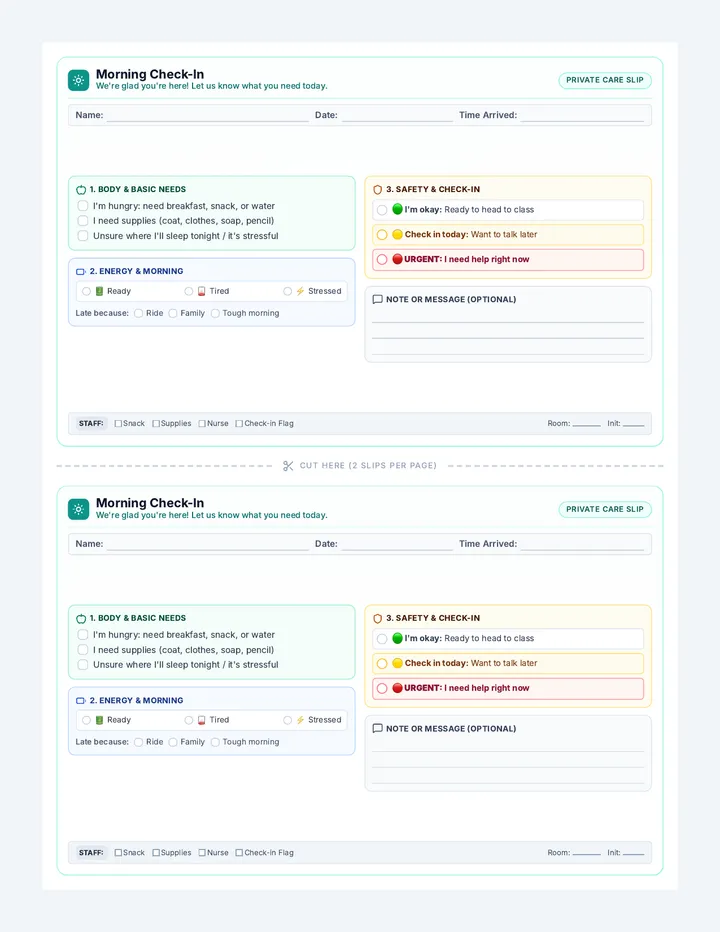
A 2-page morning check-in worksheet designed for an upper elementary or middle school student. It features an emotional temperature check, a cognitive thought reset, a power plan for coping with teasing, and a safety plan for independence, all wrapped in a supportive, confidence-building aesthetic.
A gentle, professional, and practical one-page support guide for a mother helping her child navigate grief, updated to remove specific age/gender demographic details and expanded to include additional sentence starters and shared activities.
A professional and beautifully structured district school social worker outreach flyer for Fostoria City Schools. It contains high-contrast sections covering specialized roles (McKinney-Vento, Foster Care, Handle With Care, and Caring Closet), core social work services, and when to reach out, complete with professional contact details for Tonya Hinke.
A professional and modern one-page promotional flyer for Fostoria City Schools' District School Social Worker. Designed using a polished red, black, white, and gray theme matching the district logo, it clearly outlines services, specialized liaison roles (McKinney-Vento, Foster Care, Handle With Care, and Caring Closet), scenarios for reaching out, commitment statement, and direct contact details for Tonya Hinke.
A front-and-back portrait annual report for Kitley Intermediate School Counseling Program. Uses a high-impact infographic design with rich charts, custom graphics, and detailed stats to explain Tier 1, 2, and 3 services and counseling outcome data.
A set of ten high-impact, full-page classroom labels (See, Feel, Touch, Smell, Anchor) designed for sensory grounding. The first five pages feature the number '1' below the word, and the following five pages feature the number '2' below the word. Each page is color-coded and framed by a thick matching border.
A compact grounding reference sheet featuring the 5-4-3-2-1 technique, square breathing visual, a mantra writing area, and a "Just 5 Minutes" challenge. Designed to fit easily on a single page for quick student reference.
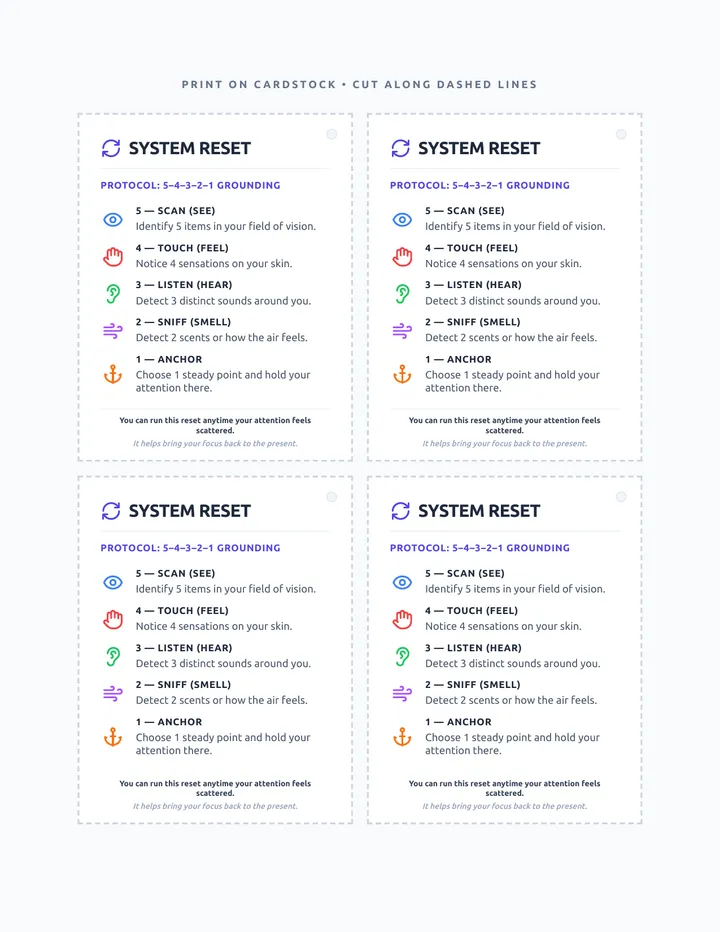
A printable set of 4 'System Reset' grounding cards with updated text, colored icons for each sensory step, and a clear 5-4-3-2-1 protocol layout.
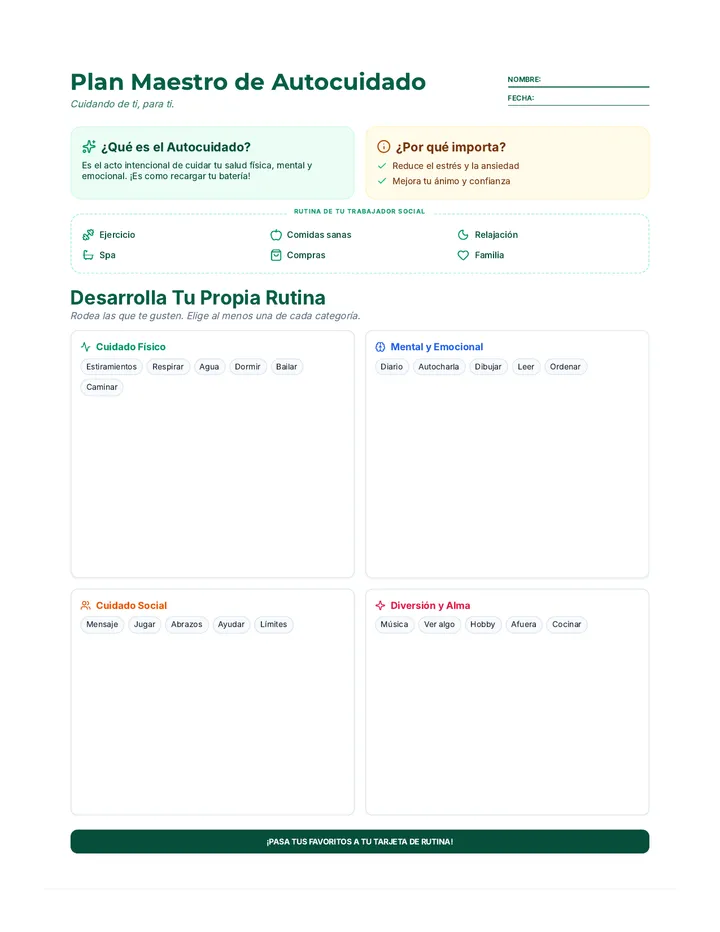
A Spanish translation of the Self-Care Blueprint toolkit. Page 1 helps students identify self-care practices across four categories, while Page 2 provides a significantly enlarged personal wellness ritual card with larger fonts and writing areas for better accessibility. Spacing and scale have been optimized to maximize the usable writing area on the second page.
A comprehensive 5-page parent resource guide for middle school families, covering academic organization, social dynamics, healthy habits (sleep, nutrition, movement), digital safety, and drug awareness.
A two-page student worksheet for a counseling session focused on the 5-4-3-2-1 grounding technique. It features a calming "nature notebook" aesthetic with sections for students to record their sensory observations and reflect on their emotional state.
An updated version of the Steady Ground Guide with improved font sizes for readability and new self-advocacy scripts for teachers to communicate their needs to colleagues and leadership.
An updated 10-page clinical handbook for adjustment counselors, now including a concise overview of the 5 Stages of Grief (Kübler-Ross) integrated with modern meaning-making models and school-based interventions.
A revised crisis management worksheet for a 12-year-old student, featuring a clear 5-step process to navigate mental loops, verify facts, practice grounding, and recall personal strengths.
A calming visual guide for school students illustrating the 5-4-3-2-1 grounding technique, featuring a soothing blue color palette and clear icons for sensory awareness.
A 6-week small group guidance program for Pre-K, Kindergarten, and 1st-grade students to manage school-related anxiety, build confidence, and develop emotional regulation skills through a superhero-themed curriculum.
A six-lesson series for K-3 students with communication IEPs, specifically those who stutter. The sequence focuses on defining bullying, identifying feelings, building self-advocacy through brave words and I-statements, and fostering empathy to become upstanders.
A structured six-session individual counseling curriculum for middle schoolers to manage anger. Through identifying triggers, physical calming techniques, cognitive reframing, and assertive communication, students build a personalized toolkit for emotional regulation.
A 4-session relapse prevention group for adults in SUD recovery, focusing on understanding relapse, identifying triggers, building coping strategies, and creating long-term support plans. This program helps participants develop skills to maintain sobriety through interactive readings, discussions, activities, and games.
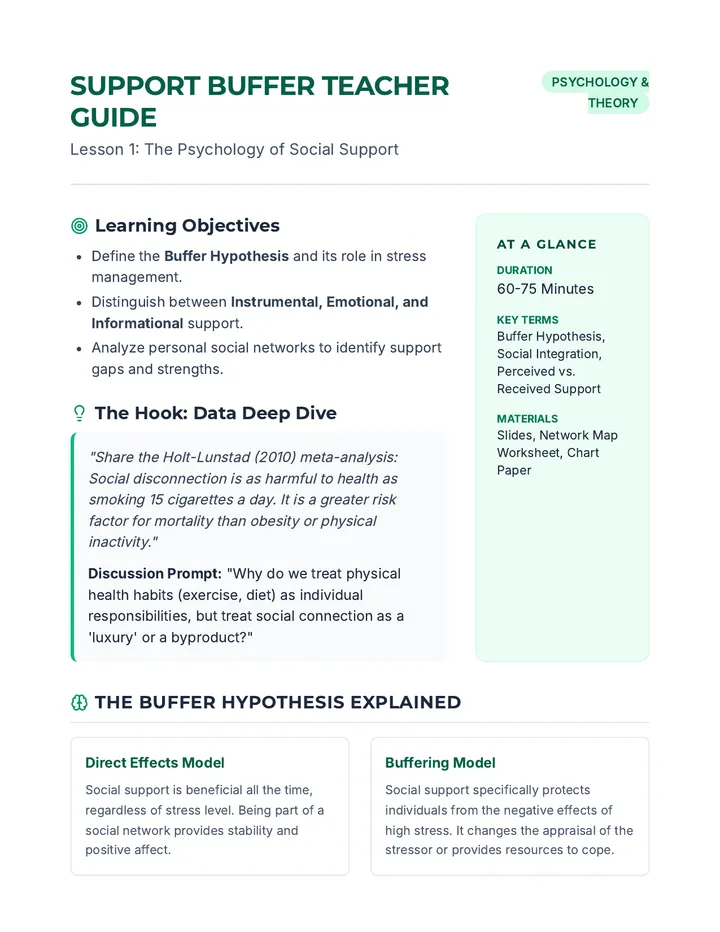
A comprehensive sequence for undergraduate students exploring the social psychology of stress and the practical skills needed to build resilient peer support networks. Students move from theoretical understanding to practical facilitation and community planning.
A graduate-level training sequence on facilitating peer support systems to mitigate stress and anxiety. Students learn the science of social support, micro-skills for active listening, boundary setting to prevent burnout, and group facilitation techniques to create sustainable communities of care.
A 10-session individual Tier 3 support program for a 7th grader with a seizure history, focusing on identifying stressors and building evidence-based coping resilience.
This sequence equips 9th-grade students to recognize signs of emotional distress and suicidal ideation using a safety-first framework. Students progress from debunking myths to identifying warning signs, understanding situational context, practicing the ACT (Acknowledge, Care, Tell) model, and mapping out support resources.
A comprehensive project-based unit where 12th-grade students master the principles of trauma-informed care. Students progress from theoretical understanding to the practical application of designing and presenting clinical intervention strategies for complex trauma cases.
This sequence helps 8th-grade students distinguish between temporary sadness and clinical depression by analyzing behavioral, physical, and emotional indicators. It culminates in learning the ACT (Acknowledge, Care, Tell) strategy for seeking help from trusted adults.
A comprehensive sequence for 4th-grade students to identify, understand, and utilize school-based mental health resources. Students will learn about the roles of school staff, the concept of confidentiality, how to request help, and how to recognize when they need support.
A comprehensive 5-lesson sequence for 11th-grade students focusing on mindfulness, distress tolerance, and radical acceptance. Students move from basic observational skills to creating a personalized 'Personal Crisis Manual' for emotional regulation.
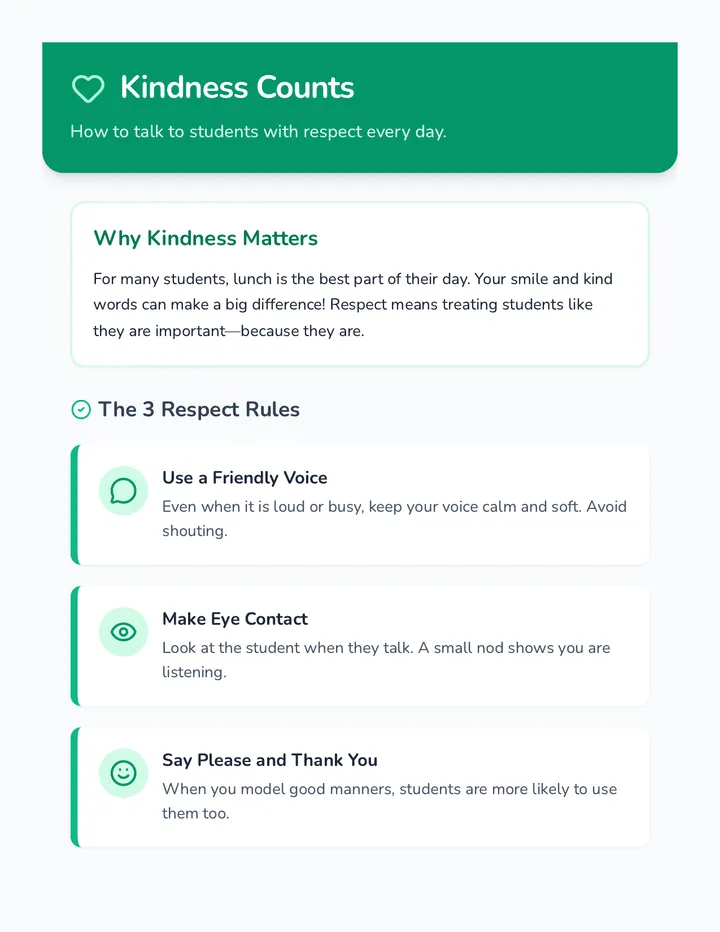
A 15-hour training program for middle school cafeteria staff focusing on respect, anti-bias, and child safety. This visually-heavy program is split into 10 hours of focused classroom-style learning and 5 hours of on-the-job application.
A comprehensive K-12 bullying prevention curriculum strictly aligned with Texas David's Law and TEC Chapter 37, focusing on the distinction between conflict and bullying, cyberbullying, and school safety. Now renamed to the Leadership Protocol.
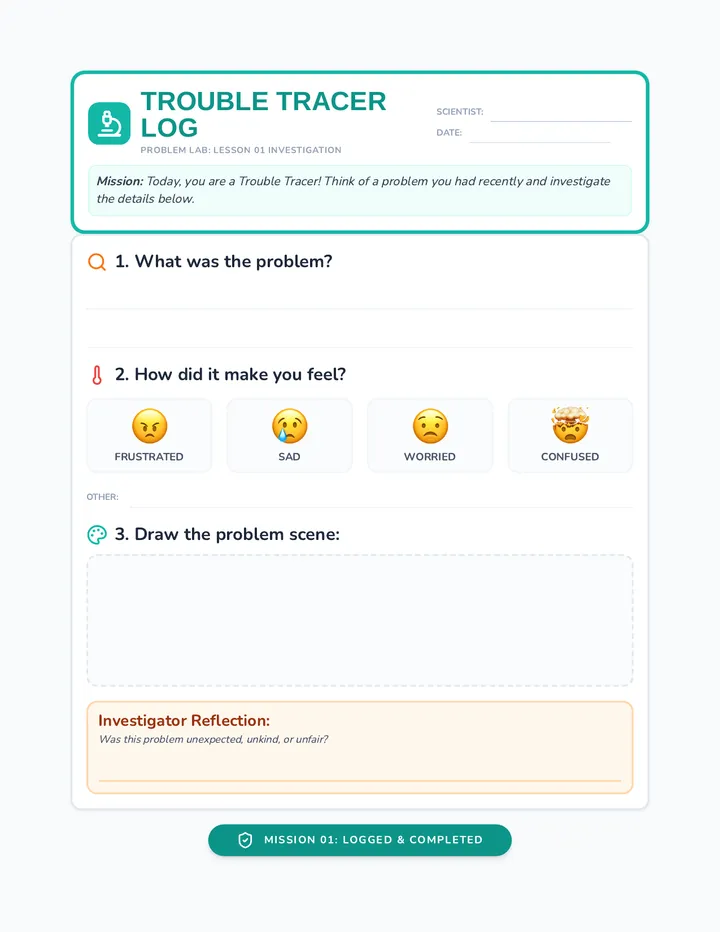
A social-emotional learning unit for 2nd graders focused on identifying problem sizes (Tiny, Small, Medium, Big, Huge) and matching reactions to those problems. Students act as 'Problem Scientists' in a lab setting to analyze and solve various social and personal challenges.
A 5-lesson sequence for 9th-grade students focused on developing social awareness and safety by identifying peer behavioral shifts and escalation warning signs through objective observation and non-verbal analysis.
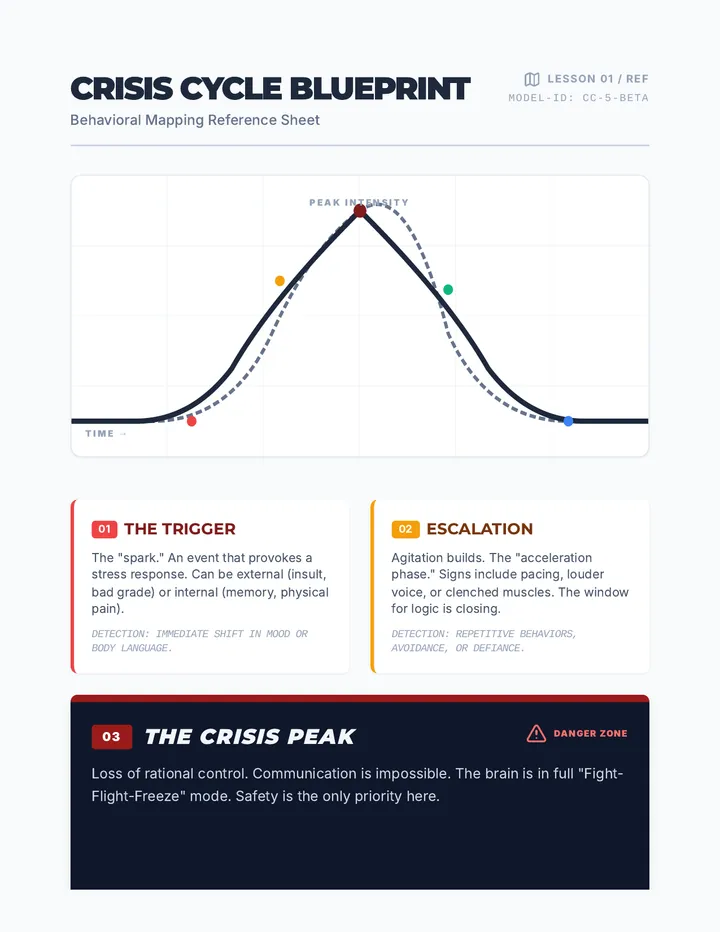
A comprehensive 5-lesson unit on the Crisis Cycle, focusing on identifying triggers, escalation stages, and intervention points through a technical mapping and simulation lens. Students move from theoretical understanding to retroactive detective work to understand behavioral patterns.
A comprehensive 5-lesson unit for 12th-grade students on identifying behavioral baselines and recognizing early warning signs of emotional escalation through analytical observation of verbal, para-verbal, and non-verbal cues.
This sequence equips undergraduate counseling students with the interpersonal and procedural skills necessary for suicide intervention, covering direct communication, de-escalation, safety planning, lethal means counseling, and legal/ethical mandates.
This graduate-level sequence focuses on the ethical and practical frameworks required to maintain psychological safety in group counseling. Students progress from initial contracting to managing complex dynamics like over-disclosure, trauma-informed gatekeeping, and conflict resolution, concluding with professional closure protocols.
This sequence trains undergraduate students in behavioral health and education to identify the early warning signs of crisis. Students move from establishing behavioral baselines to analyzing motor, verbal, and passive indicators of escalation through case studies and clinical observation.
This sequence guides students through identifying physiological and behavioral warning signs of distress, focusing on establishing baselines, mapping internal stress responses, and analyzing external kinetic and vocal shifts to prevent crisis.
A comprehensive DBT skills training sequence for elementary schools, split into K-2 and 3-5 curricula. This program covers Mindfulness, Distress Tolerance, Emotion Regulation, and Interpersonal Effectiveness using age-appropriate activities and narratives.
A multi-grade social-emotional learning unit focused on 'Summer Safety Heroes'. Lessons are tailored for different developmental levels, from 1st-grade foundations to 3rd-grade scientific mastery and risk management.
A comprehensive 13-week curriculum for middle school students focused on the four core modules of Dialectical Behavior Therapy: Mindfulness, Interpersonal Effectiveness, Emotion Regulation, and Distress Tolerance. Students learn and practice key coping strategies in a supportive group setting.
A 6-week small group program for middle schoolers that uses a detective and scientist theme to teach anxiety management, cognitive reframing, and coping skills.
Students design and create a personalized 'Coping Kit' (mental or physical) containing tools for managing crisis moments. This project-based sequence guides 3rd graders through self-reflection, visualization techniques, tool selection, and the creation of a comprehensive safety plan.
A comprehensive 5-lesson unit for 4th graders to learn somatic awareness and sensory grounding techniques for managing emotional distress. Students move from identifying physical stress signals to creating a personalized sensory safety plan.
A comprehensive school counseling resource collection, featuring a specialized stress management series for TK-6th grade and a 6-week targeted attendance intervention group.
A 45-minute lesson for 11th graders on recognizing peer crisis warning signs and using the Notice–Name–Navigate framework to connect friends to support safely while maintaining self-care boundaries.
This 45-minute lesson for 12th-grade students helps them identify and utilize safety resources in postsecondary settings and develop effective advocacy skills. Students will gain practical tools for navigating new environments safely and confidently.
A 45-minute lesson for 7th graders to distinguish between trust, confidentiality, and gossip. Students use a decision tree to navigate social scenarios and practice assertive communication to maintain healthy peer environments.
A compassionate lesson for high school students to understand the non-linear stages of grief and develop healthy coping mechanisms for navigating loss.
Students will engage in simplified role-playing scenarios to recognize different types of bullying and understand its impact. They will also discuss simple ways to prevent and respond to bullying situations. This lesson is important as it helps young students identify bullying behaviors and encourages them to be kind and supportive to their peers.
In this 45-minute lesson, 5th graders explore setting and enforcing in-person and online boundaries, practice scripts, and map out helpers for escalation support. Students will craft boundary statements and identify trusted helpers to enhance digital citizenship and safety skills.
In this 45-minute 4th grade lesson, students will learn to tell the difference between conflict, rudeness, and bullying; craft personal boundary statements; and identify trusted adults and peers for help. This vital social-emotional skillset empowers students to stay safe, respectful, and confident both face-to-face and online.
A 45-minute lesson for 3rd graders on identifying personal boundaries, practicing assertive communication, and mapping out a network of trusted adults for safety and support.
This lesson aims to educate 8th-grade students about cyberbullying, its impact, and strategies to prevent and address it. By using a video and guided discussion, students will gain a deeper understanding of the topic and learn practical steps to protect themselves and others online.
A mental health awareness lesson for Grade 8 students focusing on empathy, recognizing bullying, and the importance of checking in on friends using the short film 'Are You Okay?'.
A 30-minute lesson for 5th graders to distinguish between safe and unsafe secrets, focusing on personal safety and the social impact of inclusion and power dynamics. Students will engage in discussions and scenario analysis to build a supportive classroom environment.
This Tier 2 small group lesson empowers Kindergarten students to understand personal boundaries, identify safe and unsafe touches, and practice using their voices to seek help from trusted adults.
A comprehensive workshop for parents focused on building student connection, accountability, and relationship skills using the Move This World framework.
A 25-minute parent education session focused on identifying bullying in adolescents, understanding its mental health impact, and providing actionable communication and intervention strategies.
A comprehensive lesson designed to help children navigate the complex emotions and transitions associated with parental post-incarceration, focusing on building healthy coping strategies and support networks.
An introductory guide to navigating local community resources in Clay County, Florida, focusing on essential services for independence and advocacy. Students will explore transportation, food assistance, disability support, and recreational opportunities.
A supportive lesson for 7th-grade students to understand depression, identify emotions, and build a toolkit of coping strategies and self-care practices.
A celebratory closing session for 6th graders to acknowledge their achievements, identify coping strategies, and prepare for the transition to 7th grade and middle school growth.
A comprehensive lesson for 6th graders on understanding mental health, identifying warning signs, and knowing which trusted adults to turn to for support.
A collection of resources for parents of middle schoolers to navigate defiance and school avoidance with empathy and effective strategies.
A collaborative parent workshop designed to support the mental health of both teenagers and their families through practical, calming strategies and community connection.
A complete psychoeducational workshop bundle designed to empower older adults with evidence-based mental wellness strategies, coping mechanisms for life transitions, and self-assessment tools.
A 45-minute guidance lesson for 3rd graders focused on personal boundaries and safety. Aligned with ASCA standards, this lesson uses the 'Personal Bubble' metaphor to teach physical and emotional space.
A visually charming and supportive lesson designed to teach students effective grounding techniques for managing anxiety and panic attacks in school settings.
A 30-minute introductory lesson on personal boundaries, body ownership, and differentiating between safe and unsafe touch. Students learn to identify trusted adults and practice communication skills for setting boundaries.
A social-emotional learning lesson designed to help students identify the 'size' of various problems and learn how to match their emotional reactions to the scale of the situation. Students will investigate different scenarios and categorize them from tiny glitches to emergency situations.
A comprehensive lesson that teaches students how to identify and categorize the size of problems using a mountain climbing metaphor. Students will learn appropriate strategies for Small, Medium, and Large problems.
A presentation and workshop for parents and caregivers to understand school avoidance and how to break the accommodation cycle in middle schoolers.
A 30-minute lesson for 2nd graders to distinguish between being mean (one-time, unplanned) and bullying (repeated, intentional, power imbalance) through a detective-themed sorting game.
A social-emotional learning lesson designed for first graders to develop self-awareness regarding 'stuck' thinking and emotional regulation using a 'Brain Mechanics' theme. Students learn to categorize problem sizes and use 'flexible thinking' tools to manage their reactions.
Ova lekcija usmjerena je na osvještavanje uloge promatrača u situacijama vršnjačkog nasilja kroz analizu pisanih scenarija i kritičko razmišljanje o mogućim intervencijama.
A social-emotional learning lesson for students in grades 3-6 to manage test anxiety through preparation strategies and in-the-moment coping skills.
A 45-minute lesson designed for middle schoolers to navigate the social complexities of group chats, focusing on digital empathy, tone interpretation, and being a supportive 'upstander' in digital spaces.
A kindergarten lesson focused on distinguishing between tattling and reporting, providing students with practical tools for independent conflict resolution.