Core scientific and technical disciplines including life sciences, physical systems, and computational logic. Integrates theoretical knowledge with practical engineering principles and innovative business strategies.
A printable high-visibility iMac Quick Guide cheat sheet designed to be cut into 4 quarter-page cards for taping directly to iMac stations. Features bold typography, clear shortcut keycaps, and easy-to-follow troubleshooting steps.
A comprehensive 2-page project packet and planning guide for a Digital Citizenship & Cyber Hygiene Public Service Announcement (PSA). It includes topic selection, audience analysis, an APA citation model, research tracker, data visualization planner with sentence starters, content blueprint, and a clear evaluation rubric.
Guía de autoaprendizaje de 2 páginas para estudiantes de 6° grado sobre el concepto de abstracción en el pensamiento computacional, con registro de videos, análisis de mapas y recetas cotidianas, y desafíos prácticos.
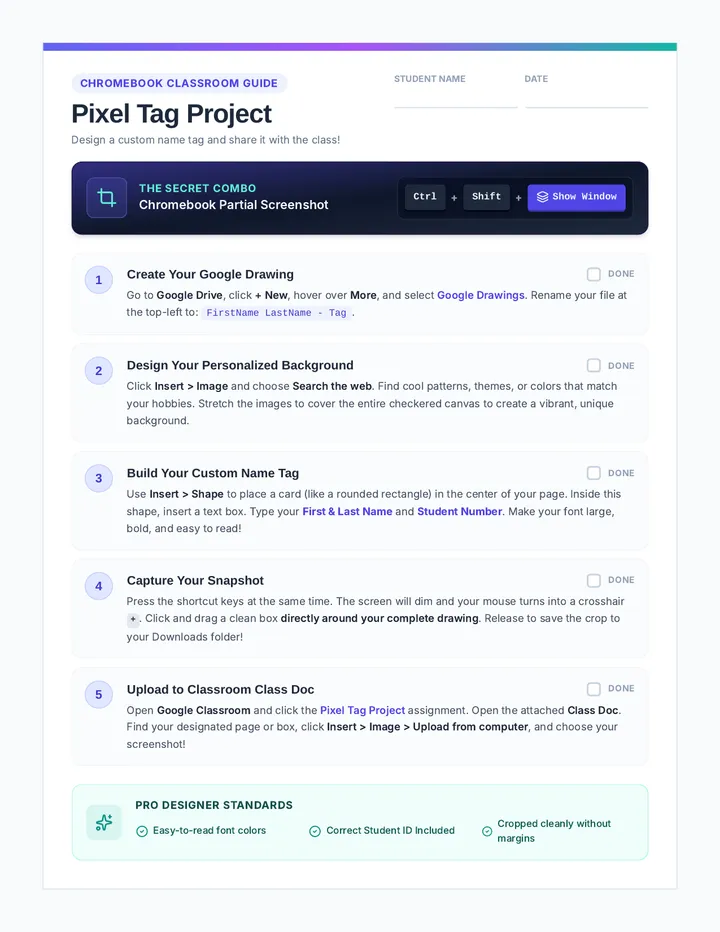
A modern, highly visual one-page checklist guide for students to create a custom Google Drawings background and name tag, take a partial screenshot using Chromebook keys, and submit it to a collaborative class document.
A two-page design thinking graphic organizer and iterative prompt cheat sheet for middle school students learning to vibe code web projects.
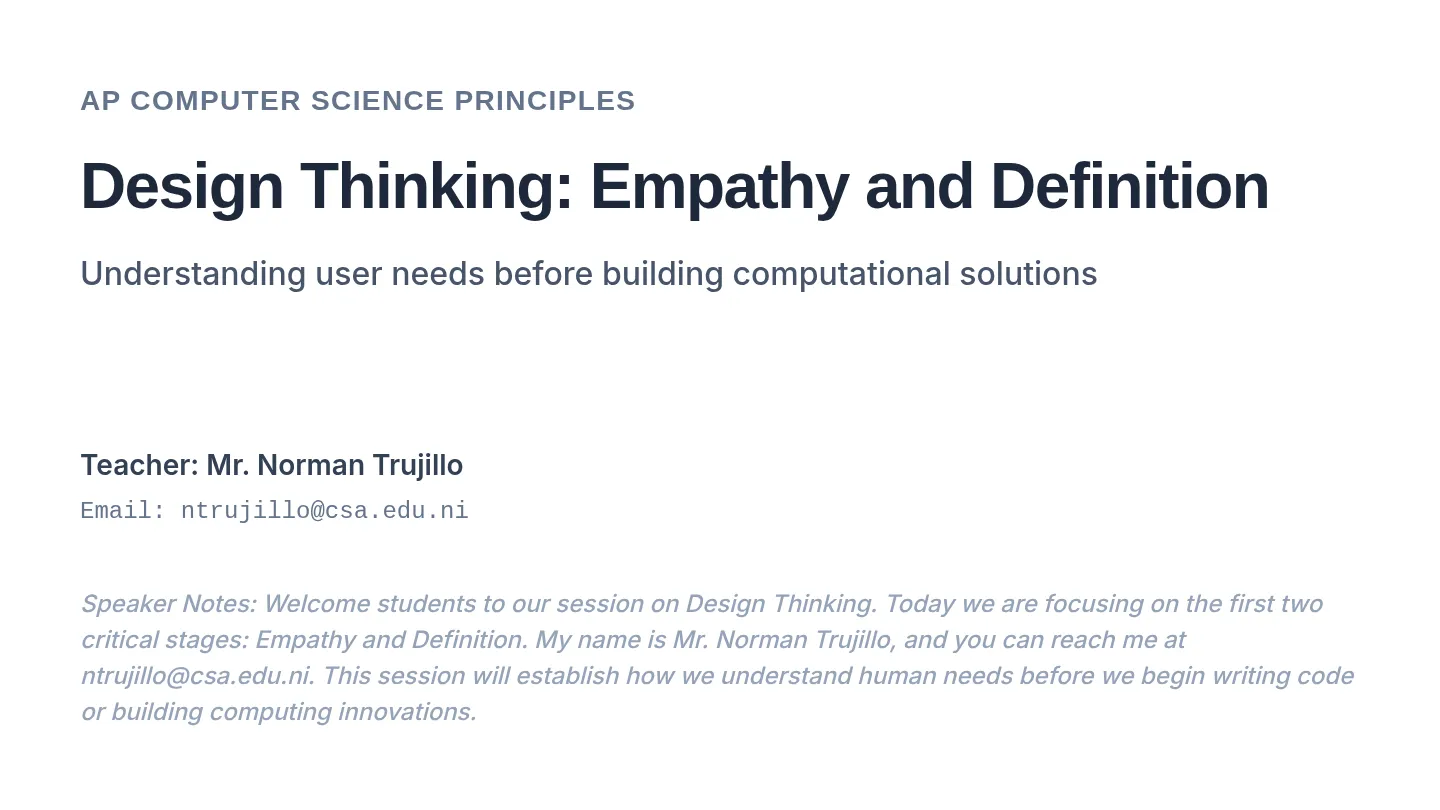
A comprehensive, highly professional 40-slide presentation in English for AP Computer Science Principles on Design Thinking: Empathy and Definition, taught by Mr. Norman Trujillo. Features clean white backgrounds, strictly sans-serif typography, large legible text (minimum 24px), detailed speaker notes, step-by-step solved examples, and interactive coding connections.
An updated high-impact rules and procedures poster for the Verizon Innovative Learning Lab, featuring six key safety and conduct rules with large icons and bold, simple text. Rule 5 has been updated to focus on digital safety and tech integrity.
A beginner-friendly three-page printable worksheet packet providing thorough reading passages, clear analogies, and guided practice on HTML, CSS, and UI/UX design thinking for students with zero prior coding experience.
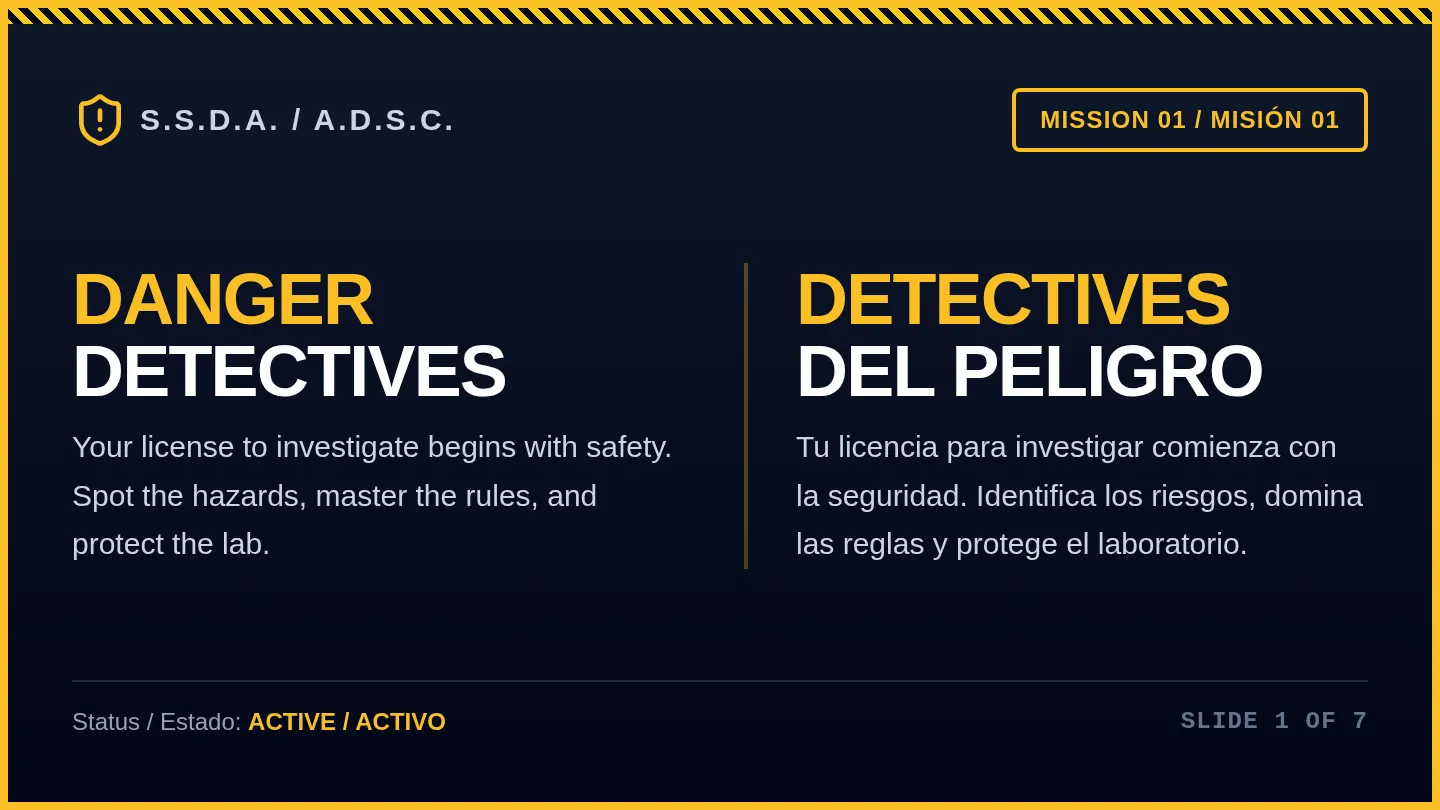
A two-page printable forensic detective investigation for 7th grade students. Students analyze math stride calculations, chemical lab residue data, and encrypted surveillance logs to solve a museum heist and draft an evidence-based warrant.
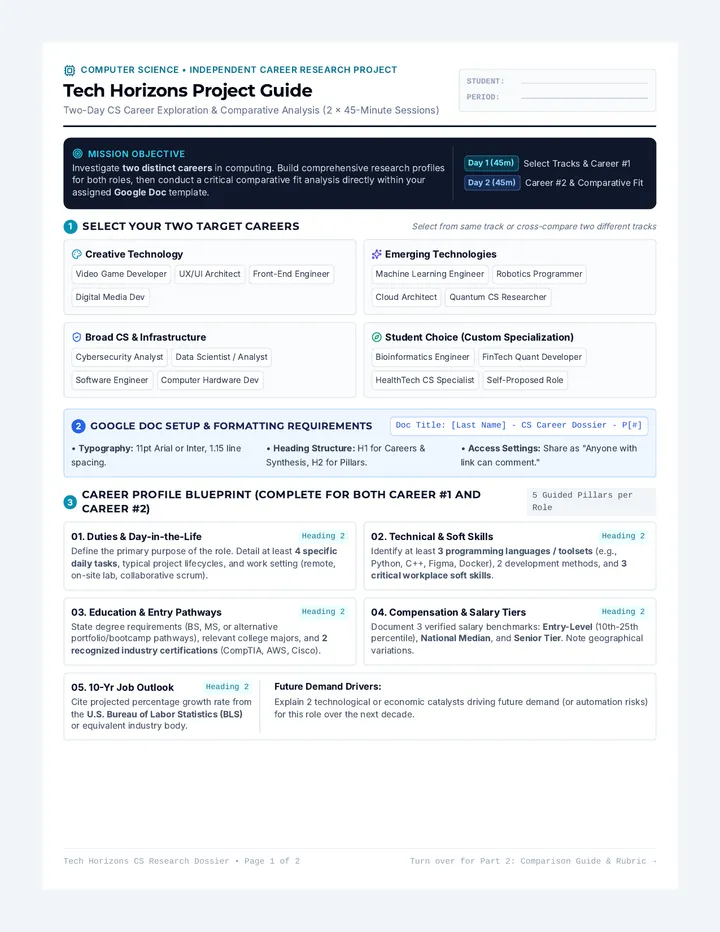
A comprehensive two-day student project guide detailing instructions for creating a Google Doc computer science career exploration and comparative research portfolio. Includes track options across creative, emerging, and core CS disciplines, profile requirements, comparative analysis prompts, credible research databases, and a scoring rubric.
A comprehensive, 2-page teacher-ready lesson plan for elementary digital technology covering computer hardware components, mouse and touchpad skills, window navigation, and lab management strategies.
A dynamic two-page STEM and game design activity exploring the physics, neuroscience, and mechanics of timing in video games. Students test their real-world reaction time through a ruler-drop physics lab and compete in an unplugged tabletop frame-trap timing duel.
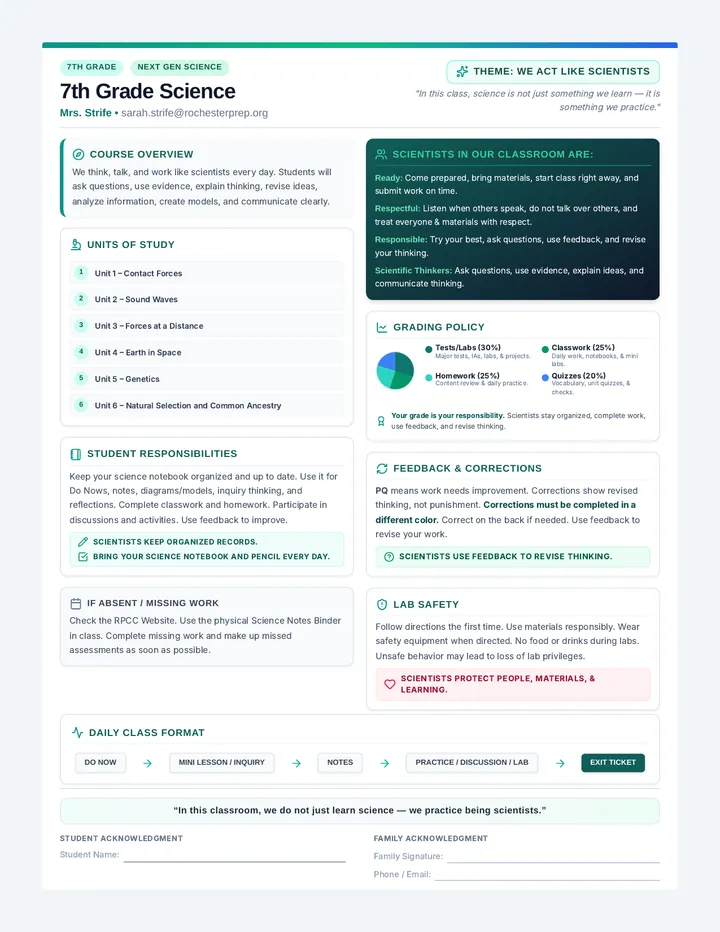
An updated 1-page 7th Grade Science Syllabus for Mrs. Strife. Formatted in a clean, professional, and visually engaging dual-column layout with organized boxes, bold headings, blue/green accent themes, and custom science icons. Includes a newly designed visual 'Grading Policy' section with a clean CSS-based donut chart. Perfect for student and parent onboarding.
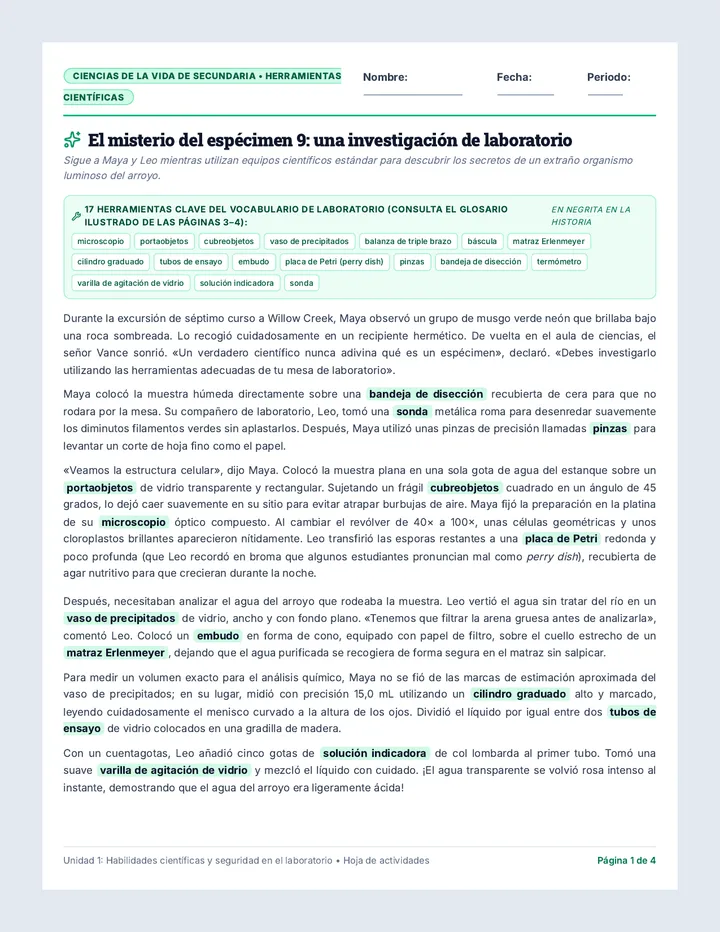
A comprehensive four-page middle school science packet containing the 'Mystery of Specimen 9' reading story, comprehension questions, and a complete two-page illustrated visual glossary featuring diagrams and definitions for all 17 laboratory tools.
An accessible, single-page science worksheet for 3rd graders focused on how wind moves, defining wind as moving air, showing warm and cool air movement without pressure jargon, and featuring gentle comprehension questions.
A 3-page printable phonics reading passage worksheet for 1st graders targeting CVC short vowels, Bossy E long vowels, and common vowel teams with decodable stories, fluency tracking stars, phonics word hunts, and spacious handwriting lines.
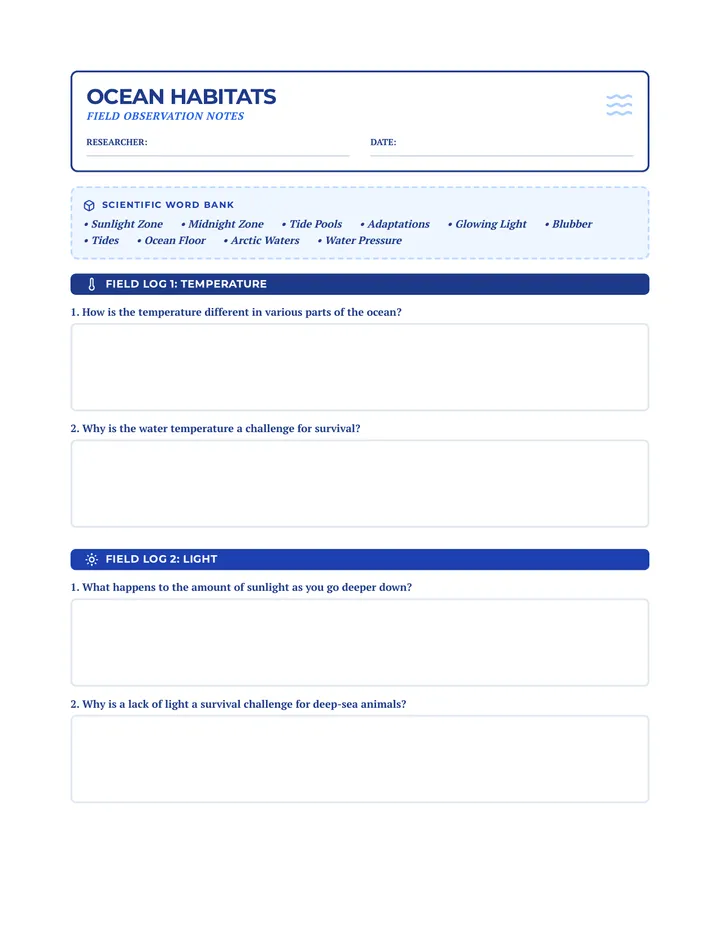
A 2-page age-appropriate guided note-taking document for studying ocean habitats. Features simplified vocabulary (Sunlight Zone, Tide Pools, etc.) and structured writing spaces for Temperature, Light, and Tides. Optimized to fit strictly on two pages.
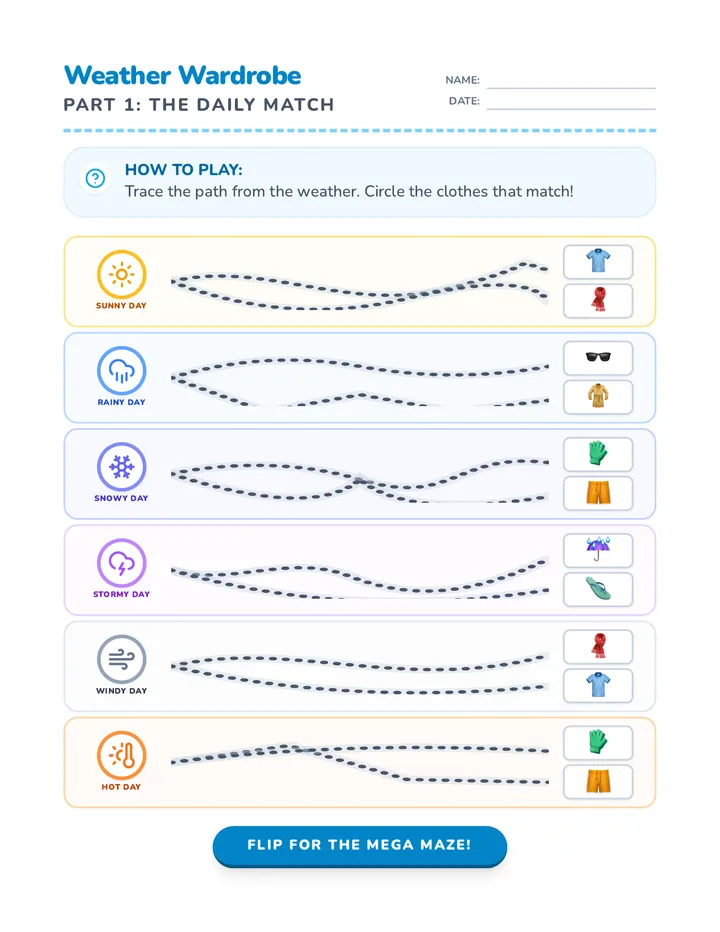
An expanded weather wardrobe activity worksheet for kindergarteners. Page 1 features matching exercises for six weather types (sunny, rainy, snowy, stormy, windy, hot) with two choices each. Page 2 contains a "Mega Maze" where students navigate complex, high-contrast paths from all six weather stations to their respective clothing items in a central closet.
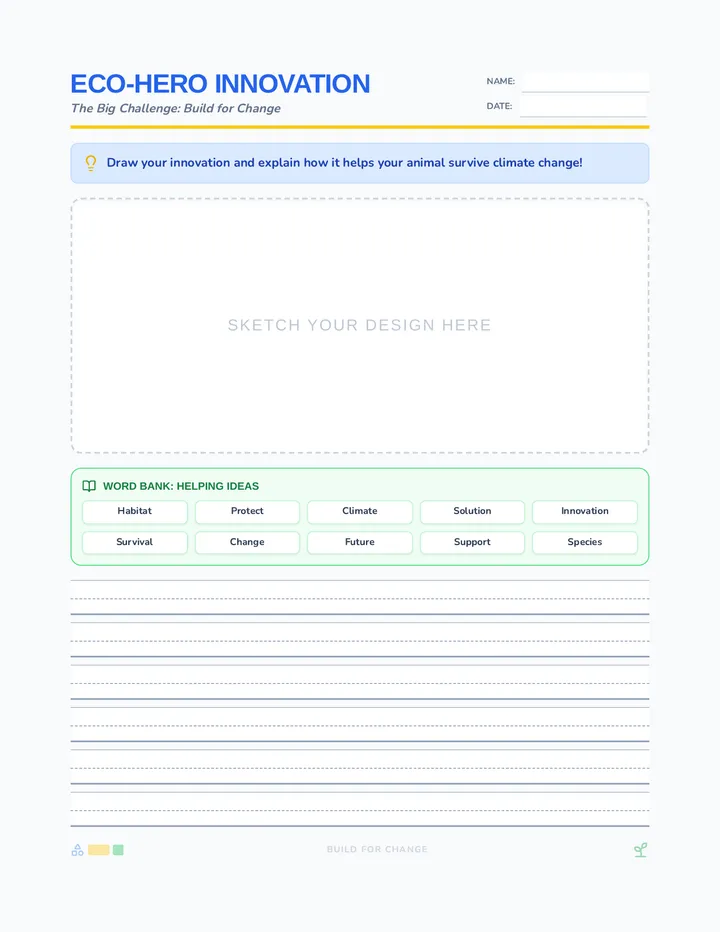
A finalized creative writing and drawing worksheet for 'The Big Challenge'. Features a spacious drawing box, a student-friendly word bank, and six sets of primary-style handwriting lines with clear top, mid (dashed), and baseline boundaries, all fitted to a single page.
A comprehensive two-page student research worksheet exploring U.S. Army Corps of Engineers civil works in Evansville, Indiana, including floodwalls, levees, and Ohio River navigation locks. Students document research sources, examine structural mechanisms for flood control and river transit, evaluate community and economic impacts, and master vital infrastructure vocabulary.
A comprehensive 34-question math showdown slide deck with multiple choice options and hidden answer reveal slides. Covers addition, subtraction, multiplication, division, rates, and multi-step word problems.
A two-page introductory reading passage and comprehension worksheet exploring why studying Earth and space science is vital for understanding our home planet and the universe.
A 4-page, highly visual, dual-language (English/Spanish) science worksheet about Earth's movements, seasons, and solar angle. It features cooperative lab group roles (for groups of 3-4 using a globe and flashlight), large crisp SVG diagrams, and a dedicated full page for each of the four main parts: Inquire/Observe (Texas vs. Argentina in July), Rotation (Day & Night), Revolution (The Year), and Axial Tilt (The Seasons).
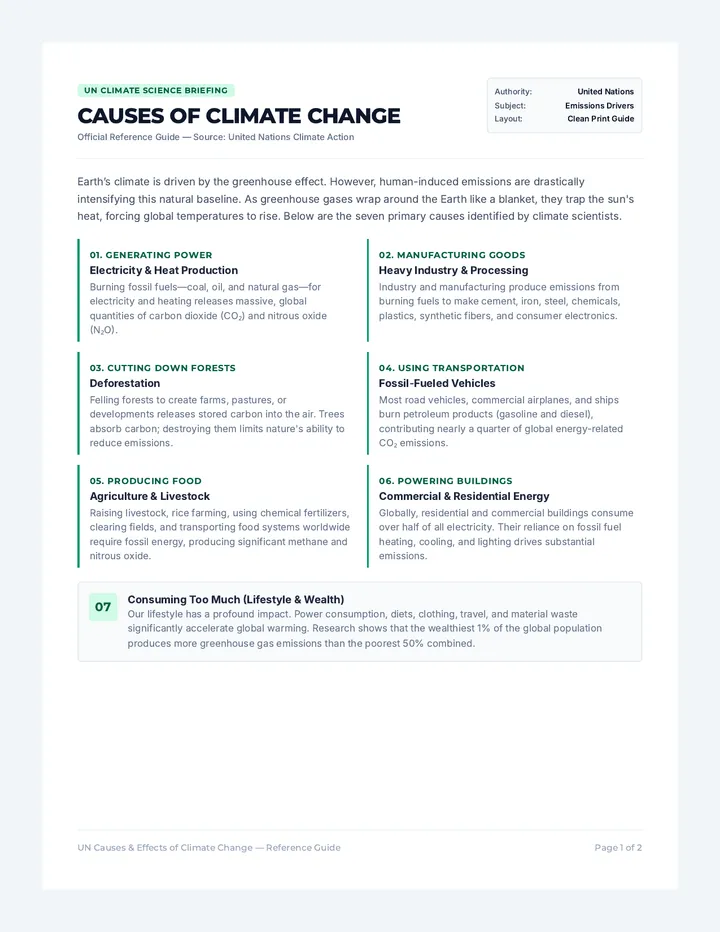
A print-optimized, high-density reference guide detailing the specific 7 causes and 8 effects of climate change outlined by the United Nations. Designed to replace graphic-heavy webpage prints with structured, high-density factual text.
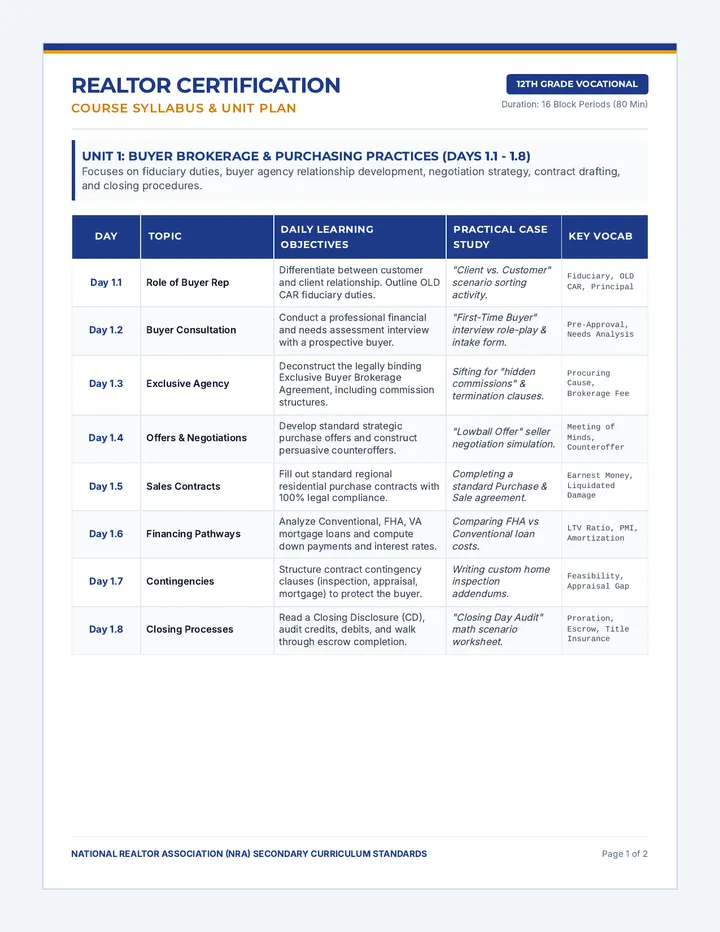
A two-unit, 16-day curriculum sequence for a 12th-grade real estate certification course. Unit 1 covers buying practices (buyer agency, contracts, negotiations, closing), and Unit 2 covers listing practices (listing agency, listings, marketing, closing).
An introductory high-school course sequence exploring the professional fashion merchandising pipelines, trend cycles, visual storefront design, and inventory strategy.
A comprehensive 7-day introduction to business and entrepreneurship. Students explore foundations, economic principles, ownership models, internal structures, and the mindset and process needed to launch a new business idea.
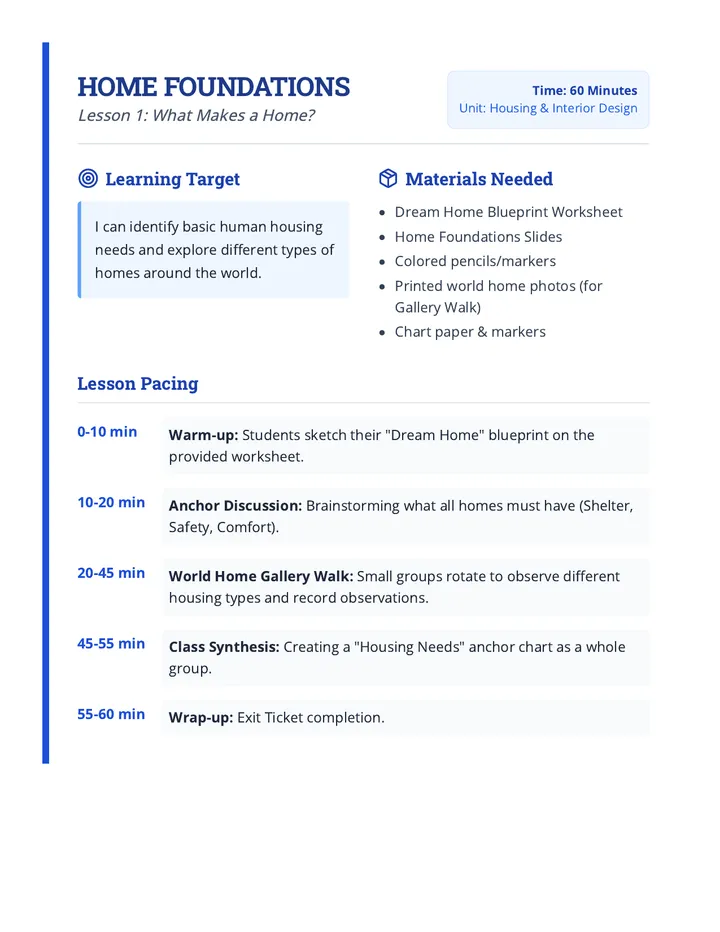
An introductory unit on Housing and Interior Design within the Human Services field. Students explore basic housing needs, sustainable green building, universal design for accessibility, the impact of local resources and climate on home construction, and residential energy efficiency.
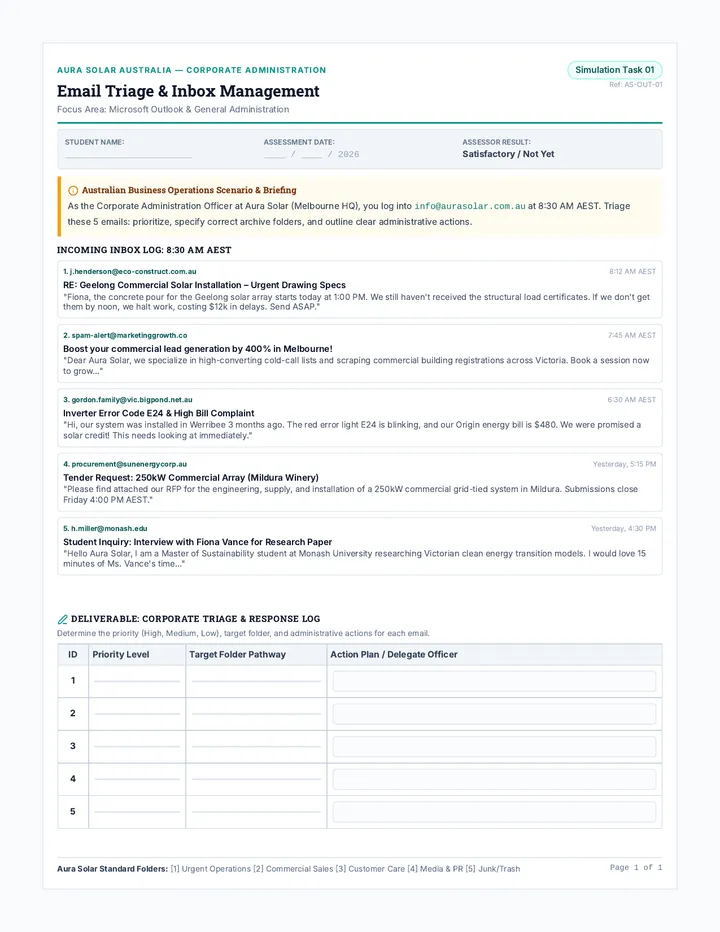
A comprehensive workplace simulation sequence following Aura Solar Australia, a major renewable energy provider based in Melbourne. Students act as Corporate Administration Officers, executing complex, realistic tasks across the Microsoft Office Suite that align with Australian business standards, GST calculations, time zones, and privacy regulations.
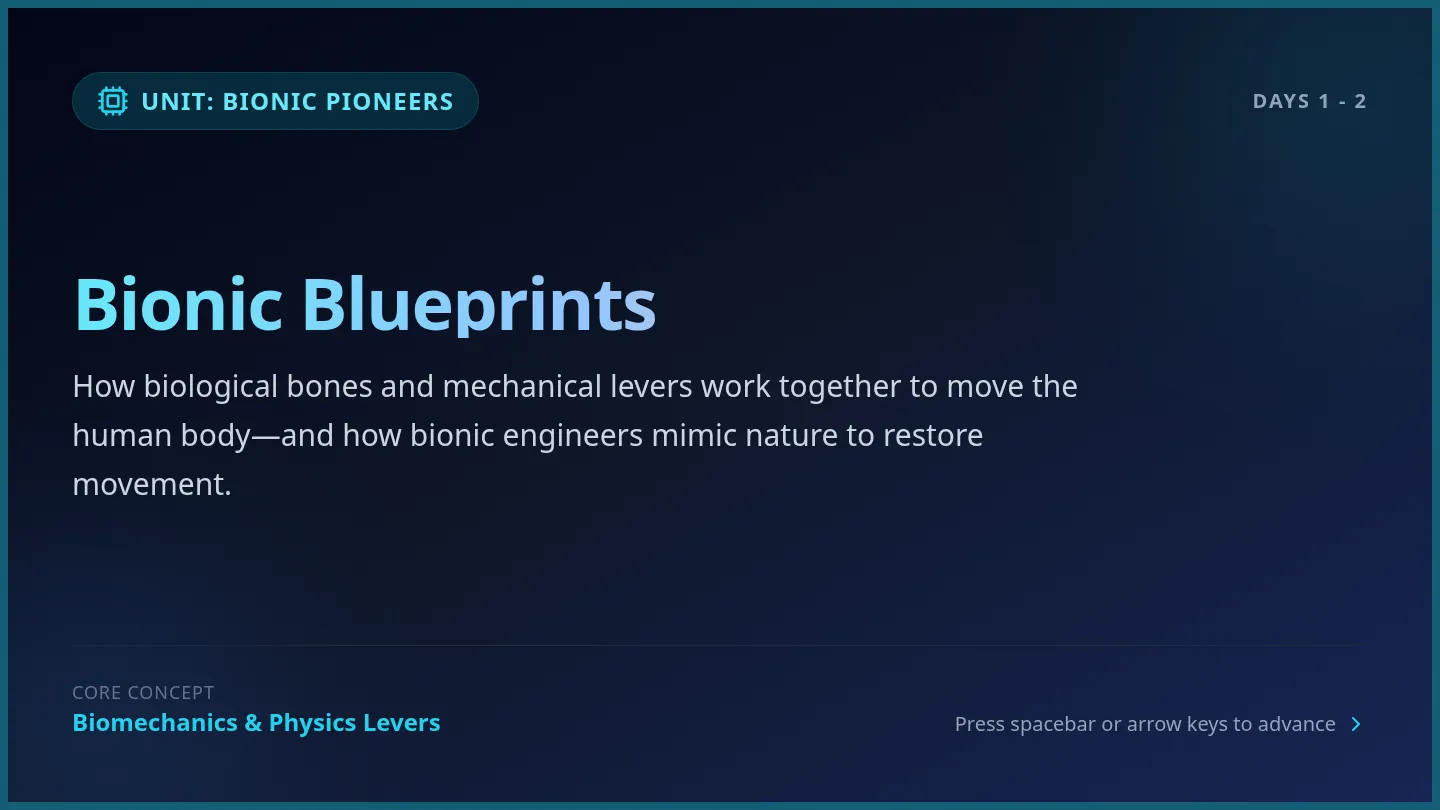
A high-impact 7th-grade STEM unit exploring biomechanics, the human skeletal-muscular leverage system, and pioneering prosthetic innovations. Students design and build physical mechanical limb models to solve real-world accessibility challenges.
A 4-week project-based learning sequence for middle school students, connecting mathematics, marketing data, apparel scaling, and budget formulas through the real-world challenge of launching a school merchandise brand.
A 10-day project-based learning unit integrating 4th grade Math (multiplication/division) and Science (photosynthesis/life cycles). Students choose between designing a community garden or creating a garden business plan, applying their knowledge of plant systems to real-world calculations.
A two-part technology sequence for Primary 3 students exploring the dual nature of technology and the engineering design process for creating helpful inventions.
An introductory unit exploring the roles, responsibilities, and essential skills of general management in modern business environments. Students learn about leadership styles, decision-making frameworks, and problem-solving strategies.
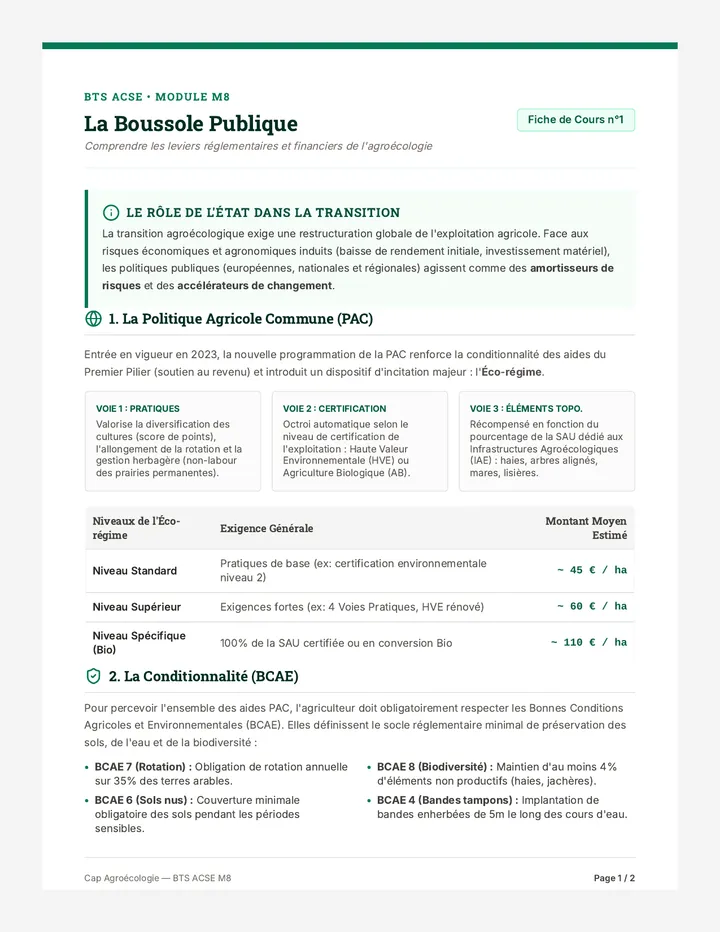
Un module complet de 10 heures pour le BTS ACSE (module M8) centré sur la transition agroécologique, l'analyse des politiques publiques (PAC, MAEC) et la conception d'un plan opérationnel d'accompagnement stratégique pour évaluer la capacité C8.3.
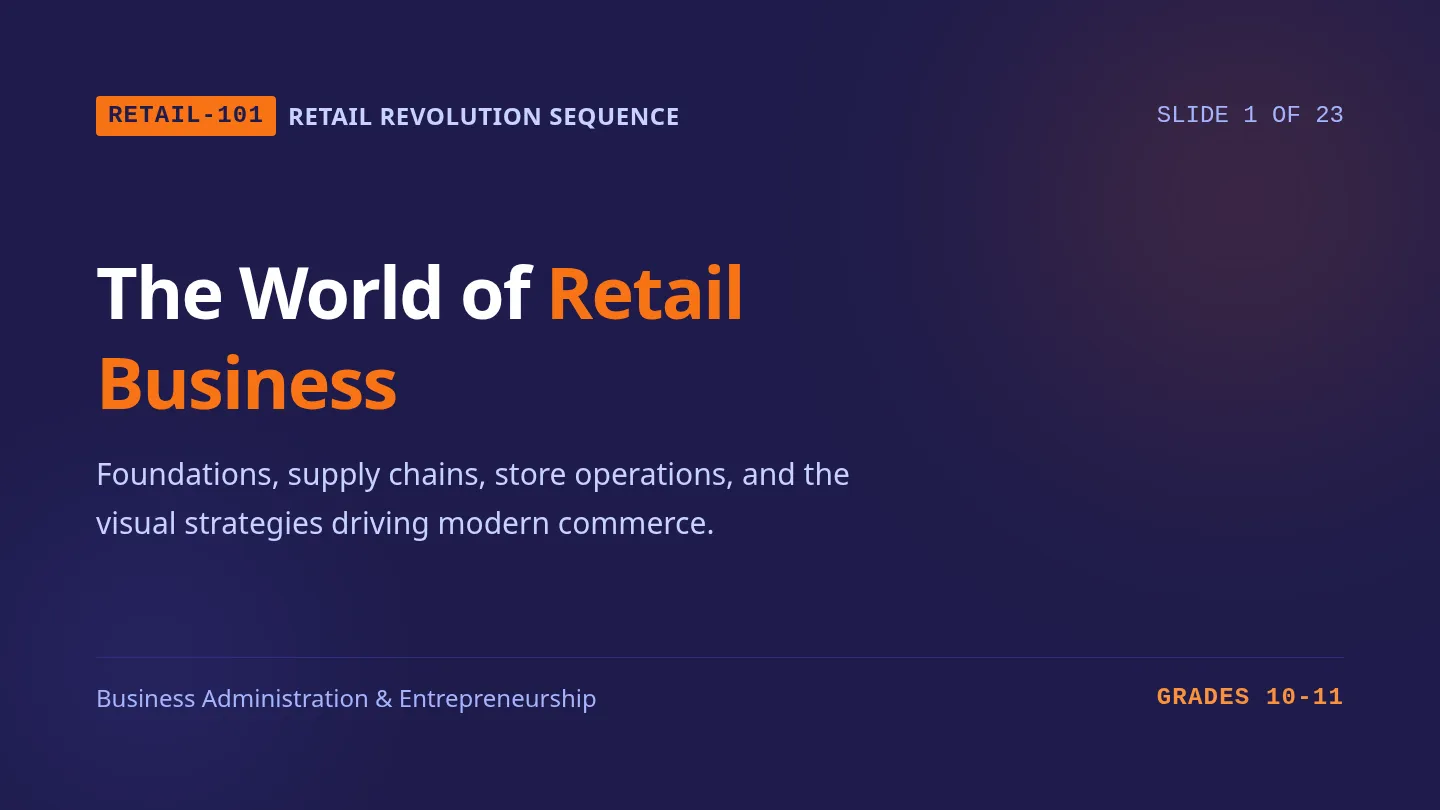
A comprehensive introductory unit on the business of retail, designed for 10th and 11th grade business students. The unit covers fundamental retail concepts, the modern supply chain, physical store operations, visual merchandising, and culminates in a hands-on storefront pitch project.
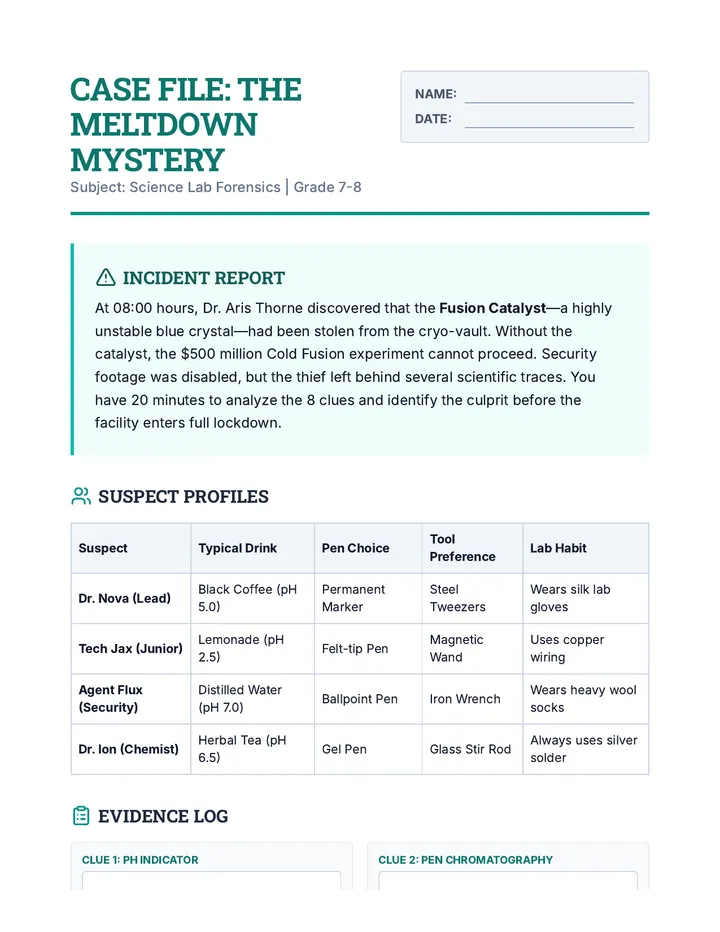
A series of high-stakes science laboratory mysteries designed for middle school students. Each mystery focuses on a specific branch of science (Biology, Physics, Chemistry, Geology, Ecology) and uses 8 forensic clues to solve a case.
A comprehensive one-week unit covering the foundations of cell theory, the technical mastery of microscopes, and the fascinating structures of unicellular organisms (Amoeba, Paramecium, Euglena, and Volvox).
A comprehensive physics unit covering the behavior of mechanical and electromagnetic waves. Students transition from hands-on slinky exploration to advanced optical modeling and mathematical derivations.
A 10-session Tier 2 intervention for 4th-grade students focused on vocabulary and comprehension, aligned with EL Education Module 2 (Animal Defenses). Students act as 'Defense Detectives' to investigate how animals survive in the wild.
A comprehensive collection of core science units covering Environmental Science, Biology, and Physical Science. This sequence provides high-impact instructional slides, hands-on lab experiences, guided notes, and differentiated assessments for five major scientific domains.
A five-day high school chemistry unit exploring thermochemistry, collision theory, enthalpy diagrams, and calorimetry through the lens of body heat and chemical reactions. Students investigate the anchoring phenomenon of exercise-induced heat while mastering TEKS C.13 standards.
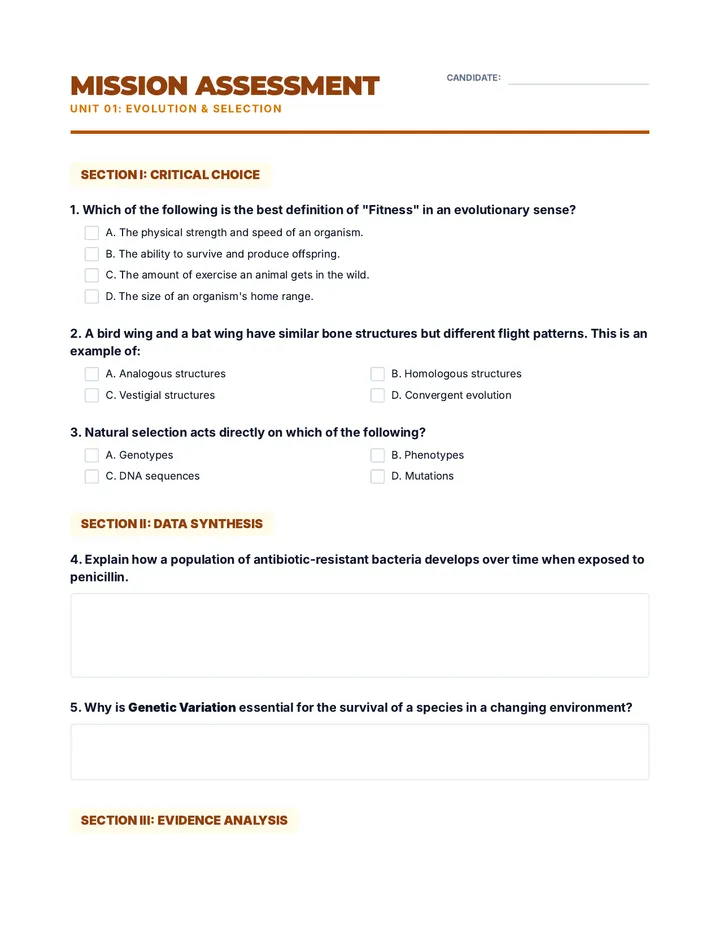
A high-intensity biology credit recovery program focused on high-yield standards: Evolution, Systems, Viruses, and Cellular Genetics.
This unit explores how chemical reactions occur and how they reach a state of balance. Students investigate reaction kinetics, energy changes, and the principles of dynamic equilibrium through modeling and laboratory investigation.
A four-part immersive crime scene investigation where 7th-grade students act as forensic detectives to solve the mystery of the missing Golden Whistle trophy. This sequence guides students through scene processing, fingerprinting, ink chromatography, and final evidence synthesis.
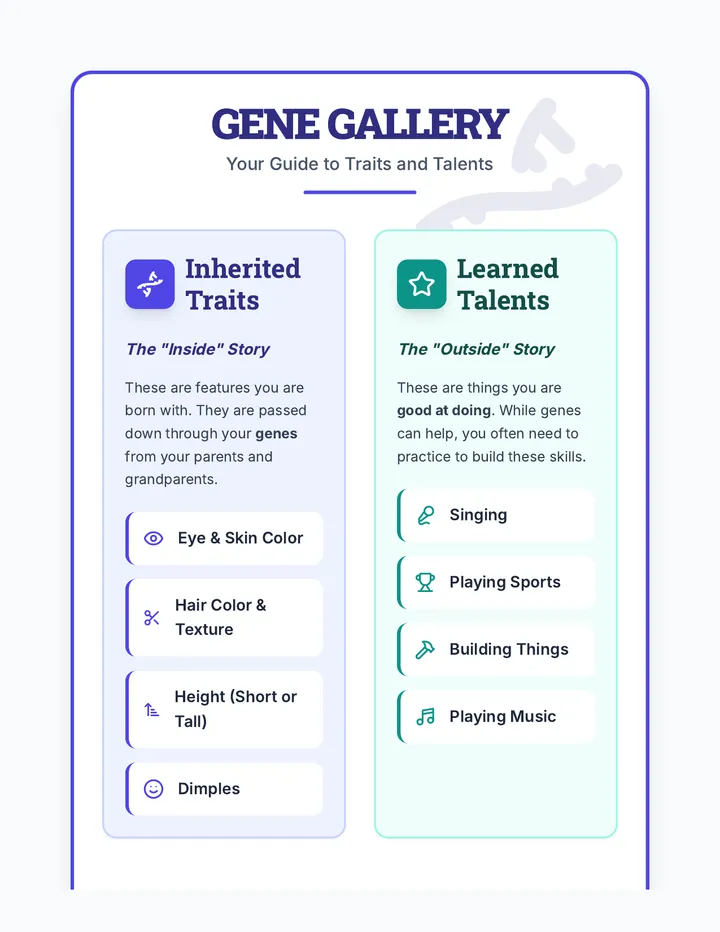
A comprehensive unit exploring inherited traits, talents, and character analysis through the lens of Kamal's story. Students will distinguish between genetic traits and learned talents, analyze character motivations, and document their own unique 'code'.
This sequence guides students through the Central Dogma of biology, exploring how genetic information flows from DNA to RNA and ultimately to functional proteins. Students will master molecular differences, the mechanics of transcription and translation, and the translation of genetic code into physical traits.
A project-based sequence for 1st grade students exploring how animal habitats provide essential needs for survival. Students learn about terrestrial and aquatic environments, engineering animal shelters, and culminating in a habitat diorama project.
A comprehensive Hi-Lo unit for 6th graders exploring the scale of the universe, our place in the Milky Way, the technology used to explore space, and the history of human spaceflight.
A series of lessons exploring the physics of fluids, including buoyancy, pressure, and fluid flow.
A series of phonics lessons focusing on vowel teams, digraphs, and other phonetic patterns through narrative passages and fluency drills.
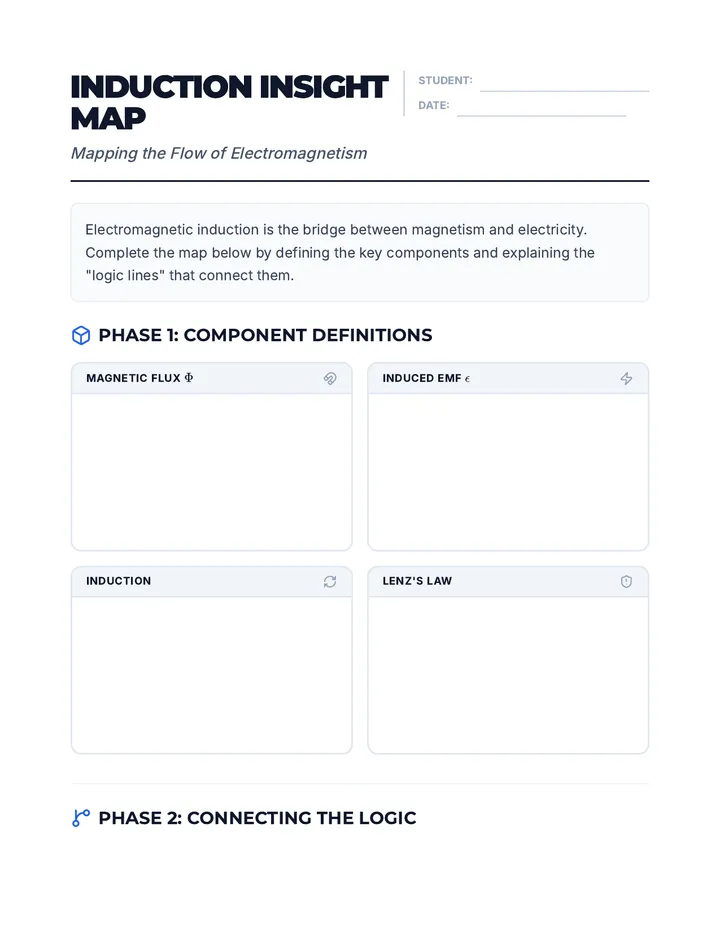
A 5-day intensive exploration of magnetic forces and fields, focusing on atomic-level causes, field interactions, and mathematical modeling of forces on charged particles. Students progress from anchoring phenomena to complex mathematical applications and a comprehensive unit review.
A comprehensive 5-lesson unit for 4th graders exploring the properties of light energy, including how it travels, reflects, refracts, and interacts with different materials.
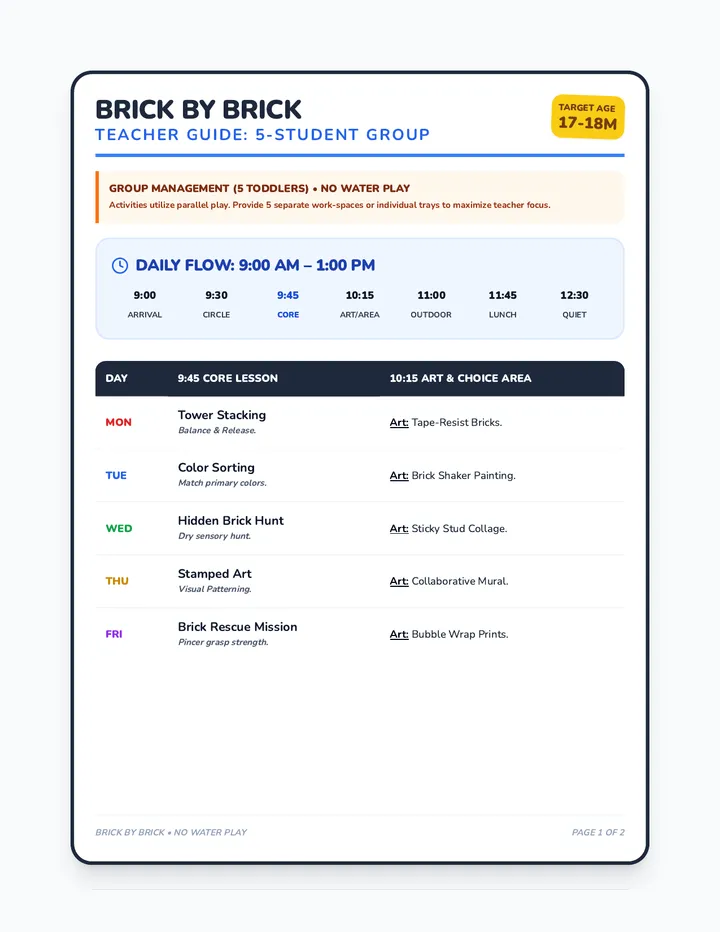
A collection of comprehensive week-long curricula for toddlers aged 17-18 months. Each themed week focuses on developmental play, sensory exploration, and fine motor skills for a group of 5 students with zero water play.
A partner-based research project for 9th-grade conceptual physics students focusing on diverse topics from celestial mechanics to the physics of dance. Students move through a structured research process with mandatory teacher checkpoints for source reliability.
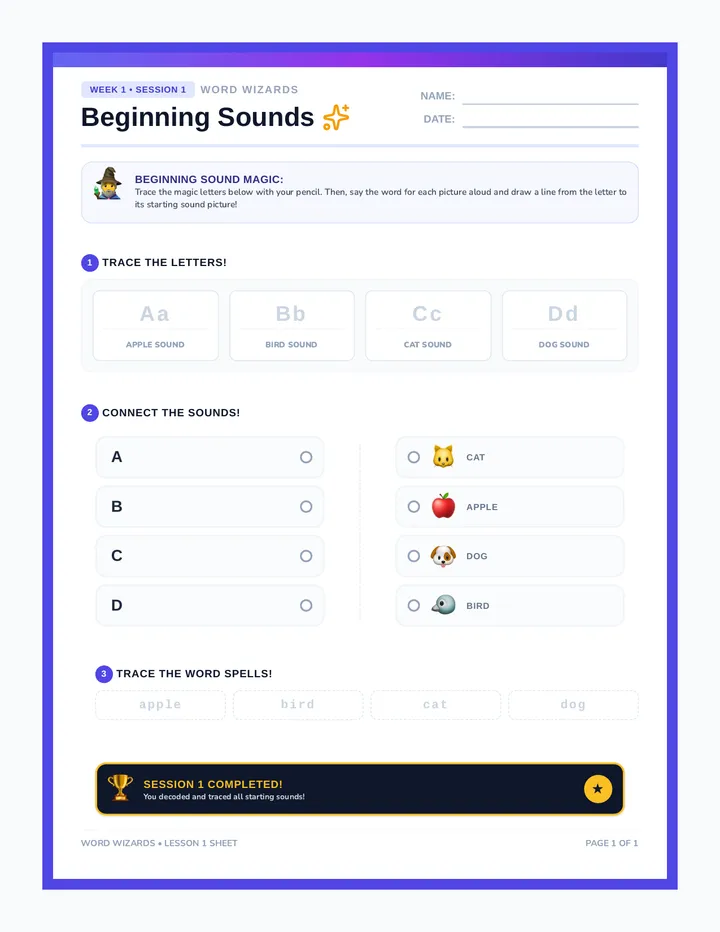
An engaging, high-impact 4-week literacy skills program for young learners. Features highly visual, fun printable worksheets focusing on beginning letter sounds, CVC phonics blending, sight word reading, and short stories.
A collection of highly visual, simplified resources designed for students with reading and word comprehension challenges to master the basics of Python programming.
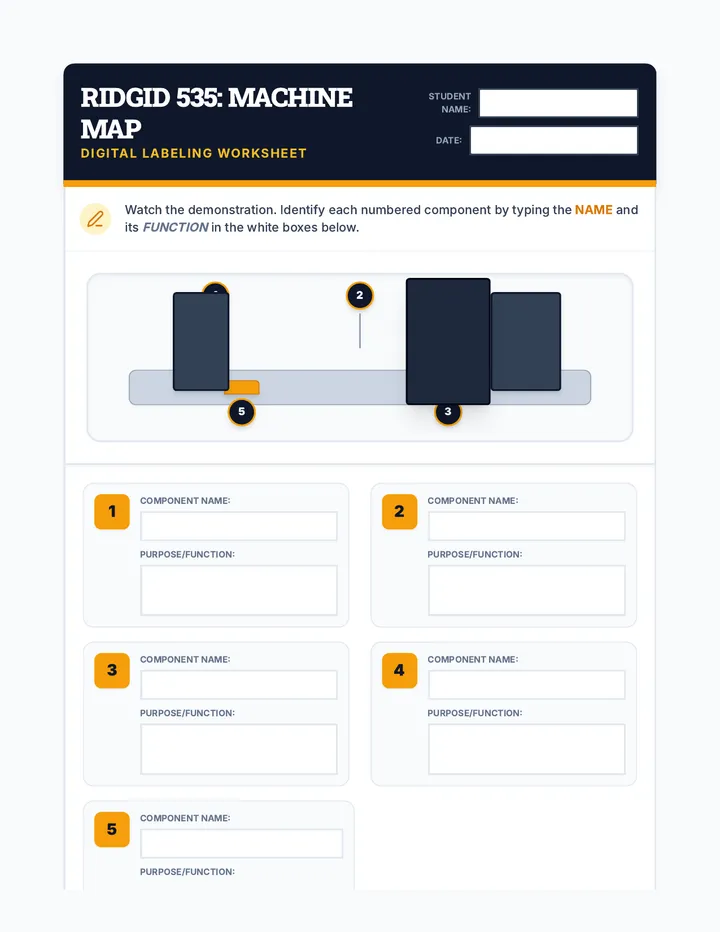
A 10-minute introductory lesson for 10th-grade students on the safe and basic operation of the Ridgid 535 pipe threader, focusing on safety protocols and component identification.
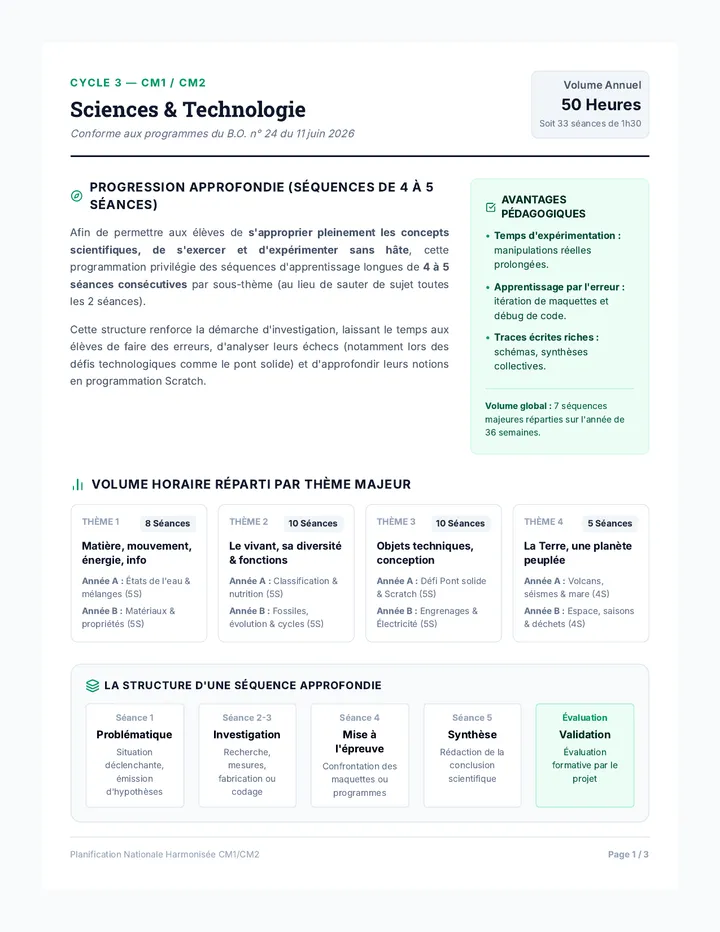
Outil de planification annuelle et de progression pour l'enseignement des sciences et technologies en classe de CM1/CM2, conforme au BO de juin 2026. Ce guide propose une répartition claire des volumes horaires et des thèmes entre l'année A et l'année B pour éviter les redondances dans les classes à double niveau.
A comprehensive 2-hour training focused on identifying emerging trends in prevention science and integrating them into evidence-based strategies to maximize community impact.
A three-day project-based lesson where 5th-grade students design, construct, and playtest board games centered on digital citizenship topics like cyberbullying, digital footprints, and online engagement tricks. Students collaborate with AI to brainstorm rules and use hands-on materials to build a playable physical game.
In this lesson, students explore the world of theme park engineering by identifying simple machines within famous attractions. They will apply their knowledge through a hands-on design challenge and a vocabulary matching game.
A comprehensive lesson for 5th graders covering the Artemis II mission, including crew details, mission goals, preparation, and its historical significance for future lunar exploration.
A comprehensive 45-minute lesson for 8th-grade students to critically analyze the ethical implications and potential risks of artificial intelligence through reading, discussion, and case scenarios.
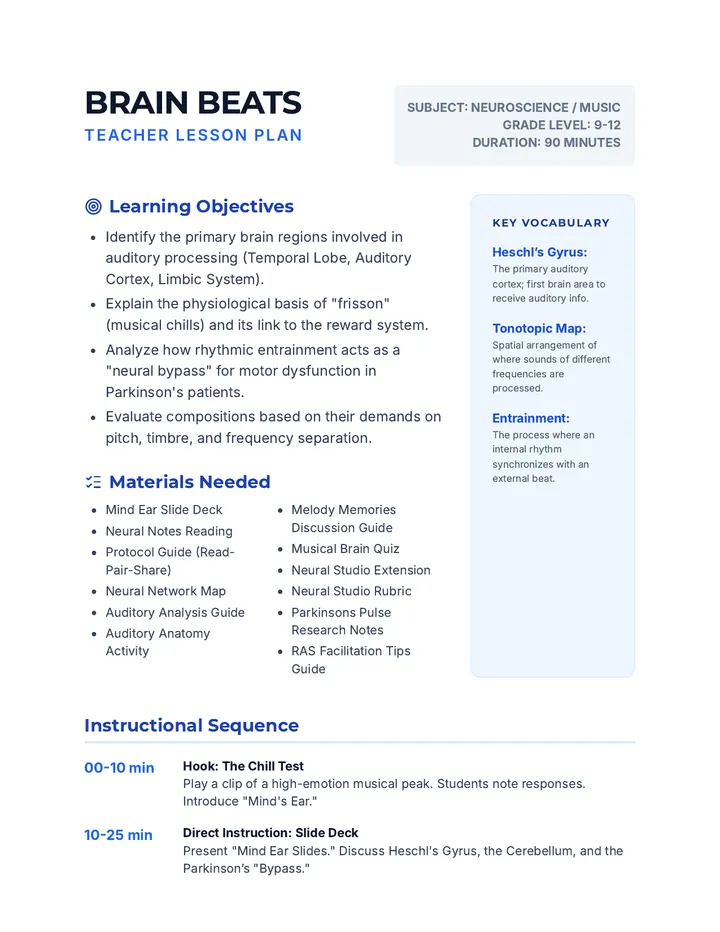
A high school lesson exploring the neuroscience of music, investigating how the brain processes auditory stimuli, triggers emotions, and encodes memories through melodies.
A high-stakes research project where students choose an environmental challenge to solve. Using the David Attenborough video as inspiration, students research, plan, and create a model or presentation to rescue our planet.
Une séance approfondie de 2 heures alignée sur le référentiel de compétences 2024, centrée sur la compétence "Rechercher et traiter des données professionnelles et scientifiques". La séance combine rigueur méthodologique, pratique intensive de la norme APA 7 et analyse critique de sources en soins infirmiers.
A foundational lesson exploring how energy moves through ecosystems, focusing on trophic levels, the 10% rule, and the complex connections in terrestrial and aquatic food webs.
A lesson focusing on the states of matter (solid, liquid, gas) and the behavior of particles at the molecular level. Students will model particle motion and arrangement, as well as the energy changes that drive phase transitions.
This lesson explores the fundamental properties of fluids, including the molecular differences between solids, liquids, and gases, the concept of density, and the characteristics of ideal fluids. Students will learn to distinguish states of matter through atomic interactions and apply the density formula to various substances.
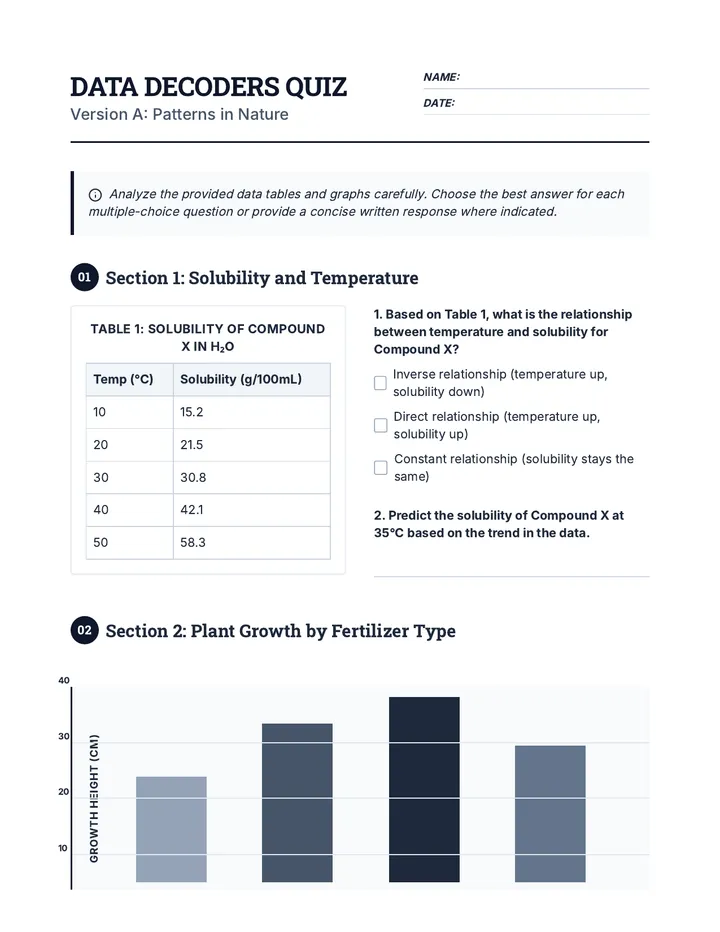
A high-stakes assessment focused on interpreting various scientific data representations, including tables, bar graphs, line graphs, and scatter plots. Students will analyze trends, identify variables, and draw conclusions from realistic scientific scenarios.
An immersive introduction to middle school science lab safety. Students analyze video content using interactive doodle notes, learn critical rules from two educational clips, and practice matching safety scenarios to key symbols in a hands-on sorting activity.
A high school biology quick lab exploring energy storage in biomolecules through the combustion of common foods representing carbohydrates, lipids, and proteins.
A comprehensive introduction to the Periodic Table, exploring how elements are organized by atomic number, the significance of groups and periods, and the distinct properties of metals, non-metals, and metalloids through real-world examples.
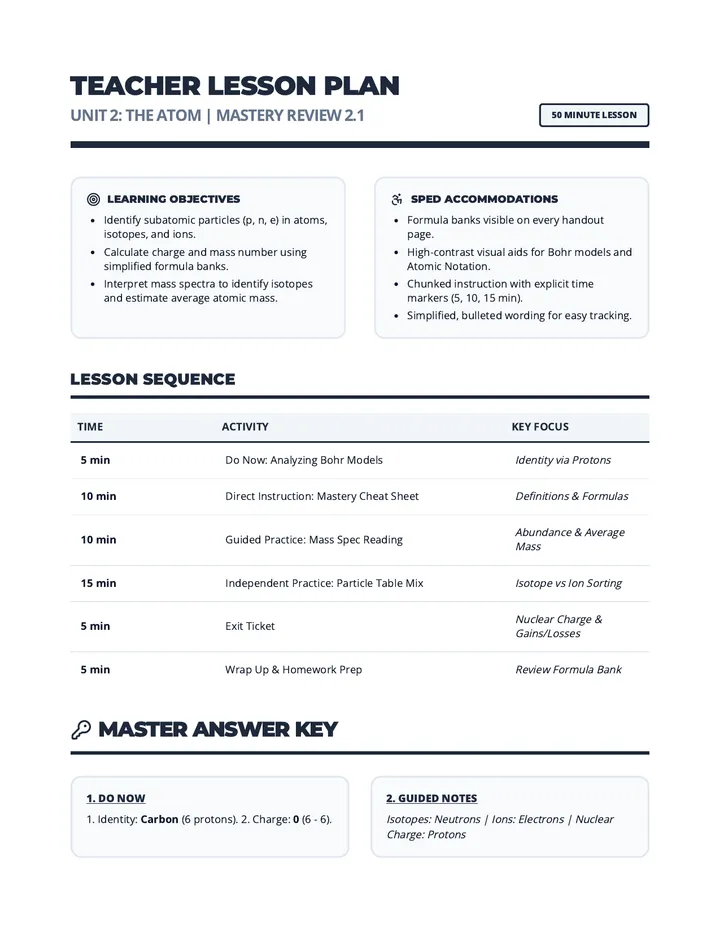
A comprehensive review lesson designed for high school special education students to master the concepts of atoms, isotopes, ions, and average atomic mass calculation using mass spectra. The lesson includes structured pacing from Do Now to Exit Ticket with heavy visual support and formula banks.
A foundational science lesson collection covering Earth systems and introductory biological concepts, life structures, and scientific organization.
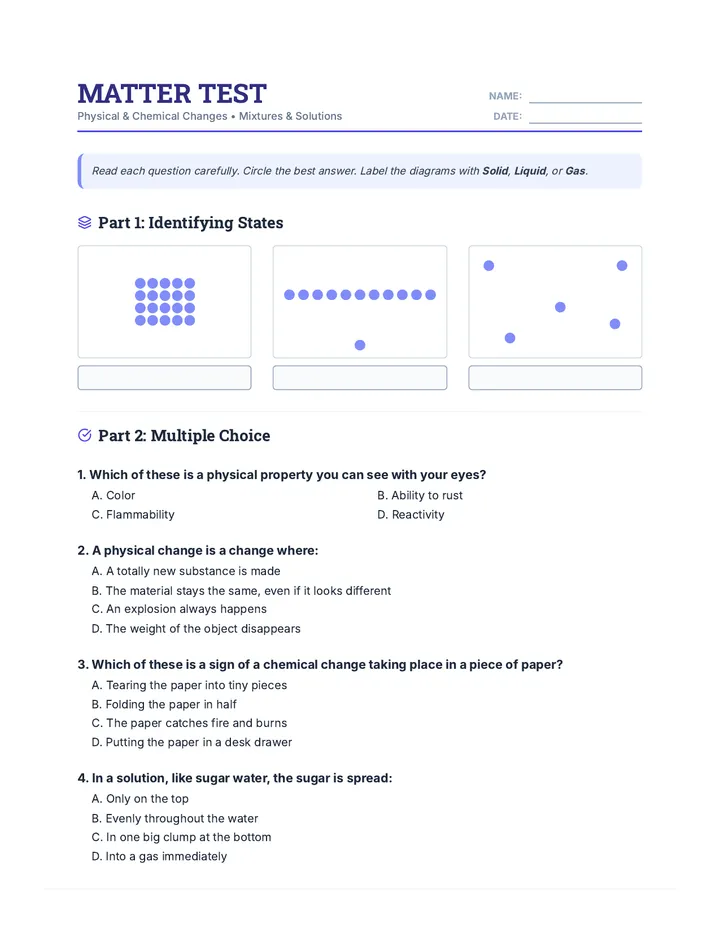
A comprehensive assessment for Grade 5 students covering physical and chemical properties, changes of state, and the characteristics of mixtures and solutions.
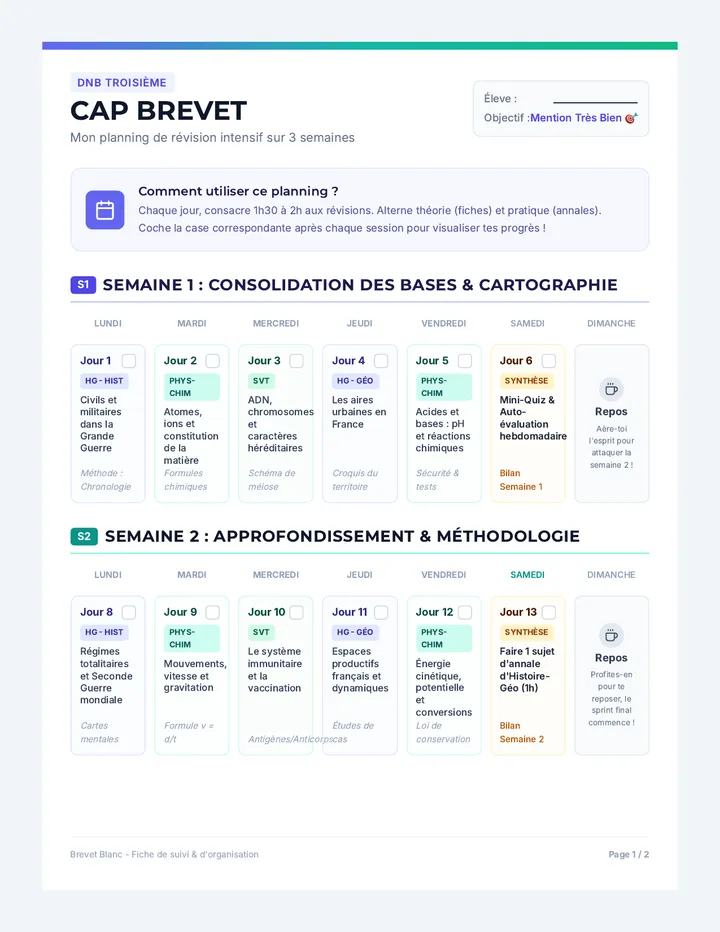
Un programme de révision intensif et structuré sur 3 semaines pour préparer sereinement les épreuves de SVT, Physique-Chimie et Histoire-Géographie du Diplôme National du Brevet.
A comprehensive lesson connecting nuclear chemistry (isotopes) to climate science (greenhouse gases, ice cores, and carbon dating). Students explore how atomic mass influences molecular vibrations and how isotope ratios serve as ancient thermometers.
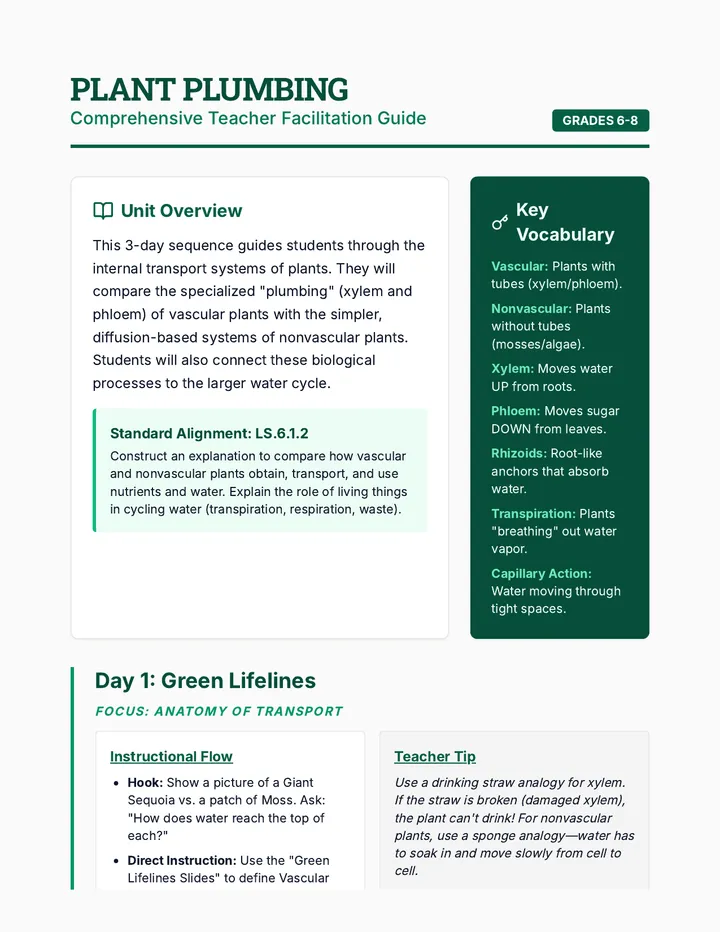
Focuses on the role of plants and animals in cycling water through ecosystems, specifically looking at transpiration and animal respiration/waste.
A comprehensive review lesson on the digestive system and enzyme function, focusing on the path of food, mechanical vs. chemical digestion, and enzyme specificity through interactive activities and guided notes.
A 50-minute lesson focusing on the CERNU conclusion framework (Claim, Evidence, Reasoning, Next steps, Unanswered questions). Students learn to analyze experimental data, connect claims to evidence, and formulate professional scientific conclusions using a detective-themed investigation approach.
A digital forensic escape room where students solve the mystery of a missing classroom phone by analyzing fingerprint evidence, identifying patterns, and matching minutiae.
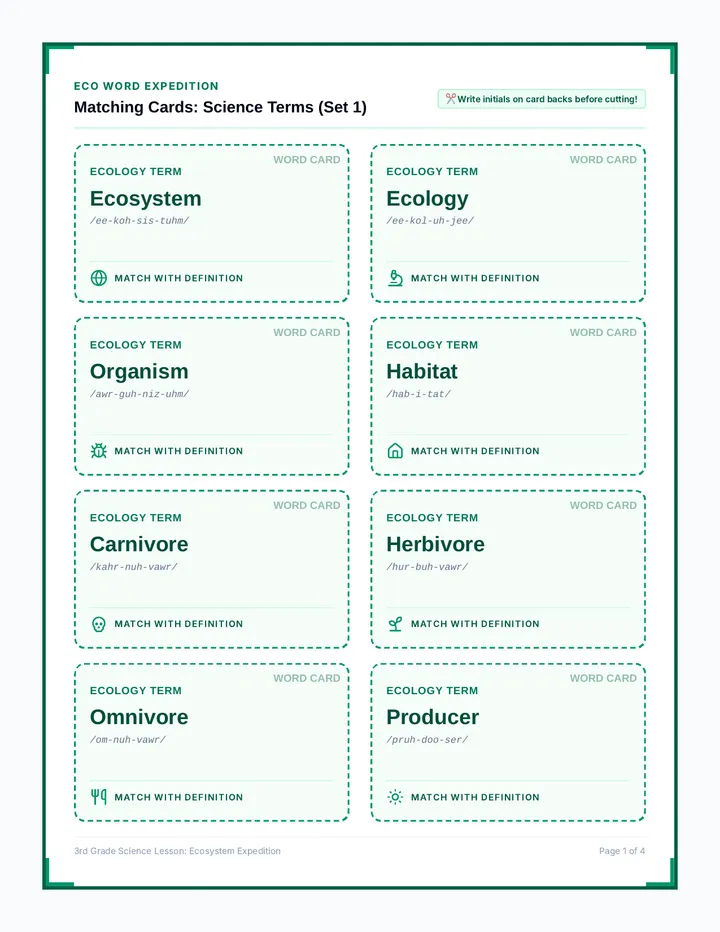
An interactive, visual vocabulary and prefix learning lesson designed specifically for 3rd-grade English Learners. Students explore key ecology terms and prefix combinations through hands-on illustrated cards, speaking scaffolds, and visual charts.
An immersive, hands-on lesson where students step into the role of 911 medical dispatchers. They analyze emergency calls to identify affected core body systems and rate the medical urgency of each scenario.
A creative project-based lesson where students research and design an educational poster about a specific global biome, focusing on adaptations, food webs, and conservation. Now expanded to include an informative research paper component.
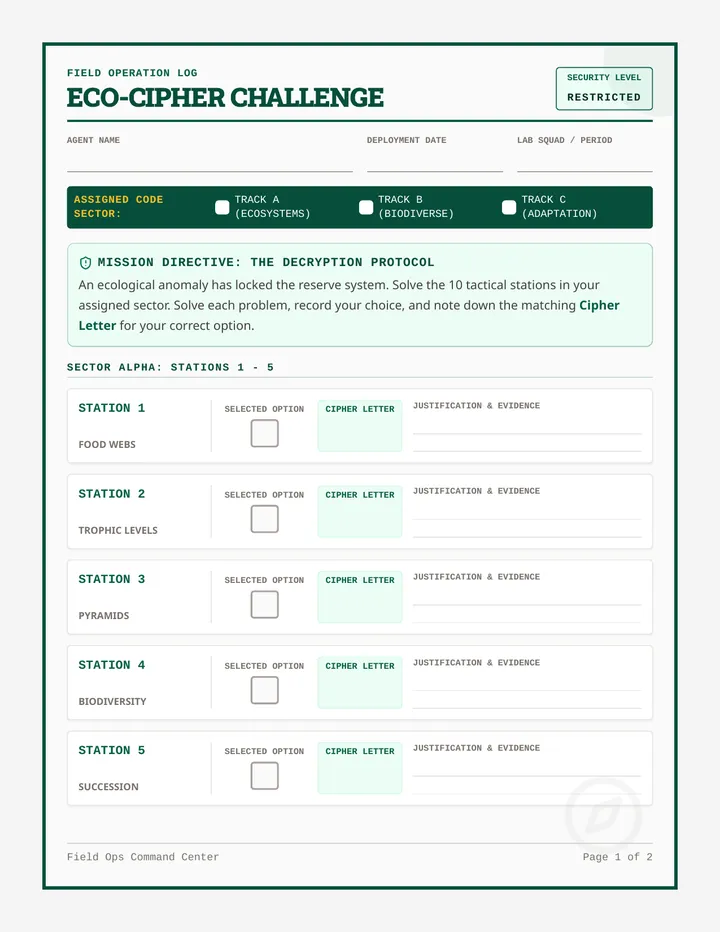
An interactive, station-based scavenger hunt where students solve ecological mysteries to decode a final ten-letter secret cipher ('ECOSYSTEMS'). Students review core concepts like food webs, trophic levels, symbiosis, succession, biomagnification, and populations.
A foundational lesson on the characteristics of life and the factors that shape ecological populations, designed to help students distinguish between living and non-living systems and understand environmental impacts.