Lenny.com
Explore
Create
ActivitiesNewMathEnglish Language ArtsScience & EngineeringSocial StudiesGlobal LanguagesHealth & Physical EducationSpecial EducationCounseling & Life SkillsArts & CreativityESL
Lenny.com
Lenny.com
Explore
Create
ActivitiesNewMathEnglish Language ArtsScience & EngineeringSocial StudiesGlobal LanguagesHealth & Physical EducationSpecial EducationCounseling & Life SkillsArts & CreativityESL
Lenny.com
Science & EngineeringLife ScienceLiving ThingsAnimalsPlantsBody SystemsTraitsAdaptationsCellsEcosystemsHeredityGenes to TraitsCell DivisionPhysicsComparing MaterialsShapes and PropertiesMagnetsMagnetismLightSoundLight and SoundMatterStates of MatterChanges of StateMixturesPhysical and Chemical ChangeHeating and CoolingHeat and Thermal EnergyEnergyForce and MotionElectrical CircuitsAtoms and MoleculesPeriodic TableMotion in One DimensionMotion in Two DimensionsScalars and VectorsForces and Laws of MotionCircular Motion and GravityMomentum and ImpulseWork, Energy, and PowerWavesElectromagnetic WavesGeometric OpticsElectricity and MagnetismSimple Harmonic MotionThermodynamicsNuclear PhysicsEarth Science & AstronomyWeatherWater CycleRocks and MineralsFossilsEarth's FeaturesEarth's ResourcesEarth's StructureWeather and ClimateEarth EventsFossils and Geologic TimePlate TectonicsHuman ImpactsAstronomyChemistryUnits and MeasurementAtomic StructurePeriodic TrendsChemical BondingNomenclatureMolecular StructureIntermolecular ForcesThe MoleStoichiometryProperties of GasesSolutionsChemical ReactionsBalancing EquationsEnergy ChangesRates of ReactionsEquilibriumAcids and BasesQuantum ModelBiologyClassificationCell StructureThe Chemistry of LifeBiomoleculesCellular TransportCell EnergyCell Growth and DivisionDNAProtein SynthesisMeiosis and Sexual ReproductionPatterns of InheritanceMulticellular OrganismsEvolutionEcologyBiodiversityComputer ScienceAlgorithms and Computational ThinkingProgramming LanguagesComputing SystemsNetworks and InternetData AnalysisCybersecurityAI and Machine LearningSoftware Design and DevelopmentBlockchainEngineering & AIDesigning ExperimentsEngineering PracticesDesign ThinkingEngineering Design ProcessMechanical EngineeringElectrical EngineeringMaterials and StructuresCAD and 3D DesignRoboticsArtificial Intelligence BasicsVibe CodingMachine LearningAI Ethics and SocietySystems ThinkingEntrepreneurship & InnovationEntrepreneurial MindsetBusiness Idea DevelopmentBusiness Plan BasicsMarketing & Customer DiscoveryFinancial Management for Startups

Chemical Reactions

Principles of stoichiometry, reaction types, and thermodynamic properties of molecular interactions. Identifies patterns in chemical changes and predicts products using balanced equations.

Lenny.com

Solutions

Lenny for EducatorsLenny for SchoolsLenny for Districts

Product

ExploreSign inCreateSupportAbout

Resources

Getting startedMTSS Acceleration Program

© 2026 Lenny Learning Inc.

TermsPrivacyAccessibility
LinkedInInstagramX
Lenny

Videos

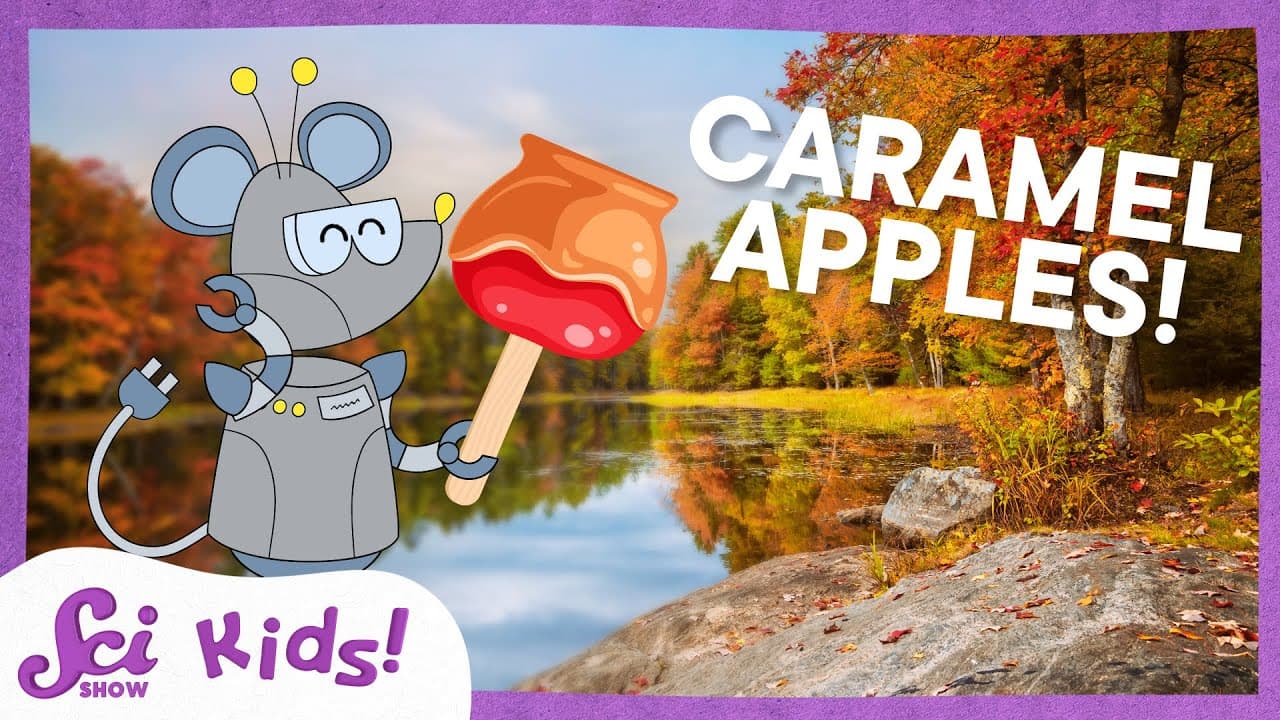
How to Make Caramel Apples and Learn Chemistry

How to Make Caramel Apples and Learn Chemistry

In this engaging episode of Sci Kids!, host Jessi and her puppet friend Sam explore the chemistry behind cooking by making caramel apples. The video introduces the concept of the Maillard reaction, a chemical process responsible for the browning and flavor development in cooked foods. Through the practical application of making caramel, students learn that cooking is essentially a form of edible science that requires specific ingredients (proteins and sugars) and conditions (heat) to work.

SciShow KidsSciShow Kids

7mins 1s

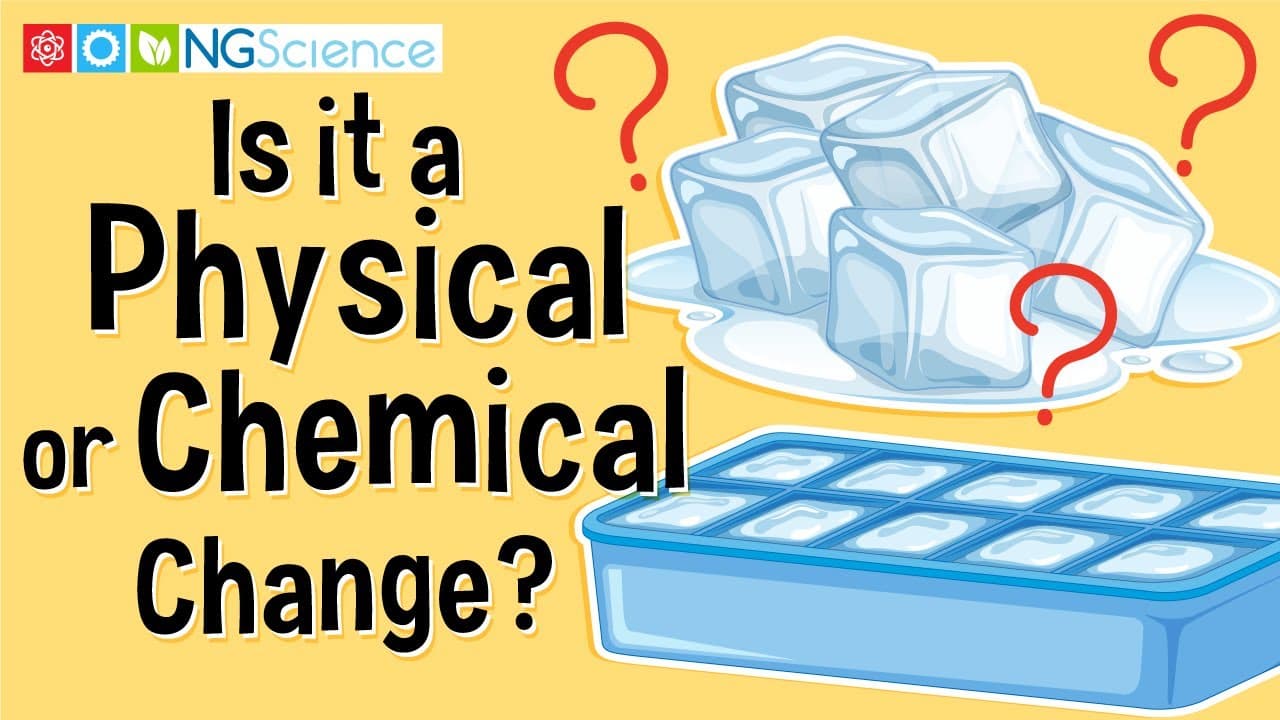
Identifying Physical and Chemical Changes: Real-World Examples

Identifying Physical and Chemical Changes: Real-World Examples

This video serves as a comprehensive visual encyclopedia of physical and chemical changes, demonstrating 16 different real-world examples without the need for voiceover narration. Through clear, high-quality close-ups, it contrasts simple physical alterations—like cutting, crushing, and mixing—with chemical reactions that produce new substances, such as burning, cooking, and fizzing. Each scene is explicitly labeled as either a "Physical Change" or "Chemical Change," allowing students to test their knowledge immediately. The content explores fundamental chemistry themes including states of matter, reversibility, and the evidence of chemical reactions. It visually highlights key indicators of chemical changes, such as the release of gas (bubbles), production of light and heat, and irreversible color changes (toasting bread, cooking an egg). Conversely, it reinforces that physical changes affect form or appearance but do not alter the chemical identity of the substance, demonstrated through dissolving, melting, and changing shape. For educators, this video is a versatile tool for both introduction and assessment. It can be used as a "silent starter" where students must predict the type of change before the label appears, or as a review station in a science rotation. The absence of narration allows teachers to pause and facilitate rich discussions about the *evidence* observed in each clip, making it adaptable for various grade levels and language learners.
Next Generation ScienceNext Generation Science

7mins 26s

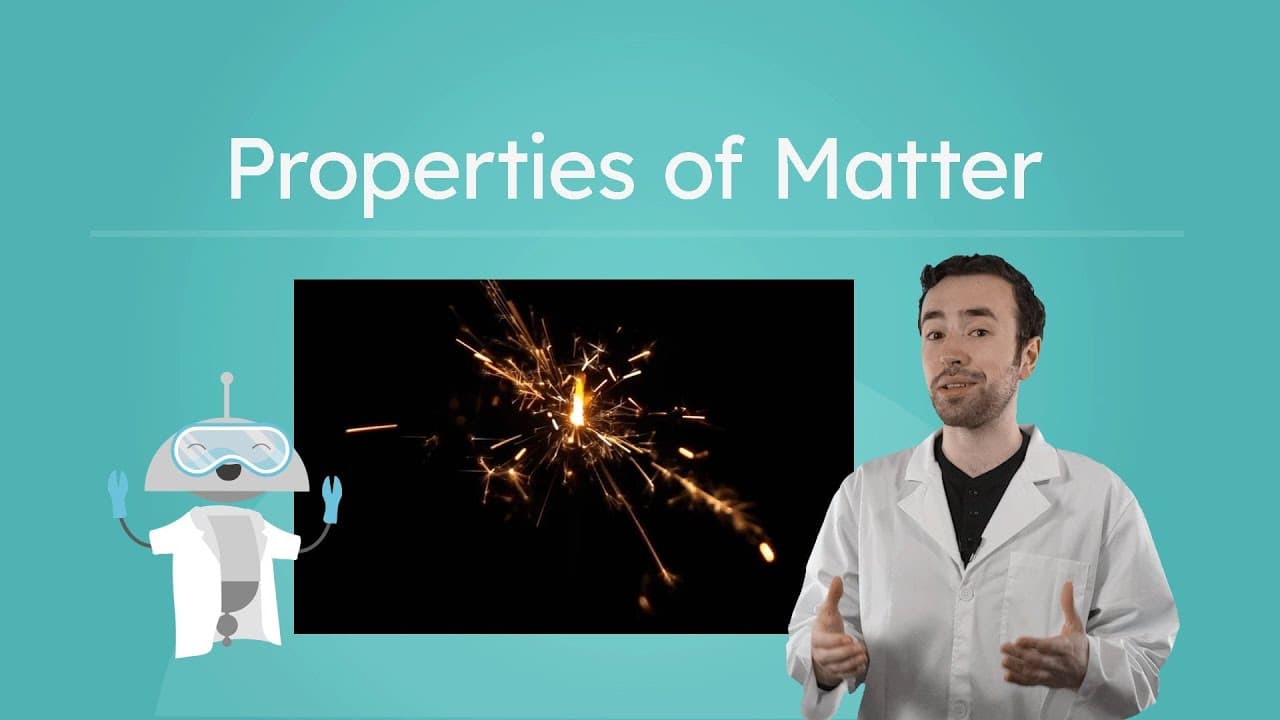
Exploring Physical and Chemical Properties of Matter

Exploring Physical and Chemical Properties of Matter

This engaging science video introduces students to the fundamental properties of matter through the narrative lens of a scientist named Justin who is trying to build a rocket ship. By framing the scientific concepts as necessary knowledge for selecting the right construction materials, the video gives a practical context to abstract definitions. It covers the crucial distinction between physical properties—traits that can be observed without changing the substance—and chemical properties, which describe how a substance changes into something new.

Miacademy & MiaPrep Learning ChannelMiacademy & MiaPrep Learning Channel

8mins 57s

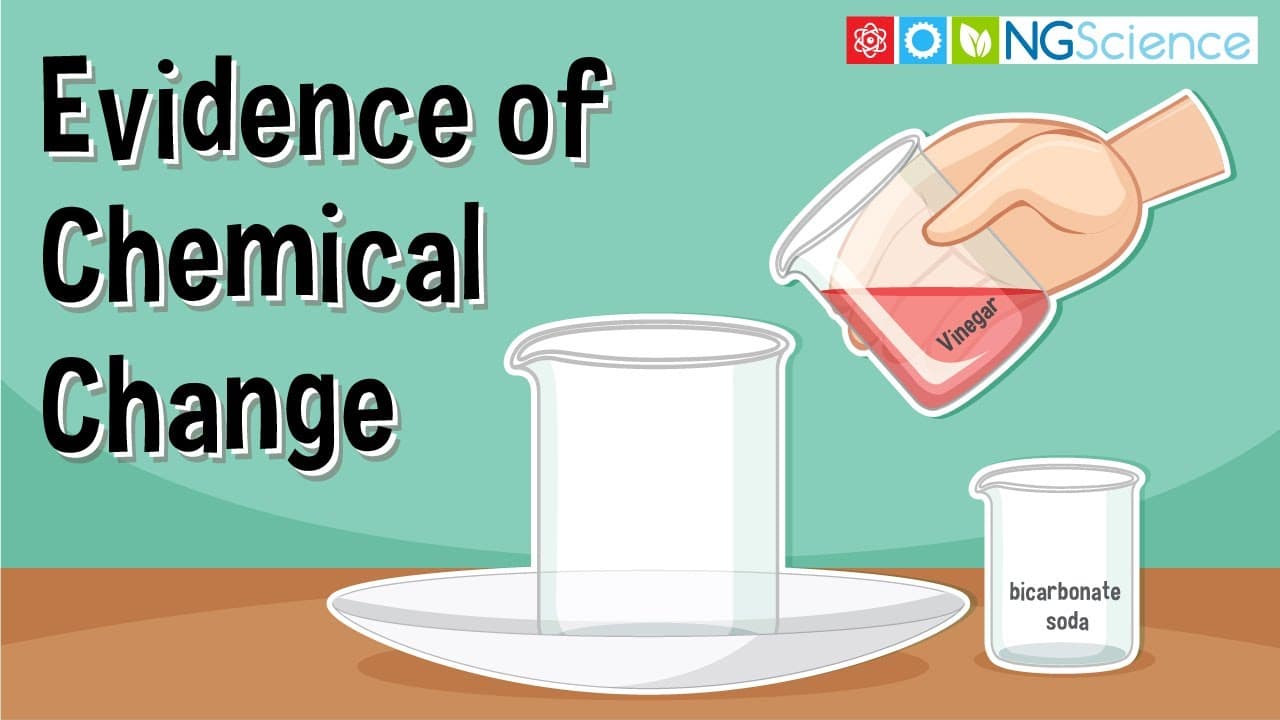
Observing Chemical Changes with Vinegar and Soda

Observing Chemical Changes with Vinegar and Soda

This concise science demonstration illustrates the concept of chemical change through a classic reaction between vinegar and bicarbonate soda. The video guides viewers through the experimental setup, clearly showing the reactants before mixing and the dramatic reaction that follows. It specifically highlights the formation of carbon dioxide gas as the key evidence that a chemical change has occurred, making the abstract concept visible and concrete. Key themes include the properties of matter, distinguishing between physical and chemical changes, and observing scientific phenomena. The video introduces essential vocabulary such as "chemical change," "evidence," and specific chemical names like "bicarbonate soda" and "carbon dioxide," linking the visual bubbling action directly to the creation of a new substance. For educators, this video serves as an excellent "phenomenon anchor" to kick off a unit on chemistry or matter. It allows students to practice prediction and observation skills without the immediate mess of a live experiment, or as a prelude to conducting the experiment themselves. The clear visual separation of ingredients followed by the immediate reaction provides a perfect opportunity to discuss cause and effect in scientific inquiries.

Next Generation ScienceNext Generation Science

1min 5s

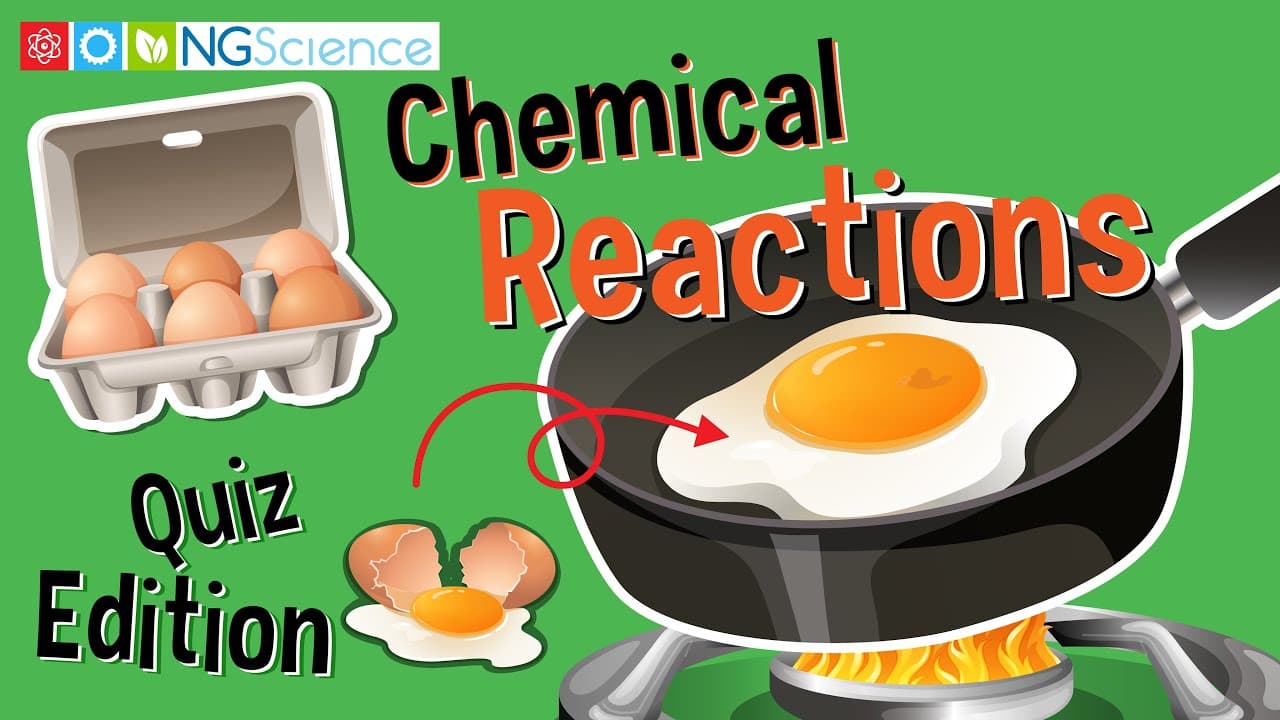
Everyday Chemical Reactions: From Cooking to Fireworks

Everyday Chemical Reactions: From Cooking to Fireworks

This engaging educational video introduces students to the concept of chemical reactions by exploring how they occur in everyday life. Through relatable examples like cooking an egg, baking a cake, and watching fireworks, the narration explains how substances combine and transform into something new. The video breaks down complex chemical processes into observable phenomena, highlighting the key indicators of reactions such as color changes, gas production (bubbles), heat, and light. The content covers a wide range of scientific themes, including physical vs. chemical changes, the role of heat in reactions, biological processes like digestion and photosynthesis, and oxidation (rusting). It specifically addresses how distinct elements like oxygen, carbon dioxide, and various metals play roles in these transformations. The video creates connections between the chemistry laboratory and the real world, showing that science is happening constantly in our bodies and environments. For educators, this resource serves as an excellent introduction or review tool for a unit on matter and chemical changes. The visual demonstrations provide concrete evidence for abstract concepts, making them accessible to elementary and middle school students. The video concludes with a comprehensive 12-question quiz, making it a ready-to-use lesson that includes direct assessment of student understanding.

Next Generation ScienceNext Generation Science

6mins 54s

How Gas Formation Indicates Chemical Change

How Gas Formation Indicates Chemical Change

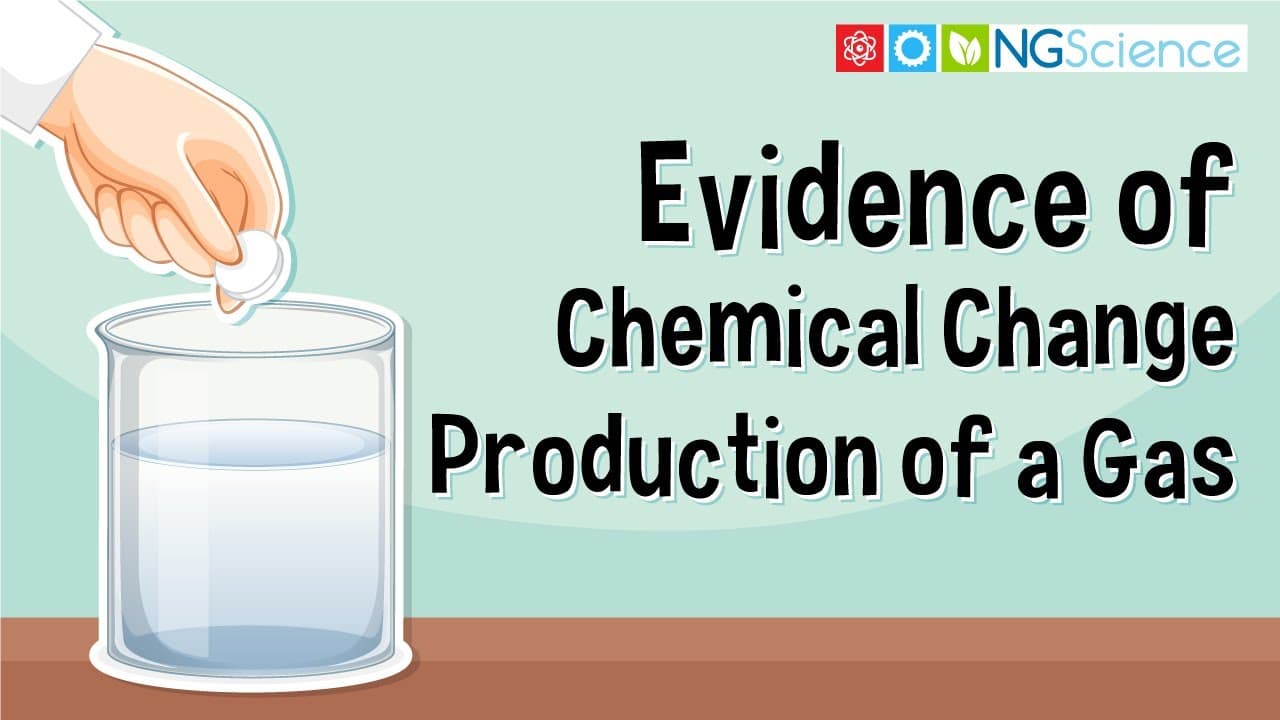
This concise educational video demonstrates a fundamental chemistry concept through a simple, observable experiment: dropping an antacid tablet into water. The video clearly captures the immediate reaction between the tablet and the water, highlighting the production of bubbles as a key visual indicator that a reaction is taking place. The content focuses on identifying evidence of chemical changes, specifically singling out "fizzing" and "gas formation" as the primary proofs. By using a familiar household item like an antacid tablet, it makes the abstract concept of chemical reactions accessible and relatable to young students who may have seen this phenomenon before without understanding the science behind it. For educators, this video serves as an excellent visual anchor for units on states of matter or introduction to chemistry. It provides a safe, clear, and repeatable demonstration that helps students distinguish between physical changes (like dissolving) and chemical changes (which create new substances, such as gas). It is ideal for training students in scientific observation and conclusion drawing.

Next Generation ScienceNext Generation Science

1min 9s

Materials

Banana Ripening Lab Worksheet

Banana Ripening Lab Worksheet

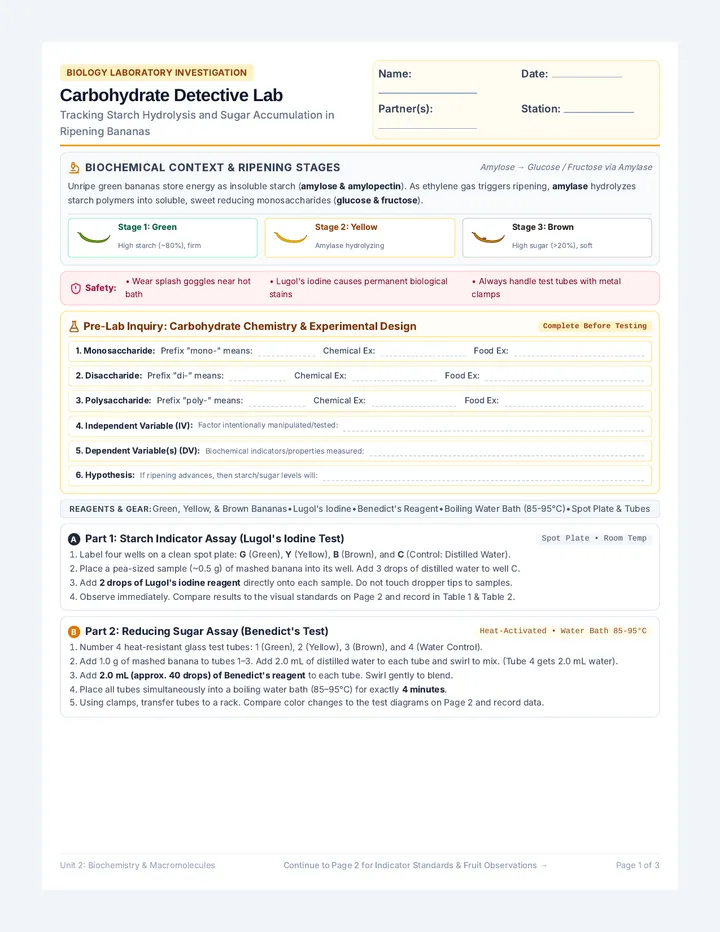
A comprehensive three-page student laboratory investigation worksheet examining carbohydrate changes across banana ripening stages, updated with 12px font sizing for enhanced legibility across instructional text, headers, and metadata, complete with visual indicator standards, photographic observation tables, and a NYS Regents biology item cluster with quantitative data and a student bar graphing grid.

S

stewart

Mystery Milk Lab Worksheet

Mystery Milk Lab Worksheet

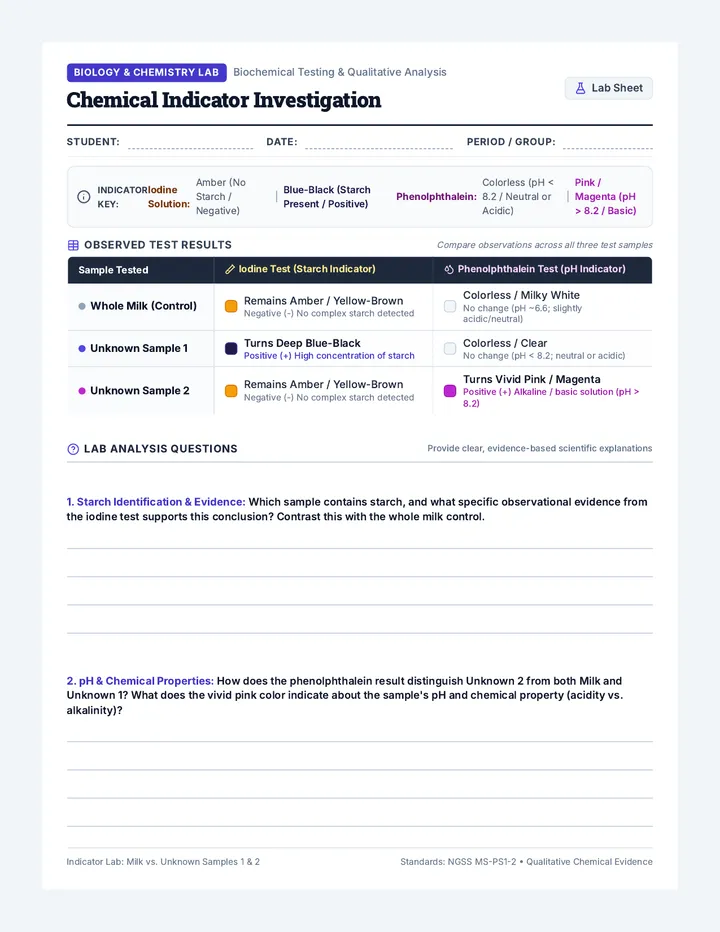
A laboratory analysis worksheet featuring an observation chart comparing milk, Unknown 1, and Unknown 2 tested with iodine and phenolphthalein. Includes an indicator reference key and two comprehensive analysis questions with ample student response lines.

S

stewart

Fizz Factor Lab Handout

Fizz Factor Lab Handout

A student-friendly, print-ready 2-page lab handout testing how water temperature affects Alka-Seltzer dissolving time. Features student-driven identification of independent, dependent, and controlled variables, plus a blank graphing activity where students label the title, axes, and plot their results.

S

stewart

Chemical Formulas Worksheet

Chemical Formulas Worksheet

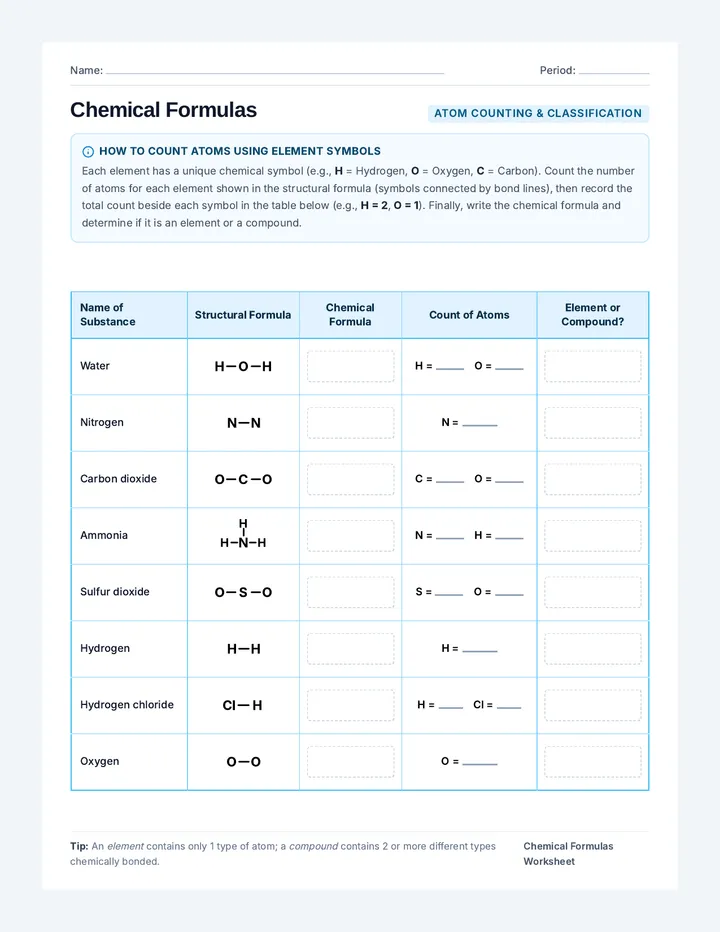
A chemistry worksheet for identifying chemical formulas, counting atoms beside element symbols using structural formulas with bond lines, and classifying substances as elements or compounds.

SH

Sarah Hale

Matter Mastery Review Worksheet

Matter Mastery Review Worksheet

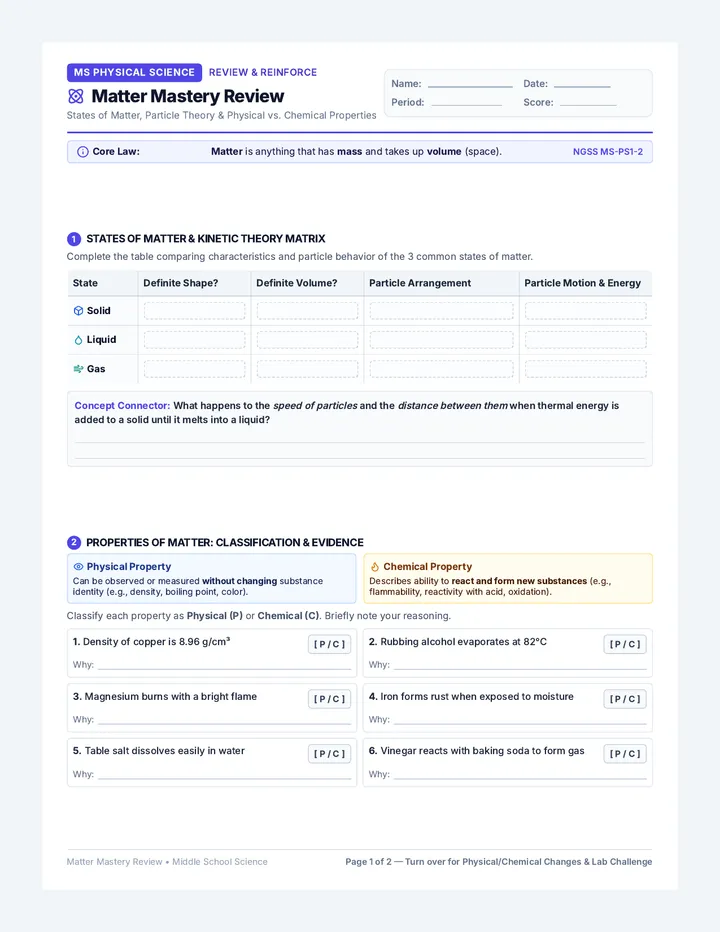
A comprehensive, two-page middle school review worksheet covering the three states of matter, particle motion, physical versus chemical properties, real-world physical and chemical change scenarios, and a Claim-Evidence-Reasoning laboratory challenge.

LP

LeShonda Price

Quimica de la Vida Examen

Quimica de la Vida Examen

Examen de química de la vida para 8.º grado con el título en inglés seguido de la indicación 'Spanish Translation' (Chemistry of Life Vocabulary Exam — Spanish Translation), manteniendo el encabezado institucional en inglés y el contenido íntegramente en español.

JE

Jeffrey Elterman

Sequences

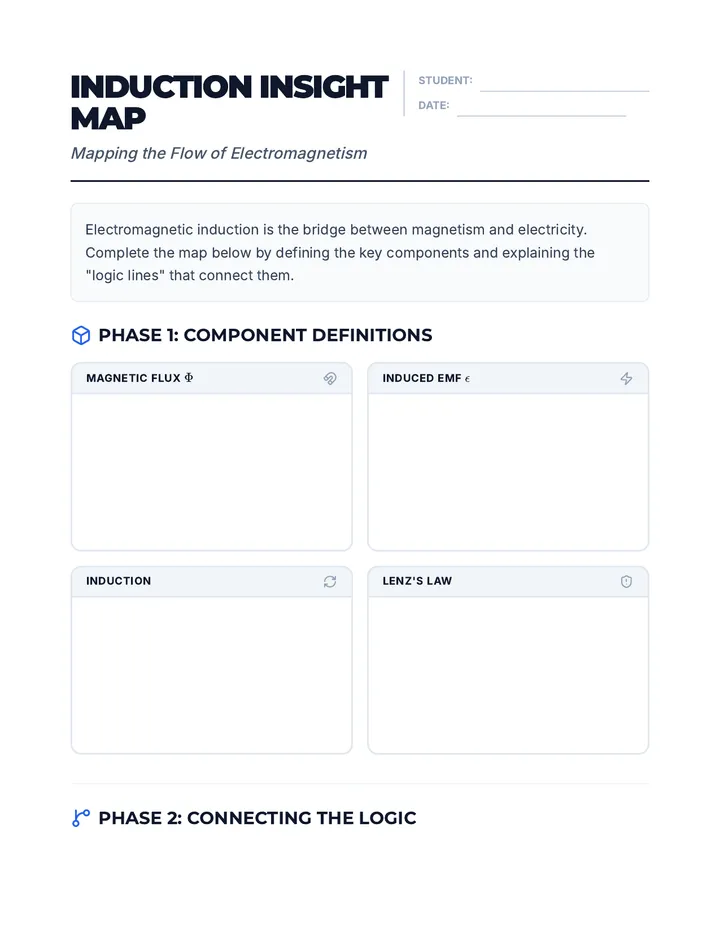
Induction Insight Map Handout

Magnetic Forces Investigation

A 5-day intensive exploration of magnetic forces and fields, focusing on atomic-level causes, field interactions, and mathematical modeling of forces on charged particles. Students progress from anchoring phenomena to complex mathematical applications and a comprehensive unit review.

OM

Olutoyin Makinde

68
Climate Crisis Slides

Science Essentials Vault

A comprehensive collection of core science units covering Environmental Science, Biology, and Physical Science. This sequence provides high-impact instructional slides, hands-on lab experiences, guided notes, and differentiated assessments for five major scientific domains.

CB

Chloe Brown

25
Hess Pathfinders Slides

Energy in Chemical Bonds

A five-day high school chemistry unit exploring thermochemistry, collision theory, enthalpy diagrams, and calorimetry through the lens of body heat and chemical reactions. Students investigate the anchoring phenomenon of exercise-induced heat while mastering TEKS C.13 standards.

OM

Olutoyin Makinde

48
Pressure Poster Workshop Handout

Pressure Power

A comprehensive 5-day chemistry unit investigating the relationships between gas pressure, volume, temperature, and moles using lab inquiries, mathematical modeling, and real-world applications.

OM

Olutoyin Makinde

69
KMT Field Manual Packet

Molecular Mayhem Gas Unit

A 10-day exploration of the Behavior of Gases using Kinetic Molecular Theory, various gas laws, and real-world phenomena to understand gas behavior at both molecular and macroscopic scales. Students will investigate compressibility, gas variables, ideal behavior, and mixtures.

OM

Olutoyin Makinde

26
Steady State Slides

Reaction Dynamics

This unit explores how chemical reactions occur and how they reach a state of balance. Students investigate reaction kinetics, energy changes, and the principles of dynamic equilibrium through modeling and laboratory investigation.

OM

Olutoyin Makinde

34

Lessons

Heat Flow Teacher Guide

Particle Behavior Review

A lesson focusing on the states of matter (solid, liquid, gas) and the behavior of particles at the molecular level. Students will model particle motion and arrangement, as well as the energy changes that drive phase transitions.

EA

Erica Andre

54
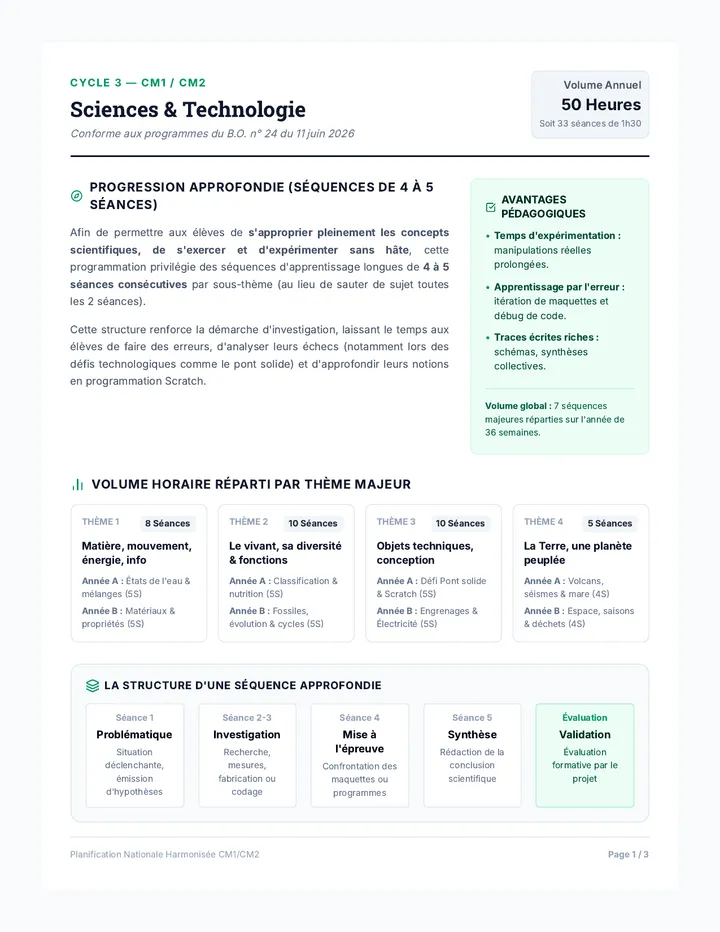
Tableau Progression Annuelle Sciences CM

Progression Sciences CM1 CM2

Outil de planification annuelle et de progression pour l'enseignement des sciences et technologies en classe de CM1/CM2, conforme au BO de juin 2026. Ce guide propose une répartition claire des volumes horaires et des thèmes entre l'année A et l'année B pour éviter les redondances dans les classes à double niveau.

LP

LAURENT PERCHE

40
Flow State Reading Guide Expanded

Flow State

This lesson explores the fundamental properties of fluids, including the molecular differences between solids, liquids, and gases, the concept of density, and the characteristics of ideal fluids. Students will learn to distinguish states of matter through atomic interactions and apply the density formula to various substances.

CM

Chuguna Murugesan

33
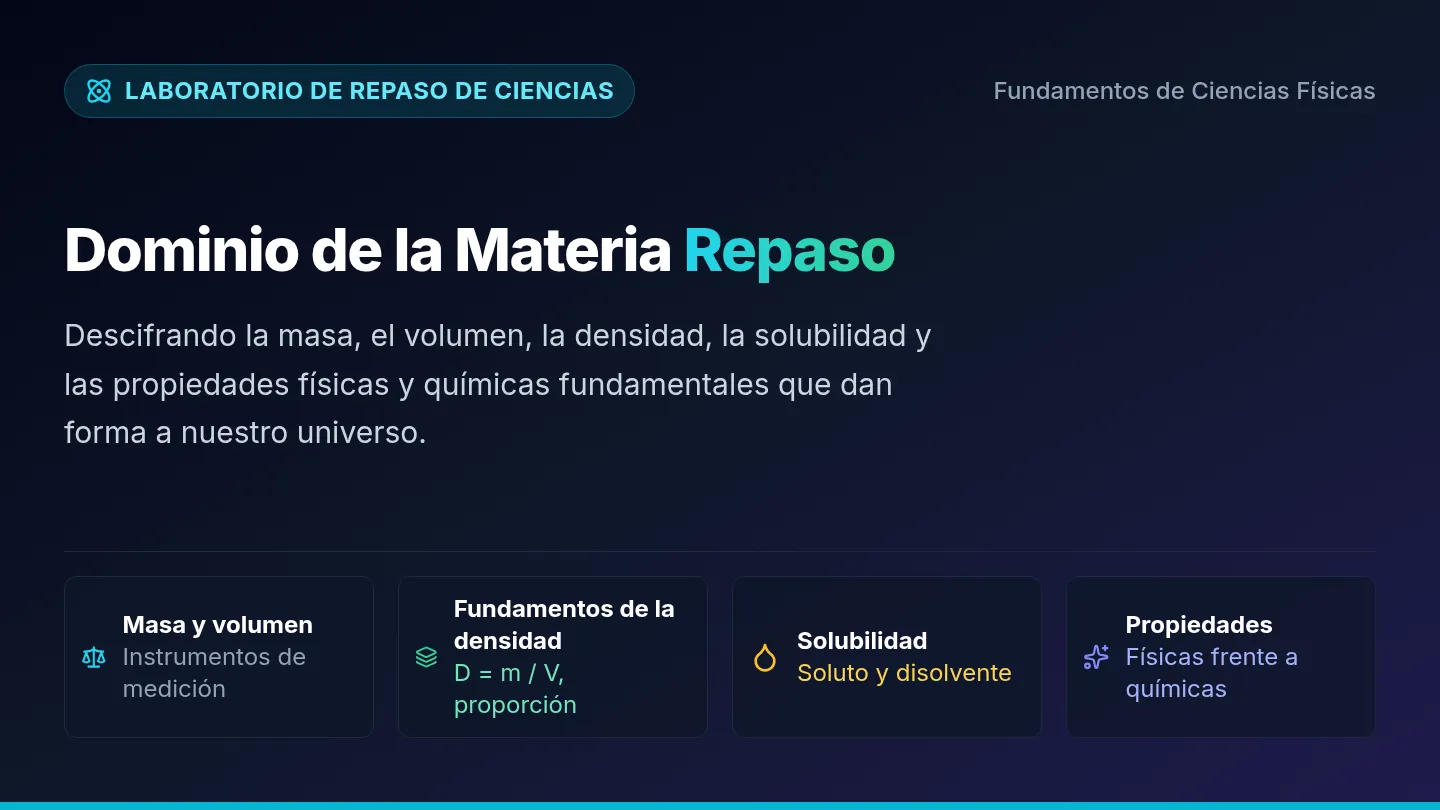
Matter Mastery Slides

Matter Mastery Review

A comprehensive review lesson on the properties of matter, mass, volume, density, temperature, solubility, and physical versus chemical changes. Features interactive instruction, scaffolded guided notes, mixed-format practice, and assessment.

MN

Monica Nicolas

9
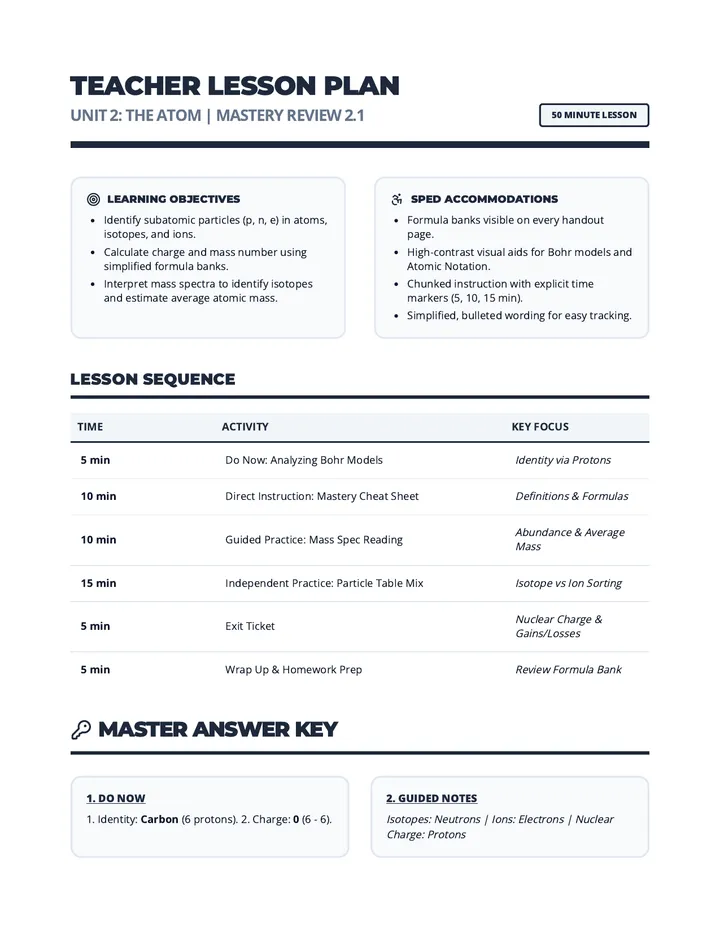
Atom Academy Lesson Plan Teacher Guide

Atom Academy Review

A comprehensive review lesson designed for high school special education students to master the concepts of atoms, isotopes, ions, and average atomic mass calculation using mass spectra. The lesson includes structured pacing from Do Now to Exit Ticket with heavy visual support and formula banks.

D

david.marques

6
Earth Systems Explorer Slides

Science Foundations

A foundational science lesson collection covering Earth systems and introductory biological concepts, life structures, and scientific organization.

SH

SaDiedrah Harris

9