Lenny.com
Explore
Create
ActivitiesNewMathEnglish Language ArtsScience & EngineeringSocial StudiesGlobal LanguagesHealth & Physical EducationSpecial EducationCounseling & Life SkillsArts & CreativityESL
Lenny.com
Lenny.com
Explore
Create
ActivitiesNewMathEnglish Language ArtsScience & EngineeringSocial StudiesGlobal LanguagesHealth & Physical EducationSpecial EducationCounseling & Life SkillsArts & CreativityESL
Lenny.com
Lenny.com

Solutions

Lenny for EducatorsLenny for SchoolsLenny for Districts

Product

ExploreSign inCreateSupportAbout

Resources

Getting startedMTSS Acceleration Program

© 2026 Lenny Learning Inc.

TermsPrivacyAccessibility
LinkedInInstagramX
Lenny

States of Matter

Physical properties of solids, liquids, and gases focusing on molecular motion and kinetic energy. Addresses phase transitions, including melting, freezing, and vaporization.

Science & EngineeringLife ScienceLiving ThingsAnimalsPlantsBody SystemsTraitsAdaptationsCellsEcosystemsHeredityGenes to TraitsCell DivisionPhysicsComparing MaterialsShapes and PropertiesMagnetsMagnetismLightSoundLight and SoundMatterStates of MatterChanges of StateMixturesPhysical and Chemical ChangeHeating and CoolingHeat and Thermal EnergyEnergyForce and MotionElectrical CircuitsAtoms and MoleculesPeriodic TableMotion in One DimensionMotion in Two DimensionsScalars and VectorsForces and Laws of MotionCircular Motion and GravityMomentum and ImpulseWork, Energy, and PowerWavesElectromagnetic WavesGeometric OpticsElectricity and MagnetismSimple Harmonic MotionThermodynamicsNuclear PhysicsEarth Science & AstronomyWeatherWater CycleRocks and MineralsFossilsEarth's FeaturesEarth's ResourcesEarth's StructureWeather and ClimateEarth EventsFossils and Geologic TimePlate TectonicsHuman ImpactsAstronomyChemistryUnits and MeasurementAtomic StructurePeriodic TrendsChemical BondingNomenclatureMolecular StructureIntermolecular ForcesThe MoleStoichiometryProperties of GasesSolutionsChemical ReactionsBalancing EquationsEnergy ChangesRates of ReactionsEquilibriumAcids and BasesQuantum ModelBiologyClassificationCell StructureThe Chemistry of LifeBiomoleculesCellular TransportCell EnergyCell Growth and DivisionDNAProtein SynthesisMeiosis and Sexual ReproductionPatterns of InheritanceMulticellular OrganismsEvolutionEcologyBiodiversityComputer ScienceAlgorithms and Computational ThinkingProgramming LanguagesComputing SystemsNetworks and InternetData AnalysisCybersecurityAI and Machine LearningSoftware Design and DevelopmentBlockchainEngineering & AIDesigning ExperimentsEngineering PracticesDesign ThinkingEngineering Design ProcessMechanical EngineeringElectrical EngineeringMaterials and StructuresCAD and 3D DesignRoboticsArtificial Intelligence BasicsVibe CodingMachine LearningAI Ethics and SocietySystems ThinkingEntrepreneurship & InnovationEntrepreneurial MindsetBusiness Idea DevelopmentBusiness Plan BasicsMarketing & Customer DiscoveryFinancial Management for Startups

Videos

How Salt Prevents Ice From Forming on Sidewalks

How Salt Prevents Ice From Forming on Sidewalks

In this engaging science demonstration, the host Anthony and his robot mouse companion Squeaks explore why we put salt on sidewalks during winter. Through a simple comparative experiment using two cups of water—one with salt and one without—placed in a freezer, the video visually demonstrates how salt affects the freezing process of water. The experiment clearly shows that while fresh water freezes into solid ice at standard temperatures, saltwater remains liquid. The video introduces key chemistry and physics concepts including states of matter (solids and liquids), freezing points, and freezing point depression. It explains that water normally freezes at 0°C (32°F), but adding salt lowers this temperature threshold, requiring much colder conditions for ice to form. This scientific principle is then directly applied to the real-world scenario of keeping sidewalks safe for walking. Finally, the video encourages critical thinking about the environmental impact of using salt, noting how runoff can harm local waterways. This leads to an open-ended inquiry prompt where students are encouraged to design their own experiments to test eco-friendly alternatives like sand, sugar, or rocks, making it an excellent springboard for classroom hands-on learning.

SciShow KidsSciShow Kids

4mins 34s

How Hot Air Balloons Fly and Function

How Hot Air Balloons Fly and Function

In this engaging episode of Lighthouse Lab, host Halle takes students on a virtual journey to understand the science and engineering behind hot air balloons. The video combines live-action hosting with clear animations to break down the mechanics of flight, transitioning from a field setting to a laboratory environment to explain the core concepts before demonstrating a launch. It provides a accessible introduction to aerodynamics and states of matter. The content focuses on two main areas: the anatomy of a hot air balloon and the physics of lift. Viewers learn about the three essential components—the envelope, the burner, and the basket—and the specific materials used. Crucially, the video simplifies the complex concept of density, using particle animations to show how heating air causes it to expand and become less dense than the surrounding cooler air, generating lift. It also explains how pilots navigate vertically by controlling the temperature using the burner and top vents. This video is an excellent resource for elementary and middle school science classrooms introducing units on matter, energy, or forces. It provides a practical, real-world application for abstract concepts like density and thermal expansion. Teachers can use this video to anchor lessons on particle theory, to illustrate how heat changes matter, or as a case study in engineering design.

Next Generation ScienceNext Generation Science

3mins 55s

How to Make Homemade Ice Cream Using Science

How to Make Homemade Ice Cream Using Science

In this engaging episode of SciShow Kids, host Jessi and her robot mouse friend Squeaks demonstrate how to make homemade ice cream using basic kitchen ingredients and the power of chemistry. The video guides viewers through a hands-on experiment that transforms liquid cream into solid ice cream without using a freezer, relying instead on a chemical reaction between ice and salt. The content focuses heavily on the scientific concepts of states of matter and freezing point depression. It explains in accessible terms why salt is added to ice (similar to salting icy roads in winter) and how this process lowers the freezing temperature of water. The video uses clear animations to visualize how melting ice draws heat away from the cream mixture, allowing it to freeze rapidly. This video is an excellent resource for elementary science classrooms as it combines a fun, edible reward with rigorous scientific inquiry. It provides a perfect practical application for lessons on phase changes, temperature, and following procedural texts. Teachers can use this video to introduce thermodynamics or simply as a guide for a beloved classroom activity that reinforces measuring skills and observation.

SciShow KidsSciShow Kids

4mins 10s

How to Recycle Crayons and Save the Earth

How to Recycle Crayons and Save the Earth

In this engaging episode of SciShow Kids, host Jessi and her robot friend Squeaks explore the concept of recycling through a practical problem: Squeaks' crayons are worn down and difficult to use. Instead of throwing them away, Jessi proposes recycling them, using this as a jumping-off point to explain waste management. The video breaks down complex topics like landfills, decomposition rates of different materials (food vs. plastic vs. glass), and the environmental importance of reducing waste.

SciShow KidsSciShow Kids

6mins 1s

The Wonders of Water: Rivers, Erosion, and the Water Cycle

The Wonders of Water: Rivers, Erosion, and the Water Cycle

In this comprehensive compilation from SciShow Kids, Jessi and her robot rat friend Squeaks take students on a journey to explore everything about Earth's water. The video is divided into three distinct segments: first, investigating where the water in our faucets comes from by exploring groundwater, rivers, oceans, and glaciers; second, a debate between puppet characters Bill and Webb about whether wind or water is a stronger force of nature, leading to a lesson on erosion and landforms; and third, a theatrical performance that dramatizes the stages of the water cycle. Key themes include the geography of water (rivers, lakes, oceans), the states of matter (liquid water, solid ice, water vapor), and the geological forces of erosion and weathering. The video covers specific landforms like the Grand Canyon, sand dunes, and stone arches, explaining how they were formed over millions of years. It also breaks down the water cycle into its four main components: evaporation, condensation, precipitation, and collection, using a play-within-a-video format to model these abstract concepts. This video is highly valuable for elementary science classrooms as it connects everyday experiences (turning on a tap, seeing rain) to global systems. It models scientific inquiry through Squeaks' hypothesis testing and uses engaging visual aids—including maps, real-world footage, and puppetry—to make complex topics like geological time and phase changes accessible. The variety of segments allows teachers to use the video as a whole or break it down to teach specific units on hydrology, geology, or weather.

SciShow KidsSciShow Kids

16mins 44s

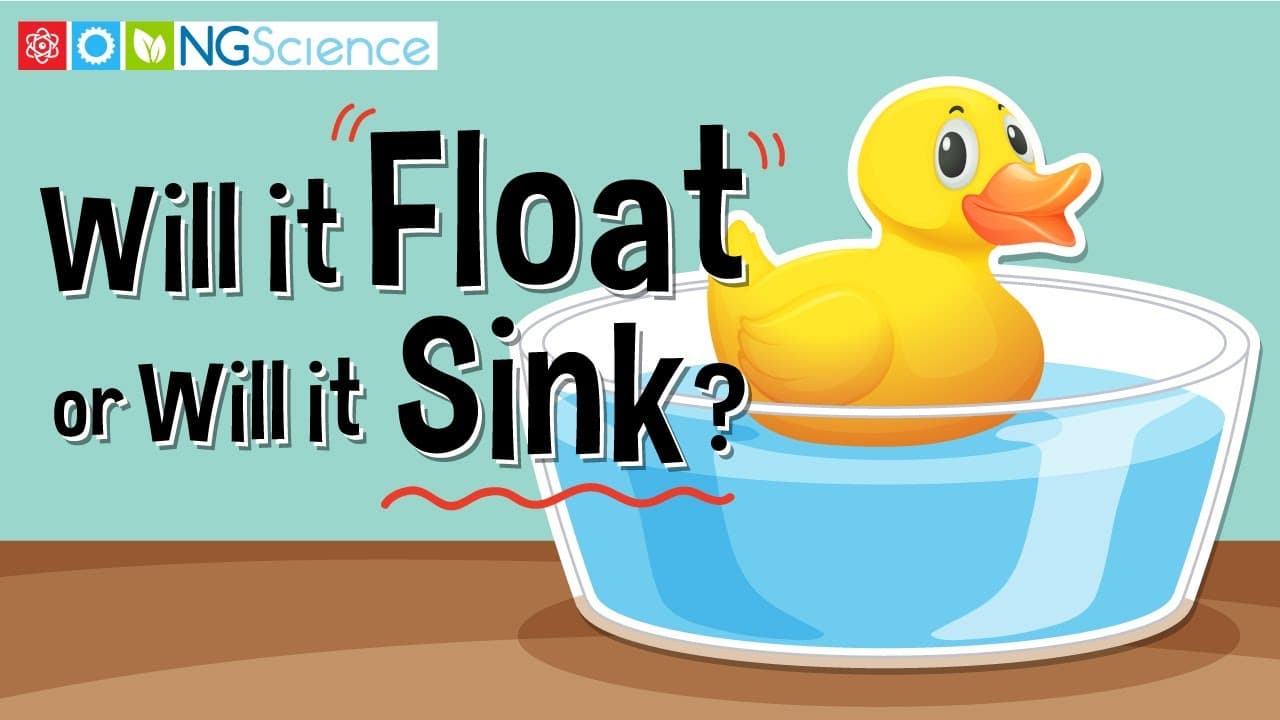
Sink or Float: Testing Common Objects

Sink or Float: Testing Common Objects

This engaging science video conducts a classic "Sink or Float" experiment, testing eleven common household objects to see how they interact with water. Using a clear tank and blue-tinted water for high visibility, the video systematically introduces an object, demonstrates dropping it into the water, and clearly labels the result as either "Sink" or "Float." The consistent pacing and clear visual cues make it an excellent resource for young learners to practice observation and prediction skills. The video explores key themes of buoyancy, density (at an introductory level), and material properties. It contrasts materials that typically sink, such as metal (lead ball, safety pin, paper clip) and dense rubber, with materials that float, like wood and certain plastics. It also implicitly addresses the concept that size does not determine buoyancy, as small heavy items sink while larger light items like the wooden block float. For educators, this video serves as a perfect digital demonstration to anchor a physical science unit on properties of matter. It allows teachers to pause before each drop to solicit student predictions, turning a passive viewing experience into an interactive game. It can be used to introduce the scientific method (predict, observe, record), prompt discussions about why certain materials float while others sink, or serve as a hook before a hands-on classroom water table activity.

Next Generation ScienceNext Generation Science

3mins 35s

Materials

Matter Science Anchor Charts

Matter Science Anchor Charts

A complete set of eight illustrated, large-print science anchor charts covering Matter, Atom, Element, Property, States of Matter, Solid, Liquid, and Gas for 6th-grade special education science students.

PL

Patrick l

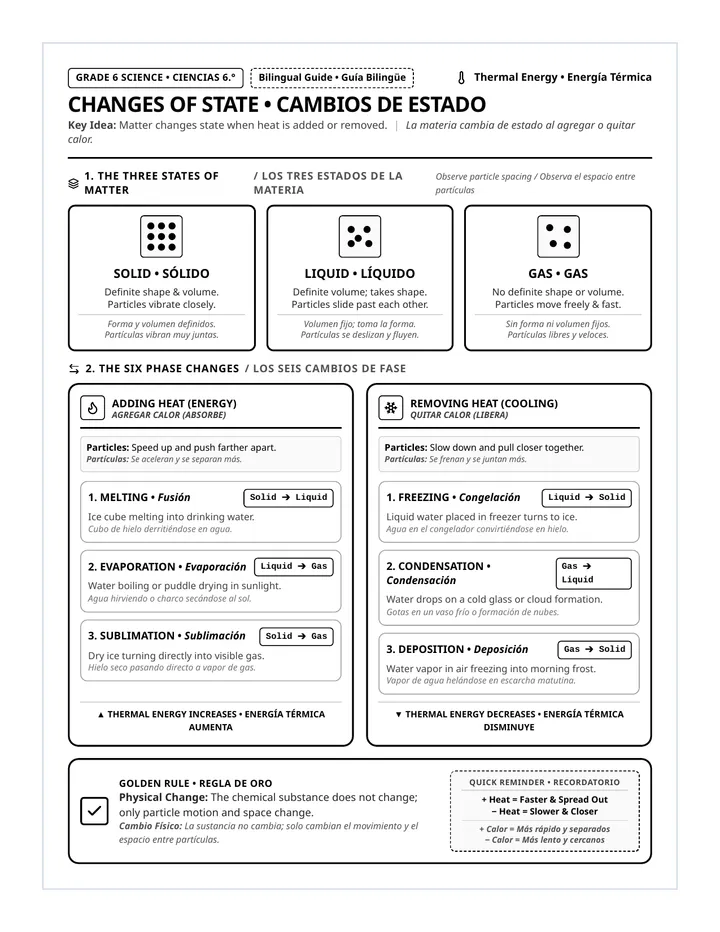
State Changes Anchor Chart

State Changes Anchor Chart

A black-and-white, printer-friendly bilingual (English-Spanish) anchor chart visual for 6th-grade science with no code switching in the quick reminder section.

AA

Aline Araujo Teixeira

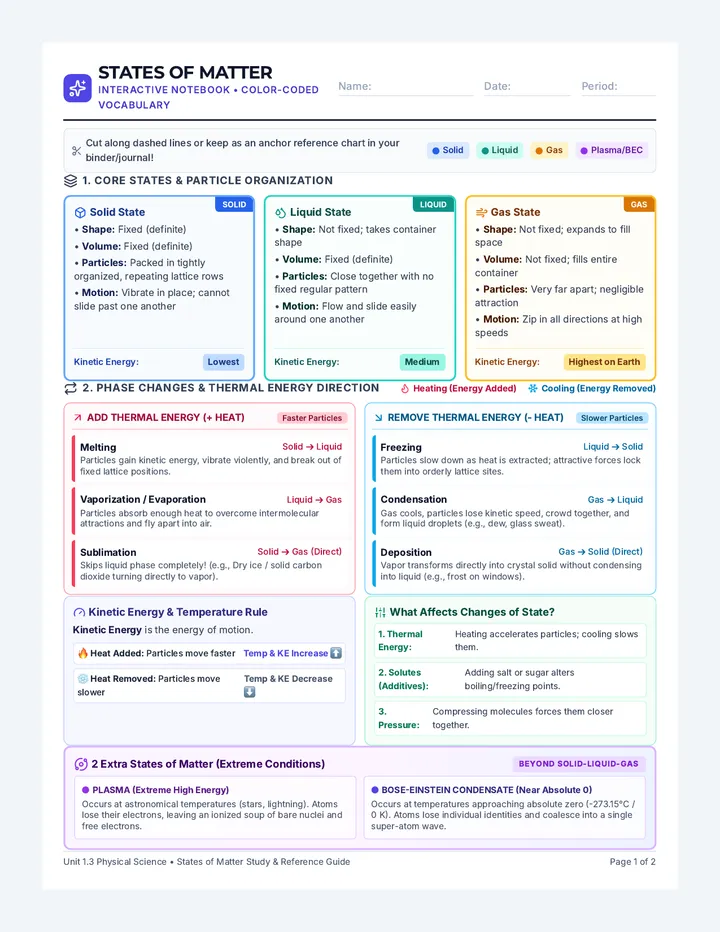
Matter Models Interactive Notebook

Matter Models Interactive Notebook

A 2-page interactive science notebook resource featuring color-coded vocabulary in distinct dotted cut-out sections and a unified single-tab 3-flap states of matter particle foldable with increasing energy progression.

RL

RMS Lenny

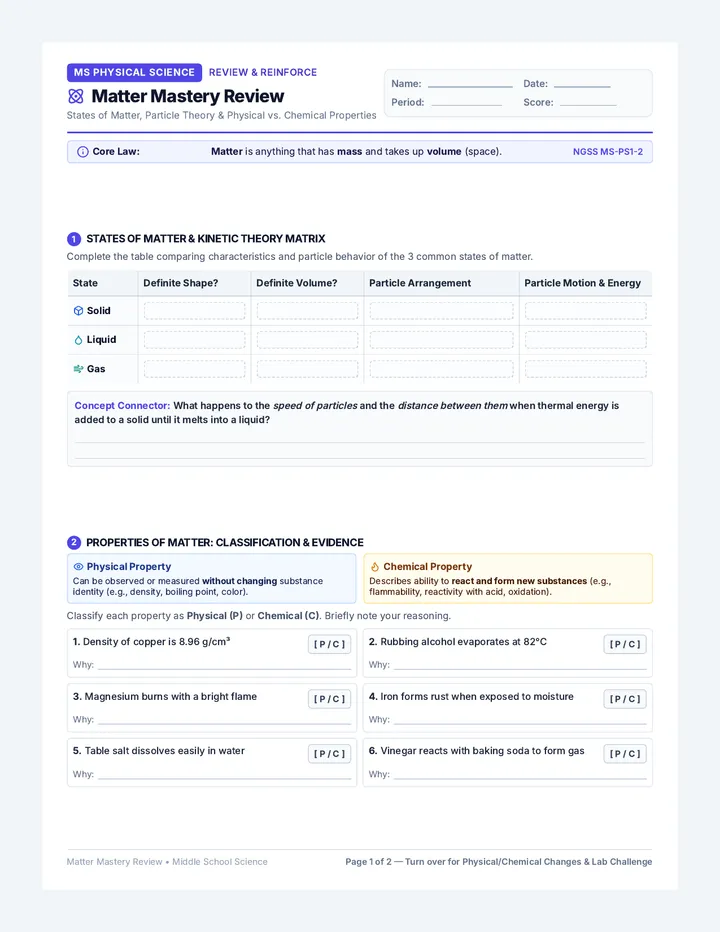
Matter Mastery Review Worksheet

Matter Mastery Review Worksheet

A comprehensive, two-page middle school review worksheet covering the three states of matter, particle motion, physical versus chemical properties, real-world physical and chemical change scenarios, and a Claim-Evidence-Reasoning laboratory challenge.

LP

LeShonda Price

Thermal Energy Review Packet

Thermal Energy Review Packet

An eight-page review packet for 8th-grade New York State science students covering kinetic molecular theory, particle diagrams, phase changes, conduction/convection/radiation, heating and cooling curves, cumulative practice, and an exit ticket. Includes a cover page titled "Morning Work Week 4".

AW

Austin WIllis

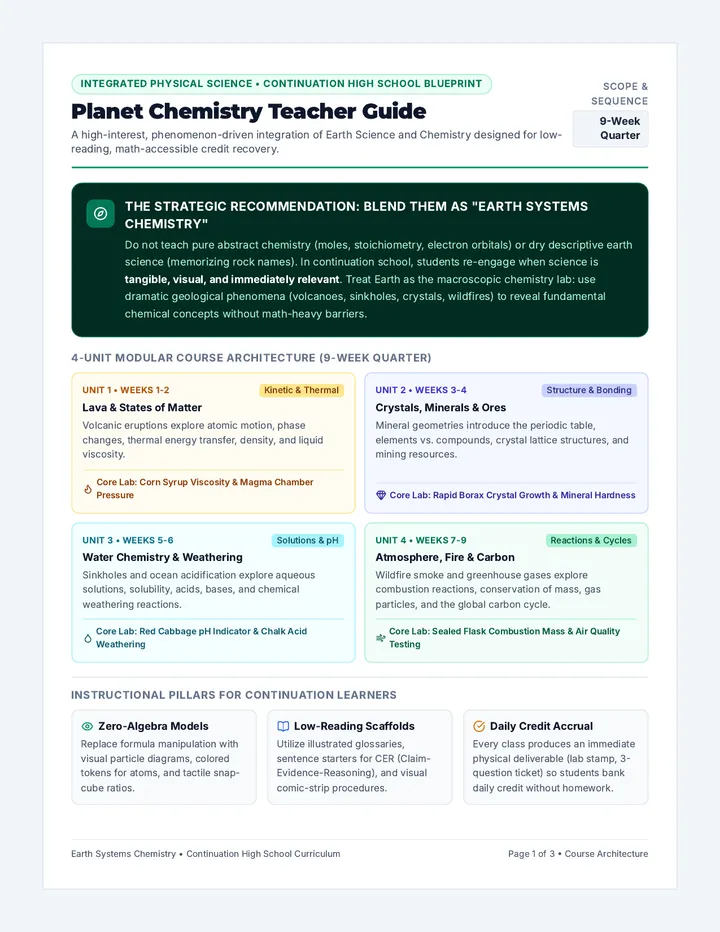
Planet Chemistry Teacher Guide

Planet Chemistry Teacher Guide

A comprehensive curriculum blueprint integrating chemistry and earth science specifically tailored for continuation high school students. Features four accessible, hands-on units, low-math lab investigations, and structured literacy supports for credit recovery.

MH

Meagan Hudson

Sequences

Naval Architect Challenge Answer Key

Fluid Dynamics

A series of lessons exploring the physics of fluids, including buoyancy, pressure, and fluid flow.

CM

Chuguna Murugesan

28
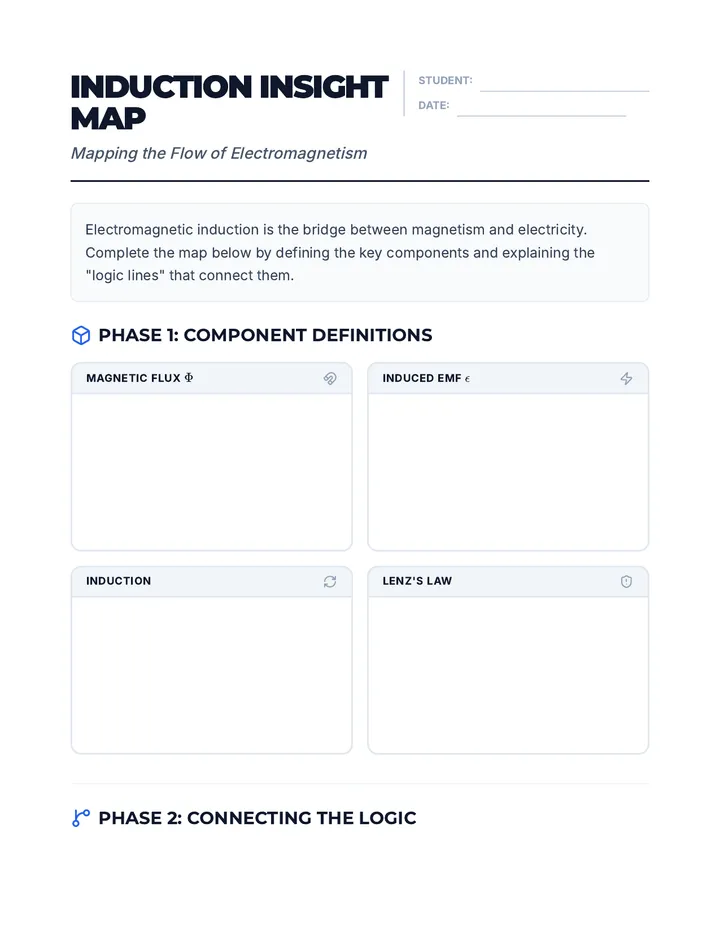
Induction Insight Map Handout

Magnetic Forces Investigation

A 5-day intensive exploration of magnetic forces and fields, focusing on atomic-level causes, field interactions, and mathematical modeling of forces on charged particles. Students progress from anchoring phenomena to complex mathematical applications and a comprehensive unit review.

OM

Olutoyin Makinde

68
Hess Pathfinders Slides

Energy in Chemical Bonds

A five-day high school chemistry unit exploring thermochemistry, collision theory, enthalpy diagrams, and calorimetry through the lens of body heat and chemical reactions. Students investigate the anchoring phenomenon of exercise-induced heat while mastering TEKS C.13 standards.

OM

Olutoyin Makinde

48
Pressure Poster Workshop Handout

Pressure Power

A comprehensive 5-day chemistry unit investigating the relationships between gas pressure, volume, temperature, and moles using lab inquiries, mathematical modeling, and real-world applications.

OM

Olutoyin Makinde

69
KMT Field Manual Packet

Molecular Mayhem Gas Unit

A 10-day exploration of the Behavior of Gases using Kinetic Molecular Theory, various gas laws, and real-world phenomena to understand gas behavior at both molecular and macroscopic scales. Students will investigate compressibility, gas variables, ideal behavior, and mixtures.

OM

Olutoyin Makinde

26
Steady State Slides

Reaction Dynamics

This unit explores how chemical reactions occur and how they reach a state of balance. Students investigate reaction kinetics, energy changes, and the principles of dynamic equilibrium through modeling and laboratory investigation.

OM

Olutoyin Makinde

34

Lessons

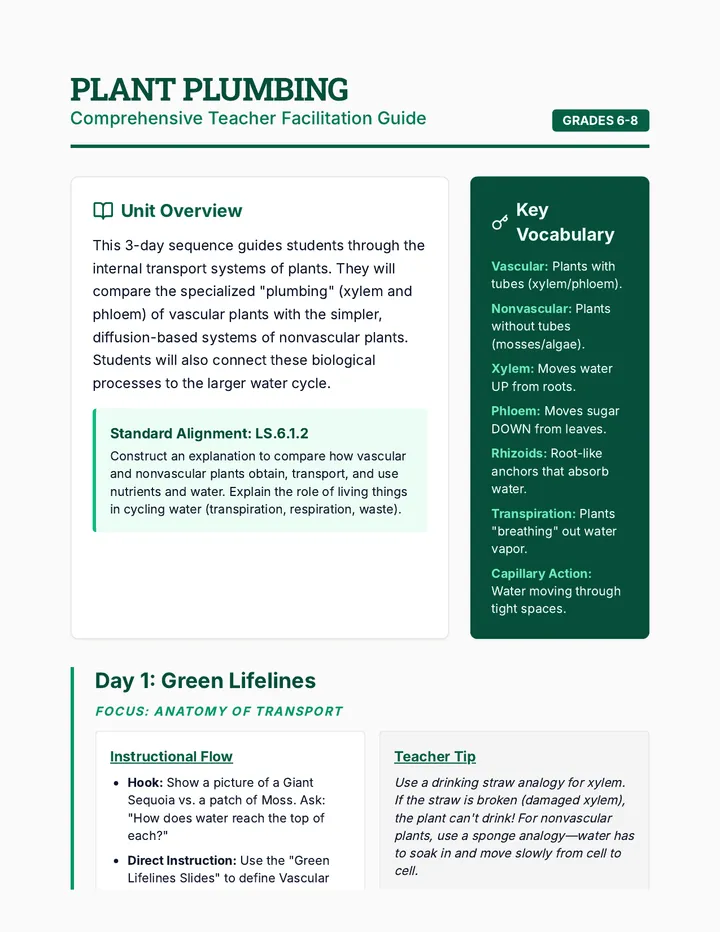
Plant Plumbing Teacher Guide

Water Wayfarers

Focuses on the role of plants and animals in cycling water through ecosystems, specifically looking at transpiration and animal respiration/waste.

CW

Candace Woodell

13
Heat Flow Teacher Guide

Particle Behavior Review

A lesson focusing on the states of matter (solid, liquid, gas) and the behavior of particles at the molecular level. Students will model particle motion and arrangement, as well as the energy changes that drive phase transitions.

EA

Erica Andre

54
Quake Coords Map Activity

Tectonic Tremors

A comprehensive GED science lesson on tectonic activity, focusing on seismic wave analysis, seismograms, and the Richter scale. Students will learn to calculate S-P intervals and interpret map data to locate epicenters and volcanic hotspots.

CL

Carmela Leone

5
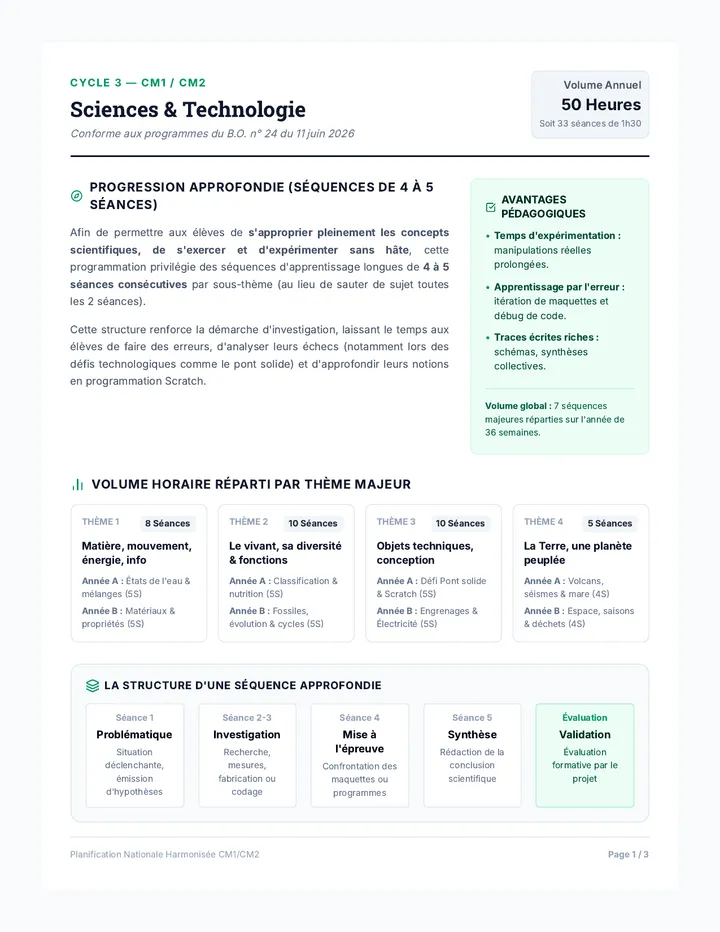
Tableau Progression Annuelle Sciences CM

Progression Sciences CM1 CM2

Outil de planification annuelle et de progression pour l'enseignement des sciences et technologies en classe de CM1/CM2, conforme au BO de juin 2026. Ce guide propose une répartition claire des volumes horaires et des thèmes entre l'année A et l'année B pour éviter les redondances dans les classes à double niveau.

LP

LAURENT PERCHE

40
Flow State Reading Guide Expanded

Flow State

This lesson explores the fundamental properties of fluids, including the molecular differences between solids, liquids, and gases, the concept of density, and the characteristics of ideal fluids. Students will learn to distinguish states of matter through atomic interactions and apply the density formula to various substances.

CM

Chuguna Murugesan

33
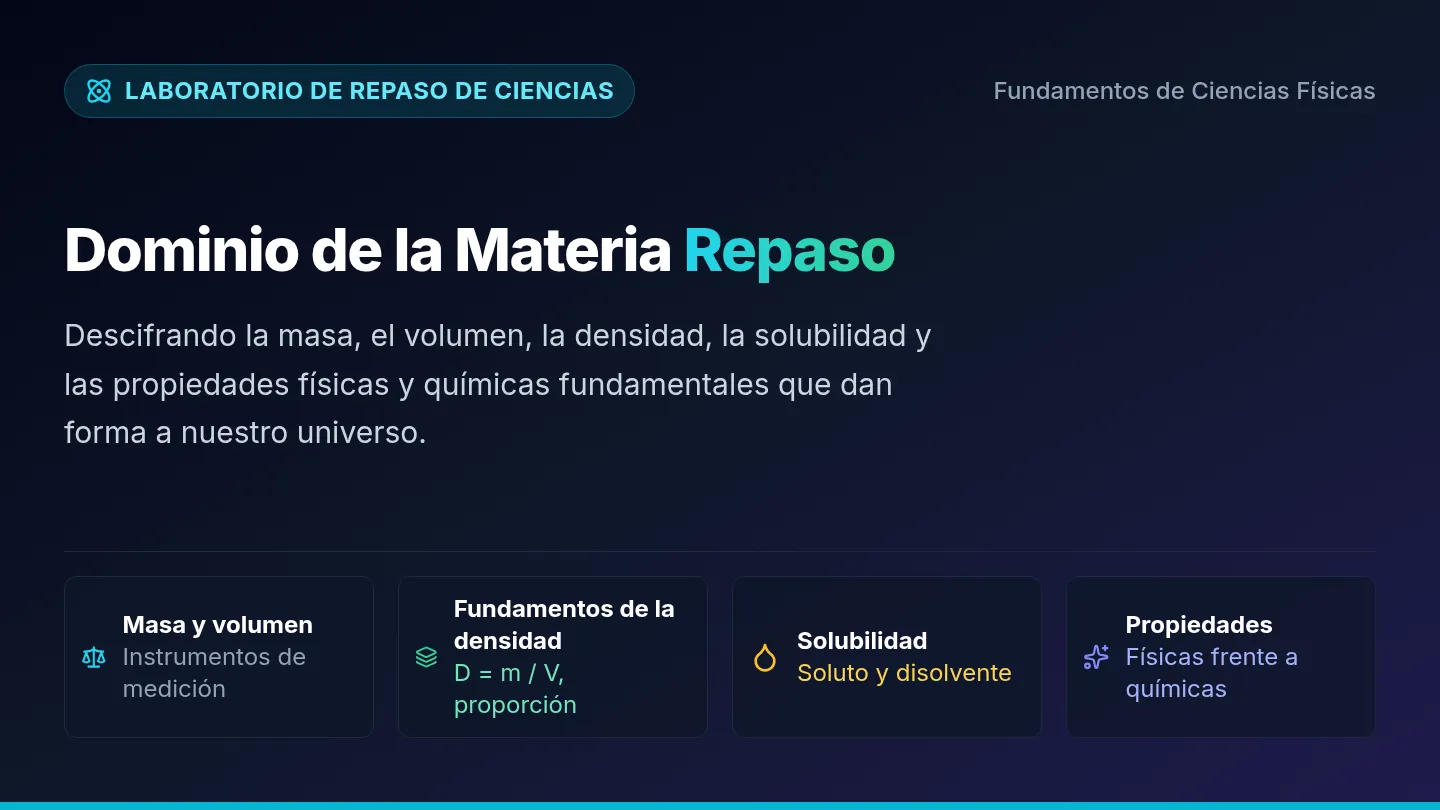
Matter Mastery Slides

Matter Mastery Review

A comprehensive review lesson on the properties of matter, mass, volume, density, temperature, solubility, and physical versus chemical changes. Features interactive instruction, scaffolded guided notes, mixed-format practice, and assessment.

MN

Monica Nicolas

9