Lenny.com
Explore
Create
ActivitiesNewMathEnglish Language ArtsScience & EngineeringSocial StudiesGlobal LanguagesHealth & Physical EducationSpecial EducationCounseling & Life SkillsArts & CreativityESL
Lenny.com
Lenny.com
Explore
Create
ActivitiesNewMathEnglish Language ArtsScience & EngineeringSocial StudiesGlobal LanguagesHealth & Physical EducationSpecial EducationCounseling & Life SkillsArts & CreativityESL
Lenny.com
Lenny.com

Solutions

Lenny for EducatorsLenny for SchoolsLenny for Districts

Product

ExploreSign inCreateSupportAbout

Resources

Getting startedMTSS Acceleration Program

© 2026 Lenny Learning Inc.

TermsPrivacyAccessibility
LinkedInInstagramX
Lenny

Astronomy

Celestial bodies, orbital mechanics, and the life cycles of stars. Examines planetary systems, galactic structures, and the physical laws governing the universe.

Science & EngineeringLife ScienceLiving ThingsAnimalsPlantsBody SystemsTraitsAdaptationsCellsEcosystemsHeredityGenes to TraitsCell DivisionPhysicsComparing MaterialsShapes and PropertiesMagnetsMagnetismLightSoundLight and SoundMatterStates of MatterChanges of StateMixturesPhysical and Chemical ChangeHeating and CoolingHeat and Thermal EnergyEnergyForce and MotionElectrical CircuitsAtoms and MoleculesPeriodic TableMotion in One DimensionMotion in Two DimensionsScalars and VectorsForces and Laws of MotionCircular Motion and GravityMomentum and ImpulseWork, Energy, and PowerWavesElectromagnetic WavesGeometric OpticsElectricity and MagnetismSimple Harmonic MotionThermodynamicsNuclear PhysicsEarth Science & AstronomyWeatherWater CycleRocks and MineralsFossilsEarth's FeaturesEarth's ResourcesEarth's StructureWeather and ClimateEarth EventsFossils and Geologic TimePlate TectonicsHuman ImpactsAstronomyChemistryUnits and MeasurementAtomic StructurePeriodic TrendsChemical BondingNomenclatureMolecular StructureIntermolecular ForcesThe MoleStoichiometryProperties of GasesSolutionsChemical ReactionsBalancing EquationsEnergy ChangesRates of ReactionsEquilibriumAcids and BasesQuantum ModelBiologyClassificationCell StructureThe Chemistry of LifeBiomoleculesCellular TransportCell EnergyCell Growth and DivisionDNAProtein SynthesisMeiosis and Sexual ReproductionPatterns of InheritanceMulticellular OrganismsEvolutionEcologyBiodiversityComputer ScienceAlgorithms and Computational ThinkingProgramming LanguagesComputing SystemsNetworks and InternetData AnalysisCybersecurityAI and Machine LearningSoftware Design and DevelopmentBlockchainEngineering & AIDesigning ExperimentsEngineering PracticesDesign ThinkingEngineering Design ProcessMechanical EngineeringElectrical EngineeringMaterials and StructuresCAD and 3D DesignRoboticsArtificial Intelligence BasicsVibe CodingMachine LearningAI Ethics and SocietySystems ThinkingEntrepreneurship & InnovationEntrepreneurial MindsetBusiness Idea DevelopmentBusiness Plan BasicsMarketing & Customer DiscoveryFinancial Management for Startups

Videos

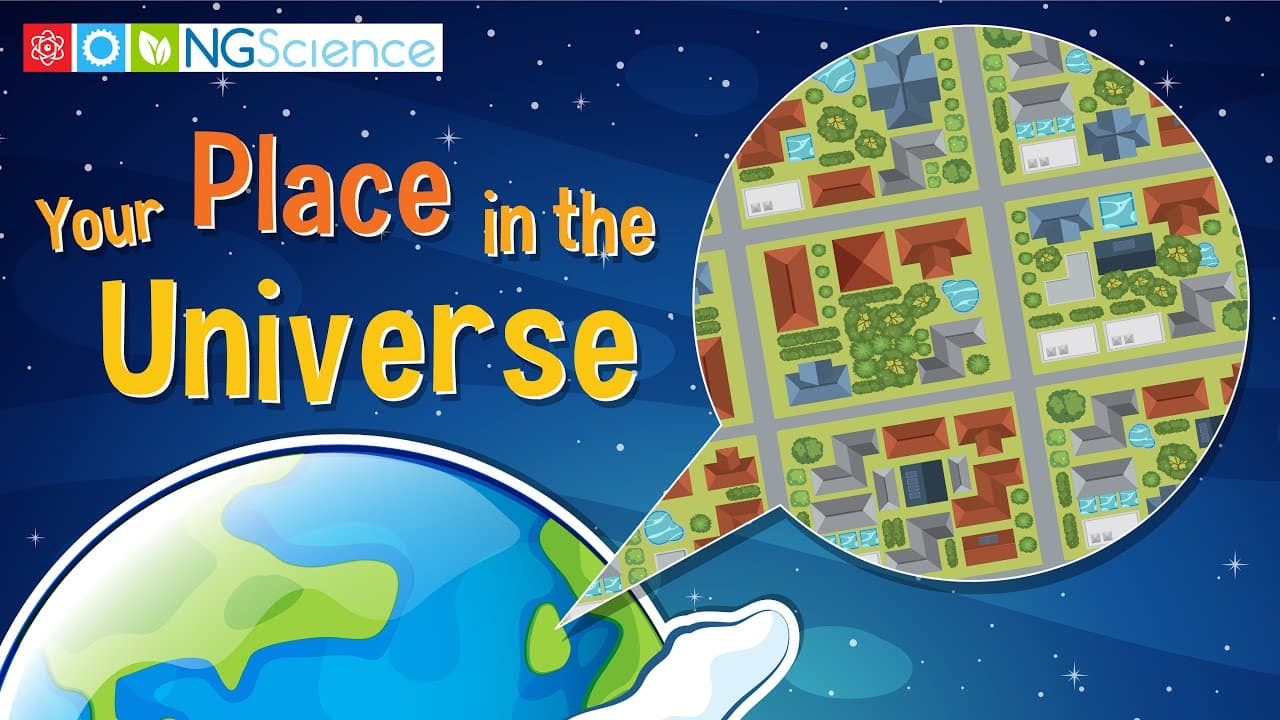
Your Cosmic Address: From Home to the Universe

Your Cosmic Address: From Home to the Universe

This visually engaging video takes students on a journey of scale and perspective, starting from a relatable domestic scene in a living room and zooming out progressively to the edges of the known universe. By anchoring the abstract concept of cosmic scale in the familiar setting of a child's home, the video builds a 'cosmic address' layer by layer: from home to street, town, country, Earth, Solar System, Milky Way, and finally the vast universe.

Next Generation ScienceNext Generation Science

2mins 53s

Tracking Shadows and the Sun's Position

Tracking Shadows and the Sun's Position

This engaging educational video explores the science behind shadows and how they change throughout the day based on the sun's position. Hosted by Sabrina Cruz, the lesson begins by defining a shadow as a dark area created when a solid object blocks light. It explains that while shadows might seem to have a mind of their own, their movement is actually caused by the Earth's rotation, which makes the sun appear to move across the sky from east to west. The video conducts a virtual experiment using a stationary lamp post to observe shadow patterns from 7:00 AM to 6:00 PM. Through this investigation, students visualize how shadows are long and point west in the morning, become shortest at noon, and grow long again pointing east in the afternoon. The lesson connects these observations to historical practices, mentioning how ancient civilizations used these predictable patterns to tell time, effectively using the sun as a giant clock. For the classroom, this video is an excellent resource for bridging Earth science and data analysis. It introduces bar graphs to interpret the observational data, helping students see the mathematical relationship between time of day and shadow length. By connecting abstract concepts like planetary rotation to concrete, observable phenomena like shadows, it provides a practical foundation for understanding the Earth-Sun system.

Crash Course KidsCrash Course Kids

4mins 53s

How to Find Constellations in the Night Sky

How to Find Constellations in the Night Sky

This engaging educational video introduces young learners to the concept of constellations—groups of stars that form patterns in the night sky. Using a relatable analogy of finding shapes in clouds, the host explains how humans throughout history have connected the stars like dots to create pictures and stories. The video specifically highlights famous constellations including the Big Dipper (and its role within Ursa Major), Orion the Hunter, the Southern Cross (Crux), and Sagittarius, while also touching on how different cultures perceive the same star groups differently. Key themes include pattern recognition, cultural perspectives on astronomy, and the specific identification of major constellations in both the Northern and Southern Hemispheres. The video also introduces scientific terminology like "nebula" through the example of the Orion Nebula, bridging the gap between ancient mythology and modern astronomy. It emphasizes imagination and observation as scientific tools. This resource is highly valuable for early elementary classrooms as an introduction to astronomy and space science. It provides clear, visual demonstrations of how to locate stars in the sky, making abstract concepts concrete. Teachers can use this video to launch units on the solar system, inspire creative writing through star myths, or explore how geography affects what we see in the sky.

SciShow KidsSciShow Kids

3mins 45s

How to Build a Mars Helicopter Model

How to Build a Mars Helicopter Model

Join Anthony and his robot pal Squeaks to explore the fascinating engineering behind NASA's Ingenuity helicopter, the first machine designed to fly on Mars. This engaging video breaks down the science of flight, comparing how helicopters work on Earth versus the unique challenges posed by the thin Martian atmosphere. Viewers learn how scientists solved these problems using specific design features like lightweight materials and extra-long, fast-spinning blades. The video transitions from theory to practice by guiding students through a hands-on STEM activity: building their own paper helicopter models. It demonstrates the importance of scientific modeling and introduces the engineering design process, encouraging viewers to test, observe, and iterate on their designs—just like real NASA engineers. This resource is an excellent tool for introducing elementary students to concepts of aerodynamics, planetary science, and engineering. It seamlessly connects complex space exploration topics with a simple, accessible classroom craft, making it perfect for lessons on the scientific method, variables, and the perseverance required in problem-solving.

SciShow KidsSciShow Kids

6mins 41s

Why the Moon Turns Red: Understanding Lunar Eclipses

Why the Moon Turns Red: Understanding Lunar Eclipses

In this engaging episode of SciShow Kids, host Jessi takes young astronomers into the observatory to explore the phenomenon of a lunar eclipse. The video breaks down the celestial mechanics behind this event, explaining how the specific alignment of the Sun, Earth, and Moon creates a shadow that changes the Moon's appearance. It specifically addresses the "Blood Moon" phenomenon, answering the intriguing question of why the Moon turns red instead of going completely dark when it passes into Earth's shadow. The content covers key astronomical concepts including the definition of "lunar" and "eclipse," the orbital paths of the Earth and Moon, and the physics of light refraction through Earth's atmosphere. Through clear, colorful animations, students visualize the straight-line alignment required for an eclipse and learn why these events are visible only from certain parts of the world and at specific times. The video also importantly distinguishes between solar and lunar eclipses regarding eye safety. This resource is highly valuable for elementary science classrooms as it simplifies the complex 3D spatial relationships of celestial bodies into understandable 2D animations. It serves as an excellent introduction to units on space, light and shadows, or the solar system. Teachers can use this video to spark curiosity about the night sky, model orbital mechanics, or introduce basic optics concepts. While the video references specific dates from 2015, the scientific explanations remain evergreen and accurate.

SciShow KidsSciShow Kids

3mins 9s

Comets, Asteroids, and Meteors: Flying Space Rocks Explained

Comets, Asteroids, and Meteors: Flying Space Rocks Explained

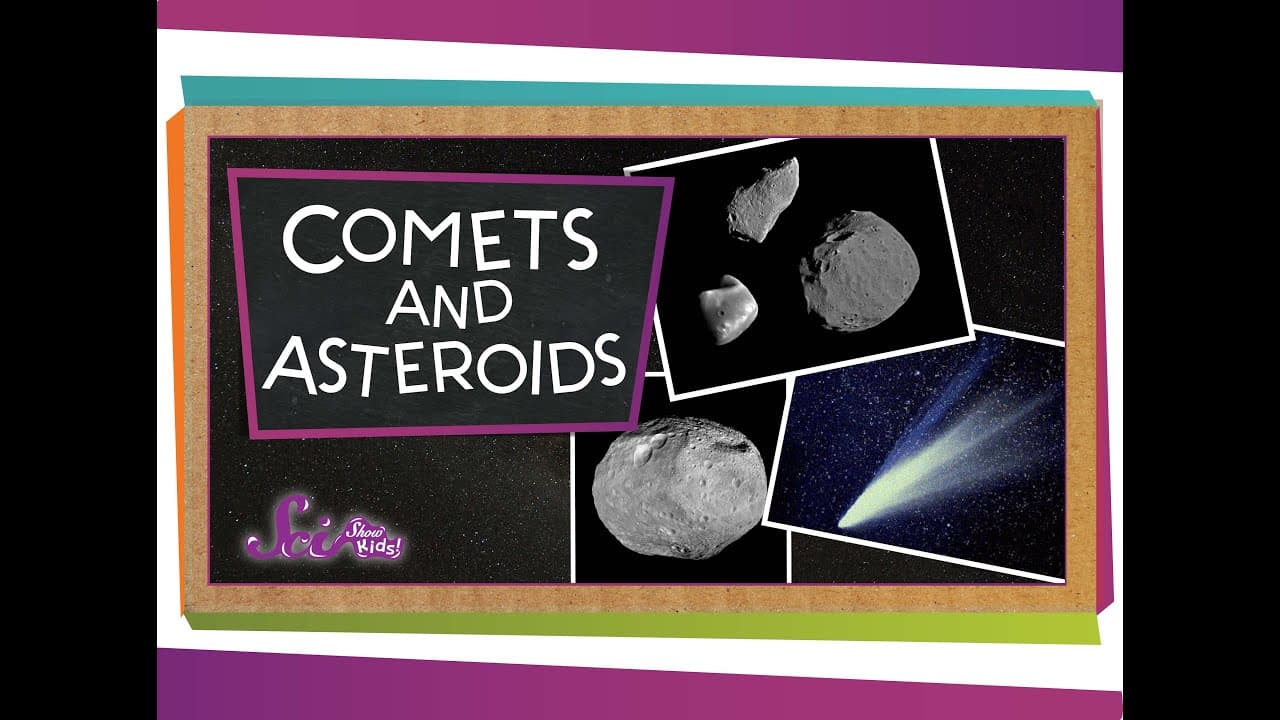
This engaging educational video from SciShow Kids introduces young astronomers to the smaller, more dynamic objects in our solar system: comets, asteroids, and meteors. While students may already be familiar with the sun and the eight major planets, host Jessi explains that the solar system is also full of "flying space rocks" that orbit the sun. The video breaks down the distinct characteristics of these objects, explaining what they are made of, where they come from, and how they behave as they travel through space. The content covers three main categories of space objects. First, it explores comets, described as "dirty snowballs" made of ice, dust, and rock that develop glowing tails when they get close to the sun. It introduces the famous Halley's Comet and its 75-year orbit. Second, it examines asteroids, rocky and metallic remnants of unfinished planets that mostly reside in the Asteroid Belt between Mars and Jupiter. Finally, the video clarifies the difference between meteors (shooting stars) and meteorites (rocks that actually land on Earth), touching briefly on the impact that likely ended the age of dinosaurs. This video is an excellent resource for elementary science classrooms exploring the solar system beyond just the planets. It provides clear, accessible definitions for vocabulary that students often confuse, supported by vivid animations and real astronomical imagery. Teachers can use this video to launch lessons on space composition, orbital mechanics, or Earth's history. It effectively demystifies space phenomena, turning abstract dots in the night sky into tangible objects with specific properties and histories.
SciShow KidsSciShow Kids

4mins 1s

Materials

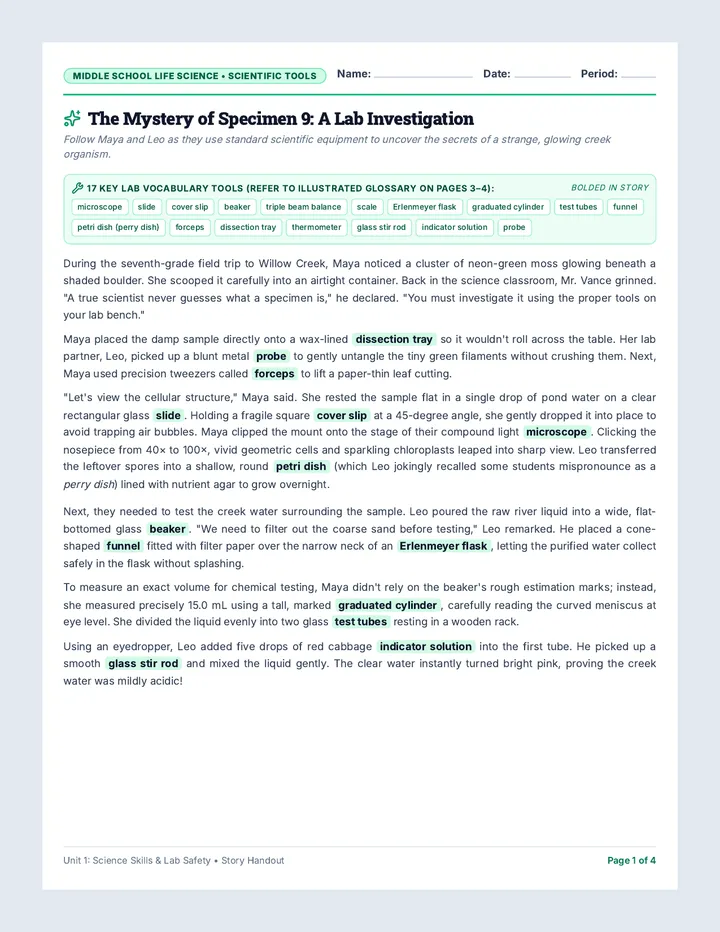
Mystery Specimen Story Handout

Mystery Specimen Story Handout

A comprehensive four-page middle school science packet containing the 'Mystery of Specimen 9' reading story, comprehension questions, and a complete two-page illustrated visual glossary featuring diagrams and definitions for all 17 laboratory tools.

S

stewart

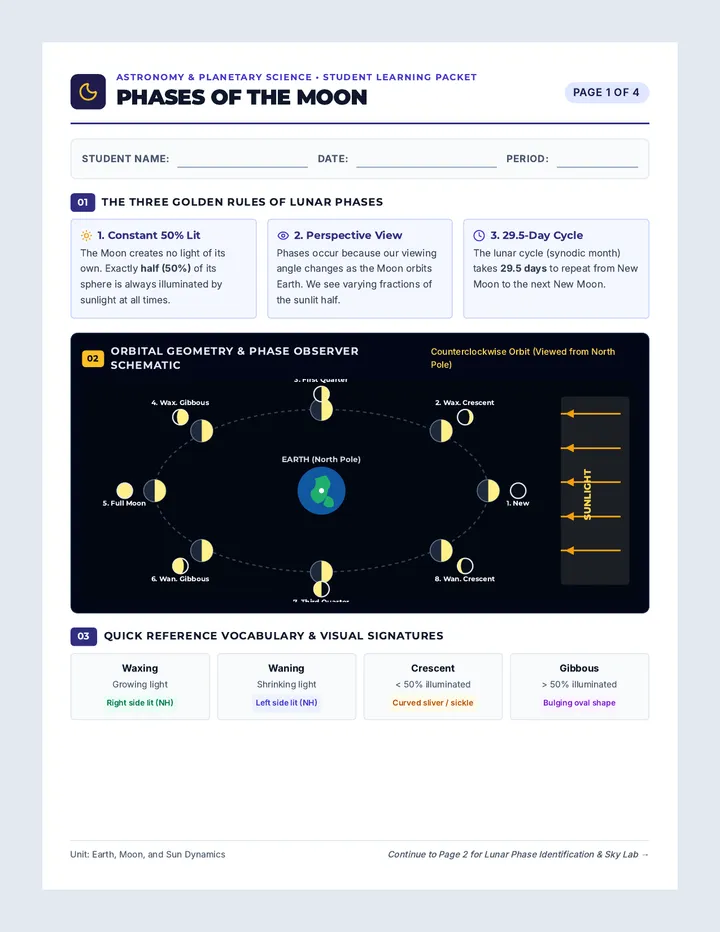
Moon Phases Learning Packet

Moon Phases Learning Packet

A comprehensive 4-page student learning packet on the phases of the Moon. Features illustrated orbital mechanics, a dedicated 8-phase visual identification lab, rigorous conceptual practice problems, and a Claim-Evidence-Reasoning scientific writing prompt.

D

ddhesketh

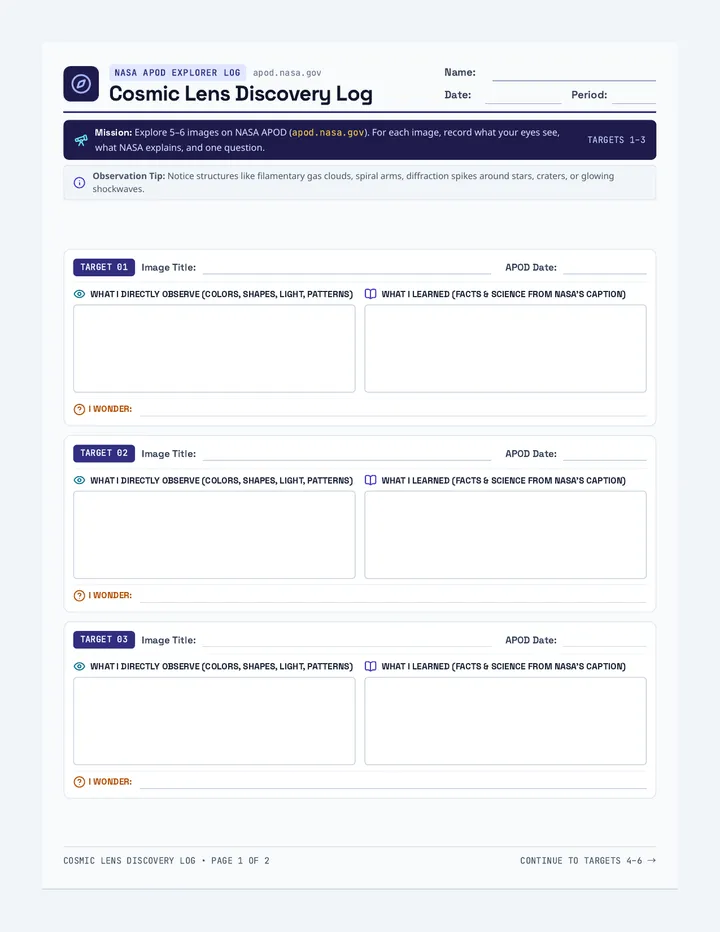
Cosmic Lens Worksheet

Cosmic Lens Worksheet

A balanced two-page APOD exploration log where all six targets across the front and back share identical dimensions and generous writing boxes (100px height for both direct observations and science learnings), ensuring students have the exact same handwriting room for every image.

M

Megan.Tanner

Math Showdown Slides

Math Showdown Slides

A comprehensive 34-question math showdown slide deck with multiple choice options and hidden answer reveal slides. Covers addition, subtraction, multiplication, division, rates, and multi-step word problems.

DH

Dee Henderson

Cosmic Quest Reading Passage

Cosmic Quest Reading Passage

A two-page introductory reading passage and comprehension worksheet exploring why studying Earth and space science is vital for understanding our home planet and the universe.

EG

Emily Gianni

Earth Move Worksheet

Earth Move Worksheet

A 4-page, highly visual, dual-language (English/Spanish) science worksheet about Earth's movements, seasons, and solar angle. It features cooperative lab group roles (for groups of 3-4 using a globe and flashlight), large crisp SVG diagrams, and a dedicated full page for each of the four main parts: Inquire/Observe (Texas vs. Argentina in July), Rotation (Day & Night), Revolution (The Year), and Axial Tilt (The Seasons).

OA

Oumhani Achour

Sequences

Planet Profile Slides

Infinite Frontier

A comprehensive Hi-Lo unit for 6th graders exploring the scale of the universe, our place in the Milky Way, the technology used to explore space, and the history of human spaceflight.

JS

Janette Sullivan

54
Vowel Valley Fluency Packet Mastered

Phonics Fluency Fun

A series of phonics lessons focusing on vowel teams, digraphs, and other phonetic patterns through narrative passages and fluency drills.

N

npowers

28
Induction Insight Map Handout

Magnetic Forces Investigation

A 5-day intensive exploration of magnetic forces and fields, focusing on atomic-level causes, field interactions, and mathematical modeling of forces on charged particles. Students progress from anchoring phenomena to complex mathematical applications and a comprehensive unit review.

OM

Olutoyin Makinde

68
Mission Scoring Rubric

Physics Frontiers Research Project

A partner-based research project for 9th-grade conceptual physics students focusing on diverse topics from celestial mechanics to the physics of dance. Students move through a structured research process with mandatory teacher checkpoints for source reliability.

C

ckroeker

13
Science Squad Student Booklet

Science Literacy Journals

A multi-grade collection of scientific reading comprehension and response booklets designed to build disciplinary literacy in Earth, Life, and Physical sciences across elementary and middle school levels.

N

nmack

4
Matter and Mixes Worksheet

Science Summit

A comprehensive end-of-year review for 5th Grade NGSS science standards, organized by domain to ensure mastery of physical, life, and Earth sciences.

MA

Madelyne Ashbaugh

9