Lenny.com
Explore
Create
ActivitiesNewMathEnglish Language ArtsScience & EngineeringSocial StudiesGlobal LanguagesHealth & Physical EducationSpecial EducationCounseling & Life SkillsArts & CreativityESL
Lenny.com
Lenny.com
Explore
Create
ActivitiesNewMathEnglish Language ArtsScience & EngineeringSocial StudiesGlobal LanguagesHealth & Physical EducationSpecial EducationCounseling & Life SkillsArts & CreativityESL
Lenny.com
Science & EngineeringLife ScienceLiving ThingsAnimalsPlantsBody SystemsTraitsAdaptationsCellsEcosystemsHeredityGenes to TraitsCell DivisionPhysicsComparing MaterialsShapes and PropertiesMagnetsMagnetismLightSoundLight and SoundMatterStates of MatterChanges of StateMixturesPhysical and Chemical ChangeHeating and CoolingHeat and Thermal EnergyEnergyForce and MotionElectrical CircuitsAtoms and MoleculesPeriodic TableMotion in One DimensionMotion in Two DimensionsScalars and VectorsForces and Laws of MotionCircular Motion and GravityMomentum and ImpulseWork, Energy, and PowerWavesElectromagnetic WavesGeometric OpticsElectricity and MagnetismSimple Harmonic MotionThermodynamicsNuclear PhysicsEarth Science & AstronomyWeatherWater CycleRocks and MineralsFossilsEarth's FeaturesEarth's ResourcesEarth's StructureWeather and ClimateEarth EventsFossils and Geologic TimePlate TectonicsHuman ImpactsAstronomyChemistryUnits and MeasurementAtomic StructurePeriodic TrendsChemical BondingNomenclatureMolecular StructureIntermolecular ForcesThe MoleStoichiometryProperties of GasesSolutionsChemical ReactionsBalancing EquationsEnergy ChangesRates of ReactionsEquilibriumAcids and BasesQuantum ModelBiologyClassificationCell StructureThe Chemistry of LifeBiomoleculesCellular TransportCell EnergyCell Growth and DivisionDNAProtein SynthesisMeiosis and Sexual ReproductionPatterns of InheritanceMulticellular OrganismsEvolutionEcologyBiodiversityComputer ScienceAlgorithms and Computational ThinkingProgramming LanguagesComputing SystemsNetworks and InternetData AnalysisCybersecurityAI and Machine LearningSoftware Design and DevelopmentBlockchainEngineering & AIDesigning ExperimentsEngineering PracticesDesign ThinkingEngineering Design ProcessMechanical EngineeringElectrical EngineeringMaterials and StructuresCAD and 3D DesignRoboticsArtificial Intelligence BasicsVibe CodingMachine LearningAI Ethics and SocietySystems ThinkingEntrepreneurship & InnovationEntrepreneurial MindsetBusiness Idea DevelopmentBusiness Plan BasicsMarketing & Customer DiscoveryFinancial Management for Startups

Motion in Two Dimensions

Vector analysis applied to projectile motion, uniform circular motion, and relative velocity. Examines the independence of horizontal and vertical components through kinematic equations and displacement calculations.

Lenny.com

Solutions

Lenny for EducatorsLenny for SchoolsLenny for Districts

Product

ExploreSign inCreateSupportAbout

Resources

Getting startedMTSS Acceleration Program

© 2026 Lenny Learning Inc.

TermsPrivacyAccessibility
LinkedInInstagramX
Lenny

Videos

Mastering Vector Components: Displacement and Velocity

Mastering Vector Components: Displacement and Velocity

This educational video provides a clear and practical introduction to physics vectors, specifically focusing on decomposing displacement and velocity into horizontal and vertical components. Starting with a relatable analogy about shooting a basketball, the narrator explains how our brains naturally process vector mathematics and how to translate that intuition into formal calculations on paper. The video covers fundamental mathematical tools including the Pythagorean theorem and basic trigonometry (sine and cosine functions) to solve physics problems.

Miacademy & MiaPrep Learning ChannelMiacademy & MiaPrep Learning Channel

16mins 31s

Solving Projectile Motion with Backyard Fireworks

Solving Projectile Motion with Backyard Fireworks

This physics lesson uses the engaging real-world context of fireworks to teach students how to solve complex projectile motion problems. The video begins with a humorous hook about backyard fireworks before transitioning into the serious mathematics required to ensure safety at professional shows. It breaks down the physics of a projectile launched at an angle, specifically focusing on decomposing velocity vectors into horizontal (x) and vertical (y) components using trigonometry.

Miacademy & MiaPrep Learning ChannelMiacademy & MiaPrep Learning Channel

13mins 33s

Solving Projectile Motion Using the Quadratic Formula

Solving Projectile Motion Using the Quadratic Formula

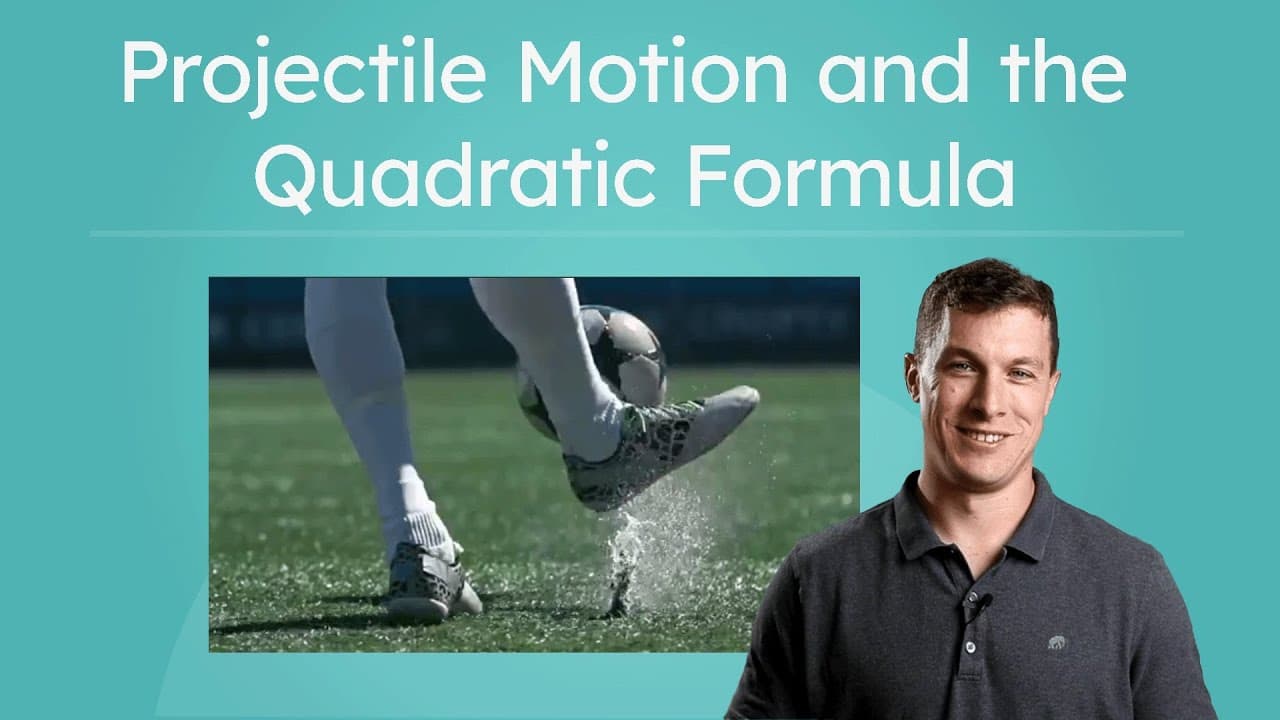
This educational video bridges the gap between abstract mathematics and physical reality by demonstrating how parabolas and the quadratic equation are used to solve projectile motion problems in physics. The narrator begins by addressing the common student question, "When will I ever use this?" by explaining the historical context of parabolas, noting how Ancient Greek geometry was later applied by Galileo to describe the motion of objects moving through the air. The video visualizes how the trajectory of a projectile, like a cannonball, maps perfectly onto an inverted parabola. The core of the video is a step-by-step tutorial on applying the quadratic formula to a specific physics problem involving a rock ejected from a volcano. The video breaks down the problem-solving process: identifying known variables, decomposing velocity vectors using trigonometry, setting up the kinematic equation, and rearranging it into the standard quadratic form ($ax^2+bx+c=0$). It explicitly connects the mathematical coefficients $a$, $b$, and $c$ to physical quantities like gravity, initial velocity, and displacement. This resource is highly valuable for bridging Algebra II and High School Physics curricula. It provides a concrete application for the quadratic formula, moving beyond rote memorization to practical implementation. Teachers can use this video to introduce 2D kinematics, review the quadratic formula in a new context, or facilitate a cross-curricular lesson connecting math and science standards. The inclusion of a mnemonic song for the formula adds a memorable engagement element for students.

Miacademy & MiaPrep Learning ChannelMiacademy & MiaPrep Learning Channel

14mins 6s

Hitting a Home Run: How to Solve Projectile Motion Problems

Hitting a Home Run: How to Solve Projectile Motion Problems

This educational video provides a comprehensive introduction to projectile motion in physics, using the engaging real-world example of hitting a home run in baseball. The lesson breaks down two-dimensional motion into a structured, five-step problem-solving process that makes complex kinematics accessible to high school students. It covers essential concepts such as splitting initial velocity into horizontal and vertical components using trigonometry, identifying the correct kinematic equations for each dimension, and understanding the role of gravity as the sole acting force. Key themes include the independence of horizontal and vertical motion, the use of time as the connecting variable between dimensions, and practical mathematical strategies like avoiding round-off errors. The video explicitly addresses the simplification of ignoring air resistance to focus on gravity's influence. Through the central problem—calculating whether a baseball hit at a specific angle and speed will clear a distant fence—students learn to apply abstract formulas to concrete scenarios. For educators, this video serves as an excellent instructional core for a unit on 2D kinematics. It models a clear, repeatable workflow for solving physics problems that students can adopt. The step-by-step derivation of the solution allows teachers to pause for guided practice, while the discussion on calculator settings (degree mode) and significant figures reinforces good scientific habits. The concluding true/false review provides a quick formative assessment tool.

Miacademy & MiaPrep Learning ChannelMiacademy & MiaPrep Learning Channel

13mins 20s

Tracking Motion: An Introduction to Kinematics and Friction

Tracking Motion: An Introduction to Kinematics and Friction

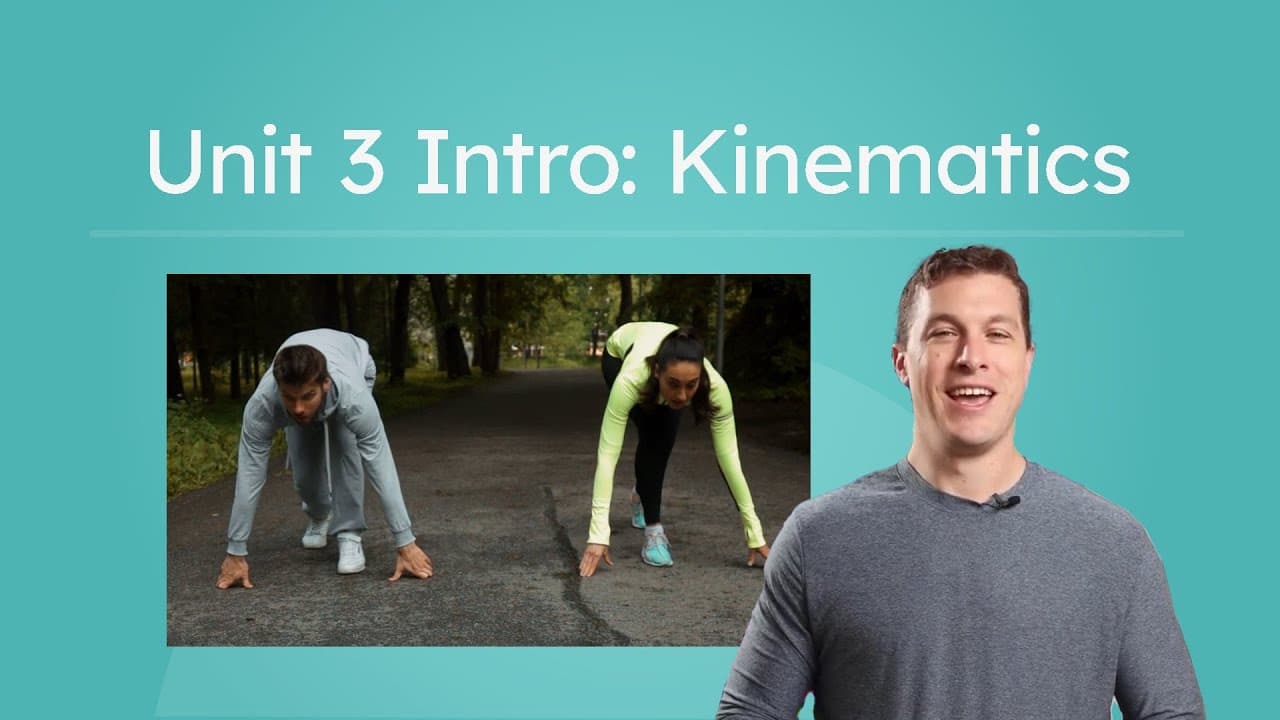
This educational video serves as a comprehensive introduction to a high school physics unit on kinematics. The host begins by connecting physics to exciting real-world examples like fast cars, rockets, and sports to explain that kinematics is the study of motion using mathematical equations. The video outlines a clear progression of learning, starting with simple one-dimensional motion, advancing to two-dimensional projectile motion, and finally introducing the concept of friction, which is often initially neglected in basic kinematic models. The content explores several key physics themes, including the difference between distance and displacement, the decomposition of vectors into vertical and horizontal components, and the distinction between static and kinetic friction. It uses visual aids like triangles overlaid on basketball shots and skiers on slopes to demonstrate how complex motion can be broken down into manageable mathematical parts. The concept of an "inclined plane" is also introduced, showing how gravity affects objects on a slope. For educators, this video is an excellent "unit hook" or introductory overview for a physics class. It sets the stage for future lessons on calculating velocity, acceleration, and force. The clear definitions and visual examples of vector components make abstract trigonometric applications concrete for students. Teachers can use the built-in review quiz at the end of the video as a formative assessment to check for immediate understanding of the key vocabulary introduced.

Miacademy & MiaPrep Learning ChannelMiacademy & MiaPrep Learning Channel

7mins 58s

Materials

Projectile Motion Companion Notes

Projectile Motion Companion Notes

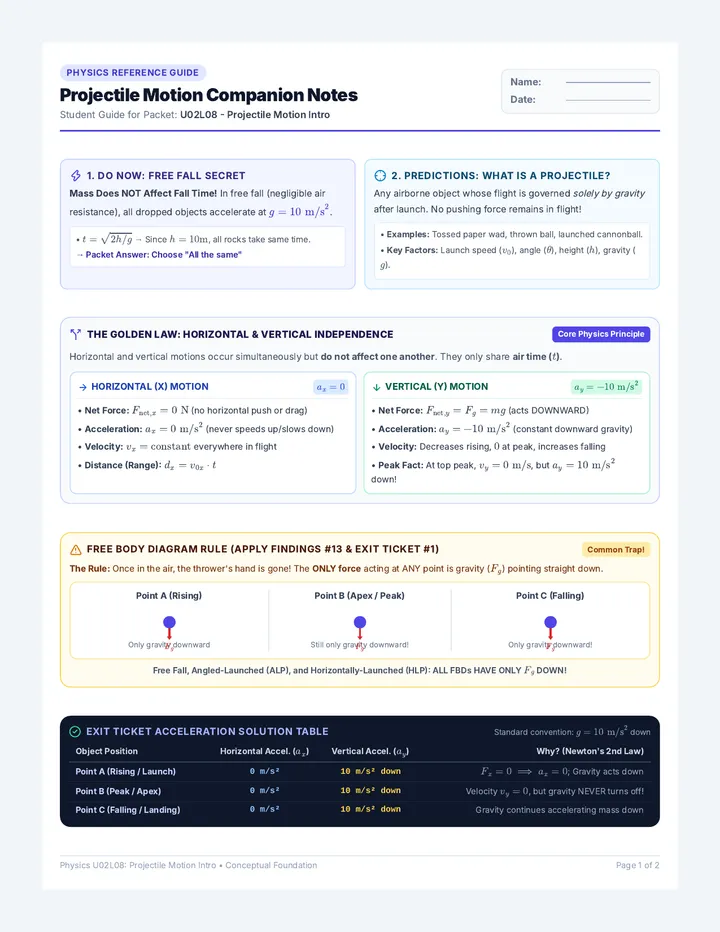
A 2-page print-ready companion study guide and problem-solving notes sheet designed to help high school physics students successfully understand and solve every section of the Projectile Motion Intro packet (Do Now, Simulator Exploration, Apply Findings, Exit Ticket, and Homework 2.08).

R

ronnie.washington

STEM Master Solver Guide

STEM Master Solver Guide

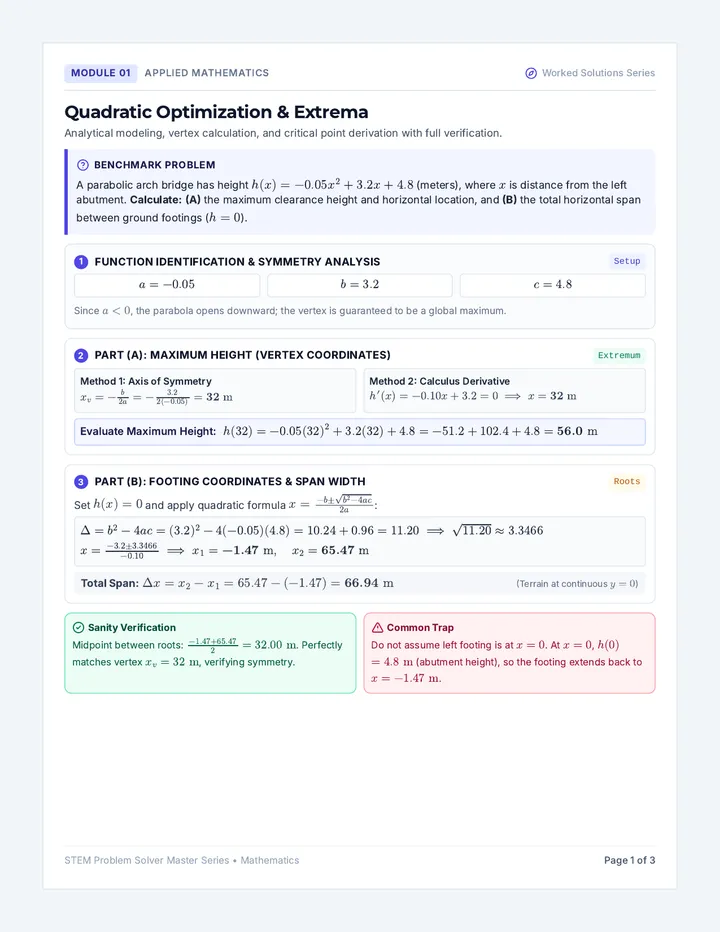
A comprehensive three-part STEM worked-example guide providing detailed, step-by-step solutions for benchmark problems in mathematics, physics, and chemistry. Each page breaks down problem setup, conceptual modeling, algebraic derivation, and rigorous verification techniques.

CZ

Claire Zietsman

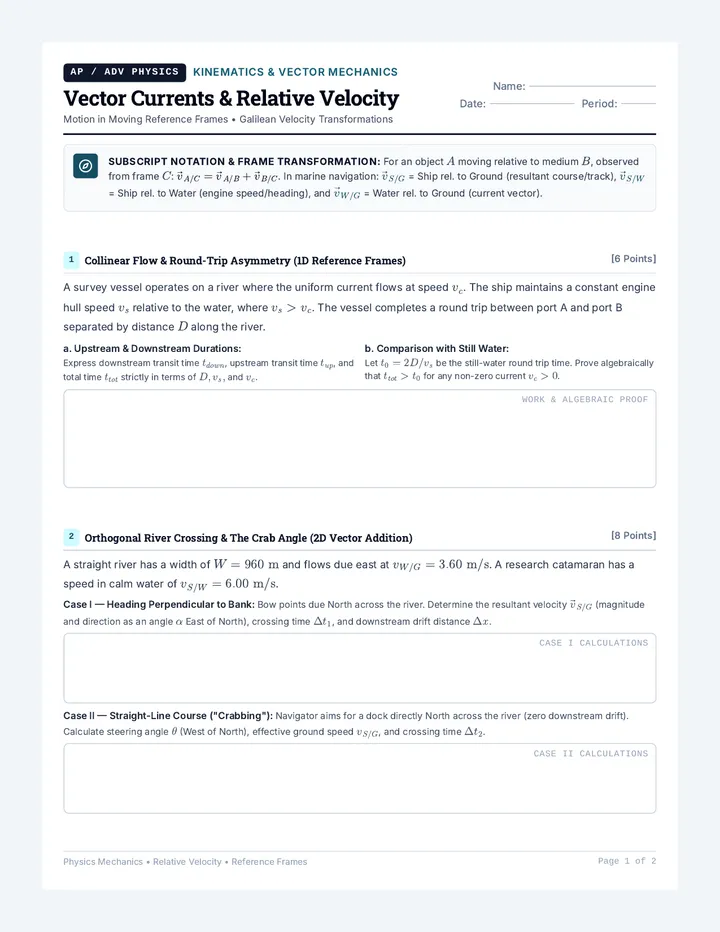
Vector Currents Worksheet

Vector Currents Worksheet

An advanced physics worksheet exploring relative velocity and reference-frame transformations through marine navigation, featuring collinear river transit, 2D vector decomposition, drift optimization, and moving-frame target interception.

Sequences

Naval Architect Challenge Answer Key

Fluid Dynamics

A series of lessons exploring the physics of fluids, including buoyancy, pressure, and fluid flow.

CM

Chuguna Murugesan

28
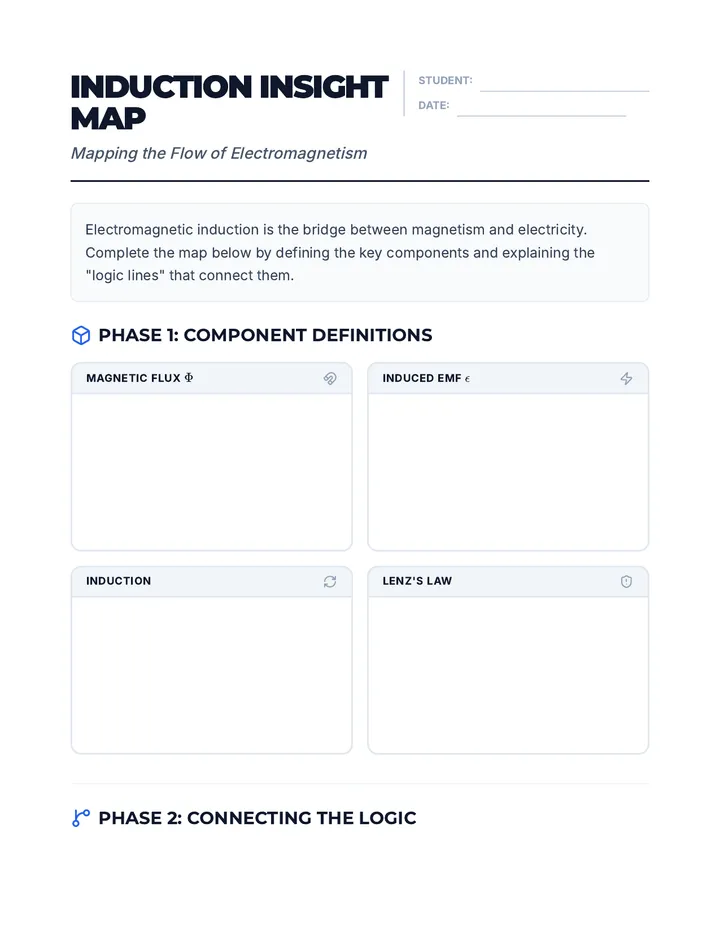
Induction Insight Map Handout

Magnetic Forces Investigation

A 5-day intensive exploration of magnetic forces and fields, focusing on atomic-level causes, field interactions, and mathematical modeling of forces on charged particles. Students progress from anchoring phenomena to complex mathematical applications and a comprehensive unit review.

OM

Olutoyin Makinde

68
Spin Cycle Reading Guide Updated v4

Spin Cycle Unit

A comprehensive unit on rotational mechanics, mapping the transition from linear motion to angular dynamics through technical analysis and real-world applications.

CM

Chuguna Murugesan

34
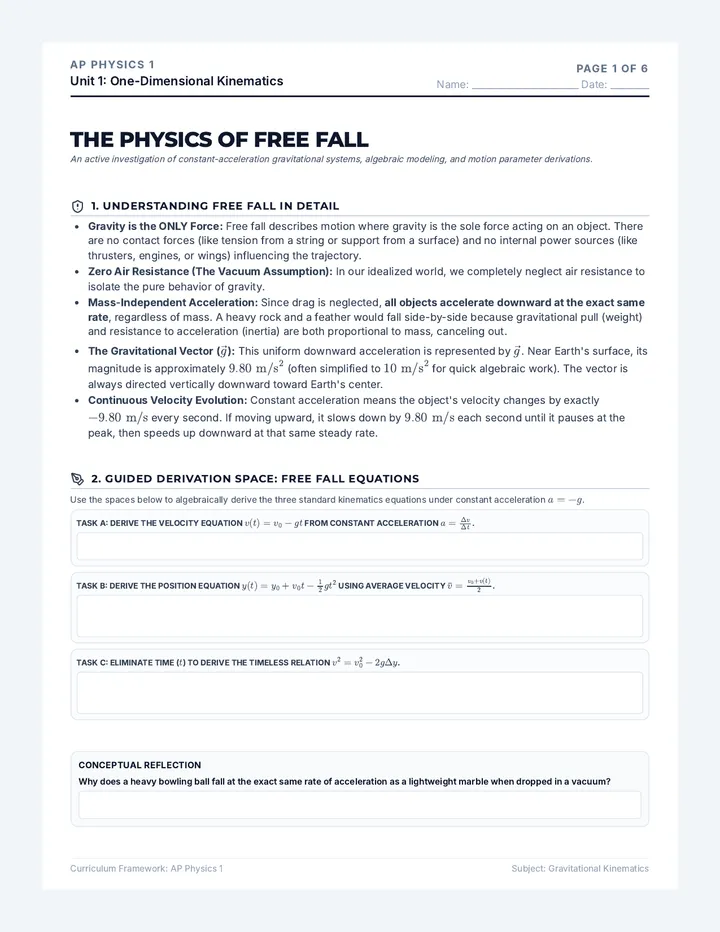
Gravitational Kinematics Reading Packet

AP Kinematics Unit

A comprehensive AP Physics 1 unit on one-dimensional and two-dimensional kinematics, covering free fall vertical motion, horizontal projectile pathways, experimental lab designs, and graphical signature analysis.

CM

Chuguna Murugesan

6
Motion Dual Reading Pack

Physics of Motion

A comprehensive unit exploring the principles of kinematics, focusing on the relationship between linear and angular motion through readings, analysis, and real-world applications.

CM

Chuguna Murugesan

8
Impact Investigations Slides

Momentum Mechanics

A guided discovery sequence on linear momentum, impulse, and 2D collisions, focusing on inquiry-based learning and vector analysis.

KA

Khairol Azmi

7

Lessons

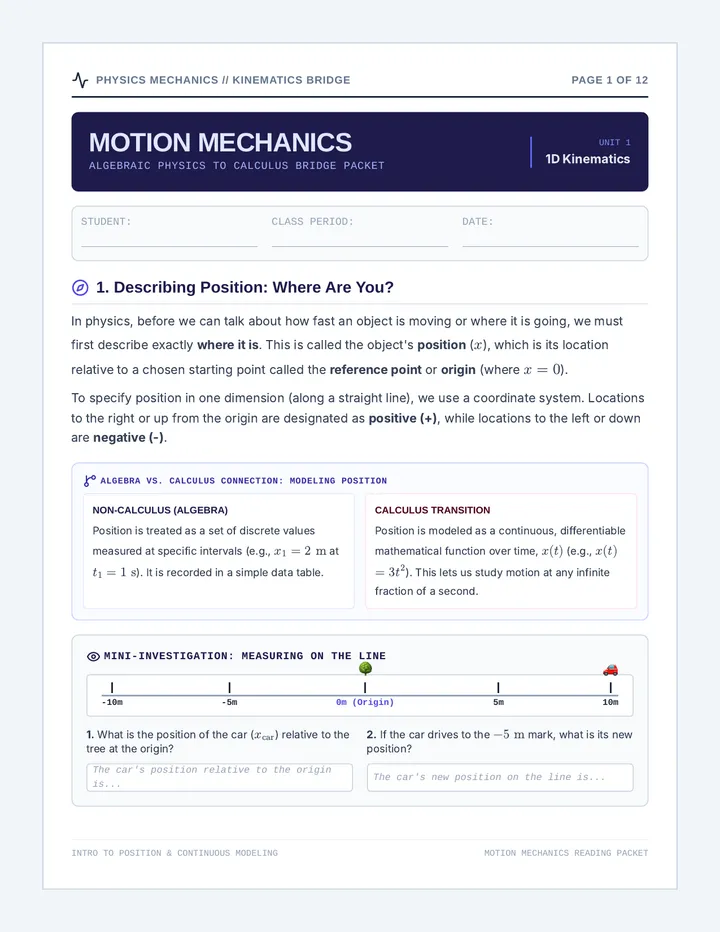
Motion Mechanics Reading Packet

Motion Mechanics

A comprehensive physics lesson bridging algebraic kinematics to introductory calculus. Includes a 12-page side-by-side reading packet, 13 instructional presentation slides, active learning Think-Pair-Share worksheets, a conceptual transition workbook, and a detailed teacher guide with full answer keys.

CM

Chuguna Murugesan

24
Motion Mechanics Anthology

Motion Mechanics

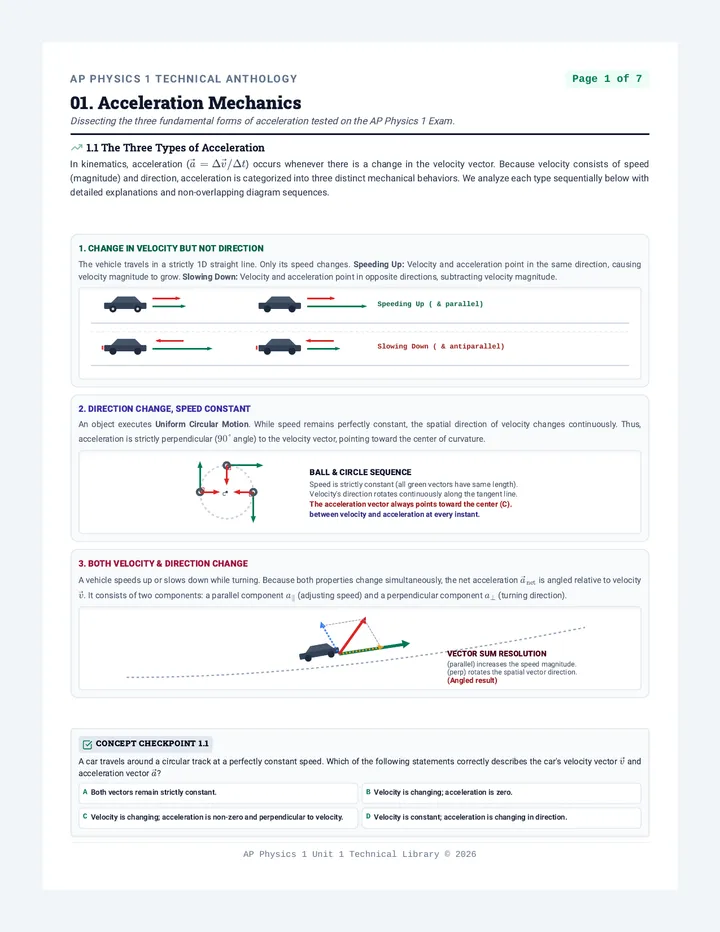
An AP Physics 1 lesson focusing on the advanced graphical, algebraic, and vector representations of velocity and acceleration. Includes a comprehensive 12-page reading anthology and a matching 12-page student analysis packet.

CM

Chuguna Murugesan

14
Acceleration Fundamentals Handout

Speed Shift Science

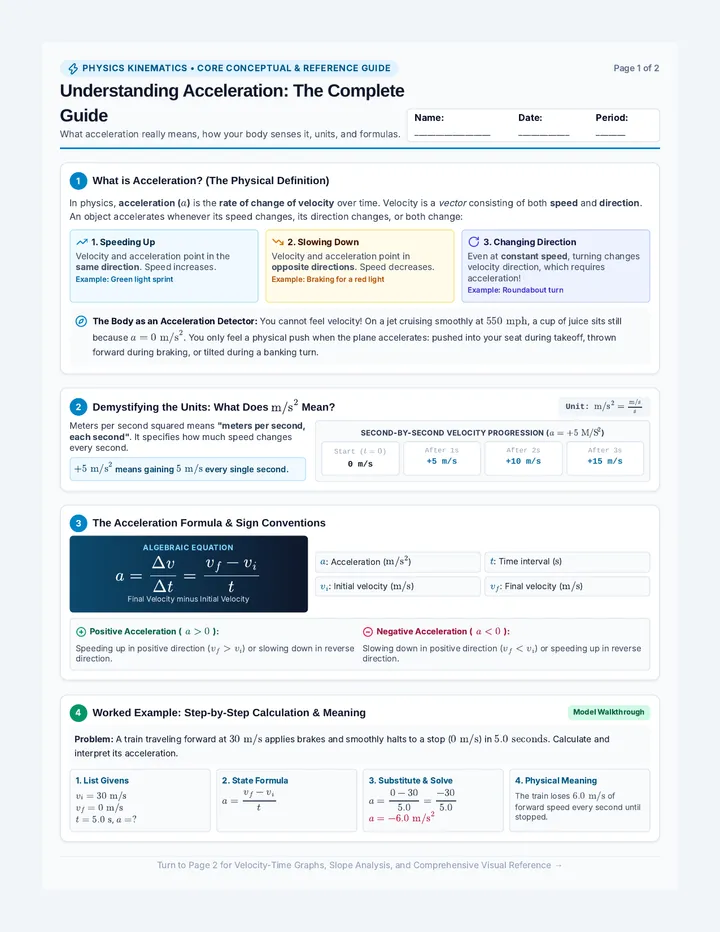
A comprehensive physics lesson focused on understanding acceleration as the rate of change of velocity, calculating acceleration using kinematic formulas, and determining acceleration from the slope of velocity-time graphs.

CM

Chuguna Murugesan

13
Kinematic Morphers Worksheet

Motion Morphers

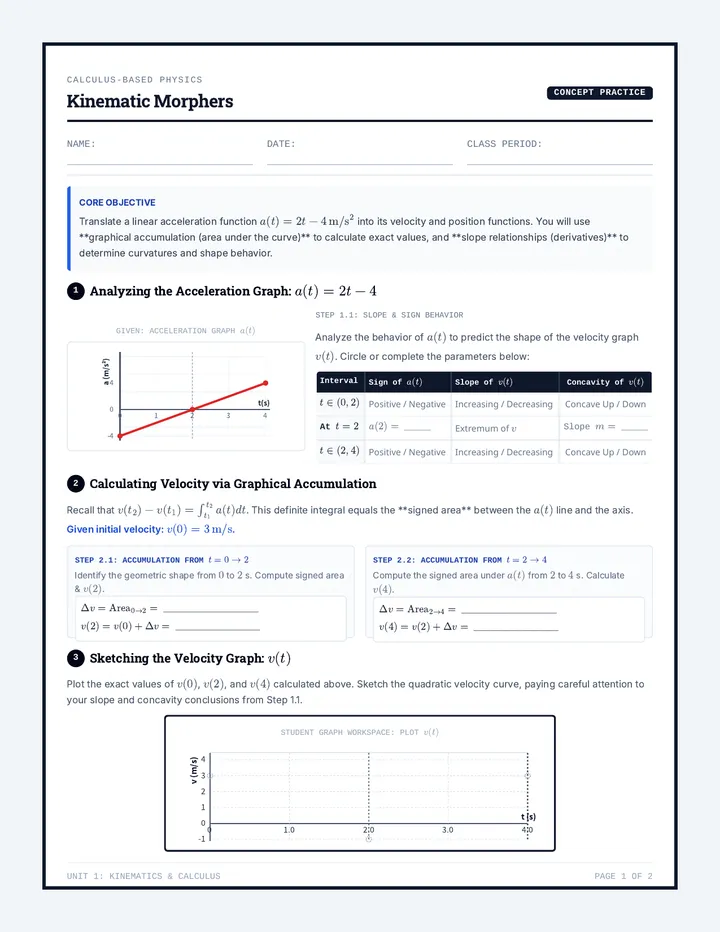
A calculus-based physics lesson focused on translating motion graphs (acceleration to velocity to position) using graphical accumulation (area under the curve) and slope relationship analysis, featuring scaffolded practice and a visual reference poster.

CM

Chuguna Murugesan

7
Spectrometer Secret Lab Notes Article

Magnetic Motion and Torque

A deep dive into the behavior of charged particles in magnetic fields, focusing on the mechanics of mass spectrometry and the rotational dynamics of current-carrying loops. Students will derive key equations for particle paths and analyze the torque that drives electric motors.

CM

Chuguna Murugesan

6
Magnetism Blueprint Article

Currents and Fields

An in-depth exploration of electromagnetism focusing on the relationship between electric currents and magnetic fields, featuring the Biot-Savart Law, Ampere's Law, and the Lorentz Force.

CM

Chuguna Murugesan

20