Reversible reactions and the balance between forward and reverse reaction rates. Addresses Le Chatelier's principle, equilibrium constants, and the impact of temperature, pressure, and concentration changes.
An AP Chemistry lesson exploring solubility rules, net ionic equations, particulate representations, and the mathematical link to Ksp and equilibrium shifts. Students engage with interactive station-based task cards simulating real laboratory precipitates.
The master blueprint for the Molecular Threads Biology curriculum, featuring a comprehensive yearlong syllabus and a teacher reference guide for weaving biochemistry anchors into every unit.
Explores the mathematical relationship between acid/base strength, dissociation constants, and equilibrium pH calculations using the ICE method.
Explores the equilibrium of buffer solutions and concludes with a summative assessment of the unit.
Focuses on neutralization reactions, predicting products, and performing titration experiments to determine unknown concentrations.
Students define acids and bases using Arrhenius and Brønsted-Lowry models, learn naming conventions, and master pH/pOH calculations.
A comprehensive review phase for the Reaction Dynamics unit. Students synthesize their knowledge of collision theory, energy pathways, and equilibrium shifts through a focused study guide and a unit-wide conceptual assessment.
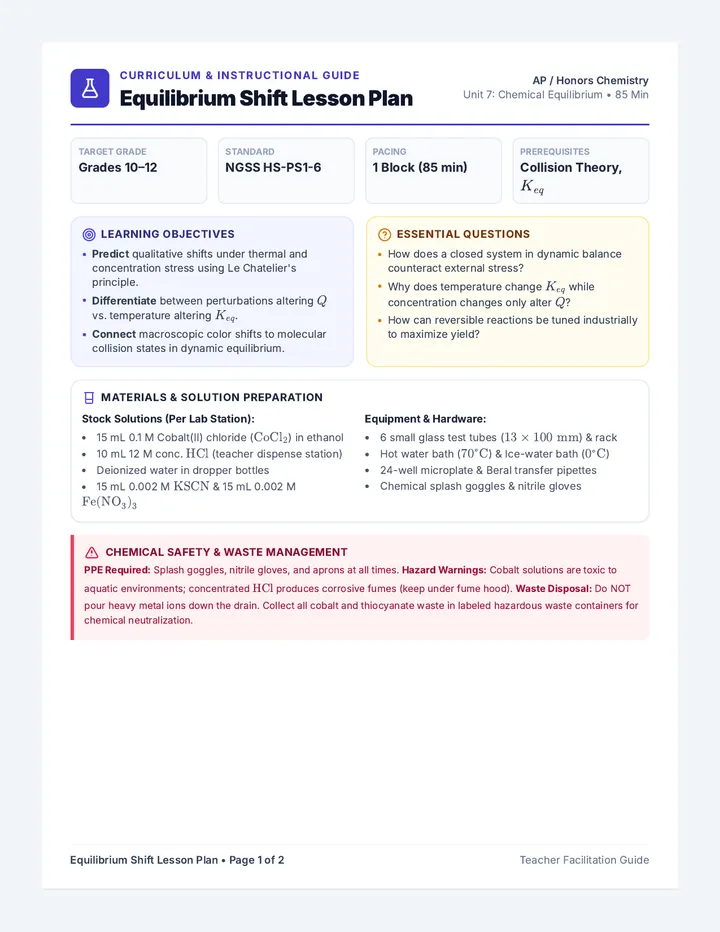
An investigation of Le Chatelier's Principle. Students apply external stresses—concentration and temperature changes—to the Iron(III) thiocyanate equilibrium system to observe, predict, and explain how a system at balance responds to change.
An introduction to reversible reactions and chemical equilibrium. Students use particle models and a pH-sensitive chemical indicator to visualize how reactions can occur in both directions and reach a point where forward and reverse rates are equal.
A comprehensive lesson exploring the mechanics of chemical reactions, including collision theory, energy diagrams, and the factors that influence reaction rates. Students will learn to visualize and calculate energy changes while conducting a hands-on investigation.
An 11th-grade chemistry engineering challenge where students design, build, and optimize salt-water powered vehicles to master redox reactions and circuit completion.
Students discover the additive nature of enthalpy through a hands-on chemical puzzle, using Hess's Law to calculate enthalpy changes for complex reactions using multiple intermediate steps.
A high school biology curriculum that weaves molecular and biochemical mechanisms into every major traditional unit, fully aligned to the Indiana Academic Standards for Biology.
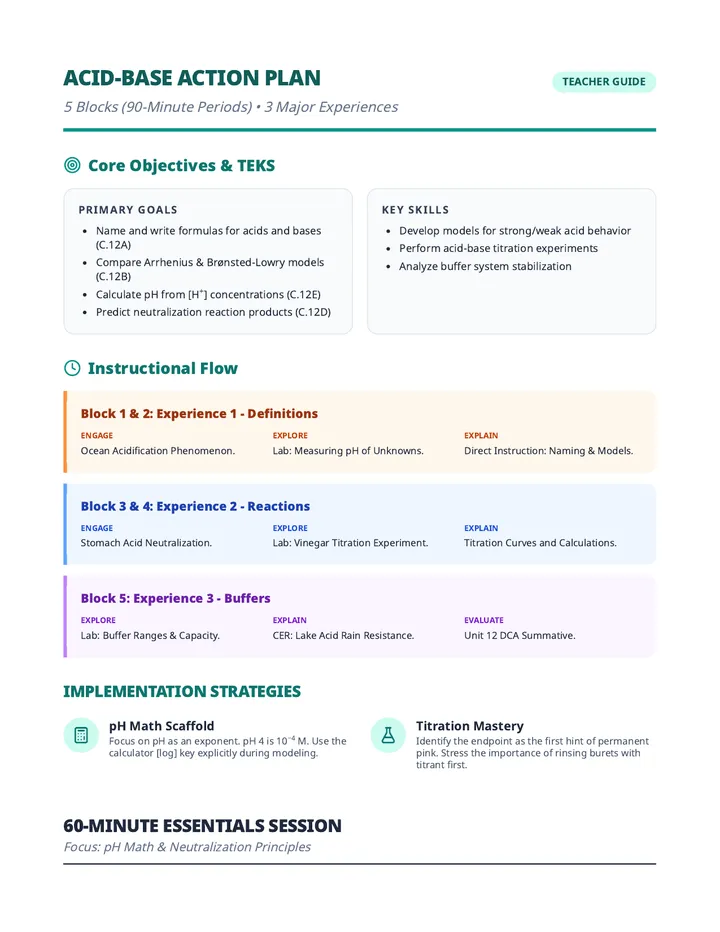
A comprehensive unit exploring the properties, reactions, and mathematical relationships of acids and bases, featuring pH calculations, titrations, and buffer systems.
This unit explores how chemical reactions occur and how they reach a state of balance. Students investigate reaction kinetics, energy changes, and the principles of dynamic equilibrium through modeling and laboratory investigation.
A five-day high school chemistry unit exploring thermochemistry, collision theory, enthalpy diagrams, and calorimetry through the lens of body heat and chemical reactions. Students investigate the anchoring phenomenon of exercise-induced heat while mastering TEKS C.13 standards.
A comprehensive 5-day chemistry unit investigating the relationships between gas pressure, volume, temperature, and moles using lab inquiries, mathematical modeling, and real-world applications.
A comprehensive 3-week unit exploring the unique physical properties of water, its role in life and geological processes, and the dynamics of watershed systems. Students investigate polarity, cohesion, and universal solubility through hands-on labs while connecting these traits to climate moderation and the health of the Chesapeake Bay.
A high-school level exploration of thermodynamics, focusing on the connection between entropy, enthalpy, and Gibbs Free Energy to predict chemical spontaneity.
A comprehensive workshop-based sequence exploring thermal separation techniques, from basic evaporation to industrial fractional distillation. Students master the physics of phase changes and boiling points to separate liquid mixtures.
This sequence explores the thermodynamic principles governing the separation of mixtures through phase changes. Students analyze intermolecular forces, vapor pressure (Raoult's Law), fractional distillation, crystallization kinetics, and membrane-based desalination, bridging the gap between molecular physics and industrial applications.
A 2nd-grade science sequence investigating how solids dissolve in liquids to form solutions, moving from basic observations to the concept of saturation.
A comprehensive undergraduate sequence on the physicochemical principles of chromatography, covering thermodynamic migration theory, kinetic efficiency (Van Deemter), phase optimization, instrumentation (GC/HPLC), and quantitative analytical methods.
An undergraduate-level sequence exploring the thermodynamic and physical principles of mixtures, covering entropy, enthalpy, phase equilibria, and practical separation techniques like distillation and recrystallization.
A comprehensive 3-page teacher facilitation guide, materials preparation checklist, common student misconceptions log, and detailed analytical answer key split across multiple pages to avoid overflow.
A high-rigor student-facing station activity worksheet and printable task cards. Integrates AP Chemistry Net Ionic writing, particulate drawings, Q vs Ksp math, common ion effect, pH dissolution, and gravimetric stoichiometry.
A premium AP Chemistry presentation deck introducing solubility rules, net ionic equations, particulate diagrams, and Ksp connections. Features a professional dark analytical-lab theme optimized for classrooms.
A comprehensive teacher guide/curriculum map detailing the specific biochemical concepts, molecular mechanisms, chemical "anchors", laboratory investigations, and classroom activities that bridge biochemistry with cell structures, genetics, evolution, and ecology.
A comprehensive high school biology syllabus fully aligned to Indiana Academic Standards, mapping out a 36-week schedule across 9 units with detailed biochemistry integration anchors and inquiry-based laboratory focus areas.
Teacher answer key for the Neutralization Numbers Worksheet, providing predicted products, balanced chemical equations, complete step-by-step mathematical setups, and correct values.
A comprehensive 2-page scaffolded student worksheet for neutralization calculations. It starts with predicting products and identifying mole ratios, introduces the equivalence shortcut formula, provides step-by-step guided practice for titration calculations, and concludes with a real-world solid-neutralization stoichiometry challenge.
Teacher answer key for the Solution Showdown Quiz, featuring correct answers and detailed rationales for each conceptual and mathematical question. Revised for improved rendering and content completeness. Now matches standardized formatting. Now includes full text of correct options for immediate context. Subscripts and superscripts fixed.
An 8-question multiple-choice review quiz covering Arrhenius definitions, nomenclature, pH calculations, Brønsted-Lowry conjugates, stoichiometry, and acid strength. Includes dedicated work areas for calculation problems. Revised for deeper math assessment and standardized formatting. Now 4 pages. Subscripts and superscripts fixed.
A comprehensive 4-page study guide covering acid-base properties, nomenclature rules, pH calculations, neutralization reactions, and strength/equilibrium concepts. Features scaffolded worked examples, an expanded section on neutralization stoichiometry with n-factor shortcuts, and a final MCQ review section with rationales. Revised for high contrast and better page breaks. Subscripts and superscripts fixed.
Teacher answer key for the pH Puzzle Pursuit Worksheet, including correct numerical answers for all 22 clues and a visual representation of the shaded solution grid. Revised for consistency with the student worksheet.
A scaffolded 2-page puzzle activity for calculating pH, pOH, and ion concentrations. Problems are categorized by calculation type with worked examples for each section, concluding with a coordinate-style grid for students to find and shade their answers.