Lenny.com
Explore
Create
ActivitiesNewMathEnglish Language ArtsScience & EngineeringSocial StudiesGlobal LanguagesHealth & Physical EducationSpecial EducationCounseling & Life SkillsArts & CreativityESL
Lenny.com
Lenny.com
Explore
Create
ActivitiesNewMathEnglish Language ArtsScience & EngineeringSocial StudiesGlobal LanguagesHealth & Physical EducationSpecial EducationCounseling & Life SkillsArts & CreativityESL
Lenny.com
Lenny.com

Solutions

Lenny for EducatorsLenny for SchoolsLenny for Districts

Product

ExploreSign inCreateSupportAbout

Resources

Getting startedMTSS Acceleration Program

© 2026 Lenny Learning Inc.

TermsPrivacyAccessibility
LinkedInInstagramX
Lenny

Solutions

Chemical properties of solutes and solvents, including concentration measures like molarity and mass percent. Examines factors affecting solubility and the behavior of colligative properties.

Science & EngineeringLife ScienceLiving ThingsAnimalsPlantsBody SystemsTraitsAdaptationsCellsEcosystemsHeredityGenes to TraitsCell DivisionPhysicsComparing MaterialsShapes and PropertiesMagnetsMagnetismLightSoundLight and SoundMatterStates of MatterChanges of StateMixturesPhysical and Chemical ChangeHeating and CoolingHeat and Thermal EnergyEnergyForce and MotionElectrical CircuitsAtoms and MoleculesPeriodic TableMotion in One DimensionMotion in Two DimensionsScalars and VectorsForces and Laws of MotionCircular Motion and GravityMomentum and ImpulseWork, Energy, and PowerWavesElectromagnetic WavesGeometric OpticsElectricity and MagnetismSimple Harmonic MotionThermodynamicsNuclear PhysicsEarth Science & AstronomyWeatherWater CycleRocks and MineralsFossilsEarth's FeaturesEarth's ResourcesEarth's StructureWeather and ClimateEarth EventsFossils and Geologic TimePlate TectonicsHuman ImpactsAstronomyChemistryUnits and MeasurementAtomic StructurePeriodic TrendsChemical BondingNomenclatureMolecular StructureIntermolecular ForcesThe MoleStoichiometryProperties of GasesSolutionsChemical ReactionsBalancing EquationsEnergy ChangesRates of ReactionsEquilibriumAcids and BasesQuantum ModelBiologyClassificationCell StructureThe Chemistry of LifeBiomoleculesCellular TransportCell EnergyCell Growth and DivisionDNAProtein SynthesisMeiosis and Sexual ReproductionPatterns of InheritanceMulticellular OrganismsEvolutionEcologyBiodiversityComputer ScienceAlgorithms and Computational ThinkingProgramming LanguagesComputing SystemsNetworks and InternetData AnalysisCybersecurityAI and Machine LearningSoftware Design and DevelopmentBlockchainEngineering & AIDesigning ExperimentsEngineering PracticesDesign ThinkingEngineering Design ProcessMechanical EngineeringElectrical EngineeringMaterials and StructuresCAD and 3D DesignRoboticsArtificial Intelligence BasicsVibe CodingMachine LearningAI Ethics and SocietySystems ThinkingEntrepreneurship & InnovationEntrepreneurial MindsetBusiness Idea DevelopmentBusiness Plan BasicsMarketing & Customer DiscoveryFinancial Management for Startups

Videos

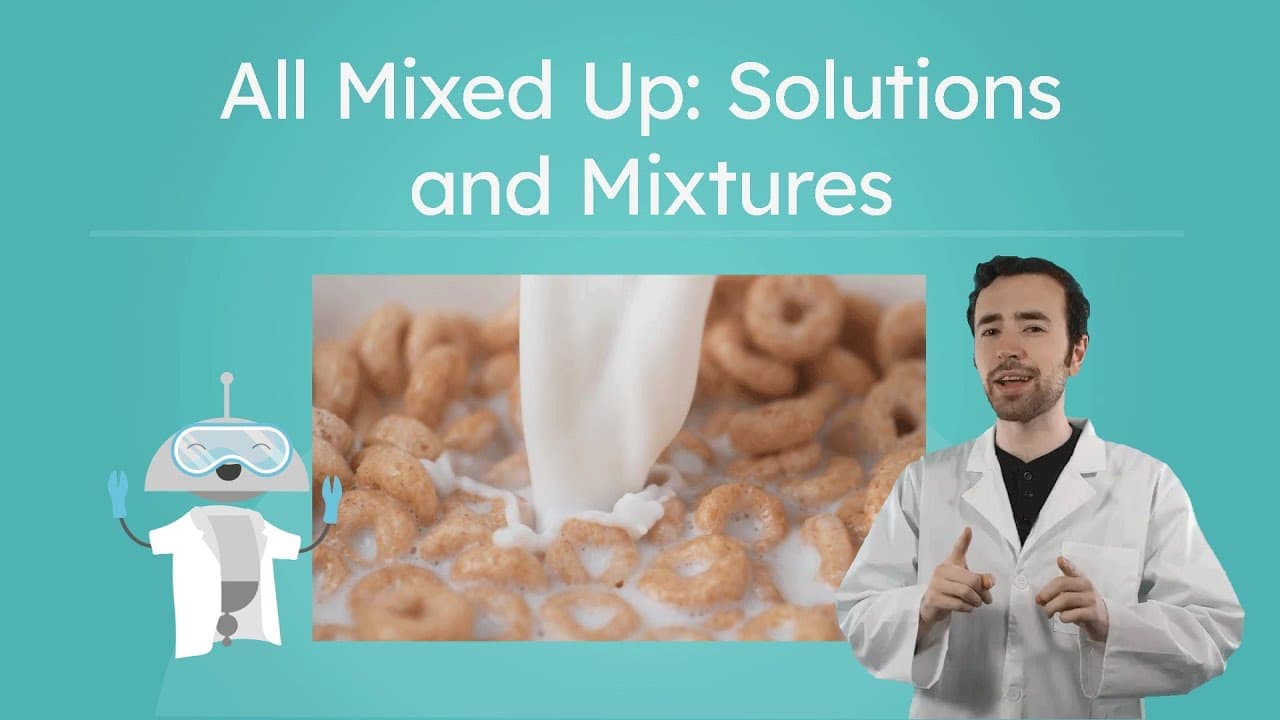
Understanding Mixtures, Solutions, and How to Separate Them

Understanding Mixtures, Solutions, and How to Separate Them

This engaging science lesson introduces students to the fundamental concepts of mixtures and solutions through a relatable problem-solving scenario. Hosted by Justin, a scientist character, the video begins with a dilemma: his baby sister has contaminated her water cup with sand and salt, prompting an investigation into how to separate these substances to clean the water. The narrative structure anchors abstract chemical concepts in a concrete, real-world application that students follow from start to finish. The video systematically breaks down the definitions of mixtures and solutions, distinguishing between them based on whether substances retain their physical identities or are evenly distributed. It introduces key vocabulary such as solubility, solute, and solvent, providing clear visual examples like lemonade, chocolate milk, and salt water. The lesson then pivots to practical engineering and scientific techniques, demonstrating how physical properties like size, state of matter, magnetism, and boiling point can be utilized to separate different types of mixtures. Ideally suited for upper elementary classrooms, this video connects chemistry concepts to everyday life. It is valuable for teachers as it models the scientific method and introduces specific separation techniques—sieving, filtration, magnetism, and evaporation—that can be easily replicated in a classroom lab setting. The video includes built-in pause points for student reflection and checking for understanding, making it a ready-to-use resource for interactive learning.
Miacademy & MiaPrep Learning ChannelMiacademy & MiaPrep Learning Channel

9mins 21s

Exploring Solubility and Polarity Through Experiments

Exploring Solubility and Polarity Through Experiments

This educational science video provides a comprehensive introduction to solutions, solubility, and the molecular properties of water. Through a blend of clear animations and a guided laboratory experiment, the presenter explains the relationship between solvents and solutes, using lemonade as an initial analogy to define these terms. The video delves into the chemistry of water, illustrating how its polar nature and hydrogen bonds allow it to act as a universal solvent for other polar substances, while repelling nonpolar substances like oil. Key themes include the definitions of mixtures and solutions, the distinction between polar and nonpolar molecules, and the scientific method. The video breaks down the atomic structure of water molecules to explain *why* dissolving happens, visualizing how positive and negative charges interact. It then transitions into a practical demonstration, walking students through a four-part experiment testing salt, pepper, sugar, and oil to determine their solubility in water. For the classroom, this video serves as an excellent bridge between theoretical chemistry concepts and practical application. It models proper lab safety and experimental procedure, including hypothesis generation and observation. Teachers can use the built-in pause points to facilitate class discussions, allowing students to make predictions before seeing the results. The content is ideal for introducing unit on matter, mixtures, or basic chemistry.

Miacademy & MiaPrep Learning ChannelMiacademy & MiaPrep Learning Channel

13mins 58s

Does Matter Just Disappear? Investigating the Conservation of Mass

Does Matter Just Disappear? Investigating the Conservation of Mass

This educational video explores the fundamental scientific principle of the Conservation of Mass. Through engaging visuals and clear examples, the host investigates whether matter can ever truly disappear or be created from nothing. The video distinguishes between physical changes (like dissolving sugar in tea) and chemical changes (like baking a cake), explaining how matter behaves in each scenario. It specifically addresses the common misconception that when something dissolves or evaporates, it is gone forever. The content breaks down complex terminology into accessible concepts, defining key terms such as reactants, products, and physical versus chemical changes. It uses a concrete experiment—weighing sugar and water before and after mixing—to provide empirical evidence that mass remains constant even when visible properties change. The narrative connects everyday observations, like a glass of water evaporating or sugar dissolving, to the broader scientific law that mass is never made or lost. For educators, this video is an excellent tool for introducing the particle nature of matter and the law of conservation of mass. It provides a ready-made demonstration that can be replicated in the classroom and offers clear definitions of vocabulary essential for upper elementary and middle school science curricula. The visual proof provided by the digital scale reading serves as a powerful anchor for students grappling with abstract concepts of invisible matter.

Crash Course KidsCrash Course Kids

4mins 9s

Why Water Is Essential for Life: A Molecular Look

Why Water Is Essential for Life: A Molecular Look

This video provides a comprehensive exploration of the biological importance of water, bridging the gap between molecular chemistry and macroscopic biological functions. It begins by contrasting the diverse life of the Amazon Rainforest with the sparse life of the Sahara Desert to illustrate water's critical role in ecosystems. The narrator then zooms in to the molecular level, explaining the chemical structure of water ($H_2O$), the difference between elements and compounds, and the concept of polarity, using magnets as an analogy for how positive hydrogen and negative oxygen atoms interact.

Miacademy & MiaPrep Learning ChannelMiacademy & MiaPrep Learning Channel

15mins 32s

How to Identify Unknown Substances Using Properties

How to Identify Unknown Substances Using Properties

In this engaging episode of Crash Course Kids, host Sabrina Cruz explores how physical properties can be used to identify unknown substances. Starting with a relatable scenario about choosing candy from a gift bag without looking, the video introduces the scientific definition of 'properties' and explains how scientists use observable traits to categorize matter. It defines key terms like 'substance' and 'element' while reviewing properties of common groups like metals (shiny, conductive, magnetic) and gases (shapeless, transparent). The video transitions into a practical 'investigation' segment that demonstrates how to distinguish between similar-looking substances. It first tackles two white powders (sugar and sand) by testing their solubility in water, emphasizing the critical safety rule of 'No Tasting.' Then, using a blindfold challenge, it distinguishes between a metal nail and a gummy frog based on hardness, flexibility (malleability), and magnetism. This hands-on approach models scientific inquiry and deductive reasoning. Ideally suited for upper elementary science classrooms, this video provides a solid foundation for units on matter. It connects abstract definitions to concrete examples and simple experiments that can be replicated in class. Teachers can use this resource to introduce the concept of characteristic properties, teach laboratory safety, or kick off a mystery substance lab activity where students must identify materials using only physical tests.

Crash Course KidsCrash Course Kids

4mins 27s

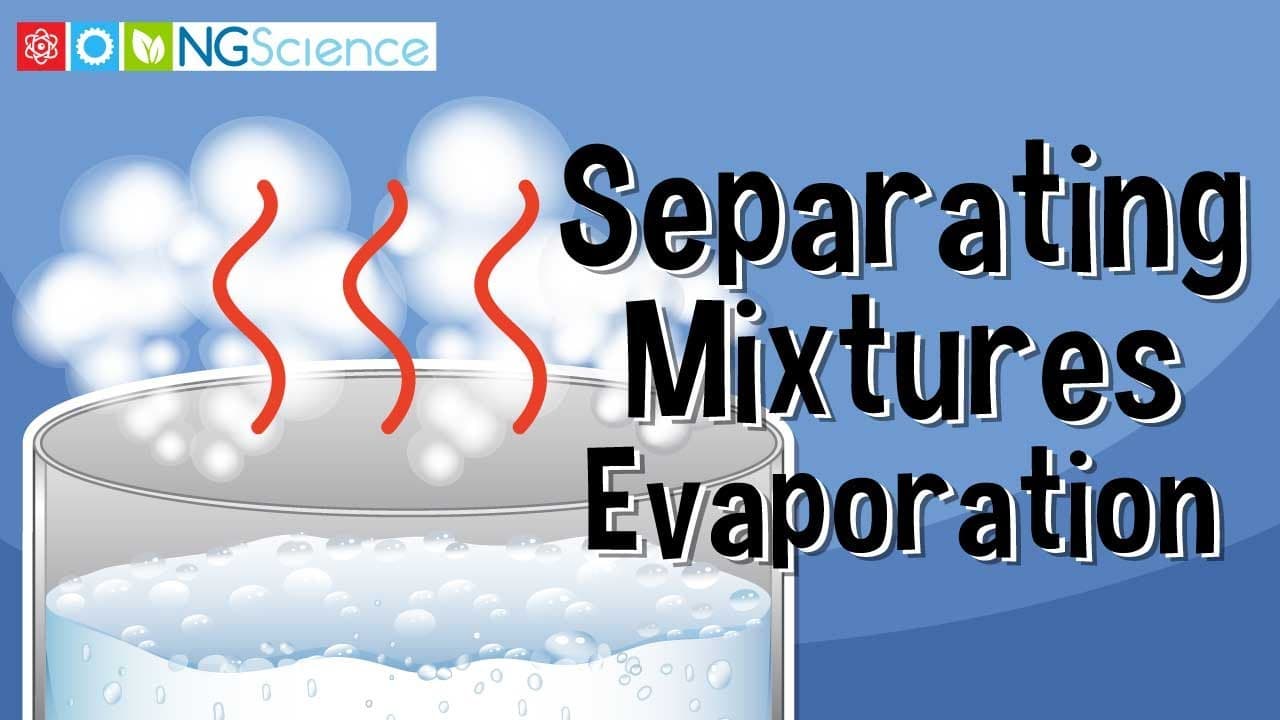
How to Separate Mixtures Using Evaporation

How to Separate Mixtures Using Evaporation

This educational animation provides a clear and concise demonstration of how to separate a soluble solid from a liquid using evaporation. It begins by defining key scientific concepts such as mixtures, solutions, solvents, and solutes through a virtual experiment involving table salt and water. The video visually demonstrates the process of dissolving, explaining how the solid salt integrates into the water to create a uniform solution. The narrative then shifts to the separation process, introducing laboratory equipment like a beaker, ring stand, and Bunsen burner. It explains the physical change that occurs during evaporation, where heat causes the liquid solvent (water) to turn into a gas (vapor), eventually leaving the solid solute (salt) behind. This section effectively illustrates conservation of matter and reversible physical changes. The video concludes with an interactive six-question quiz that reinforces the terminology and concepts covered. This comprehensive resource is valuable for science classrooms as it visualizes abstract processes that are often difficult to see in real-time, making it an excellent tool for introducing or reviewing the properties of matter and separation techniques.

Next Generation ScienceNext Generation Science

3mins 53s

Materials

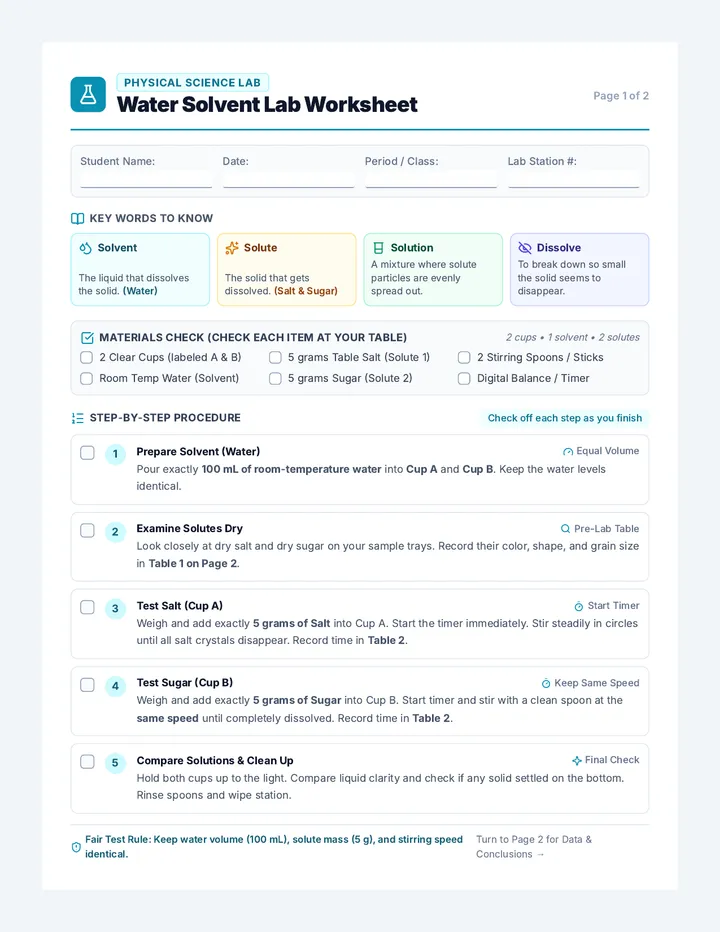
Water Solvent Lab Worksheet

Water Solvent Lab Worksheet

A structured two-page student lab worksheet investigating water as a universal solvent with salt and sugar solutes, featuring clear directions and a dedicated workspace to construct a bar graph comparing solute type (independent variable) against dissolving time (dependent variable).

S

stewart

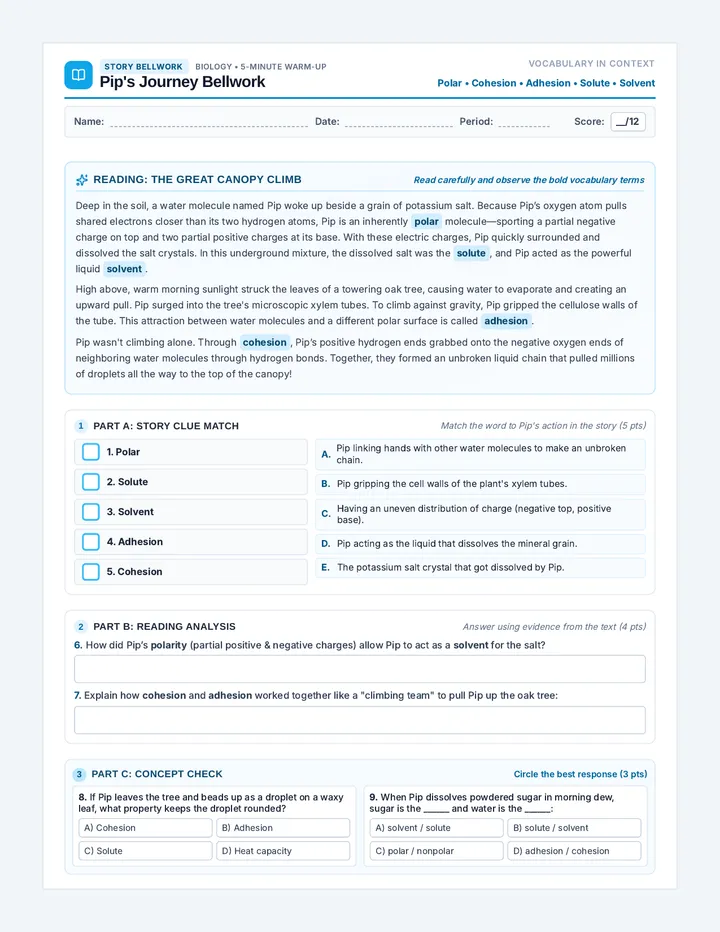
Pip Journey Bellwork

Pip Journey Bellwork

A bellwork review featuring an engaging short story about a water molecule named Pip that demonstrates polarity, cohesion, adhesion, solute, and solvent, paired with story-based vocabulary matching and comprehension questions.

S

stewart

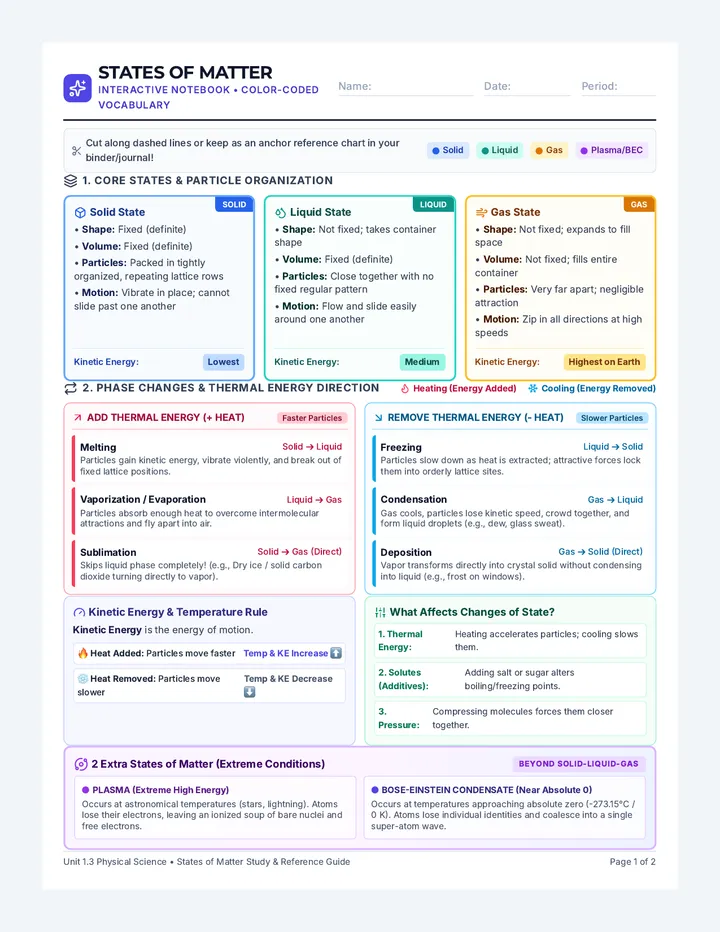
Matter Models Interactive Notebook

Matter Models Interactive Notebook

A 2-page interactive science notebook resource featuring color-coded vocabulary in distinct dotted cut-out sections and a unified single-tab 3-flap states of matter particle foldable with increasing energy progression.

RL

RMS Lenny

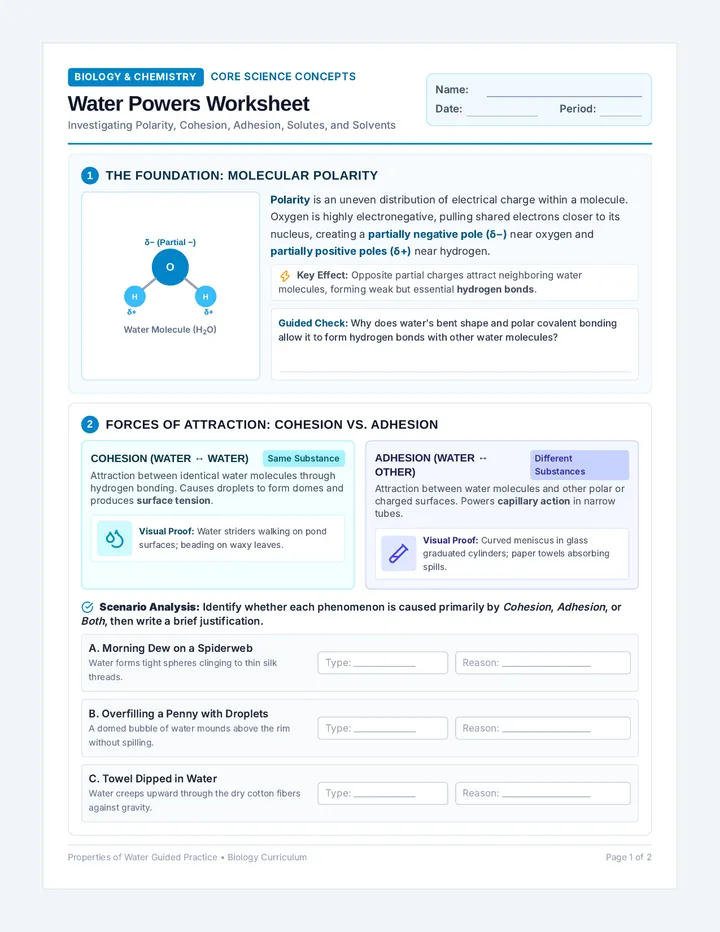
Water Powers Worksheet

Water Powers Worksheet

A comprehensive two-page guided practice worksheet exploring the unique properties of water, updated with crystal-clear concrete solute/solvent examples, an explicit modeled anchor row, and labeled hydration diagrams.

S

stewart

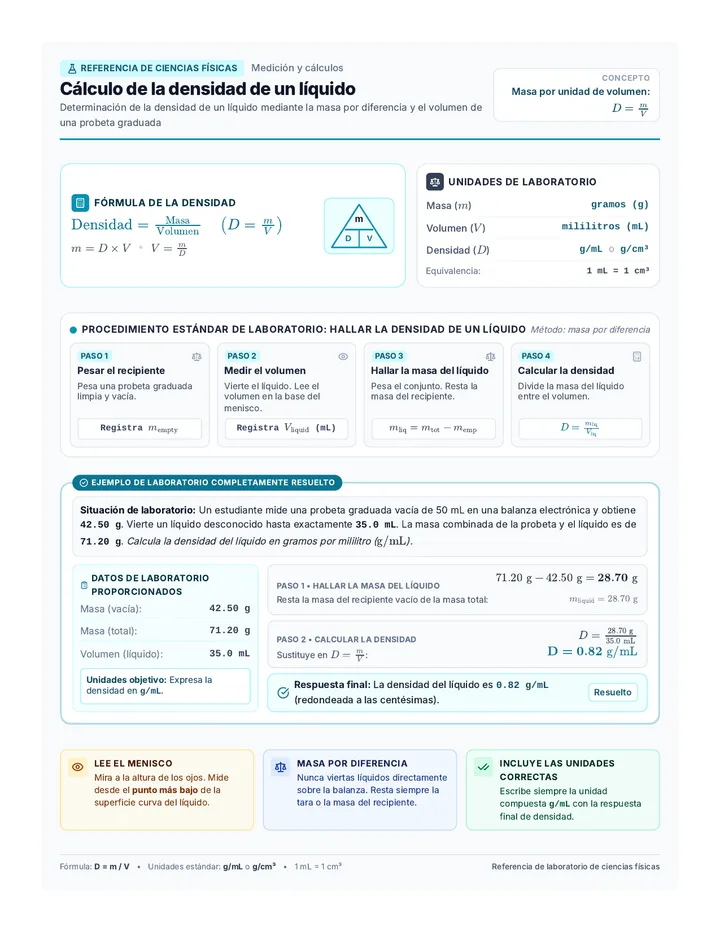
Liquid Density Reference Sheet

Liquid Density Reference Sheet

A comprehensive visual reference guide detailing how to calculate the density of a liquid using mass by difference and volume measurements, featuring the formula triangle, step-by-step protocol, a complete worked laboratory example with final unit verification, and measurement best practices.

S

stewart

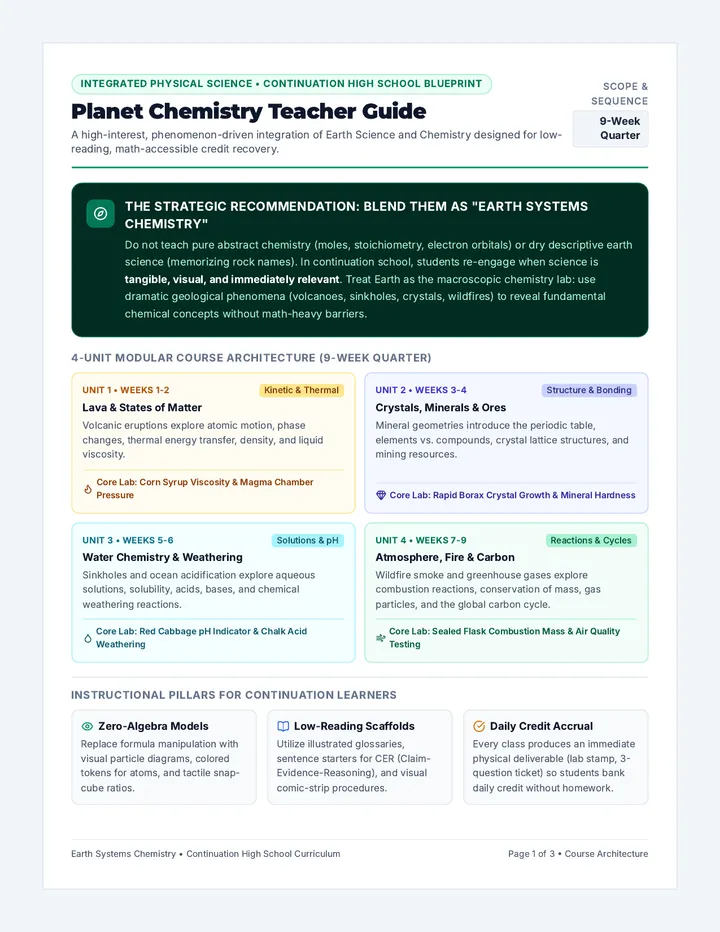
Planet Chemistry Teacher Guide

Planet Chemistry Teacher Guide

A comprehensive curriculum blueprint integrating chemistry and earth science specifically tailored for continuation high school students. Features four accessible, hands-on units, low-math lab investigations, and structured literacy supports for credit recovery.

MH

Meagan Hudson

Sequences

Positionnement Diagnostic Test

Cap sur les Automatismes

Séquence d'accueil et de consolidation des automatismes numériques (nombres, fractions, priorités opératoires) comprenant un test de positionnement et des fiches d'exercices contextualisées.

EK

Emmanuelle Klaus-Baron

7
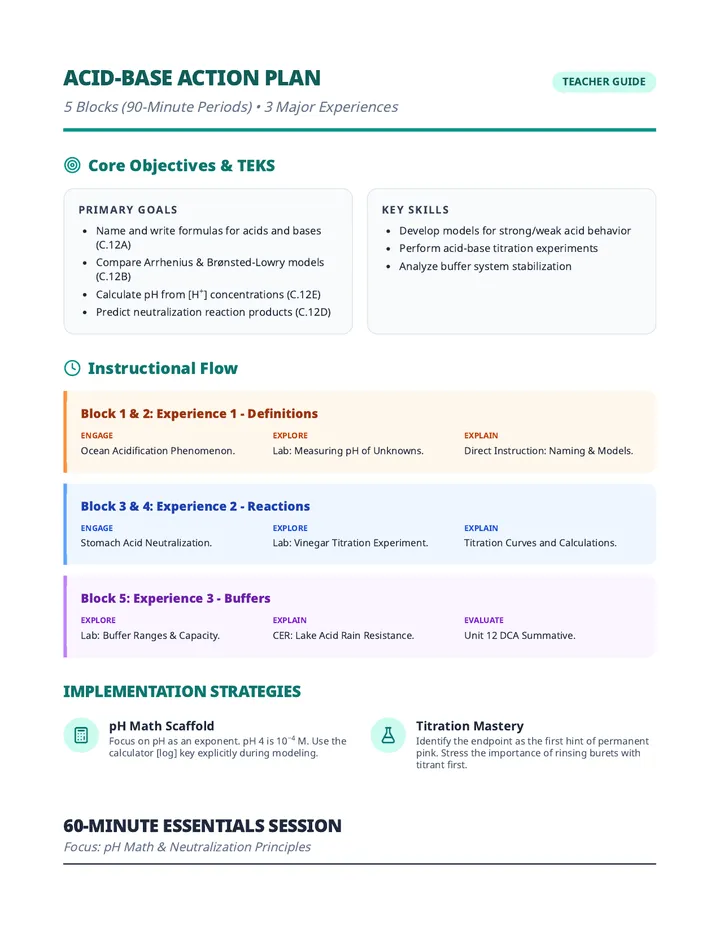
Acid Base Action Plan

Acid Base Investigation

A comprehensive unit exploring the properties, reactions, and mathematical relationships of acids and bases, featuring pH calculations, titrations, and buffer systems.

OM

Olutoyin Makinde

34
CHEM 1406 Study Guide

CHEM 1406 Lab Midterm Review

A comprehensive review of CHEM 1406 introductory chemistry lab concepts, including safety, measurement, atomic structure, bonding, and chemical reactions.

OM

Olutoyin Makinde

4
Lab Success Study Guide

Lab Chemistry Mastery

A specialized curriculum designed to prepare students for introductory chemistry laboratory examinations, focusing on practical applications, quantitative calculations, and organic structure identification.

OM

Olutoyin Makinde

3
Turtle Field Log Handbook Acton

Watershed Guardians

A Grade 5 PBL sequence focused on the hydrosphere and human impact, partnered with Zoo New England. Students investigate the connection between the particulate nature of matter and the survival of fostered endangered turtles in the Nashoba Brook Watershed.

K

kthompson

11
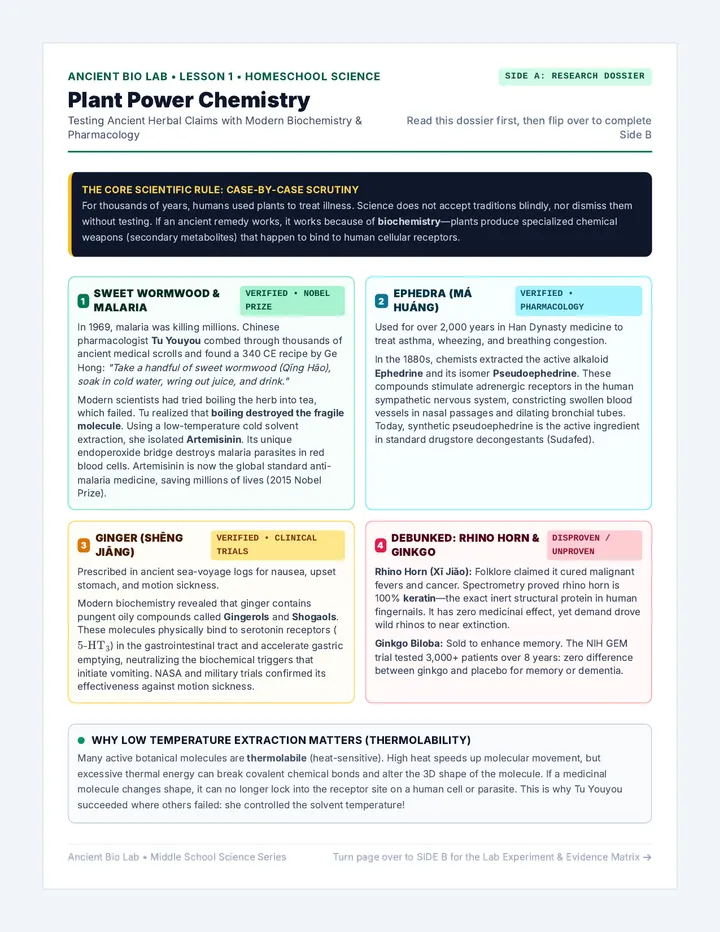
Botanical Evidence Worksheet

Ancient Bio Lab

A three-part middle school science and physical health sequence exploring ancient Chinese medicine and movement through modern clinical trials, pharmacology, neurobiology, and biomechanics.

DB

Danielle Burham

6

Lessons

Heat Flow Teacher Guide

Particle Behavior Review

A lesson focusing on the states of matter (solid, liquid, gas) and the behavior of particles at the molecular level. Students will model particle motion and arrangement, as well as the energy changes that drive phase transitions.

EA

Erica Andre

54
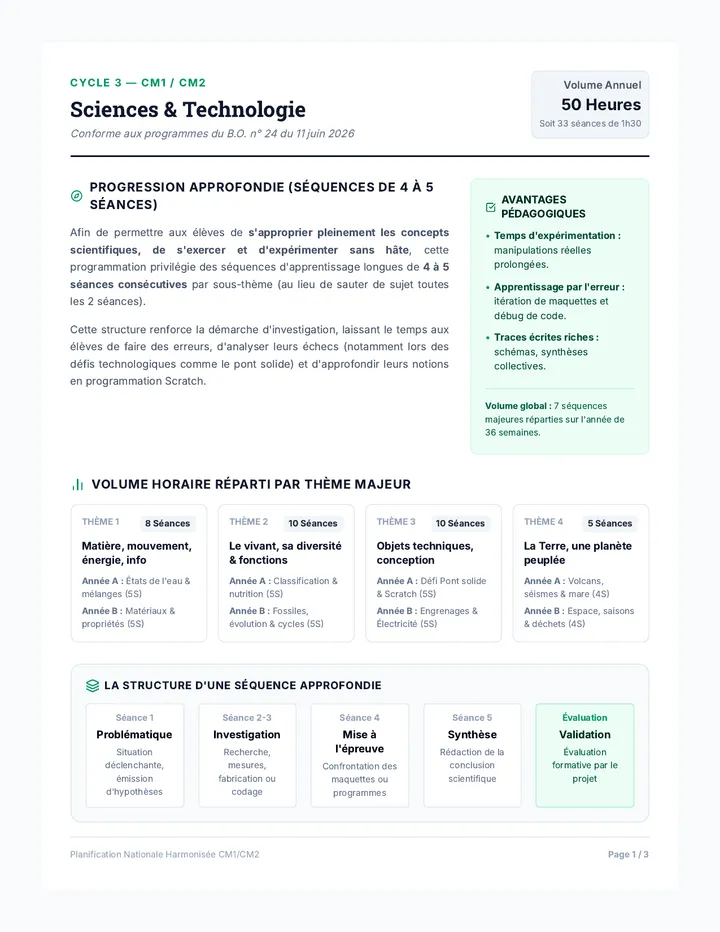
Tableau Progression Annuelle Sciences CM

Progression Sciences CM1 CM2

Outil de planification annuelle et de progression pour l'enseignement des sciences et technologies en classe de CM1/CM2, conforme au BO de juin 2026. Ce guide propose une répartition claire des volumes horaires et des thèmes entre l'année A et l'année B pour éviter les redondances dans les classes à double niveau.

LP

LAURENT PERCHE

40
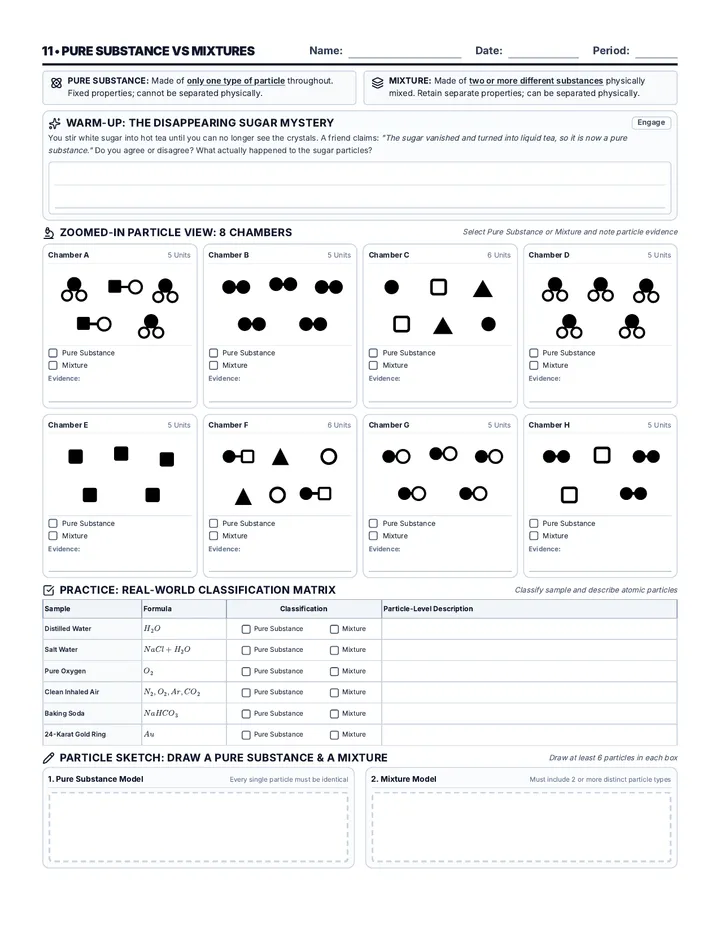
Pure Substance vs Mixtures Worksheet

Substance Showdown

A middle school physical science investigation exploring pure substances and mixtures through everyday observations and zoomed-in particle models. Students analyze atomic arrangements, classify diverse materials, and design physical separation methods.

MM

Megan McDonald

2
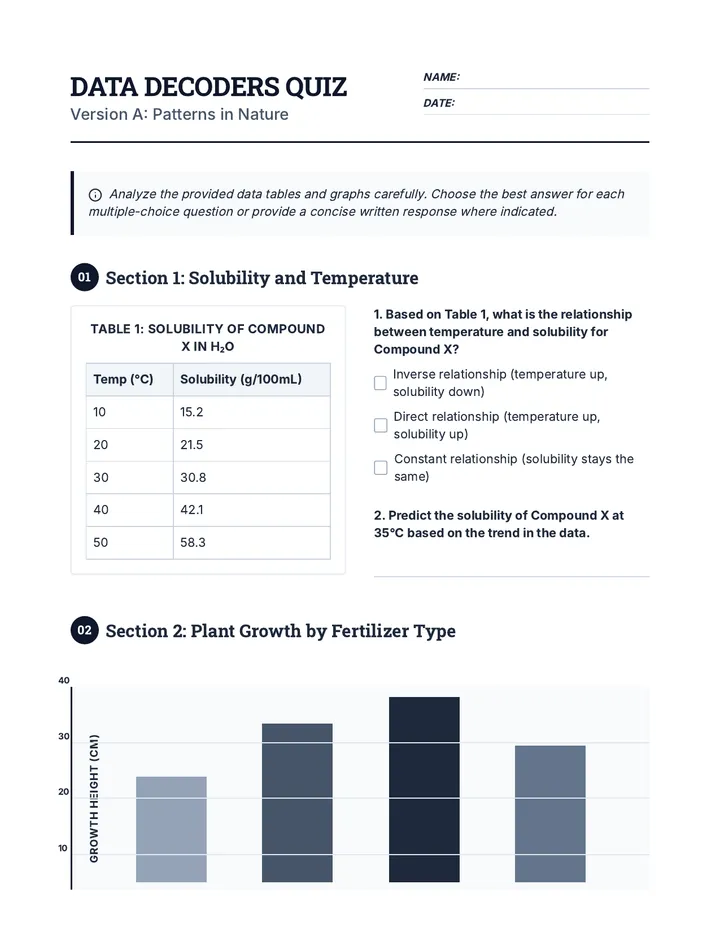
Data Decoders Quiz A

Data Decoders Assessment

A high-stakes assessment focused on interpreting various scientific data representations, including tables, bar graphs, line graphs, and scatter plots. Students will analyze trends, identify variables, and draw conclusions from realistic scientific scenarios.

JF

Jim Fusaro

4
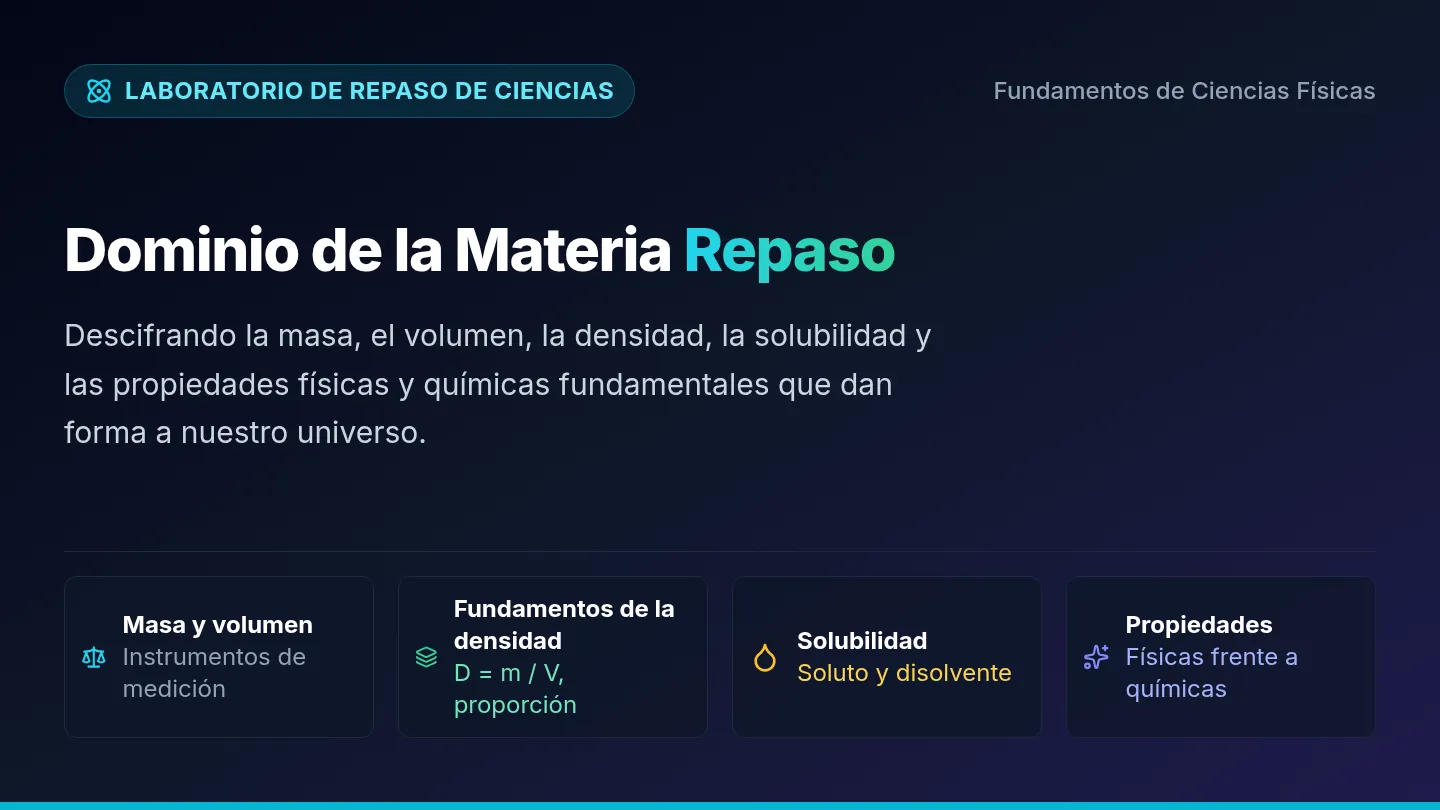
Matter Mastery Slides

Matter Mastery Review

A comprehensive review lesson on the properties of matter, mass, volume, density, temperature, solubility, and physical versus chemical changes. Features interactive instruction, scaffolded guided notes, mixed-format practice, and assessment.

MN

Monica Nicolas

9
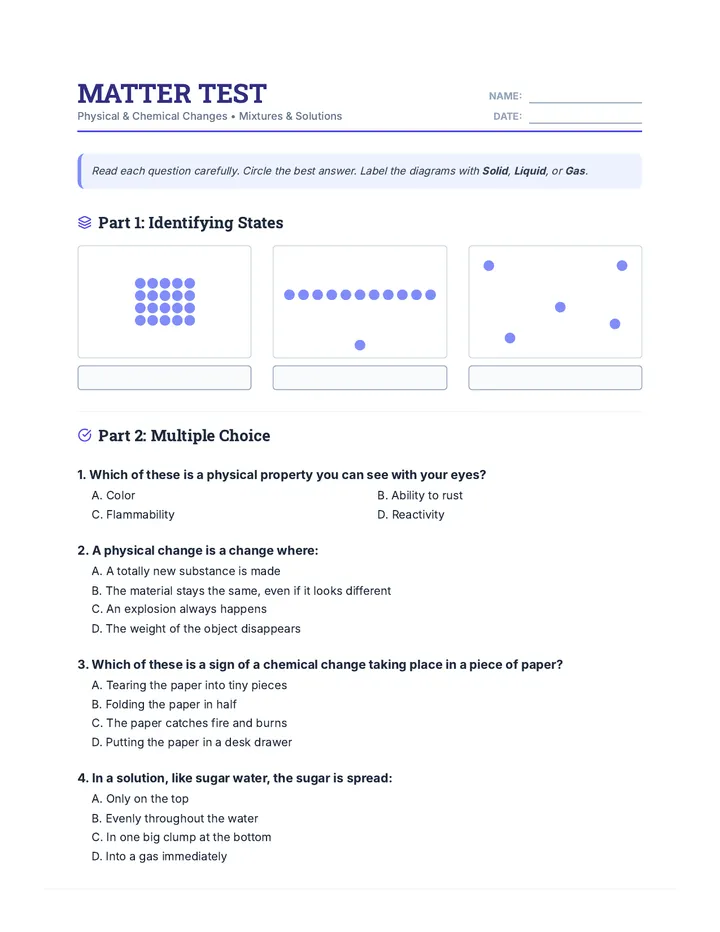
Matter Test Document

Matter Mastery Assessment

A comprehensive assessment for Grade 5 students covering physical and chemical properties, changes of state, and the characteristics of mixtures and solutions.

AD

Amanda Daniels

4