Lenny.com
Explore
Create
ActivitiesNewMathEnglish Language ArtsScience & EngineeringSocial StudiesGlobal LanguagesHealth & Physical EducationSpecial EducationCounseling & Life SkillsArts & CreativityESL
Lenny.com
Lenny.com
Explore
Create
ActivitiesNewMathEnglish Language ArtsScience & EngineeringSocial StudiesGlobal LanguagesHealth & Physical EducationSpecial EducationCounseling & Life SkillsArts & CreativityESL
Lenny.com
Lenny.com

Solutions

Lenny for EducatorsLenny for SchoolsLenny for Districts

Product

ExploreSign inCreateSupportAbout

Resources

Getting startedMTSS Acceleration Program

Newsletters

School Funding Newsletter

© 2026 Lenny Learning Inc.

TermsPrivacyAccessibility
LinkedInInstagramX
Lenny

Quantum Model

Maps electron probability distributions through atomic orbitals and wave-particle duality principles. Defines quantum numbers and energy quantization to explain atomic structure beyond the Bohr model.

Science & EngineeringLife ScienceLiving ThingsAnimalsPlantsBody SystemsTraitsAdaptationsCellsEcosystemsHeredityGenes to TraitsCell DivisionPhysicsComparing MaterialsShapes and PropertiesMagnetsMagnetismLightSoundLight and SoundMatterStates of MatterChanges of StateMixturesPhysical and Chemical ChangeHeating and CoolingHeat and Thermal EnergyEnergyForce and MotionElectrical CircuitsAtoms and MoleculesPeriodic TableMotion in One DimensionMotion in Two DimensionsScalars and VectorsForces and Laws of MotionCircular Motion and GravityMomentum and ImpulseWork, Energy, and PowerWavesElectromagnetic WavesGeometric OpticsElectricity and MagnetismSimple Harmonic MotionThermodynamicsNuclear PhysicsEarth Science & AstronomyWeatherWater CycleRocks and MineralsFossilsEarth's FeaturesEarth's ResourcesEarth's StructureWeather and ClimateEarth EventsFossils and Geologic TimePlate TectonicsHuman ImpactsAstronomyChemistryUnits and MeasurementAtomic StructurePeriodic TrendsChemical BondingNomenclatureMolecular StructureIntermolecular ForcesThe MoleStoichiometryProperties of GasesSolutionsChemical ReactionsBalancing EquationsEnergy ChangesRates of ReactionsEquilibriumAcids and BasesQuantum ModelBiologyClassificationCell StructureThe Chemistry of LifeBiomoleculesCellular TransportCell EnergyCell Growth and DivisionDNAProtein SynthesisMeiosis and Sexual ReproductionPatterns of InheritanceMulticellular OrganismsEvolutionEcologyBiodiversityComputer ScienceAlgorithms and Computational ThinkingProgramming LanguagesComputing SystemsNetworks and InternetData AnalysisCybersecurityAI and Machine LearningSoftware Design and DevelopmentBlockchainEngineering & AIDesigning ExperimentsEngineering PracticesDesign ThinkingEngineering Design ProcessMechanical EngineeringElectrical EngineeringMaterials and StructuresCAD and 3D DesignRoboticsArtificial Intelligence BasicsVibe CodingMachine LearningAI Ethics and SocietySystems ThinkingEntrepreneurship & InnovationEntrepreneurial MindsetBusiness Idea DevelopmentBusiness Plan BasicsMarketing & Customer DiscoveryFinancial Management for Startups

Videos

Understanding the Strange World of Quantum Mechanics

Understanding the Strange World of Quantum Mechanics

This engaging video introduces students to the fundamental and often counterintuitive principles of quantum mechanics. Through clear narration and helpful analogies, it breaks down complex topics such as wave-particle duality, the observer effect, the Heisenberg Uncertainty Principle, and energy quantization. The video uses visual demonstrations, like the double-slit experiment and car speedometer analogies, to make these abstract concepts accessible to high school students. Key themes include the strange behavior of subatomic particles, the difference between continuous and quantized energy, and how observation fundamentally alters quantum systems. The video also explores practical applications of these theories, explaining how quantum mechanics allows us to determine the composition of stars through spectroscopy, improves television displays with Quantum Dots (QLED), and powers the future of quantum computing. Ideally suited for high school physics and chemistry classrooms, this video bridges the gap between theoretical science and real-world technology. It provides a solid conceptual foundation for understanding atomic structure and modern technology, making it an excellent resource for introducing a unit on modern physics or electron configurations.

Miacademy & MiaPrep Learning ChannelMiacademy & MiaPrep Learning Channel

10mins 18s

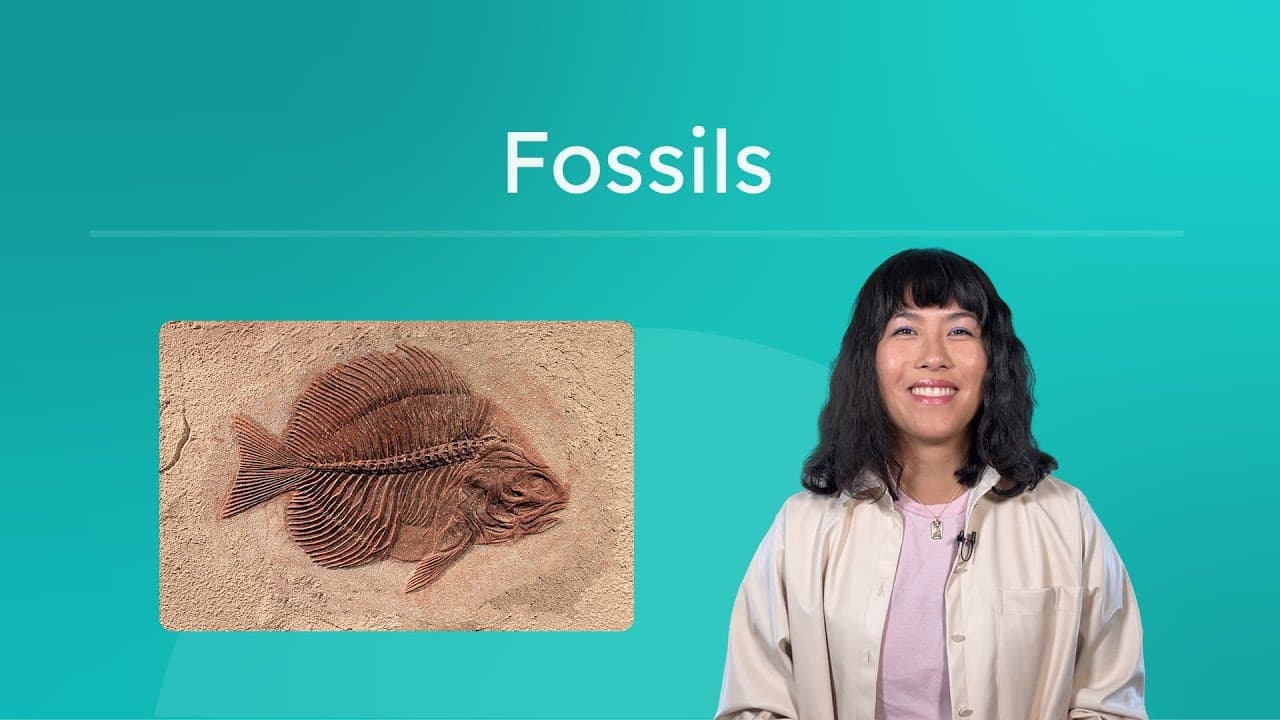
How Fossils Form and How Scientists Date Them

How Fossils Form and How Scientists Date Them

This educational video provides a comprehensive overview of paleontology, focusing on the formation, discovery, and dating of fossils. It begins by defining fossils as the remains or traces of once-living organisms and explains the specific, rare environmental conditions necessary for fossilization to occur, such as rapid burial in sediment, ice, or amber. The video differentiates between body fossils (bones, soft tissue) and trace fossils (footprints, nests), giving students a clear understanding of the diversity of the fossil record. The content then delves into the two primary methods scientists use to date these discoveries: relative dating and absolute dating. It explains relative dating through the Law of Superposition and the use of index fossils like trilobites to establish chronological order in rock layers. It then introduces the more complex concept of absolute dating, using animations to demonstrate radioactive decay, isotopes, and half-lives. Specific examples using Carbon-14 and Potassium-40 are provided to show how scientists calculate specific ages for fossils ranging from thousands to billions of years old. For educators, this video is a valuable tool for bridging biology and earth science concepts. It effectively simplifies the abstract mathematics of radioactive half-lives into visual models that are easier for students to grasp. The video includes built-in learning goals, practice problems, and real-world examples (such as cyanobacteria and woolly mammoths), making it a self-contained lesson on geological time and the evidence for evolution.

Miacademy & MiaPrep Learning ChannelMiacademy & MiaPrep Learning Channel

13mins 37s

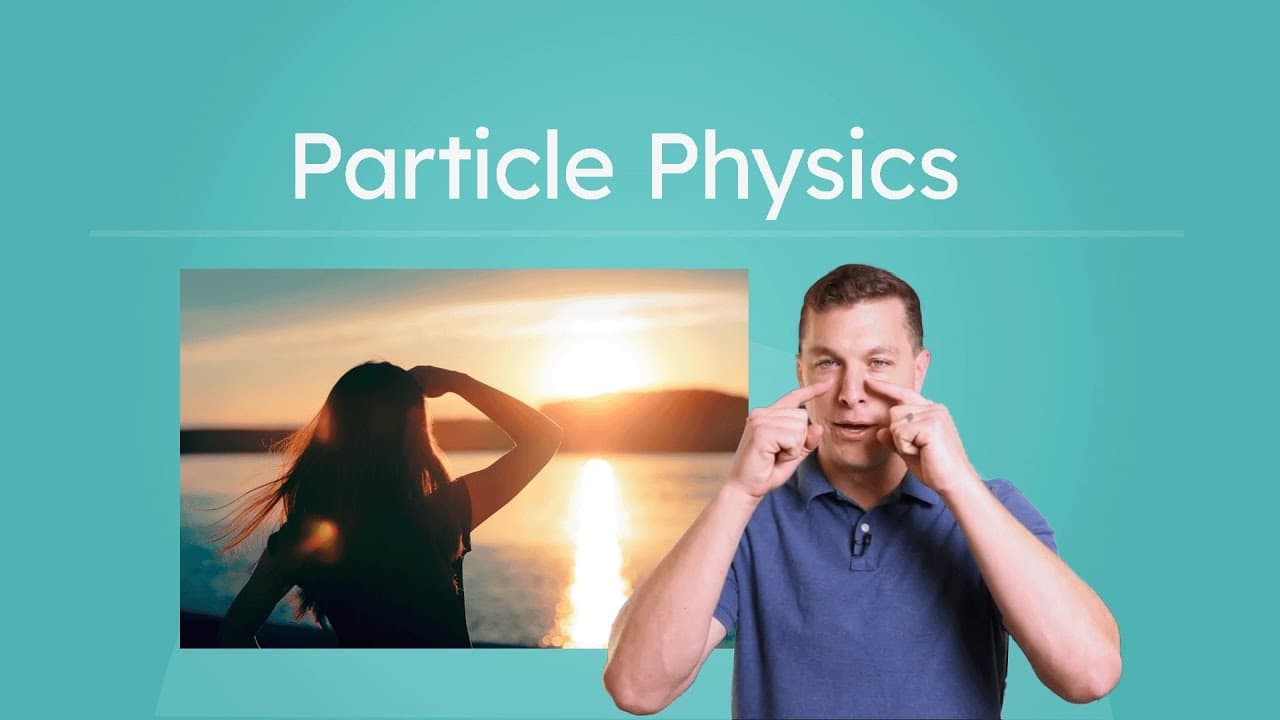
The Building Blocks of Matter: Exploring Particle Physics

The Building Blocks of Matter: Exploring Particle Physics

This educational video provides a comprehensive introduction to particle physics, delving deeper than the standard model of protons, neutrons, and electrons to explore the fundamental building blocks of the universe. The narrator guides viewers through the "particle zoo," explaining how protons and neutrons are actually composite particles made of quarks, while electrons belong to a different family called leptons. The video clarifies the distinction between fermions (matter builders) and bosons (force carriers), offering clear analogies to explain how forces operate at the subatomic level. Key themes include the structure of the atom, the Standard Model of elementary particles, and the four fundamental forces of nature: electromagnetic, strong nuclear, weak nuclear, and gravitational. The video breaks down complex concepts like fractional charges in quarks, the pairing of leptons with neutrinos, and the role of particle accelerators in discovering new particles like the Higgs boson. It also addresses current gaps in scientific knowledge, such as the hypothetical nature of the graviton. For educators, this video serves as an excellent bridge between basic chemistry/physics concepts and advanced modern physics. It uses clear graphics and simple math (adding fractions for quark charges) to demystify abstract concepts. The content is valuable for high school physics and chemistry classrooms to deepen students' understanding of matter, introduce the concept of fundamental forces, and spark interest in contemporary scientific research.

Miacademy & MiaPrep Learning ChannelMiacademy & MiaPrep Learning Channel

12mins 40s

Materials

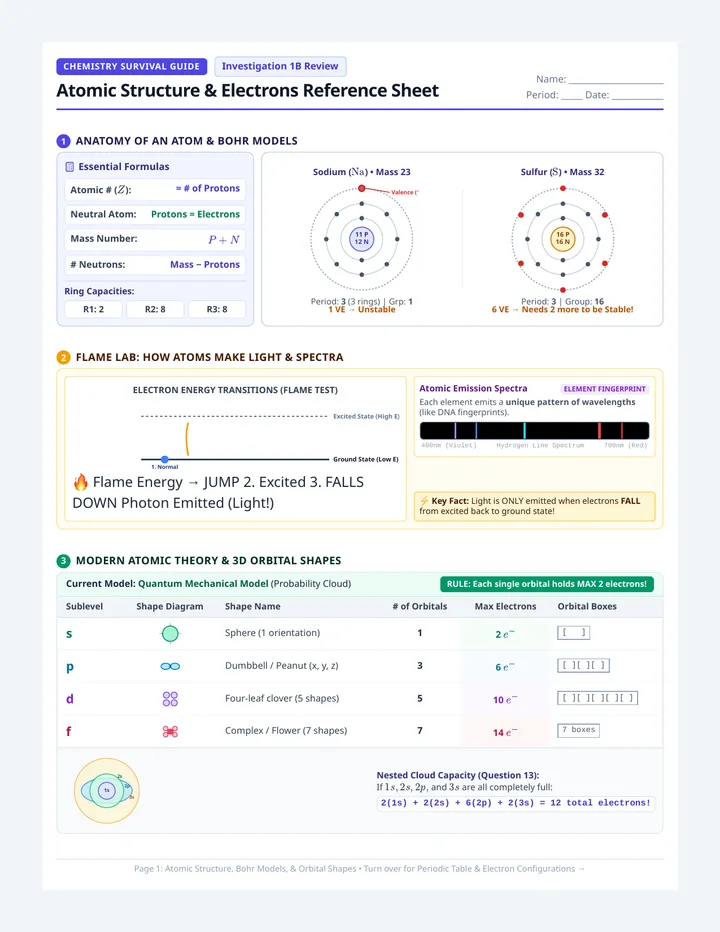
Atomic Structure Reference Sheet

Atomic Structure Reference Sheet

A highly visual 2-page assessment reference sheet for high school sophomore co-taught chemistry students, featuring detailed diagrams of Bohr models, flame test energy transitions, 3D orbital shapes (s, p, d, f), nested orbital shells, a full periodic table block map, electron configuration guides, orbital box diagrams, and Lewis dot structures.

SP

Stephanie Petrucci

درع الشمس عرض شرائح

درع الشمس عرض شرائح

عرض شرائح تفصيلي وبصري من 10 شرائح للمرحلة الثانوية يستعرض كيمياء واقيات الشمس، يشمل طاقة الفوتونات، ونظرية فجوة النطاق، والأنظمة المترافقة، والاستقرار الضوئي، وحساب SPF، والكيمياء الخضراء.

ا

الجوهره

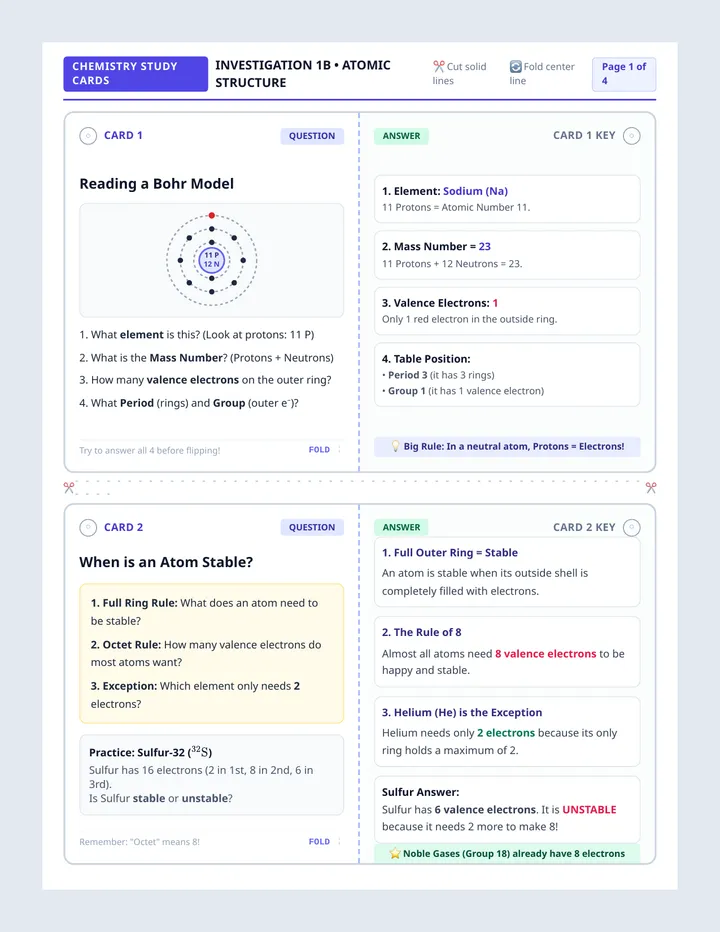
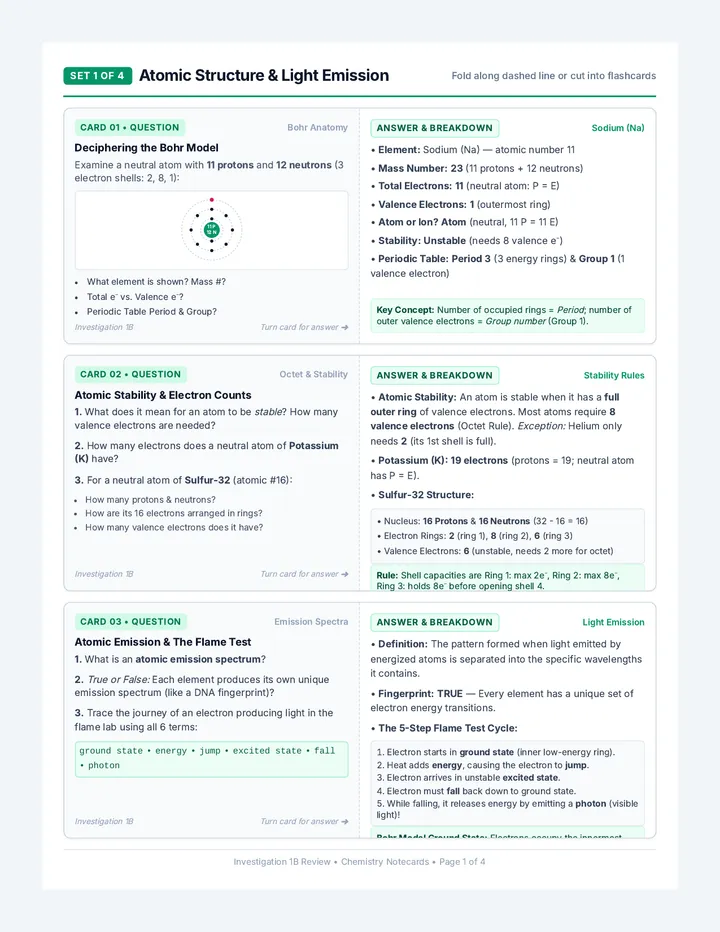
Atomic Blueprint Flashcards

Atomic Blueprint Flashcards

An accessible, dyslexia- and LD-friendly 4-page set of 8 large study flashcards tailored for a high school sophomore with a reading disability. Features 2 large cards per page, 14-16px high-contrast typography, bite-sized bullet points, step-by-step visual arrows, memory analogies, and clear cut/fold guides.

SP

Stephanie Petrucci

Atomic Structure Study Notecards

Atomic Structure Study Notecards

Printable study notecards based on the Investigation 1B Review Guide, formatted as fold-or-cut flashcards covering Bohr models, atomic stability, emission spectra, quantum mechanics, orbital sublevels, Lewis dot structures, orbital diagrams, and electron configurations.

SP

Stephanie Petrucci

Sequences

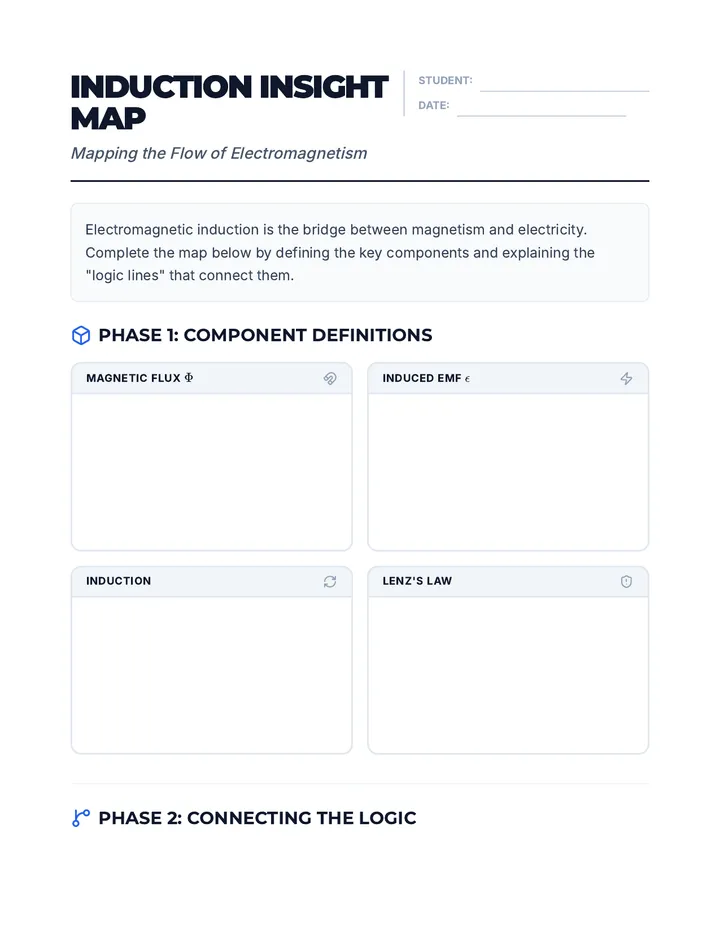
Induction Insight Map Handout

Magnetic Forces Investigation

A 5-day intensive exploration of magnetic forces and fields, focusing on atomic-level causes, field interactions, and mathematical modeling of forces on charged particles. Students progress from anchoring phenomena to complex mathematical applications and a comprehensive unit review.

OM

Olutoyin Makinde

68
Pressure Poster Workshop Handout

Pressure Power

A comprehensive 5-day chemistry unit investigating the relationships between gas pressure, volume, temperature, and moles using lab inquiries, mathematical modeling, and real-world applications.

OM

Olutoyin Makinde

69
KMT Field Manual Packet

Molecular Mayhem Gas Unit

A 10-day exploration of the Behavior of Gases using Kinetic Molecular Theory, various gas laws, and real-world phenomena to understand gas behavior at both molecular and macroscopic scales. Students will investigate compressibility, gas variables, ideal behavior, and mixtures.

OM

Olutoyin Makinde

26
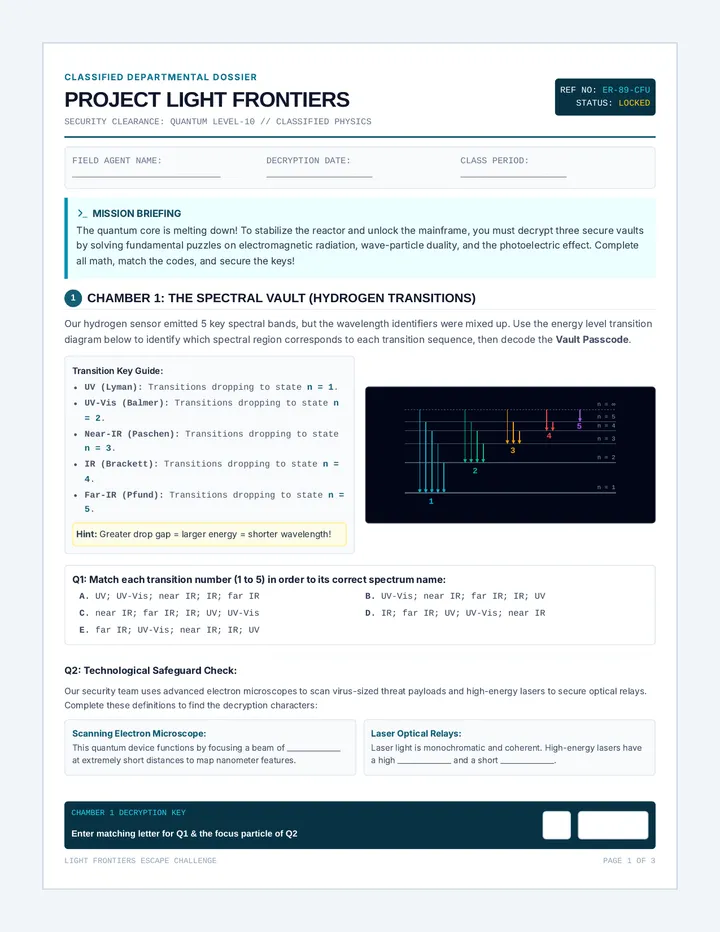
Quantum Escape Room Worksheet

Light Frontiers

A comprehensive physics sequence exploring the dual nature of light, the electromagnetic spectrum, and the interactions of radiation with matter, including the photoelectric effect and polarization.

OM

Olutoyin Makinde

18
Flashcard Fusion Cards

Atomic Architecture

A comprehensive study sequence covering atomic structure, periodic trends, chemical bonding, and nomenclature to prepare students for chemistry assessments.

MB

Marsha Bolden

4
Atom Anatomy Worksheet Worksheet

Atomic Origins

A comprehensive set of materials exploring the historical development of atomic theory from ancient Greece to the modern quantum model, provided in a bilingual format to support English and Spanish speaking learners.

MB

Marsha Bolden

5

Lessons

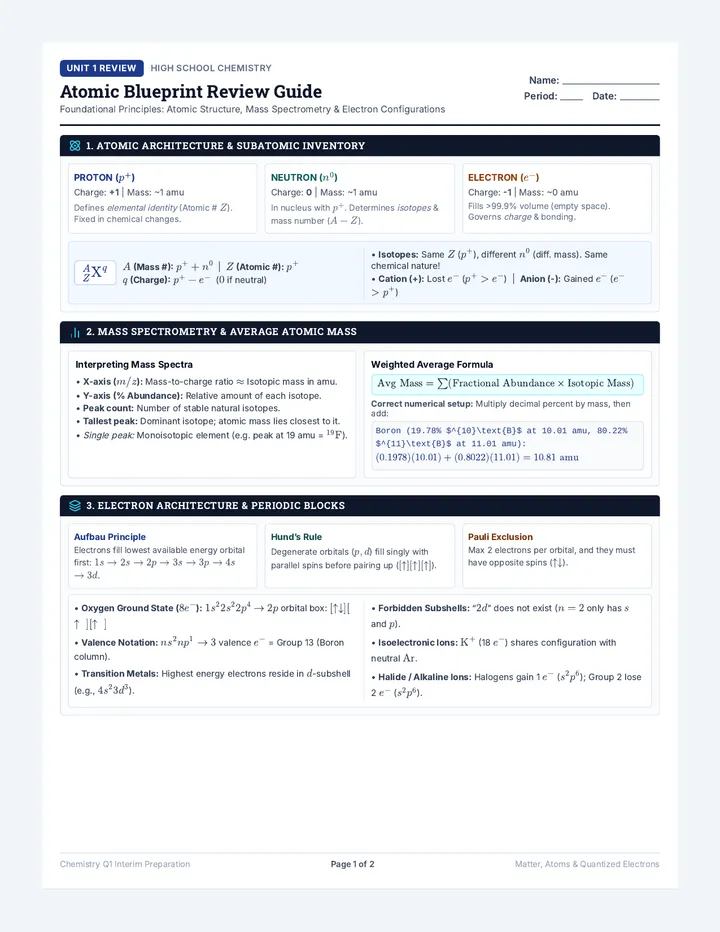
Atomic Blueprint Review Guide

Atomic Blueprint

A targeted chemistry review and practice bundle covering atomic structure, isotopes, mass spectrometry, electron configurations, periodic families, matter classification, and physical versus chemical changes. Includes interactive review slides, a comprehensive concept review guide, an assessment-style practice worksheet, and a detailed teacher solutions guide.

T

timothy.nixon

4
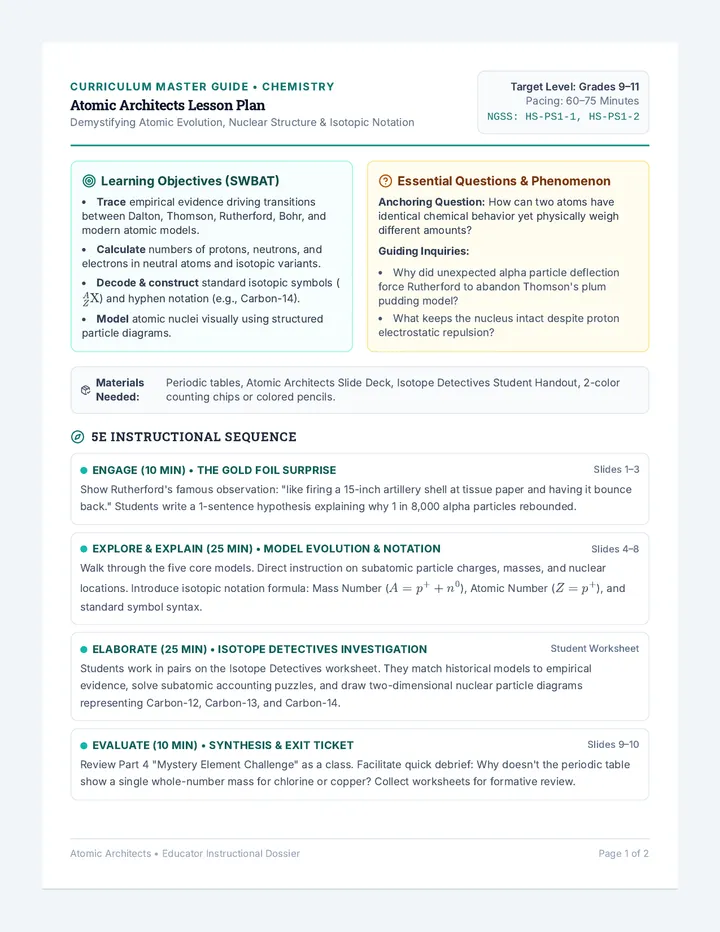
Atomic Architects Lesson Plan

Atomic Architects

A comprehensive chemistry lesson exploring the evolution of atomic models, subatomic particle accounting, isotope notation, and nuclear diagrams. Students investigate historical experiments from Thomson to Rutherford, master isotope notation drills, and solve quantitative atomic mass problems.

CB

Chloe Brown

9
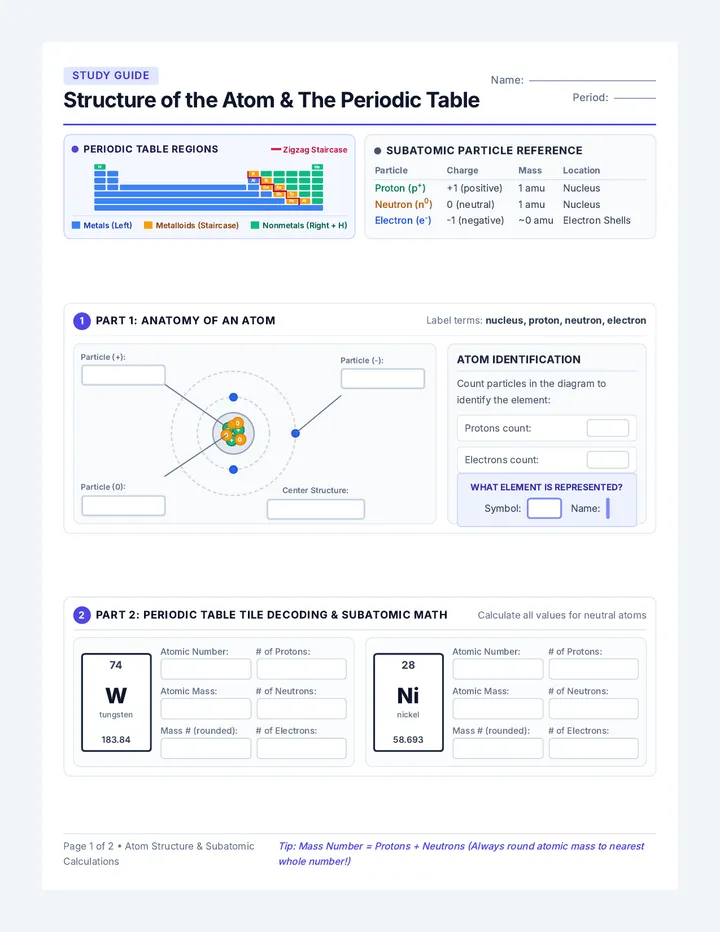
Atom Secrets Study Guide

Atomic Architecture

A foundational unit lesson covering atomic structure, subatomic particles, Bohr models, and periodic table trends with study materials and complete answer keys.

SH

Sarah Hale

2
Flame Bingo Activity Landscape

Alchemist Flame Mystery

A chemistry-focused lesson framing flame tests as an ancient alchemical decoding challenge, focusing on atomic spectroscopy and logical inference.

DB

Danielle Burham

4
Natural Clock Field Guide

Earths Natural Clock

A comprehensive introduction to radiometric dating, explaining how scientists use radioactive isotopes to determine the absolute age of rocks and fossils, and comparing it to relative dating methods.

LN

Leah Nickols

4
Atomic Blueprint Handout

Electron Maps

A foundational lesson on electron configurations, covering subshell filling orders, orbital notation, and specific examples to visualize how electrons occupy atomic space.

D

david.marques

7