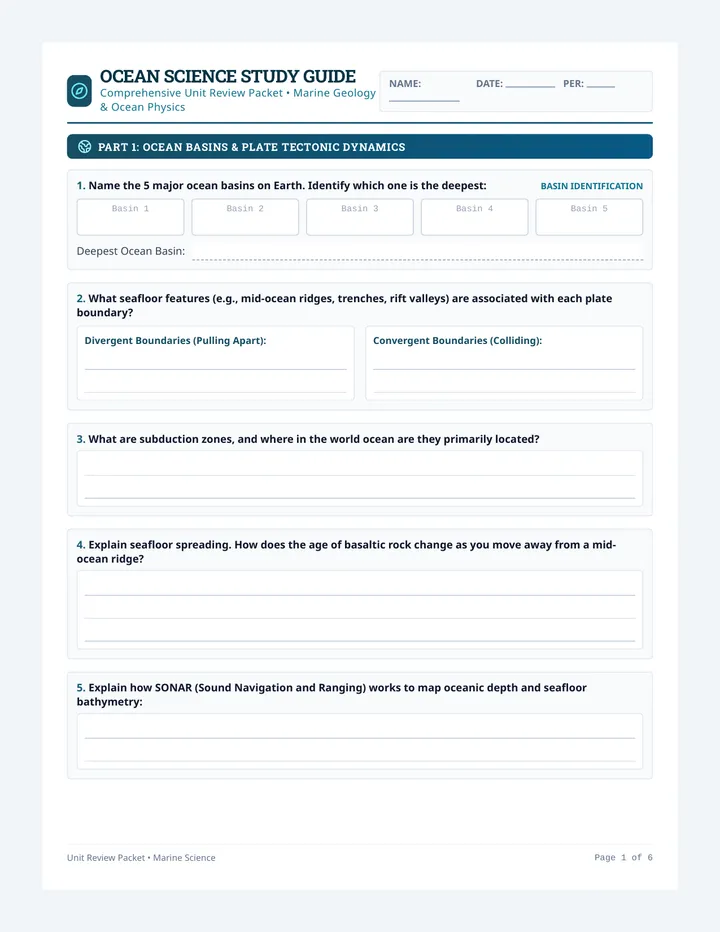
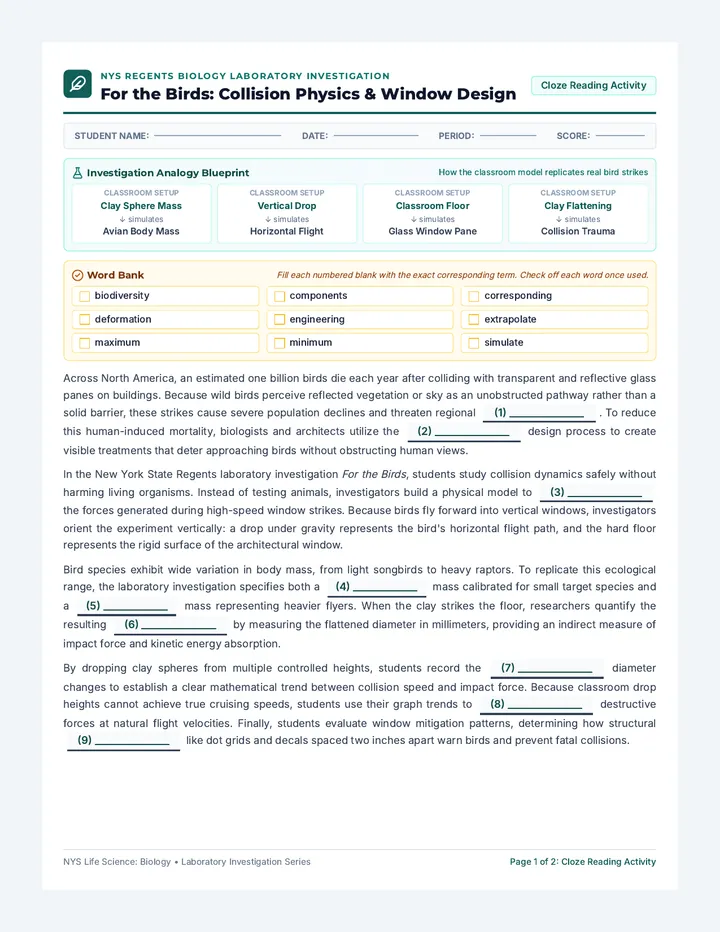
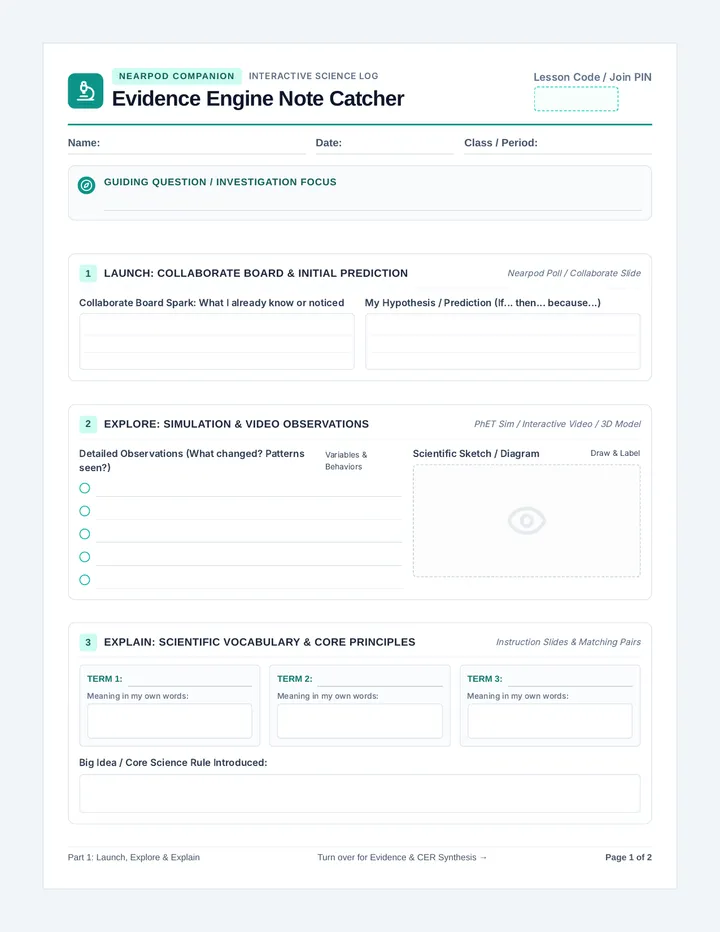
Natural Clock Field Guide Radiometric Dating Explained
Field Guide: Earth's Natural Clock
Name: ______________________
Date: _______________________
Scientists want to know how old rocks and fossils are to learn about Earth’s history. One important way they do this is called radiometric dating . This method helps scientists figure out the age of rocks and fossils by looking at tiny amounts of special atoms inside them.
Analysis Method
Atomic Chronology
How Radiometric Dating Works
Everything is made of tiny parts called atoms. Some atoms are special because they are radioactive. This means they slowly change into other atoms over time. Scientists call the original atoms parent isotopes and the new atoms they change into daughter isotopes.
Isotope Decay Sequence
START
100% Parent
1 HALF-LIFE
50% Parent / 50% Daughter
2 HALF-LIVES
25% Parent / 75% Daughter
3 HALF-LIVES
12% Parent / 88% Daughter
Parent Isotope (Unstable)
Daughter Isotope (Stable)
Scientists know exactly how fast these changes happen. This speed is called the half-life, which is the time it takes for half of the parent isotopes to change into daughter isotopes.
By measuring how many parent and daughter isotopes are in a rock or fossil, scientists can calculate how old it is.
Comparing Relative and Absolute Age
Relative Age: Which Came First?
Relative age tells us which rock or fossil is older or younger compared to others but doesn’t give an exact number. It’s like looking at a sandwich and knowing the bottom slice of bread was put there before the top slice.
Example: If you find a fossil in a lower rock layer and another fossil in a higher layer, the one in the lower layer is usually older.
YOUNGER
OLDER LAYER 🦴
150,000,000
Years Old
Absolute Age: The Exact Number
Absolute age tells us exactly how old something is, like knowing someone’s birthday. Radiometric dating gives us this exact age by measuring isotopes.
Example: Using radiometric dating, scientists found that the Archaeopteryx fossil is about 150 million years old. That’s its absolute age!
Why Radiometric Dating Is Important
It helps scientists know the age of rocks and fossils.
It tells us when different plants and animals lived.
It helps us understand Earth’s history and life's change over millions of years.
Example: The Archaeopteryx Fossil
The Archaeopteryx is a famous fossil that shows features of both dinosaurs and birds.
Scientists used radiometric dating to find out it is about 150 million years old! By studying the radioactive atoms in the rocks where the Archaeopteryx was found, they could tell exactly when it lived.
Vocabulary Reference
Word Definition Example Sentence Atom Building block of everything. Water is made of atoms. Radioactive A type of atom that changes over time. Uranium is radioactive. Isotope Forms of the same atom with different weights. Carbon-14 is an isotope. Parent The original radioactive atom that changes. Parent isotopes turn into daughter isotopes. Daughter The new atom formed when a parent isotope changes. Measure daughter isotopes to find age. Half-Life Time for 50% of the parent atoms to change. Half-life is like a clock. Fossil The remains or signs of ancient living things. The Archaeopteryx fossil. Relative Age Older or younger order without exact numbers. Relative age is based on rock layers. Absolute Age The exact age, usually found by radiometric dating. Find absolute age for the date.
Summary
Scientists use radiometric dating to find the age of rocks and fossils.
They measure radioactive atoms inside the sample.
The rate of change, called the half-life, helps them calculate the absolute age.
This method works like a natural clock inside the rocks.
Archaeopteryx fossil dating proves it lived 150 million years ago.
Radiometric dating helps us understand Earth’s history and the life that lived long ago.
Dating Earth Slides Earth Science Unit 1.1
Earth's Natural Clock
Discovering the absolute age of rocks and fossils through the science of Radiometric Dating .
Geology Division
How Old Is That Rock?
Scientists need to know the age of Earth's materials to understand how our planet has changed.
The Solution
Radiometric Dating
Relative vs. Absolute Age
Relative Age
• Comparing order: "Older than" or "Younger than".
• No specific number given.
"The bottom layer came first!"
Absolute Age
• Gives an exact number of years.
• Uses scientific tools to calculate dates.
"That fossil is 150 million years old!"
The Power of Atoms
P
Parent Isotope
The original, unstable atom.
D
Daughter Isotope
The new, stable atom after decay.
Radioactive Decay
This change happens at a constant rate. It doesn't speed up or slow down, making it a perfect clock!
Defining: Half-Life
The time it takes for half of the parent atoms to change into daughter atoms.
0
Half-Lives
100% Parent
1
Half-Life
50% Parent
2
Half-Lives
25% Parent
?
3 Half-Lives
How much parent is left?
🦖
Archaeopteryx
"The First Bird"
The Fossil Proof
Scientists dated the rocks surrounding the fossil.
Found to be 150 Million Years Old!
Checkpoint
Topic 1
What is the difference between Parent and Daughter isotopes?
Topic 2
Why is radiometric dating called an "absolute" method?
Topic 3
If a rock has 1/4 of its parent isotopes left, how many half-lives have passed?
Half Life Hunt Worksheet Half-Life Hunt
Radiometric Dating Practice Worksheet
Name:
Date:
Part 1: Vocabulary Match-Up
Match each term with its correct definition.
A. Parent Isotope
The original, unstable radioactive atom.
B. Daughter Isotope
The stable atom formed after decay.
C. Half-Life
Time for 50% of the parent to decay.
D. Absolute Age
The exact age of a rock/fossil in years.
Part 2: Reading the Atomic Clock
Start
100% P
1 Half-Life
50% P
50% D
2 Half-Lives
25% P
75% D
1. After two half-lives, what percentage of parent is left?
2. If a rock is 75% daughter isotope, how many half-lives have passed?
3. Explain why radiometric dating is called a "clock". How does decay tell time?
Part 3: The Fossil Detective
🦖
Case #150: Archaeopteryx
Scientists dated rocks surrounding a fossil with a half-life of 50 million years . They found that exactly 2 half-lives have passed.
1. How old is the fossil in millions of years?
2. Is this an example of Relative Age or Absolute Age ?
3. Why would relative dating not be enough for this specific discovery?
Part 4: Method Comparison
Check the correct box for each statement.
Statement Relative Age Absolute Age "The rock is 4.5 billion years old."
|
| "This fossil is younger than the one below it." |
|
|
| "It compares ages without using specific numbers." |
|
|
| "This method uses Radiometric Dating." |
|
|
Natural Clock Answer Key Answer Key
Teacher Resource: Half-Life Hunt
Confidential
Part 1: Vocabulary Match-Up
A. Parent Isotope
→
The original, unstable radioactive atom.
B. Daughter Isotope
→
The stable atom formed after decay.
C. Half-Life
→
Time for 50% of the parent to decay.
D. Absolute Age
→
The exact age of a rock/fossil in years.
Part 2: Reading the Atomic Clock
1. After two half-lives, what percentage of the Parent Isotope is left?
25%
2. If 75% of the atoms in a rock are Daughter Isotopes , how many half-lives have passed?
2 Half-Lives
3. Explain why radiometric dating is called a "clock". How does decay tell time?
It is a "clock" because decay happens at a steady, predictable speed. By comparing parent isotopes to daughter isotopes, scientists can calculate exactly how long the "clock" has been ticking.
Part 3: The Fossil Detective
1. How old is the fossil in years?
100 Million Years (50m x 2 half-lives)
2. Is this an example of Relative Age or Absolute Age ?
Absolute Age
3. Why would relative dating not be enough for this discovery?
Relative dating only tells you if it is older or younger than something else. To know it is exactly 100 million years old (absolute age), you must use radiometric dating.
Part 4: Method Comparison
Statement Relative Age Absolute Age "The rock is 4.5 billion years old." "This fossil is younger than the one below it." "It compares ages without using specific numbers." "This method uses Radiometric Dating."