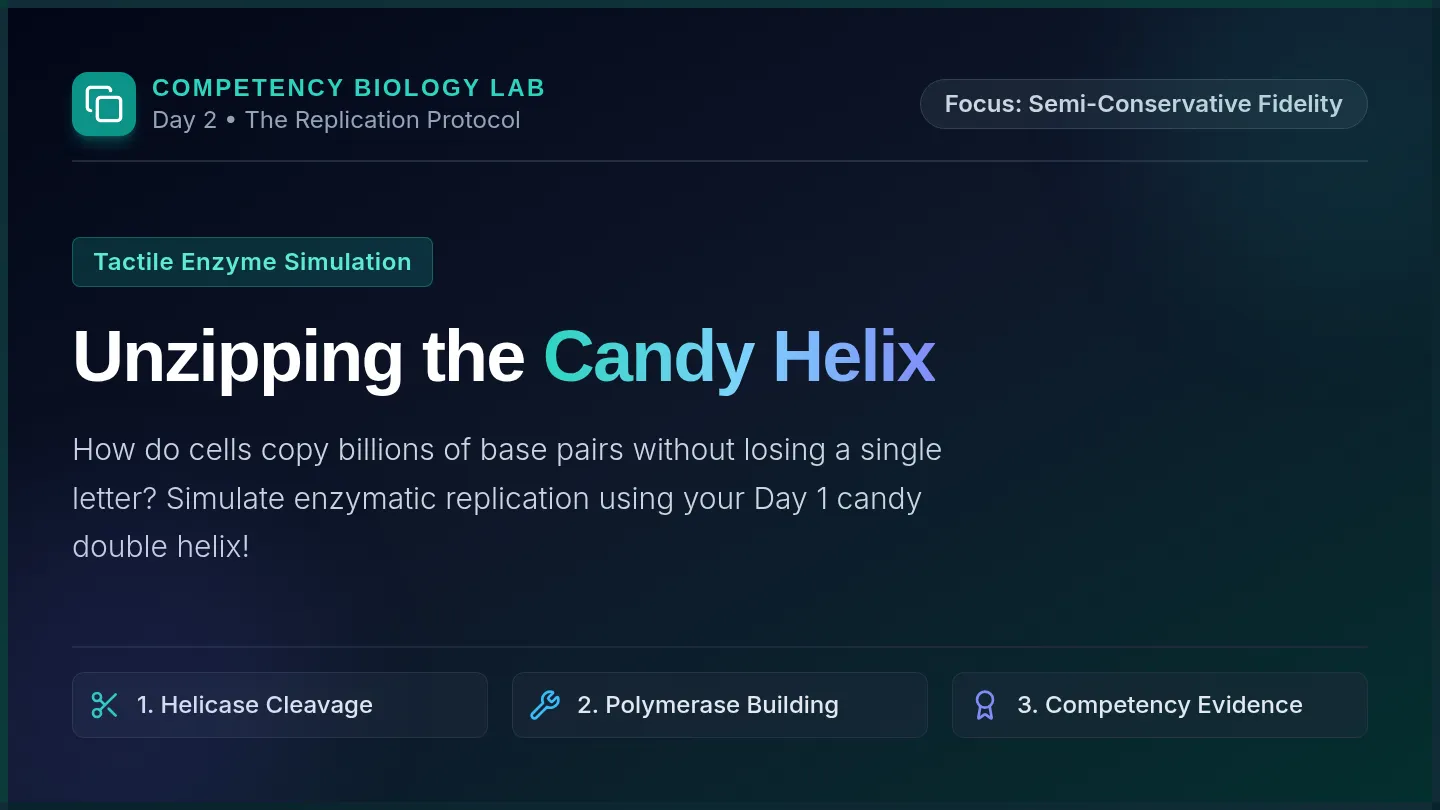
A multi-day competency-based biology sequence exploring DNA architecture, complementary base pairing, and semi-conservative replication through tactile candy modeling and evidence-based assessment.
Part 4: Structural Analysis & Competency Explanations
Standard BIO.1C: Model Evaluation
1. Spatial Geometry: Why must a purine (Adenine/Guanine) always pair with a pyrimidine (Thymine/Cytosine)? What physical defect would occur in your candy model if Adenine paired with Guanine?
2. Bond Strength Difference: In a cell, the sugar-phosphate backbone is held by strong covalent bonds, while bases pair via weak hydrogen bonds. Why is this difference in bond strength essential for replication?
3. Predictive Synthesis: If an organism's DNA contains 300 base pairs (600 total bases) and 70 of those bases are Guanine, calculate the exact number of Thymine bases present in this DNA molecule:
Preserve completed candy double helix for Day 2 Replication Lab! Page 2 of 2
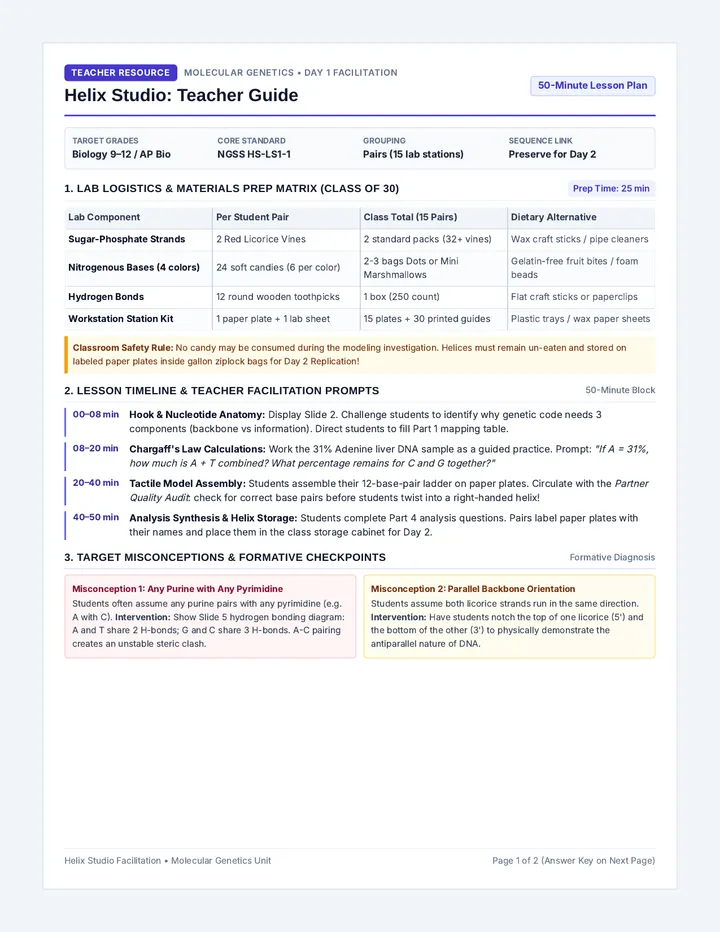
Misconception 1: Any Purine with Any Pyrimidine
Students often assume any purine pairs with any pyrimidine (e.g. A with C). Intervention: Show Slide 5 hydrogen bonding diagram: A and T share 2 H-bonds; G and C share 3 H-bonds. A-C pairing creates an unstable steric clash.
Misconception 2: Parallel Backbone Orientation
Students assume both licorice strands run in the same direction. Intervention: Have students notch the top of one licorice (5') and the bottom of the other (3') to physically demonstrate the antiparallel nature of DNA.
Helix Studio Facilitation • Molecular Genetics Unit Page 1 of 2 (Answer Key on Next Page)
Candy Helix Lab Guide: Complete Answer Key
Official solutions and grading benchmarks for Student Lab Sheet
• Color Pairs: Green (A) pairs with Red (T); Yellow (C) pairs with Blue (G).
Part 2: Chargaff Math Solution
• Thymine (T): 31% (Equal to Adenine)
• Cytosine (C): 19% \([100 - (31+31)] \div 2\)
• Guanine (G): 19% (Equal to Cytosine)
Scoring Criteria: Award full points for showing \(A+T = 62\%\), \(100\% - 62\% = 38\%\), and dividing \(38\% \div 2 = 19\%\).
Part 3: 12-Base Pair Sequence Master Key
Position
1
2
3
4
5
6
7
8
9
10
11
12
Template (Given)
T
A
C
G
G
A
T
C
A
T
G
C
Complement Strand
A
T
G
C
C
T
A
G
T
A
C
G
Candy Color
Grn
Red
Blu
Yel
Yel
Red
Grn
Blu
Red
Grn
Yel
Blu
Part 4: Exemplar Explanations & Rubric Benchmarks
Q1. Spatial Geometry (Purine-Pyrimidine Width):
Exemplar: "Purines (A, G) have a double-ring structure, while pyrimidines (T, C) have a single ring. Combining a purine with a pyrimidine maintains an exact 3-ring width (~2.0 nanometers) along the entire helix. If Adenine paired with Guanine (purine-purine), the model would bulge outward; if T paired with C, the helix would narrow and pinch inward, distorting the backbone."
Q2. Bond Strength (Covalent Backbone vs Hydrogen Base Bonds):
Exemplar: "The strong covalent phosphodiester bonds ensure that each individual strand remains intact and the sequence order is permanently conserved. The weak hydrogen bonds between base pairs allow enzymes (like Helicase) to easily unzip the double helix with low energy input to read or replicate the genetic code without breaking the backbone."
Q3. Predictive Synthesis Math (300 base pairs = 600 bases; 70 Guanines):
Calculation: If \(G = 70\), then \(C = 70\) (total \(G + C = 140\) bases). Total bases in DNA = 600. Remaining bases for \(A + T = 600 - 140 = 460\) bases. Since \(A = T\), Thymine = \(460 \div 2 = \) 230 Thymine bases (or 230 base pairs).
Differentiation & Extension Notes:For Emerging Learners: Provide color-coded dot stickers directly on toothpicks before insertion. For Advanced Learners: Challenge them to explain why G-C pairs require higher denaturation temperatures than A-T pairs (3 hydrogen bonds vs 2).
Helix Studio Teacher Guide • Competency Assessment Milestone 1 Page 2 of 2
1 Old Parent Strand 1 New Synthesized
Daughter Molecule 2
1 Old Parent Strand 1 New Synthesized
Essential Takeaway: Neither daughter molecule is completely brand new! Each contains exactly one conserved original strand and one newly assembled strand.
Candy Lab Replication Protocol
Hands-On Phase 2
1
Step 1: Helicase Action
Gently untwist your Day 1 helix back into a flat ladder. Using lab scissors (or clean hands), snip the 12 toothpick rungs in half down the middle to separate the two parent strands.
2
Step 2: Collect New Substrates
Obtain 2 new Twizzlers (different flavor/color if available, representing new sugar-phosphate strands) and 24 new matching candy bases + 12 fresh toothpicks.
3
Step 3: DNA Polymerase Synthesis
For each separated parent strand, build a matching complementary daughter strand following base pairing rules: Green (A) with Red (T), Yellow (C) with Blue (G).
4
Step 4: Twist Two Identical Helices
Attach the new backbone Twizzlers. Twist both models! Place them side-by-side: verify they have 100% identical sequence order.
Competency Checkpoint: Do both resulting candy helices have the exact same 12-base sequence? Check with partner!
What If a Base Mismatches? Mutations
Proofreading
DNA Polymerase has an exonuclease "backspace" feature. But if an incorrect base escapes correction, a mutation is permanent.
Mismatched Base Pair Simulation
Imagine your partner placed a Green (A) across from a Blue (G).
A (Purine) + G (Purine) = Helix Bulge Error!
The hydrogen bonds fail to align correctly, warping the backbone shape and triggering repair enzymes.
Polymerase Proofreading Power
DNA Polymerase senses structural distortions immediately.
It reverses direction, removes the incorrect nucleotide, and inserts the proper complementary partner before moving forward.
Overall Error Rate: ~1 mistake per 1 billion bases replicated!
Record your error analysis and partner proofreading audit in Part 2 of your assessment guide now.
Competency Assessment Task
Summative Evidence
Today's 3-Part Demonstration of Mastery:
1. Lab Model Evidence
Show teacher your two replicated helices. Explain which strands are conserved parent strands and which are newly synthesized daughter strands.
2. Written Synthesis
Answer the 3 mechanistic questions on Page 1 comparing Helicase, Polymerase, and the semi-conservative model.
3. Mastery Exit Ticket
Independently complete the 5-item knowledge check on Page 2 (sequence matching, mutation detection, and 3-2-1 exit reflection).
Lab Clean-Up Protocol:
Once your model is scored on the rubric, toothpicks go in trash; candies can be enjoyed!
Begin Assessment
Refer to the Competency Rubric on your assessment sheet to confirm your target mastery level.
Part 3: Mechanistic Written Explanations
Connecting tactile lab observations to cellular biochemistry
Written Evidence
1. Enzymatic Specialization: In the candy lab, you used scissors to cut toothpicks, then added new toothpicks and candies. Compare the biological roles of DNA Helicase and DNA Polymerase in this sequence:
2. Error Prevention & Proofreading: Why is complementary base pairing (A with T, C with G) critical for minimizing replication mutations? What happens when a mismatched base is inserted?
Individual Task
Part 4: Mastery Check Exit Ticket
Independent Completion • 10 Minutes
Task 1: Replication Sequence Synthesis — Provide the newly synthesized complementary strand for the template below:
Template Strand: 3' - A G C T T A C G C T A A - 5'
Task 2: Mutation Spotter Scenario — A sequencing machine reads the following replicated segment. Circle the error and explain:
Strand A: 5' - T A C C G A T T A - 3' | | | | | | | | | Strand B: 3' - A T G G C T A C A - 5'
Identify the mismatch and explain how DNA Polymerase corrects this during replication:
Task 3: 3-2-1 Quick Reflection
3 Key Terms:
2 Enzymes:
1 Wonder/Question:
Turn in completed assessment with lab evidence for competency sign-off Page 2 of 2
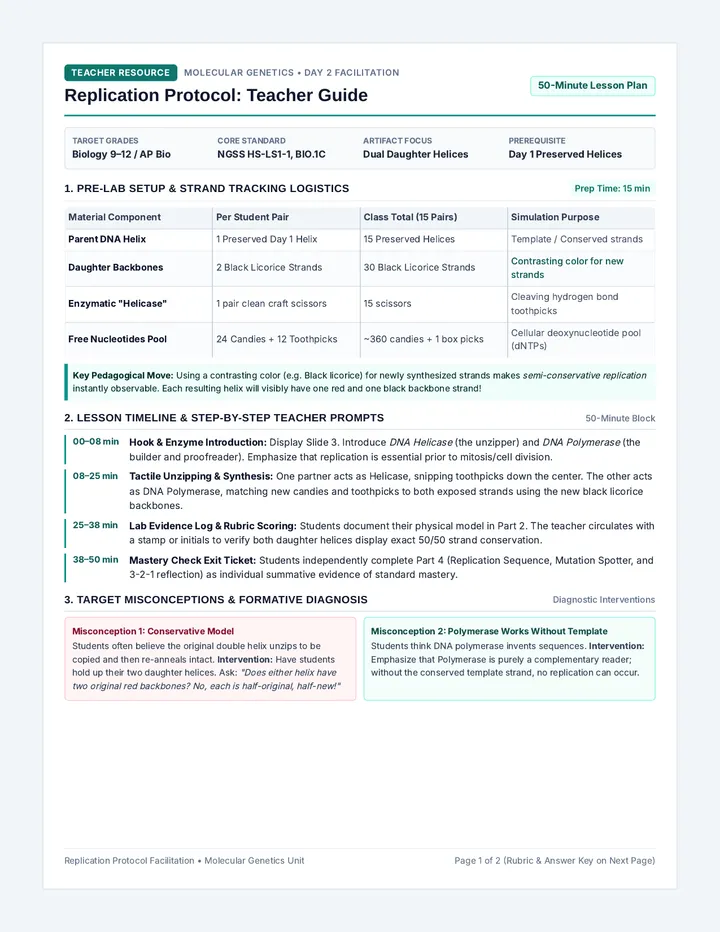
3. Target Misconceptions & Formative Diagnosis
Diagnostic Interventions
Misconception 1: Conservative Model
Students often believe the original double helix unzips to be copied and then re-anneals intact. Intervention: Have students hold up their two daughter helices. Ask: "Does either helix have two original red backbones? No, each is half-original, half-new!"
Misconception 2: Polymerase Works Without Template
Students think DNA polymerase invents sequences. Intervention: Emphasize that Polymerase is purely a complementary reader; without the conserved template strand, no replication can occur.
Replication Protocol Facilitation • Molecular Genetics Unit Page 1 of 2 (Rubric & Answer Key on Next Page)
Replication Assessment: Complete Answer Key
Rubric calibration benchmarks and solutions for Student Assessment Sheet
Master Key & Rubric
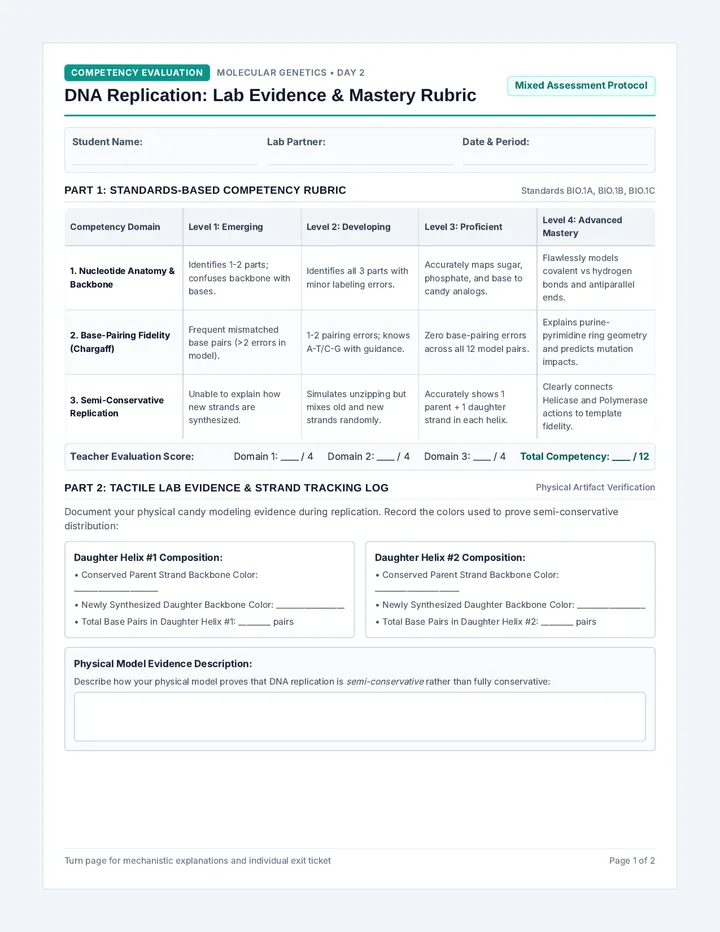
Part 1: Rubric Scoring Calibration (How to Grade Student Work)
Domain 1 (Anatomy) Level 3 (Proficient): Sugar, phosphate, and base accurately mapped. Level 4 (Advanced): Explains antiparallel orientation and covalent vs hydrogen bond energetics.
Domain 2 (Fidelity) Level 3 (Proficient): Zero errors across all 12 pairs in both helices. Level 4 (Advanced): Accurately identifies mismatched base pairs and explains 3'→5' proofreading.
Domain 3 (Replication) Level 3 (Proficient): Models 1 parent + 1 daughter strand in each helix. Level 4 (Advanced): Connects Helicase and Polymerase mechanisms to Meselson-Stahl density data.
Part 2: Lab Evidence Verification
• Daughter Helix #1: 1 Red Parent + 1 Black Daughter backbone; 12 base pairs.
• Daughter Helix #2: 1 Red Parent + 1 Black Daughter backbone; 12 base pairs.
• Physical Evidence Benchmark: Students must state that if replication were conservative, one helix would be entirely red and the other entirely black. Having one red and one black strand in both helices proves semi-conservation.
Part 3: Mechanistic Questions Key
Q1. Helicase vs Polymerase:
Helicase unwinds the double helix and breaks hydrogen bonds. DNA Polymerase reads template strands and synthesizes complementary daughter strands by linking nucleotides.
Q2. Base Pairing & Proofreading:
Complementary geometry prevents distortion. When a mismatch occurs, DNA Polymerase pauses, excises the wrong nucleotide via 3'→5' exonuclease activity, and inserts the correct base.
Part 4: Individual Exit Ticket Master Key
Task 1: Replication Sequence Synthesis
Template: 3' - A G C T T A C G C T A A - 5' Daughter: 5' - T C G A A T G C G A T T - 3'
Note: Award full credit only if 5' and 3' prime designations are correctly oriented antiparallel!
Task 2: Mutation Spotter Scenario
Error Identified: At position 8, Adenine (Strand A) is erroneously paired with Cytosine on Strand B (A should pair with Thymine).
Correction Mechanism: DNA Polymerase senses the irregular diameter caused by mismatched hydrogen bonding, reverses direction, utilizes its 3'→5' exonuclease catalytic subunit to snip off the incorrect Cytosine, and replaces it with Thymine before continuing.
• 2 Enzymes: DNA Helicase and DNA Polymerase (also accept Primase or Ligase).
• 1 Wonder/Question: Evaluated for curiosity (e.g. speed of replication, telomeres, cancer mutations).
Advanced AP Biology Extension: Connect this tactile simulation to the classic 1958 Meselson-Stahl experiment with \(^{15}\text{N}\) and \(^{14}\text{N}\) isotopes. Have students graph expected density bands in CsCl centrifuge tubes across Generation 0, 1, and 2!