Natural language programming and high-level software development using large language models. Equips developers to build functional applications by prioritizing iterative prompting and intent-based logic over manual syntax.
A 5-6 week capstone project framework for Grade 10 Exploring Technology, focusing on a Minimum Viable Product (MVP) approach and weekly engineering milestones.
A comprehensive graduate-level exploration of the technical and ethical shifts in engineering caused by AI-assisted 'vibe coding'. This sequence focuses on automation bias, security vulnerabilities, intellectual property challenges, and the evolution of the software engineer's role from author to auditor.
An advanced engineering sequence for graduate students exploring the architecture, security, and implementation of autonomous AI coding agents. Students progress from tool-use theory to building self-healing, multi-agent systems.
This sequence guides graduate students through the transition from syntax-focused coding to 'Vibe Coding,' emphasizing iterative prompting, automated testing, and self-correcting refinement loops to build functional MVPs.
A graduate-level sequence exploring how to design software architectures optimized for AI-generated code, focusing on context management, determinism, and agentic API consumption.
This sequence explores the transition from syntax-based programming to intent-driven development using LLMs. Graduate students will master the art of 'vibe coding'—using natural language as a high-level abstraction for complex software engineering tasks.
This critical thinking sequence explores the ethical, security, and social implications of using AI for software development. Students learn to move from passive 'vibe coders' to active, responsible 'system architects' who can audit AI-generated code for quality and bias.
A sequence for 8th-grade students exploring 'Vibe Coding' through UI/UX prototyping. Students learn to use natural language to describe layouts, generate style variations, ensure accessibility, add interactive micro-interactions, and iterate based on user feedback.
A 5-lesson unit for 8th grade students exploring the iterative nature of 'vibe coding' - using AI to generate code and then refining it through debugging, logic checks, and guardrail implementation.
A project-based journey where students learn to build functional web applications using AI. They master decomposition, structural planning, logical implementation, and aesthetic styling to turn ideas into working digital products.
This introductory sequence establishes the foundational concepts of 'vibe coding'—programming via natural language descriptions rather than manual syntax entry. Students explore how Large Language Models (LLMs) interpret intent to generate code, comparing traditional coding workflows with AI-assisted development.
This advanced sequence explores the shift from manual coding to 'agentic' workflows, where AI tools have direct access to file systems and terminals. Students learn to orchestrate autonomous agents, customize their behavior through rules, and manage complex multi-step reasoning tasks.
Teacher guidance and student tracking tools for the 5-week Tech Capstone project, including evaluation rubrics and progress monitoring.
A comprehensive tutorial for Mile Tree School staff on integrating Lenny Learning into their workflow, covering login procedures, material creation, and pedagogical benefits.
A comprehensive onboarding module designed to help educators master Lenny Learning, from initial login to generating high-quality custom resources for their classrooms.
Cette leçon enseigne l'art de concevoir des prompts efficaces pour l'IA en utilisant 10 composantes clés, de la définition du rôle à l'itération finale.
Ce cours initie les enseignants du primaire à l'utilisation pédagogique de l'IA générative. Il couvre les concepts de base, la rédaction de prompts efficaces, la création de ressources personnalisées et les enjeux éthiques liés à l'usage scolaire.
Students deliberately induce and then identify subtle logical errors or 'hallucinations' in AI-generated code. The lesson teaches the critical skill of skepticism and verification, ensuring the final output matches the original intent.
Students synthesize their learning to project the future of software engineering. They explore the shift from 'writer' to 'architect/editor' and map out the human-centric skills that AI cannot replicate.
Students learn that in Vibe Coding, high-quality documentation is the blueprint for the AI. They practice writing READMEs and comments that serve as instructions for future AI modifications.
The sequence ends with a focus on cleanup. Students take a working but messy conversation-generated codebase and use final prompts to standardize variable names, add comments, and format the code for human readability.
Students debate the complex legal and ethical landscape of AI-generated code authorship. They explore concepts of intellectual property, open-source licensing, and what it means to be an 'author' in a world of vibes.
Instead of manually rewriting code, students learn to guide the AI to refactor existing codebases for readability or efficiency. They practice iterative dialogue, asking the model to 'make it more Pythonic' or 'optimize for memory usage' and verifying the results.
Students assemble their final code, run a full test, and present their functional apps while reflecting on the modular approach and prompt effectiveness.
A student-facing 'Survival Guide' checklist for the 5-week Capstone project, summarizing weekly goals and the MVP mindset.
A comprehensive weekly milestone rubric for the 5-week Tech Capstone project, aligned with the Level 1-4 grading scale used in Nova Scotia schools.
Teacher-facing evaluation and pedagogical explanation of the 5-week Tech Capstone project, including curriculum alignment for Nova Scotia Exploring Technology 10.
A professional 2-page document explaining the Lenny Learning platform for Mile Tree School staff. Updated with consistent black branding for the title and a Blue and Green color palette.
A one-page reference guide for Mile Tree School staff providing quick instructions on logging in, example prompts, and a checklist of materials available on Lenny Learning. Updated with a Blue and Green color palette and consistent black branding.
A polished slide presentation for Mile Tree School staff introducing Lenny Learning, updated with a Blue and Green color palette and consistent black branding for the title.
A detailed lesson plan and facilitation guide for school leaders or instructional coaches to lead a 60-minute workshop on getting started with Lenny Learning, tailored for Stony Hill School grades 2-3.
A one-page printable reference sheet customized for Stony Hill School teachers (grades 2-3), summarizing what Lenny Learning is, how to log in, and examples for primary grade levels.
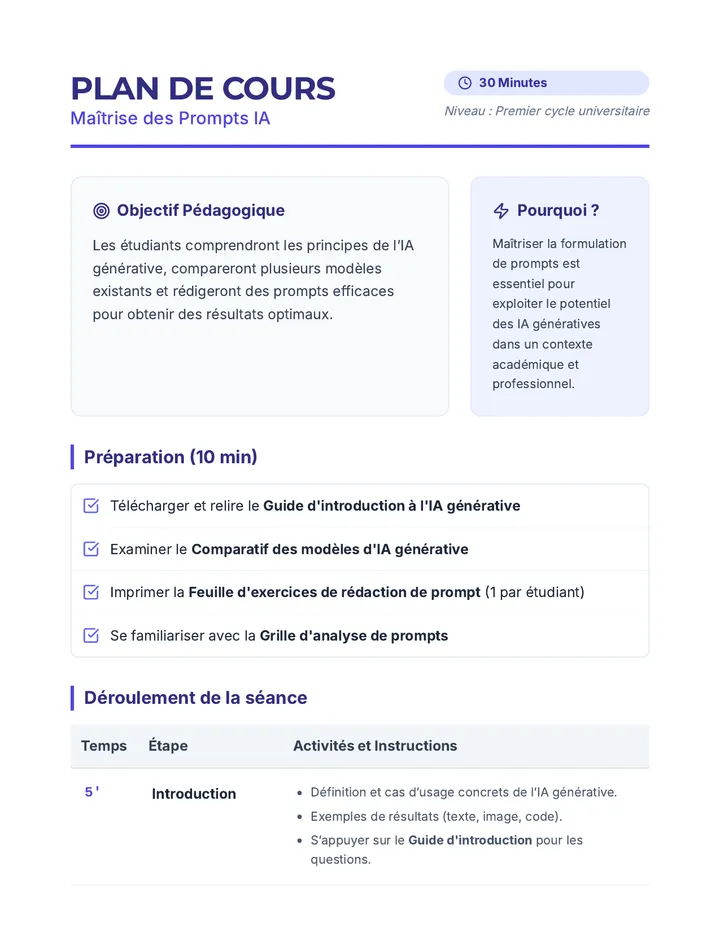
Un guide complet pour l'enseignant incluant le plan de cours, les objectifs pédagogiques, le déroulement de la séance minute par minute et des conseils de facilitation pour enseigner l'art du prompt.
Une carte de référence rapide d'une page résumant les 10 composantes du prompt, les types d'approches et la philosophie "Contexte, Clarté, Contrôle". Idéal comme aide-mémoire de bureau.
Une fiche de travail structurée permettant aux étudiants de concevoir leurs propres prompts en remplissant chacune des 10 composantes avant de les assembler dans un "Master Prompt".
Une présentation complète en 9 diapositives couvrant les 10 composantes d'un prompt parfait, les types d'approches, les hallucinations et la philosophie de collaboration avec l'IA.