Ethical frameworks, algorithmic bias, and data privacy in automated systems. Examines the societal impact of machine learning and strategies for responsible AI governance.
A 3-part mini-lesson series designed to teach middle schoolers how to use AI tools responsibly for final projects. The series focuses on AI as a thinking partner, prompt engineering, and critical fact-checking through a modern 'Notebook/Sketch' aesthetic.
A collection of technology and language arts lessons exploring modern digital literacy and core communication skills.
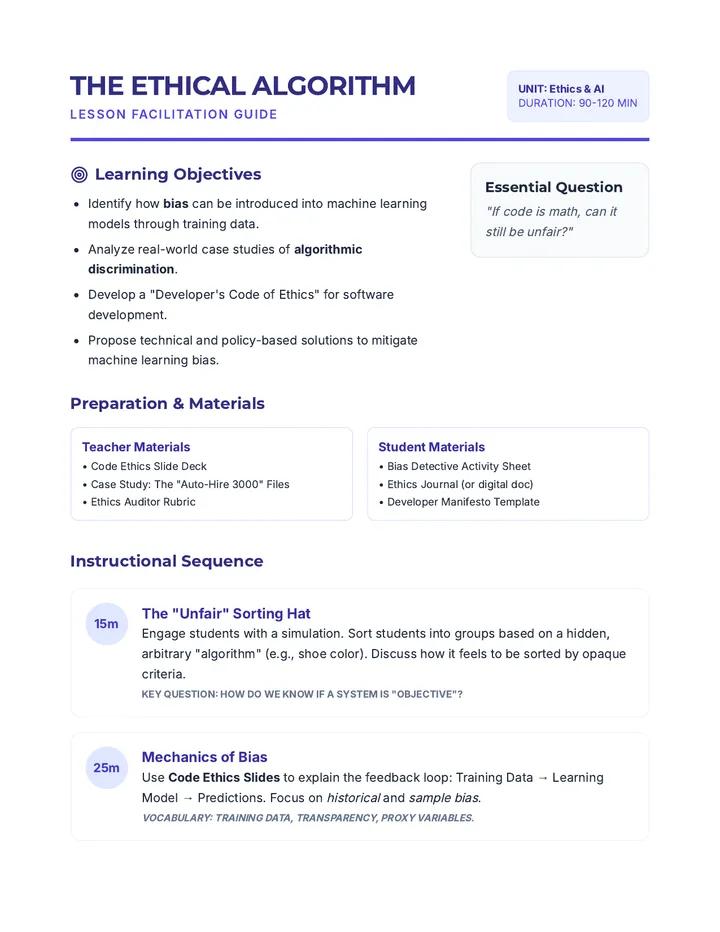
A capstone unit exploring the intersections of machine learning, data ethics, and the societal impact of algorithmic decision-making. Students transition from being technical builders to critical auditors of modern software.
A comprehensive training sequence designed to help organizations leverage AI for operational efficiency, covering everything from initial audits to full-scale workflow integration.
A comprehensive K-8 curriculum designed to build foundational AI literacy through understanding, evaluation, application, and ethics. Each grade level tackles a specific theme, progressing from basic robot concepts to complex algorithmic bias and societal impact.
A comprehensive K-12 AI literacy sequence covering the fundamentals of how AI works, machine learning, ethics, social impact, and creative application through age-appropriate lessons.
Une séquence de formation pour les enseignants de l'enseignement agricole visant à développer un esprit critique face à l'IA, s'appuyant sur les rapports de l'inspection (2025) et les notes de service (2026). Elle explore les enjeux cognitifs, le cadre juridique et les mutations de l'évaluation par capacités.
A multi-day project where students trace the lineage of household technology, culminating in a prototype design and a presentation on societal impact.
A comprehensive unit focused on understanding how data is collected, stored, and analyzed in various computing environments, specifically aligned with North Carolina CS10 Objective 3.01.
A comprehensive sequence for 11th-grade students exploring the legal and ethical landscapes of digital publishing. Students examine intellectual property, dark patterns in UX design, data privacy regulations, and open-source ethics to build a foundation for responsible web creation.
A comprehensive sequence for 10th Grade students exploring the ethical and technical standards of Web Accessibility (a11y), focusing on WCAG guidelines, inclusive design, and technical remediation for visual, motor, and cognitive disabilities.
A comprehensive sequence for 7th graders on web design and publishing, focusing on digital file management, intellectual property, web hosting, quality assurance, and digital footprint management. Students move from local development to a live, professional web presence.
An expanded set of 12 high-contrast, simplified visual task cards to assist developmentally disabled students in building safe, basic prompts, designing healthy menus, and identifying digital privacy rules.
A sleek 5-slide presentation demonstrating the RTCC prompt engineering formula, practical life skills use-cases, and prompt iteration.
A visually polished 5-slide presentation on AI safety, digital privacy boundaries, and ethical habits for teenagers.
A detailed, 2-page step-by-step facilitation guide for teachers with lesson outlines, discussion prompts, student misconceptions, and complete answer keys for the student activities.
An engaging 2-page student activity pack with structured prompt-building templates, daily planning challenges, and safety scenario cards.
A visually rich, poster-style anchor chart highlighting the "Do's and Don'ts" of AI safety, the anatomy of a perfect prompt, and privacy rules.
A complete, classroom-ready 3-page student document including a pros/cons graphic organizer (Detective Blueprint), a structured guide with roles and a note-taking grid for the classroom debate, and a personal AI code of ethics with reflection scenarios and action items.
A visually stunning, high-contrast slide deck designed to guide students through the positive impacts, data privacy concerns, and environmental footprints of AI. Features large, readable text, clear discussion prompts, and structured visuals for middle school classrooms.
A self-discovery questionnaire and guidance packet featuring a 6-question situational quiz, archetype breakdown keys (Digital Guardian, Cosmic Pioneer, Biosphere Builder, Eco-Acoustician), and an actionable career reflection roadmap.
A print-ready, four-page workbook containing engaging hands-on challenges and beautifully formatted response zones for the Station Rotation activities. Features Algae Couture, Bias Busters, Ocean Soundscapes, and Mars Habitat design.
A high-energy, visually stunning slide presentation featuring interactive discussion prompts, diverse STEM career profiles, and an overview of the Station Rotation challenges. Designed to break stereotypes and broaden horizons.
A comprehensive strategic integration roadmap for department heads, acting as a workshop planning tool to audit curriculums, design custom academic policies, and build workload-efficient AI playbooks. Includes clear work fields with pristine white backgrounds.
A complete guide for teenagers to responsibly use AI for everyday learning tasks, mastering critical safety habits, privacy boundaries, and advanced prompting techniques.
A balanced, highly engaging lesson for upper elementary and middle school students exploring the dual nature of AI. Students discover cutting-edge AI innovations in science and accessibility, examine the digital footprint of data centers, and learn practical digital citizenship skills regarding data privacy.
An 8th-grade exploratory lesson on diverse, non-traditional, and underrepresented careers in STEM. Students challenge stereotypes, analyze cutting-edge career profiles, complete a hands-on station rotation, and discover their own STEM archetypes.
A professional development session designed for department heads and instructional leaders to strategically integrate AI and educational technology into their subject-specific curricula while managing academic integrity and teacher workload.
Covers AI hallucinations, the necessity of cross-referencing sources, and the core principles of academic honesty in the age of AI.
Teaches students the art of the prompt, focusing on specificity and context to get better academic support without skipping the thinking process.
Introduces the concept of AI as a 'co-pilot' rather than an 'autopilot', clarifying appropriate vs. inappropriate use cases for school projects.
An introductory lesson exploring the fundamentals of Artificial Intelligence, its practical applications in daily life, and the ethical considerations surrounding its use.
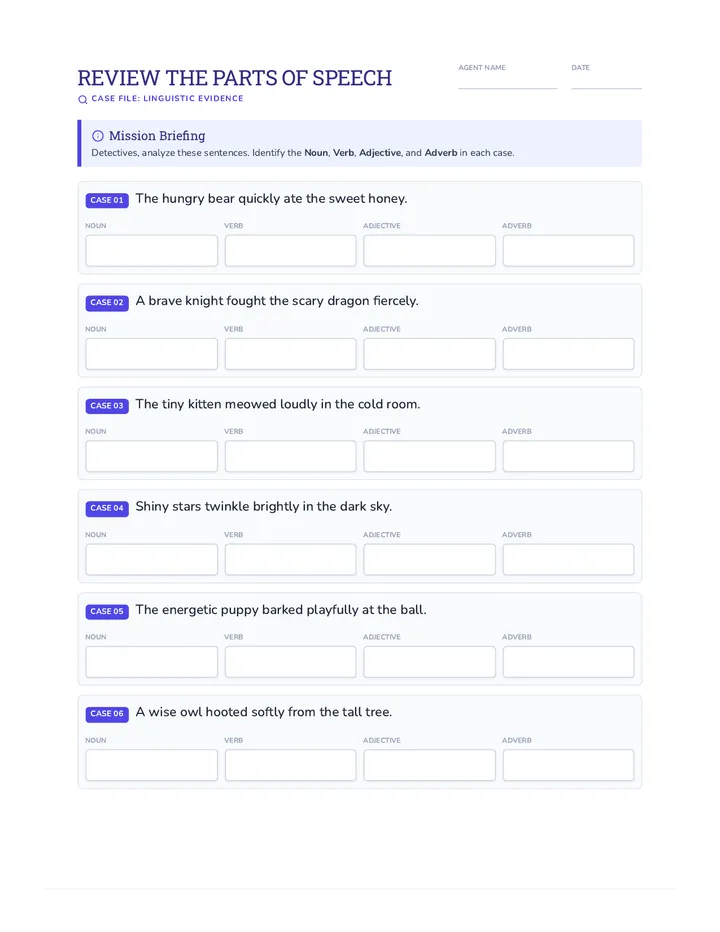
A grammar review lesson where students become 'Speech Detectives' to identify nouns, verbs, adjectives, and adverbs in complex sentences. This lesson focuses on the functional application of parts of speech in context.
A lesson exploring the role of AI in education through a story about responsible use, featuring comprehension questions, a vocabulary matching activity, and a reflective writing prompt.
A lesson exploring the mechanics of AI generators and their social impact, specifically focusing on the experiences of young African Americans in tech and representation.
A comprehensive introduction to Artificial Intelligence, exploring its benefits, risks, and ethical usage through reading, discussion, and critical writing.