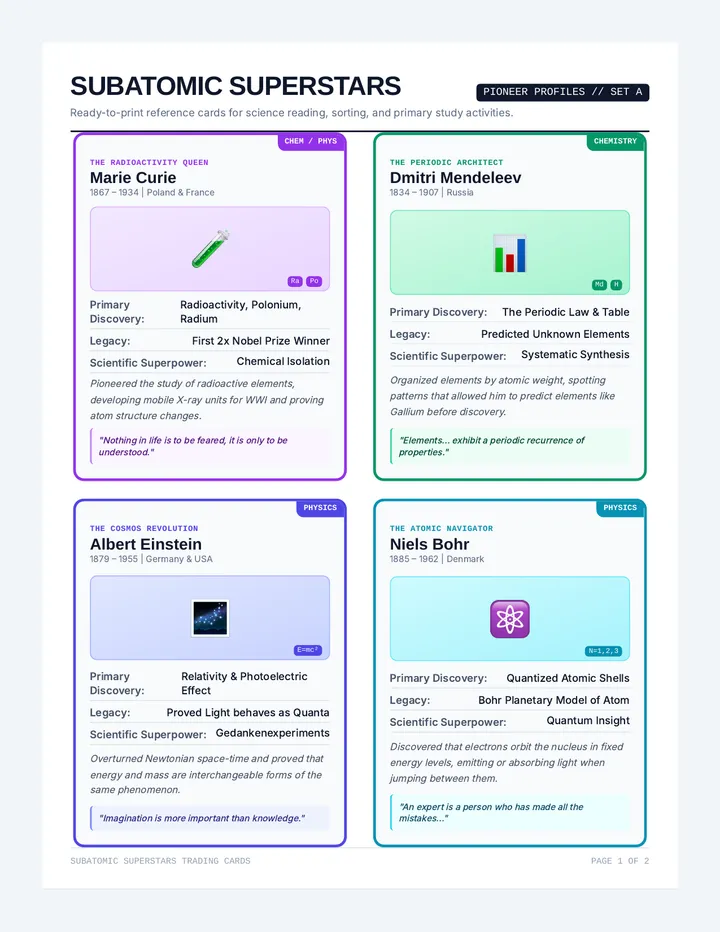
Atomic structure, electron configurations, and periodic trends like electronegativity and ionization energy. Examines group properties and the organization of elements by atomic number.
Une leçon de physique-chimie de niveau 3ème pour maîtriser la structure des atomes, la formation des ions et les tests d'identification chimique du Brevet.
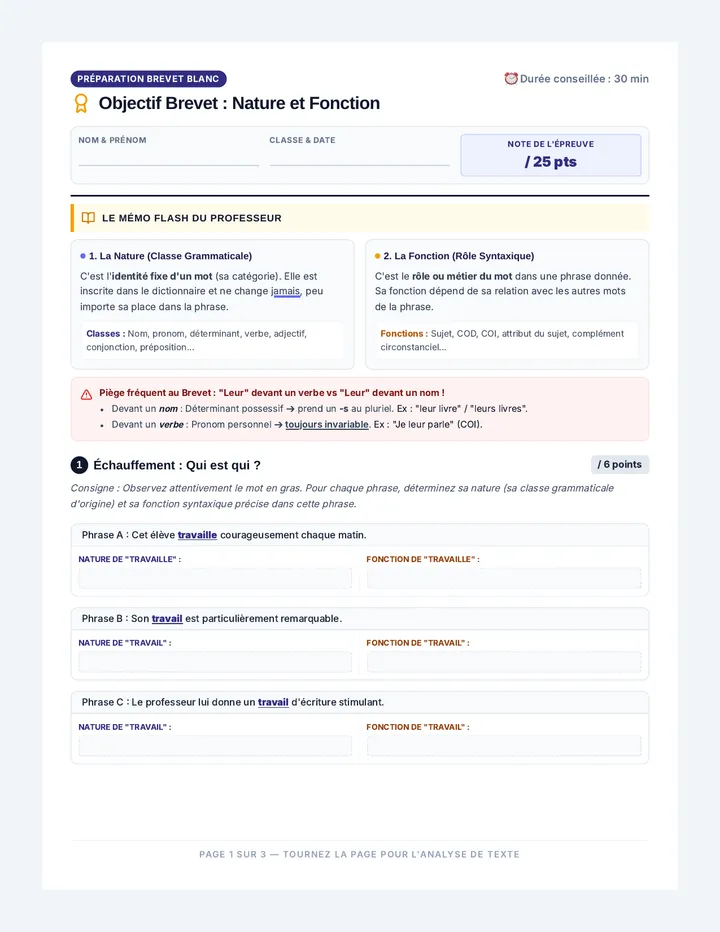
Séance d'entraînement intensive de 30 minutes conçue par un professeur pour maîtriser la distinction cruciale entre nature et fonction au brevet de français, accompagnée de sa correction détaillée.
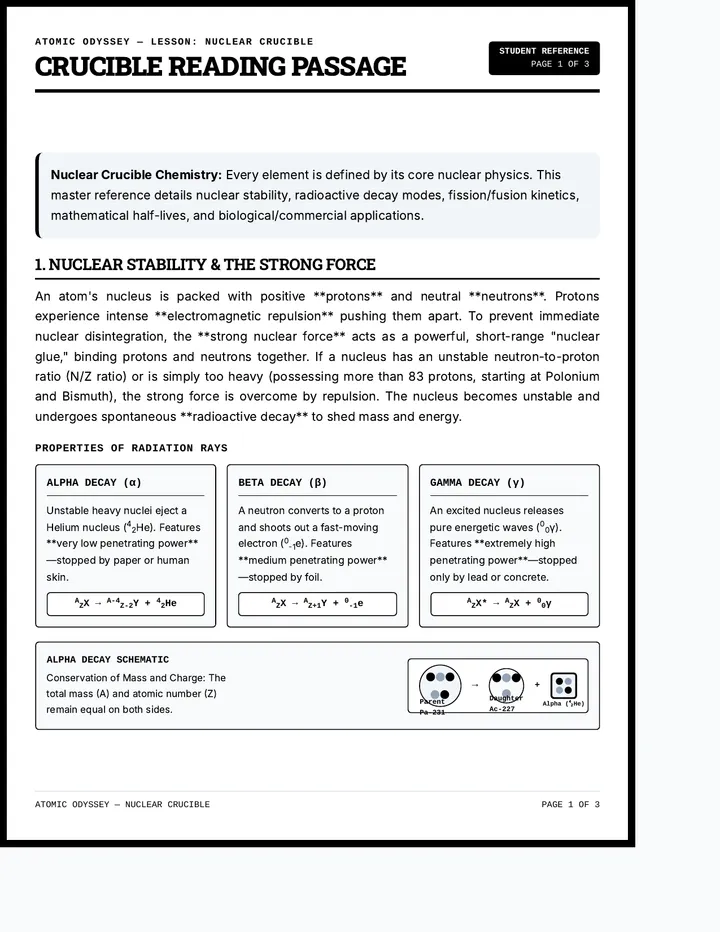
An interactive, station-based exploration of nuclear processes in chemistry. Students rotate through four distinct stations with comprehensive reading passages and analytical tasks covering radioactive decay and stability, fission versus fusion, half-life calculations for archaeological dating, and modern technological applications.
A comprehensive 8th-grade review game covering major concepts in Social Studies, Math, and Science. Designed for classroom engagement and cumulative review.
A comprehensive STEM project choice unit designed for 7th-grade students to explore various scientific and engineering topics through self-directed learning and creative output.
An exploration of how atoms become charged particles. Students learn about valence electrons, the octet rule, cation and anion formation, and the energy required to remove electrons.
A journey through the organization of matter. Students explore atomic structure, periodic trends, and the unique properties of chemical families.
An investigation into the building blocks of life. Students compare plant and animal cells, identify organelle functions, and understand how cells maintain homeostasis.
A deep dive into Newton's three laws of motion. Students calculate force, mass, and acceleration while observing physics in everyday life through hands-on experiments.
Unlocking the secrets of DNA and inheritance. Students learn how traits are passed from parents to offspring using Punnett squares and pedigree analysis.
An exploration of the greenhouse effect, global warming, and the measurable impact of human activity on Earth's ecosystems. Students analyze data and design solutions for a more sustainable future.
Students investigate how distance affects electrostatic force, focusing on the inverse square relationship and developing the mathematical intuition for division in the formula.
Une fiche de révision visuelle, synthétique et claire récapitulant la structure de l'atome, la formation des ions et les couleurs des précipités pour l'épreuve de sciences du Brevet. Inclut des schémas vectoriels détaillés avec légendes de l'atome et de l'ion.
La correction complète, détaillée et ultra-pédagogique des 9 exercices de physique-chimie sur l'infiniment petit (atomes, ions et molécules) tirés du PDF d'entraînement. Inclut des rappels de cours et des astuces mnémotechniques.
Fiche d'exercices de préparation de physique-chimie sur la constitution de la matière, le calcul des particules subatomiques, la formation des ions et l'analyse de solutions aqueuses pour le Brevet.
Fiche de révision visuelle et ultra-claire récapitulant les 10 classes grammaticales (variables et invariables) à connaître par cœur pour l'épreuve de français du Brevet. Inclut des exemples et des moyens mnémotechniques.
Le corrigé complet et détaillé des 10 exercices d'entraînement pour maîtriser l'intégralité du programme de grammaire du Brevet.
Un cahier de 10 exercices progressifs conformes aux exigences réelles du Brevet. Les titres thématiques et indices ont été supprimés pour garantir un entraînement en conditions d'examen réelles.
Correction complète et détaillée avec barème précis, commentaires de correction, explications des pièges grammaticaux et conseils du correcteur pour réussir le Brevet.
Fiche d'exercices d'entraînement de 30 minutes de type Brevet pour maîtriser les classes et fonctions grammaticales. Inclut un mémo visuel clair révisé, un exercice d'échauffement, une analyse littéraire de Camus et une réécriture.
Day 1 Nuclear Crucible Teacher Guide detailing setup guidelines, rotation pacing timelines, target misconceptions, prompting questions, and complete keys for all station activities.
Laminated classroom station reading cards (1 page per station) featuring dense, informative chemistry-aligned reading passages, balanced chemical equations, comparing tables, and active instructions. It explicitly includes penetrating powers for alpha, beta, and gamma radiation.
A printable student recording worksheet packet allowing students to transition through four key areas answering questions on decay, fission vs fusion, half-life, and modern nuclear technology. It features scaffolded worked examples for nuclear equations and half-life decay.
A sleek, high-contrast slideshow for the 1-day Nuclear Crucible lesson. It introduces nuclear notation refresher, mass-energy equivalence, rules for station rotation, safety procedures, and reflection.
Un programme complet de révision intensive pour le Brevet, regroupant des fiches, exercices et corrigés détaillés en français et en physique-chimie.
A comprehensive, highly engaging chemistry exploration of nuclear processes, including radioactive decay, nuclear stability, fission, fusion, half-life calculations, and modern nuclear technologies. Studentsrotate through four interactive stations to master atomic chemistry.
A comprehensive collection of core science units covering Environmental Science, Biology, and Physical Science. This sequence provides high-impact instructional slides, hands-on lab experiences, guided notes, and differentiated assessments for five major scientific domains.
A 4-lesson sequence designed to help high school chemistry students master Coulomb's Law through qualitative reasoning, mathematical practice, and application to atomic structure. The sequence aligns with Iowa High School Chemistry standards and OpenSciEd's inquiry-based approach.
A 15-day intensive review sequence for the 8th Grade Science STAAR, focusing on Category 1-4 TEKS and new STAAR 2.0 question formats.
A comprehensive science curriculum for 8th grade students working at a 1st grade academic level, covering all North Carolina Essential Standards with simplified language, high-interest visuals, and structured support.
A series of high-stakes science laboratory mysteries designed for middle school students. Each mystery focuses on a specific branch of science (Biology, Physics, Chemistry, Geology, Ecology) and uses 8 forensic clues to solve a case.
A 5-lesson sequence for 6th-grade students connecting the Periodic Table to engineering and material science. Students explore how atomic structure determines macroscopic properties, research elements in technology, investigate carbon's versatility, and apply their knowledge to solve engineering design challenges.
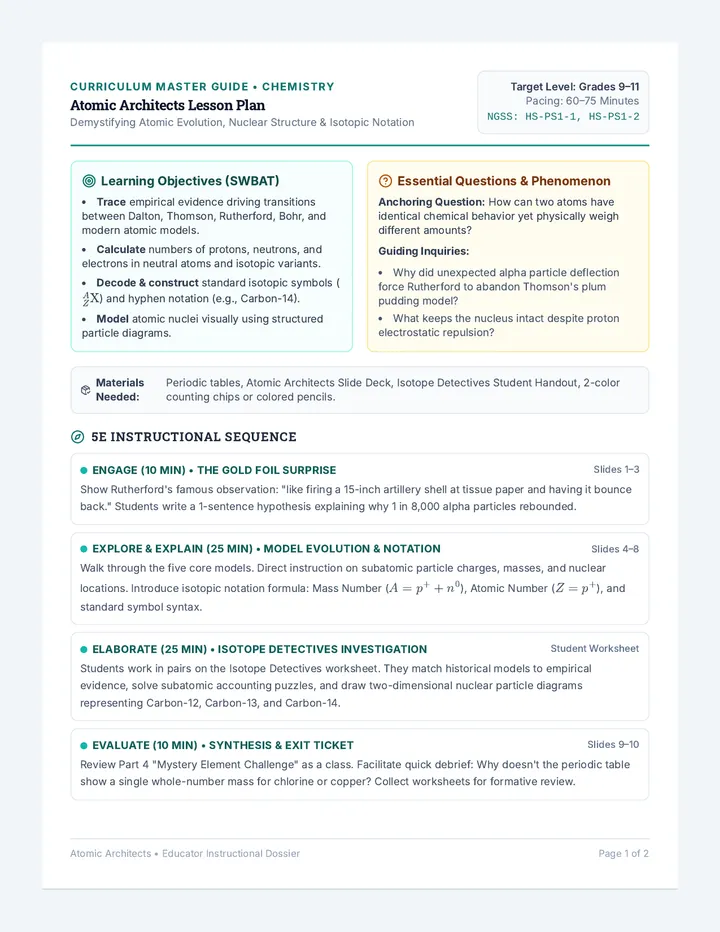
This sequence introduces 6th-grade students to atomic structure, focusing on subatomic particles, atomic number, isotopes, and electron shells. Students progress from identifying fundamental particles to constructing complex Bohr models for the first eighteen elements of the periodic table.
A comprehensive sequence for 8th-grade students exploring the internal structure of atoms. Students move from modeling subatomic particles to calculating atomic mass, constructing Bohr models, and investigating isotopes, culminating in the ability to decode periodic table tiles.
A project-based physics sequence exploring how periodic properties like conductivity and band gaps inform material science and engineering. Students learn about metals, semiconductors, alloys, and isotopes, culminating in a design challenge.
An inquiry-driven sequence for 11th-grade students to explore the physical forces behind periodic trends using data analysis and Coulombic principles. Students move from understanding atomic forces to predicting properties of unknown elements.