A series of high-stakes science laboratory mysteries designed for middle school students. Each mystery focuses on a specific branch of science (Biology, Physics, Chemistry, Geology, Ecology) and uses 8 forensic clues to solve a case.
A comprehensive introduction to meteorology focused on identifying and understanding the ten primary cloud types and their impact on weather patterns.
A comprehensive unit exploring how fossils form, how they are dated, and what they reveal about Earth's biological and geological history.
This sequence guides 7th-grade students through the scientific criteria used to define life, moving from intuitive observations to biological analysis of metabolism, cellular structure, and homeostasis. Students explore ambiguous examples and conduct experiments to build a robust definition of what it means to be alive.
A 2-day science investigation exploring the chemical decomposition of hydrogen peroxide and baking soda, focusing on gas production, pressure, and its real-world implications for waste management and chemical safety.
An astronomy unit focused on the Earth-Moon-Sun system and celestial patterns.
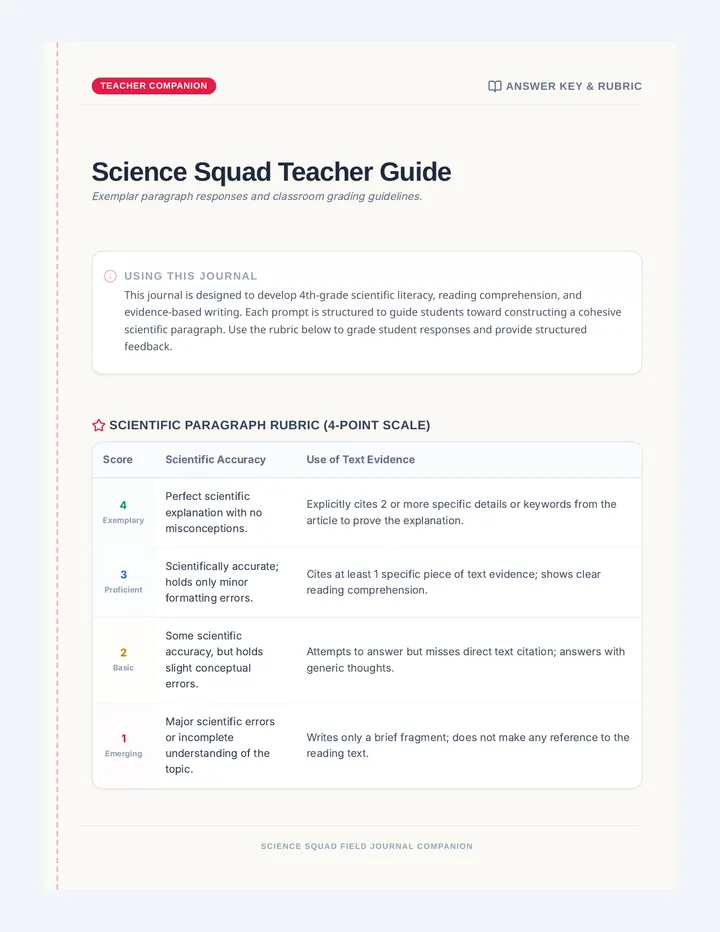
A comprehensive set of tools for middle school chemistry students to master the formal scientific method in their lab reports.
A short sequence introducing students to the fundamental concepts of electricity and magnetism.
A comprehensive unit exploring the intricate webs of life, focusing on the relationships and environmental factors that shape ecosystems.
A series of materials focused on building and programming assistive technology interfaces, specifically switch-based controls for accessibility.
A bilingual (English/Spanish) unit exploring the structure and organization of the periodic table, focusing on atomic properties and element classification.
A series of quick, engaging bell-ringer activities focused on building technical vocabulary and understanding computer-related terminology through matching exercises.
A professional development series for PreK-12 educators that reframes Computer Science as a "Superpower" through Computational Thinking. Teachers explore how CS concepts like decomposition, abstraction, and automation are already present in their daily instructional practices and Iowa Core content.
Students learn to use digital tools to organize, compare, and analyze market data using advanced spreadsheet techniques like formulas, sorting, and filtering.
A unit focused on the visual principles of brand identity, moving from theory (color, type) to creation using vector-based tools like Google Drawing.
A comprehensive identity design unit where students explore the psychological and visual elements of branding, including color theory, typography, and logo composition.
A 3-lesson unit on the water cycle, weather patterns, and global circulation designed for 7th-grade SPED students. This sequence covers the energy drivers of water movement, the interaction of air masses, and the patterns of oceanic and atmospheric circulation with heavy scaffolding and visual supports.