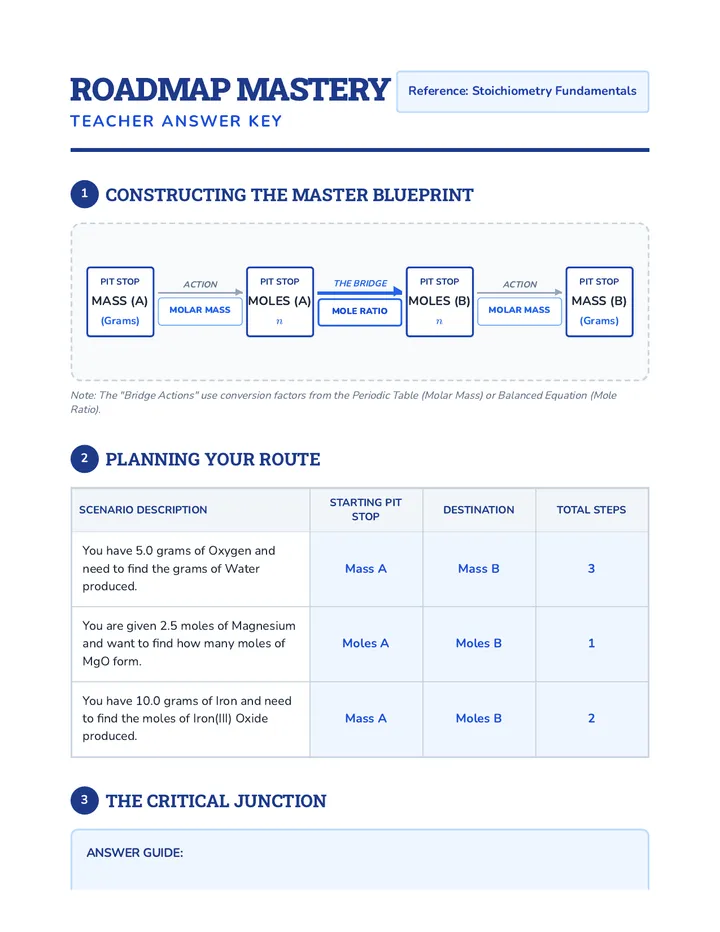
Quantitative relationships between reactants and products using balanced chemical equations. Develops skills in mole-to-mass conversions, limiting reactant analysis, and theoretical yield calculations.
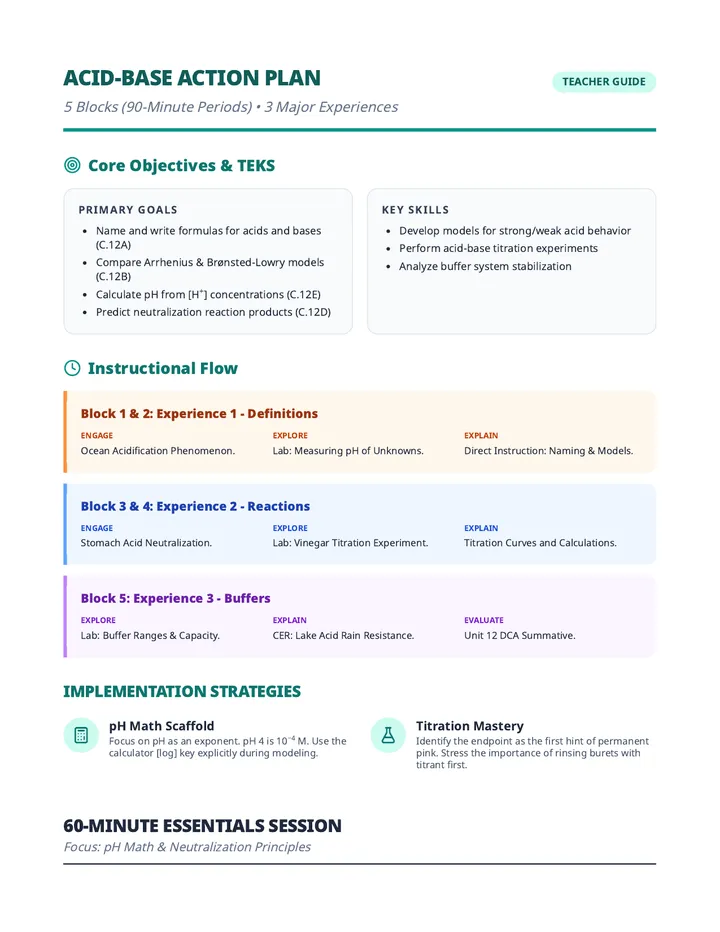
A comprehensive unit exploring the properties, reactions, and mathematical relationships of acids and bases, featuring pH calculations, titrations, and buffer systems.
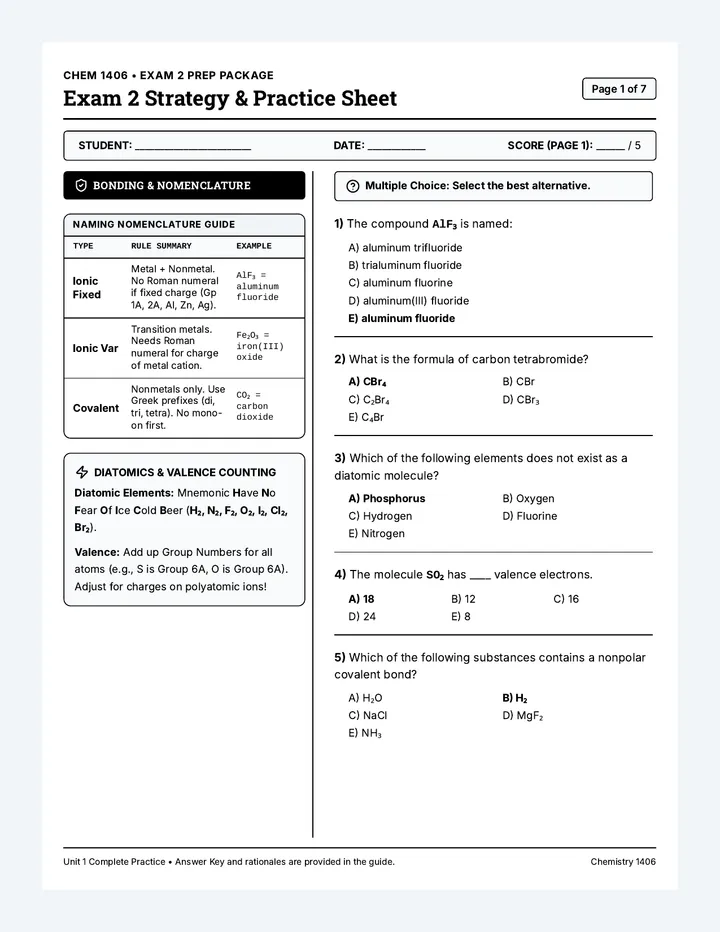
A comprehensive review package for CHEM 1406, featuring in-depth study guides for key topics and a full practice exam with detailed solutions.
A comprehensive end-of-year review for 5th Grade NGSS science standards, organized by domain to ensure mastery of physical, life, and Earth sciences.
A five-day high school chemistry unit exploring thermochemistry, collision theory, enthalpy diagrams, and calorimetry through the lens of body heat and chemical reactions. Students investigate the anchoring phenomenon of exercise-induced heat while mastering TEKS C.13 standards.
A 5-day intensive exploration of magnetic forces and fields, focusing on atomic-level causes, field interactions, and mathematical modeling of forces on charged particles. Students progress from anchoring phenomena to complex mathematical applications and a comprehensive unit review.
A comprehensive review of foundational chemistry concepts including atomic structure, periodic trends, chemical bonding, and stoichiometry to prepare students for midterm assessments.
A comprehensive unit on chemical quantitative analysis, focusing on the mathematical foundations of chemistry through dimensional analysis, the mole concept, and stoichiometry.
A focused sequence on the mechanical process of dimensional analysis in chemistry, prioritizing algebraic substitution and grid-based problem-solving over real-world scenarios.
A comprehensive 5-day chemistry unit investigating the relationships between gas pressure, volume, temperature, and moles using lab inquiries, mathematical modeling, and real-world applications.
A comprehensive STEM sequence focusing on TEKS-aligned physical science concepts, from system parts in lower elementary to complex mixtures and conservation of matter in upper elementary. Students solve relatable real-world problems through hands-on engineering challenges and laboratory investigations.
A Grade 5 PBL sequence focused on the hydrosphere and human impact, partnered with Zoo New England. Students investigate the connection between the particulate nature of matter and the survival of fostered endangered turtles in the Nashoba Brook Watershed.
A 10-day exploration of the Behavior of Gases using Kinetic Molecular Theory, various gas laws, and real-world phenomena to understand gas behavior at both molecular and macroscopic scales. Students will investigate compressibility, gas variables, ideal behavior, and mixtures.
Tier 3 (Advanced) Stoichiometry Quiz focusing on green chemistry & automotive emissions (catalytic converters), featuring complex limiting reactant analyses, theoretical yield, and atom economy calculations.
Tier 2 (Standard) Stoichiometry Quiz focusing on aerospace propulsion (hydrazine rocket propellant combustion) with intermediate scaffolding, theoretical yield calculations, and percent yield analysis.
Tier 1 (Scaffolded) Stoichiometry Quiz focusing on culinary chemistry (baking soda decomposition) with visual roadmaps, pre-structured dimensional analysis grids, and atomic mass reference cards.
A matching 7-page detailed answer key with step-by-step explanatory rationales for all 30 practice exam questions. Highlights correct option letters and breaks down calculations, stoichiometry mole-ratios, balanced chemical equations, and solubility rules for easy self-study or teacher facilitation with enlarged, highly readable black typography.
A highly structured side-by-side study companion and practice exam with enlarged, highly readable black typography. Pairs condensed high-yield summary tables, formula maps, and rules in the left column directly with a 30-question practice exam in the right column across 7 beautifully spaced pages.
A comprehensive 3-page teacher facilitation guide, materials preparation checklist, common student misconceptions log, and detailed analytical answer key split across multiple pages to avoid overflow.
A high-rigor student-facing station activity worksheet and printable task cards. Integrates AP Chemistry Net Ionic writing, particulate drawings, Q vs Ksp math, common ion effect, pH dissolution, and gravimetric stoichiometry.
A premium AP Chemistry presentation deck introducing solubility rules, net ionic equations, particulate diagrams, and Ksp connections. Features a professional dark analytical-lab theme optimized for classrooms.
A comprehensive 2-page print-ready study packet covering key chemical reaction types, core vocabulary, and a highly scaffolded stoichiometry calculation guide with exam-style practice questions.
Teacher answer key for the Neutralization Numbers Worksheet, providing predicted products, balanced chemical equations, complete step-by-step mathematical setups, and correct values.
A comprehensive 2-page scaffolded student worksheet for neutralization calculations. It starts with predicting products and identifying mole ratios, introduces the equivalence shortcut formula, provides step-by-step guided practice for titration calculations, and concludes with a real-world solid-neutralization stoichiometry challenge.
Teacher answer key for the Solution Showdown Quiz, featuring correct answers and detailed rationales for each conceptual and mathematical question. Revised for improved rendering and content completeness. Now matches standardized formatting. Now includes full text of correct options for immediate context. Subscripts and superscripts fixed.
A differentiated stoichiometry assessment suite tiered by mathematical complexity, visual scaffolding, and conceptual depth. Features three distinct, parallel versions of a 2-page quiz centered around unique real-world chemistry applications.
A comprehensive study and practice package for Chemistry 1406 Exam 2. It contains a highly structured, side-by-side strategy guide paired with a 30-question practice exam, and a matching detailed answer key with step-by-step rationales.
An AP Chemistry lesson exploring solubility rules, net ionic equations, particulate representations, and the mathematical link to Ksp and equilibrium shifts. Students engage with interactive station-based task cards simulating real laboratory precipitates.
A comprehensive lesson focused on mastering chemical equations, reaction types, and stoichiometry calculations through guided scaffolding and structured review.
Explores the mathematical relationship between acid/base strength, dissociation constants, and equilibrium pH calculations using the ICE method.
Explores the equilibrium of buffer solutions and concludes with a summative assessment of the unit.
Focuses on neutralization reactions, predicting products, and performing titration experiments to determine unknown concentrations.
Students define acids and bases using Arrhenius and Brønsted-Lowry models, learn naming conventions, and master pH/pOH calculations.
A comprehensive assessment and review package covering chemical quantities, molar conversions, and stoichiometric calculations for CP Chemistry.
A comprehensive assessment covering the mole, percent composition, and stoichiometry for high school chemistry students.
A full-length practice exam mirroring the final's format, accompanied by a comprehensive step-by-step solution manual.
Detailed one-page study summaries covering the seven core pillars of introductory chemistry found in the final exam.