"What goes in must come out! Use coefficients to ensure the number of atoms matches on both sides."
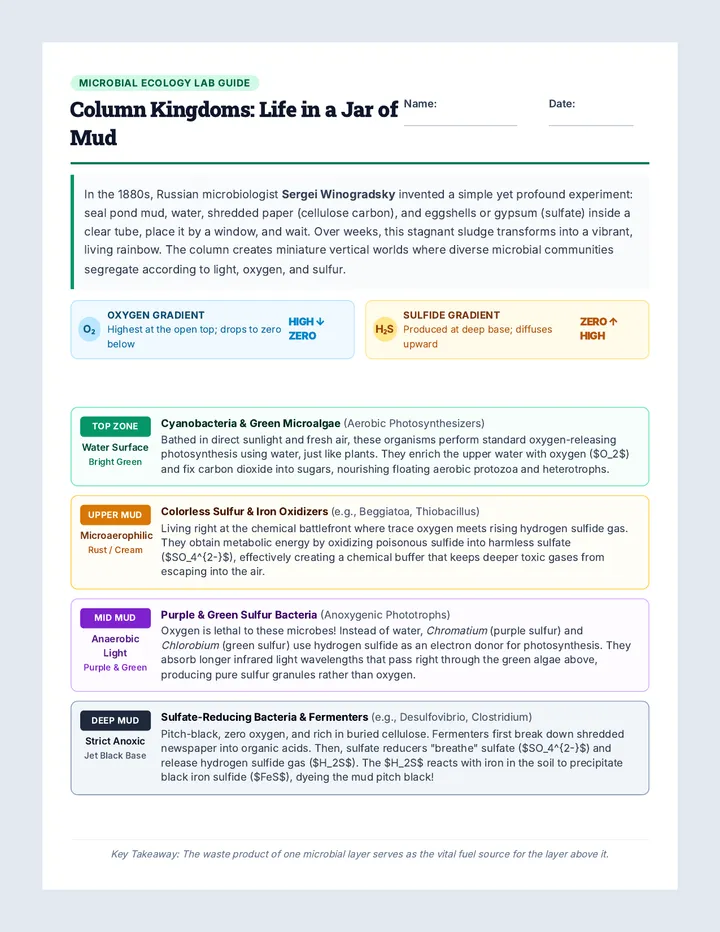
Ionic & Polar solutes dissolve in Polar solvents (Water).
Nonpolar solutes dissolve in Nonpolar solvents (e.g., Hexane, CO\(_2\)).
20. When Mg reacts with H\(_2\text{SO}_4\), which gas is evolved?
21. Which solute would be soluble in Hexane (a nonpolar solvent)?
(e.g., NaCl, Mineral Oil, or Water)
22. If solubility is 60g/100g water, what type of solution forms if 150g is added to 200g water?
23. A patient needs 0.072 g of a drug. 12-mg tablets are in stock. How many tablets are given?
24. An isotope of \(^{35}_{17}\text{Cl}\) has how many neutrons?
25. Draw the Lewis Dot Structure for Nitrogen:
26. What is the chemical formula for Magnesium Nitrate?
27. What is the proper IUPAC name for CuCl\(_2\)?
28. Balance the following reaction:
\[\underline{\quad} \text{C}_2\text{H}_4 + \underline{\quad} \text{O}_2 \rightarrow \underline{\quad} \text{CO}_2 + \underline{\quad} \text{H}_2\text{O}\]
29. How many moles are in 25.0 g of NaOH?
30. List one way to increase the rate of solution formation:
Page 1 of 3
Atomic Structure & Bonding • Part 3
Part 3
Q11. Identify Reaction: \(2\text{HgO} \rightarrow 2\text{Hg} + \text{O}_2\)
Decomposition
Rationale: Upon applying thermal energy, a single compound (\(\text{HgO}\)) cleanly breaks down into metallic mercury (\(\text{Hg}\)) and oxygen gas (\(\text{O}_2\)).
Q12. Magnesium Electron Config
\(1s^2 2s^2 2p^6 3s^2\) (or 2, 8, 2)
Rationale: Neutral Magnesium has atomic number 12, giving 12 total electrons. They occupy levels from lowest to highest orbital energy.
Q13. Oxygen-18 Isotope Symbol
\(^{18}_{8}\text{O}\)
Rationale: Oxygen always contains 8 protons. An isotope containing 10 neutrons has a combined mass number of 18 (\(8 \text{ protons} + 10 \text{ neutrons} = 18\)).
Q14. Element with 17 Protons
Chlorine (Cl)
Rationale: The atomic number of an element is defined strictly by its number of protons. The element with atomic number 17 on the periodic table is Chlorine.
Q15. Total Electrons in Iodine
53 Electrons
Rationale: In any neutral atom, the negative charge of electrons is balanced by the positive protons. Iodine has atomic number 53, so it has 53 protons and 53 electrons.
Q16. Molar Mass of \(\text{ZnSO}_4\)
\(161.4 \text{ g/mol}\)
Rationale: Mass = \(65.38\text{ (Zn)} + 32.06\text{ (S)} + (4 \times 16.00)\text{ (O)} = 161.44\text{ g/mol}\), which rounds to 4 significant figures as \(161.4\text{ g/mol}\).
Q17. KCl Flame Test Color
Light Purple / Lilac
Rationale: The potassium cation (\(\text{K}^+\)) emits a characteristic light-violet light when its thermally excited valence electrons relax back to their ground states.
Q18. Polarity of \(\text{CO}_2\)
Covalent Compound
Rationale: Both carbon and oxygen are non-metal elements. To bond, they share valence electrons symmetrically, forming covalent bonds rather than transferring ions.
Page 2 of 3
Stoichiometry & Solutions • Part 4
Part 4
Q19. Moles of \(\text{O}_2\) for 3.0 Moles \(\text{CH}_4\)
\(6.0 \text{ moles } \text{O}_2\)
Rationale: Equation ratio is \(1\text{ CH}_4 : 2\text{ O}_2\). Therefore, \(3.0\text{ moles } \text{CH}_4 \times (2 / 1) = 6.0\text{ moles } \text{O}_2\).
Q20. Gas evolved: \(\text{Mg} + \text{H}_2\text{SO}_4\)
Hydrogen gas (\(\text{H}_2\))
Rationale: This single-replacement reaction produces hydrogen gas and magnesium sulfate salt: \(\text{Mg} + \text{H}_2\text{SO}_4 \rightarrow \text{MgSO}_4 + \text{H}_2\).
Q21. Soluble in Hexane (Nonpolar)
Mineral Oil
Rationale: Like dissolves like. Hexane is nonpolar, so it dissolves nonpolar solutes like mineral oil, but not polar water or ionic salts.
Q22. Solution state (150g added to 200g)
Saturated with excess solid
Rationale: Max solubility in 200g water is 120g. Adding 150g means 120g dissolves (saturated) and 30g sits at the bottom.
Q23. Dosage: 0.072g Needed (12-mg stock)
6 Tablets
Rationale: \(0.072\text{ g} = 72\text{ mg}\). Total tablets needed is calculated by division: \(72\text{ mg} \div 12\text{ mg/tablet} = 6\text{ tablets}\).
Q24. Neutrons in \(^{35}_{17}\text{Cl}\)
18 Neutrons
Rationale: Neutrons are computed by subtracting atomic number from mass number: \(35 \text{ (mass)} - 17 \text{ (protons)} = 18 \text{ neutrons}\).
Q25. Lewis Dot Structure for Nitrogen
N with 5 valence dots
Rationale: Nitrogen is in group 15, indicating 5 valence electrons. It is represented by one lone pair and three unpaired single dots.
Q26. Formula of Magnesium Nitrate
\(\text{Mg}(\text{NO}_3)_2\)
Rationale: Magnesium forms a \(^{2+}\) cation, while nitrate is \(^{1-}\). Two nitrate polyatomic anions are needed to cancel out the charge.
Q27. IUPAC Name of \(\text{CuCl}_2\)
Copper(II) chloride
Rationale: Chlorine ions have a \(-1\) charge. Two ions equal \(-2\), requiring Copper to be a \(+2\) cation, expressed with roman numerals.
Q28. Balancing \(\text{C}_2\text{H}_4 + \text{O}_2 \rightarrow \text{CO}_2 + \text{H}_2\text{O}\)
Coefficients: 1, 3, 2, 2
Rationale: Balanced form: \(1\text{C}_2\text{H}_4 + 3\text{O}_2 \rightarrow 2\text{CO}_2 + 2\text{H}_2\text{O}\). Matches atom count (2 C, 4 H, 6 O) on both sides.
Q29. Moles in 25.0g NaOH
0.625 moles
Rationale: Molar mass of \(\text{NaOH}\) is \(40.0\text{ g/mol}\). Moles = \(25.0\text{ g} \div 40.0\text{ g/mol} = 0.625\text{ moles}\) of sodium hydroxide.
Q30. Speed up dissolution
Stirring, heating, grinding solute
Rationale: Agitation exposes fresh solute. Heat increases kinetic energy to break lattice bonds. Grinding increases available surface area.
Page 3 of 3