Lenny.com
Explore
Create
ActivitiesNewMathEnglish Language ArtsScience & EngineeringSocial StudiesGlobal LanguagesHealth & Physical EducationSpecial EducationCounseling & Life SkillsArts & CreativityESL
Lenny.com
Lenny.com
Explore
Create
ActivitiesNewMathEnglish Language ArtsScience & EngineeringSocial StudiesGlobal LanguagesHealth & Physical EducationSpecial EducationCounseling & Life SkillsArts & CreativityESL
Lenny.com
Lenny.com

Solutions

Lenny for EducatorsLenny for SchoolsLenny for Districts

Product

ExploreSign inCreateSupportAbout

Resources

Getting startedMTSS Acceleration Program

© 2026 Lenny Learning Inc.

TermsPrivacyAccessibility
LinkedInInstagramX
Lenny
Science & EngineeringLife ScienceLiving ThingsAnimalsPlantsBody SystemsTraitsAdaptationsCellsEcosystemsHeredityGenes to TraitsCell DivisionPhysicsComparing MaterialsShapes and PropertiesMagnetsMagnetismLightSoundLight and SoundMatterStates of MatterChanges of StateMixturesPhysical and Chemical ChangeHeating and CoolingHeat and Thermal EnergyEnergyForce and MotionElectrical CircuitsAtoms and MoleculesPeriodic TableMotion in One DimensionMotion in Two DimensionsScalars and VectorsForces and Laws of MotionCircular Motion and GravityMomentum and ImpulseWork, Energy, and PowerWavesElectromagnetic WavesGeometric OpticsElectricity and MagnetismSimple Harmonic MotionThermodynamicsNuclear PhysicsEarth Science & AstronomyWeatherWater CycleRocks and MineralsFossilsEarth's FeaturesEarth's ResourcesEarth's StructureWeather and ClimateEarth EventsFossils and Geologic TimePlate TectonicsHuman ImpactsAstronomyChemistryUnits and MeasurementAtomic StructurePeriodic TrendsChemical BondingNomenclatureMolecular StructureIntermolecular ForcesThe MoleStoichiometryProperties of GasesSolutionsChemical ReactionsBalancing EquationsEnergy ChangesRates of ReactionsEquilibriumAcids and BasesQuantum ModelBiologyClassificationCell StructureThe Chemistry of LifeBiomoleculesCellular TransportCell EnergyCell Growth and DivisionDNAProtein SynthesisMeiosis and Sexual ReproductionPatterns of InheritanceMulticellular OrganismsEvolutionEcologyBiodiversityComputer ScienceAlgorithms and Computational ThinkingProgramming LanguagesComputing SystemsNetworks and InternetData AnalysisCybersecurityAI and Machine LearningSoftware Design and DevelopmentBlockchainEngineering & AIDesigning ExperimentsEngineering PracticesDesign ThinkingEngineering Design ProcessMechanical EngineeringElectrical EngineeringMaterials and StructuresCAD and 3D DesignRoboticsArtificial Intelligence BasicsVibe CodingMachine LearningAI Ethics and SocietySystems ThinkingEntrepreneurship & InnovationEntrepreneurial MindsetBusiness Idea DevelopmentBusiness Plan BasicsMarketing & Customer DiscoveryFinancial Management for Startups

Candy Code Sequence

A multi-day competency-based biology sequence exploring DNA architecture, complementary base pairing, and semi-conservative replication through tactile candy modeling and evidence-based assessment.

TMTeri Minami
Helix Studio

Students dissect nucleotide anatomy and discover base pairing rules by engineering an accurate candy double helix model with complementary nitrogenous bases and sugar-phosphate backbones.

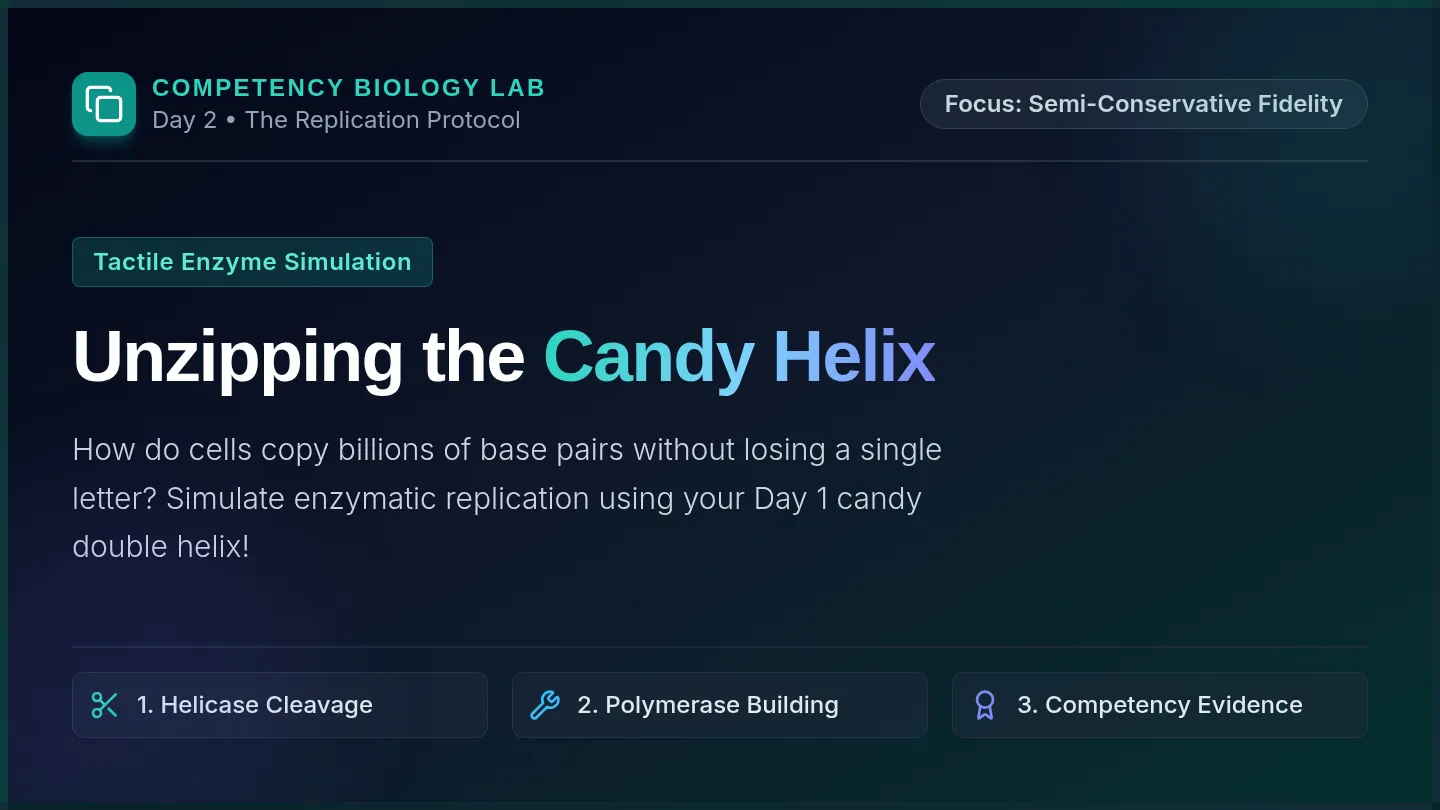
Replication Protocol

Students simulate semi-conservative DNA replication by enzymatically unzipping candy strands and building complementary daughter helices, demonstrating competency through lab evidence and knowledge checks.

Candy Code Sequence

A multi-day competency-based biology sequence exploring DNA architecture, complementary base pairing, and semi-conservative replication through tactile candy modeling and evidence-based assessment.

TMTeri Minami
1
2
3
4
5
6
7
8
9
10
11
12
Template StrandTACGGATCATGC
Complement Strand
Candy Colors

Partner Quality Audit: Partner Sign-off: _________________

All 12 pairs follow A-T & C-G

Twizzler backbones secure

Helical 3D twist stable

Part 4: Structural Analysis & Competency Explanations

Standard BIO.1C: Model Evaluation

1. Spatial Geometry: Why must a purine (Adenine/Guanine) always pair with a pyrimidine (Thymine/Cytosine)? What physical defect would occur in your candy model if Adenine paired with Guanine?

2. Bond Strength Difference: In a cell, the sugar-phosphate backbone is held by strong covalent bonds, while bases pair via weak hydrogen bonds. Why is this difference in bond strength essential for replication?

3. Predictive Synthesis: If an organism's DNA contains 300 base pairs (600 total bases) and 70 of those bases are Guanine, calculate the exact number of Thymine bases present in this DNA molecule:

Preserve completed candy double helix for Day 2 Replication Lab! Page 2 of 2

1 Old Parent Strand 1 New Synthesized

Daughter Molecule 2

1 Old Parent Strand 1 New Synthesized

Essential Takeaway: Neither daughter molecule is completely brand new! Each contains exactly one conserved original strand and one newly assembled strand.


Candy Lab Replication Protocol

Hands-On Phase 2

1

Step 1: Helicase Action

Gently untwist your Day 1 helix back into a flat ladder. Using lab scissors (or clean hands), snip the 12 toothpick rungs in half down the middle to separate the two parent strands.

2

Step 2: Collect New Substrates

Obtain 2 new Twizzlers (different flavor/color if available, representing new sugar-phosphate strands) and 24 new matching candy bases + 12 fresh toothpicks.

3

Step 3: DNA Polymerase Synthesis

For each separated parent strand, build a matching complementary daughter strand following base pairing rules: Green (A) with Red (T), Yellow (C) with Blue (G).

4

Step 4: Twist Two Identical Helices

Attach the new backbone Twizzlers. Twist both models! Place them side-by-side: verify they have 100% identical sequence order.

Competency Checkpoint: Do both resulting candy helices have the exact same 12-base sequence? Check with partner!


What If a Base Mismatches? Mutations

Proofreading

DNA Polymerase has an exonuclease "backspace" feature. But if an incorrect base escapes correction, a mutation is permanent.

Mismatched Base Pair Simulation

Imagine your partner placed a Green (A) across from a Blue (G).

A (Purine) + G (Purine) = Helix Bulge Error!

The hydrogen bonds fail to align correctly, warping the backbone shape and triggering repair enzymes.

Polymerase Proofreading Power

DNA Polymerase senses structural distortions immediately.

It reverses direction, removes the incorrect nucleotide, and inserts the proper complementary partner before moving forward.

Overall Error Rate: ~1 mistake per 1 billion bases replicated!

Record your error analysis and partner proofreading audit in Part 2 of your assessment guide now.


Competency Assessment Task

Summative Evidence

Today's 3-Part Demonstration of Mastery:

1. Lab Model Evidence

Show teacher your two replicated helices. Explain which strands are conserved parent strands and which are newly synthesized daughter strands.

2. Written Synthesis

Answer the 3 mechanistic questions on Page 1 comparing Helicase, Polymerase, and the semi-conservative model.

3. Mastery Exit Ticket

Independently complete the 5-item knowledge check on Page 2 (sequence matching, mutation detection, and 3-2-1 exit reflection).

Lab Clean-Up Protocol:

Once your model is scored on the rubric, toothpicks go in trash; candies can be enjoyed!

Begin Assessment

Refer to the Competency Rubric on your assessment sheet to confirm your target mastery level.

Part 3: Mechanistic Written Explanations

Connecting tactile lab observations to cellular biochemistry

Written Evidence

1. Enzymatic Specialization: In the candy lab, you used scissors to cut toothpicks, then added new toothpicks and candies. Compare the biological roles of DNA Helicase and DNA Polymerase in this sequence:

2. Error Prevention & Proofreading: Why is complementary base pairing (A with T, C with G) critical for minimizing replication mutations? What happens when a mismatched base is inserted?

Individual Task

Part 4: Mastery Check Exit Ticket

Independent Completion • 10 Minutes

Task 1: Replication Sequence Synthesis — Provide the newly synthesized complementary strand for the template below:

Template Strand: 3' - A G C T T A C G C T A A - 5'
Daughter Strand: 5' - _______________________________ - 3'

Task 2: Mutation Spotter Scenario — A sequencing machine reads the following replicated segment. Circle the error and explain:

Strand A:  5' - T A C C G A T T A - 3' | | | | | | | | | Strand B:  3' - A T G G C T A C A - 5'

Identify the mismatch and explain how DNA Polymerase corrects this during replication:

Task 3: 3-2-1 Quick Reflection

3 Key Terms:

2 Enzymes:

1 Wonder/Question:

Turn in completed assessment with lab evidence for competency sign-off Page 2 of 2

You might also like

Broadcast Breakthroughs Slides

Broadcast Tech Spotlight

A dynamic multimedia project sequence where students investigate cutting-edge sports broadcasting technologies, craft scripted storyboards, and produce professional recorded voiceover presentations.

S

Stacy.Bogart

5
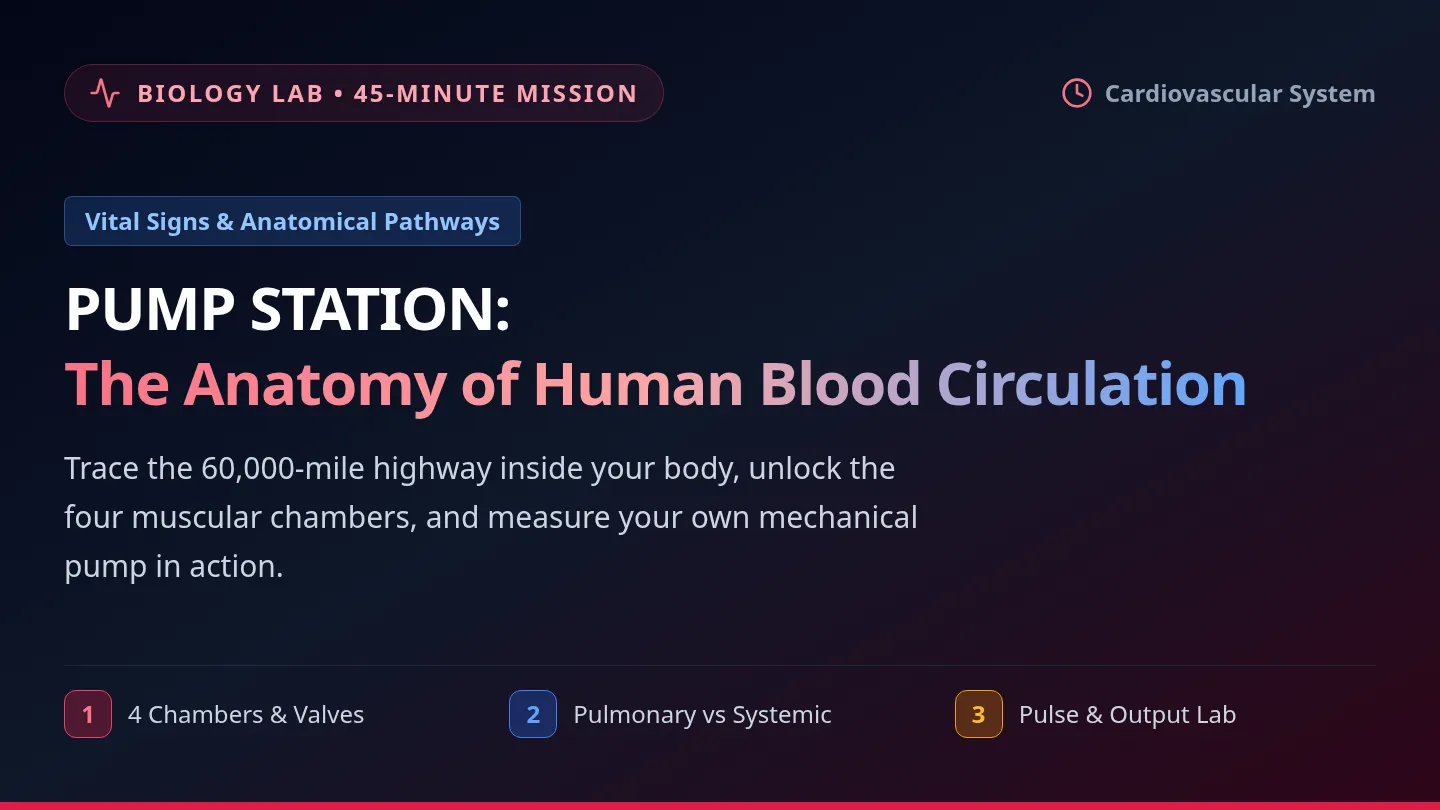
Pump Station Slides

Pump Station

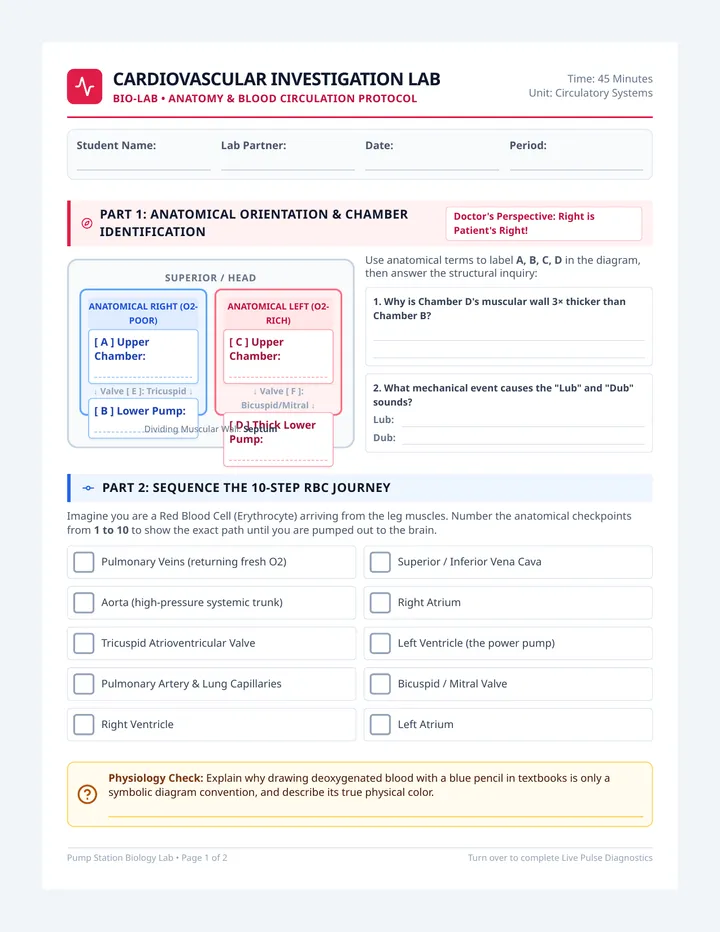
A high-energy, 45-minute biology lesson exploring cardiac anatomy, pulmonary versus systemic circulation, and the journey of blood through the human body with hands-on pulse diagnostics and pathway mapping.

GG

Grace Gnamoa

3
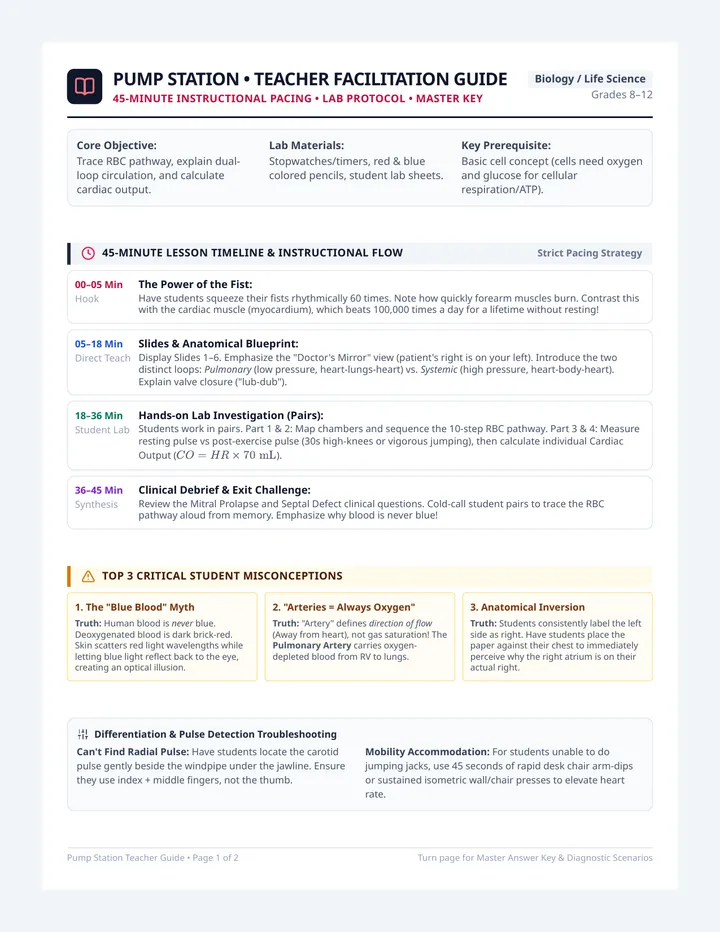
Pump Station Teacher Guide

Pump Station Teacher Guide

A 2-page teacher pacing guide, pedagogical misconception kit, facilitation script, and complete answer key for the 45-minute cardiovascular lesson and lab.

GG

Grace Gnamoa

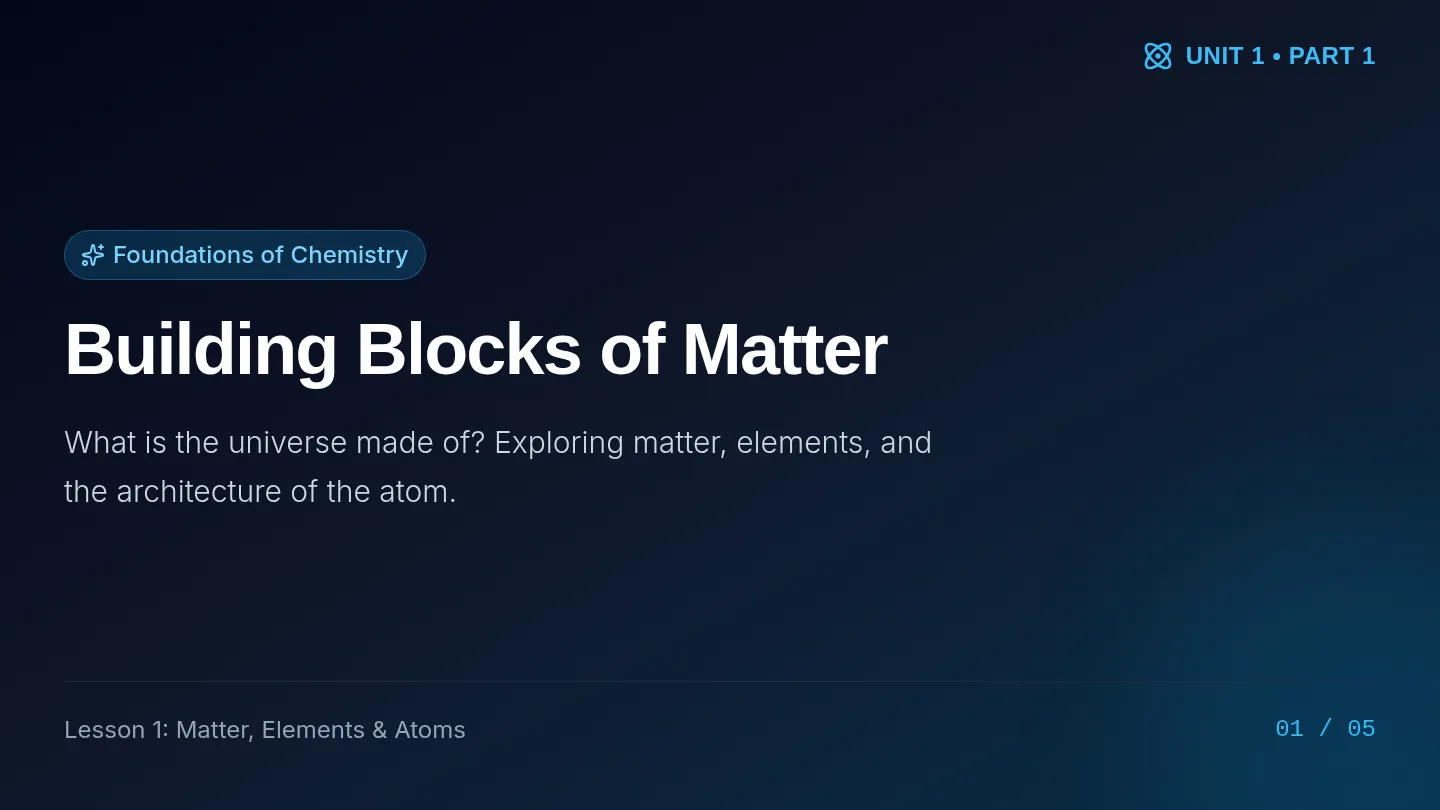
Building Blocks Slides

Atomic Foundations

A 3-part comprehensive scaffolded unit exploring matter, atomic architecture, subatomic particles, nuclear calculations, and atomic variations like ions and isotopes.

M

meagan_asp

6
Replication Protocol Slides

Replication Protocol

Students simulate semi-conservative DNA replication by enzymatically unzipping candy strands and building complementary daughter helices, demonstrating competency through lab evidence and knowledge checks.

TM

Teri Minami

2
Heart Circuit Lab Worksheet

Heart Circuit Lab Worksheet

A 2-page hands-on student lab worksheet covering cardiac chamber anatomy, blood flow pathway mapping, real-time pulse measurement, and cardiac output calculations.

GG

Grace Gnamoa

Day 1 Foundations Worksheet

Carb Masters Nutrition

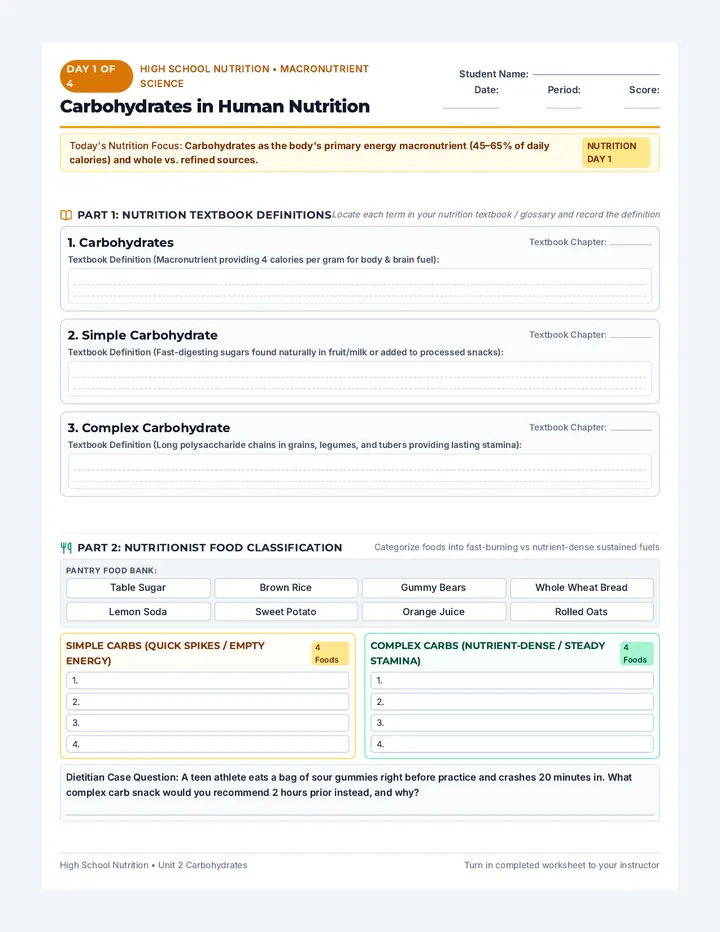
A comprehensive 4-day nutrition curriculum exploring dietary carbohydrates, digestion mechanics, fiber benefits, insulin homeostasis, and glycemic meal planning.

J

Jennifer.Leber

16
Helix Studio Slides

Helix Studio

Students dissect nucleotide anatomy and discover base pairing rules by engineering an accurate candy double helix model with complementary nitrogenous bases and sugar-phosphate backbones.

TM

Teri Minami

2
Pump Station Slides

Pump Station Slides

A 7-slide visual presentation for a 45-minute biology lesson on heart anatomy, the two-loop circulatory system, valve mechanics, and cardiac output.

GG

Grace Gnamoa

Lizard Clash Slides

Science Score Sprint

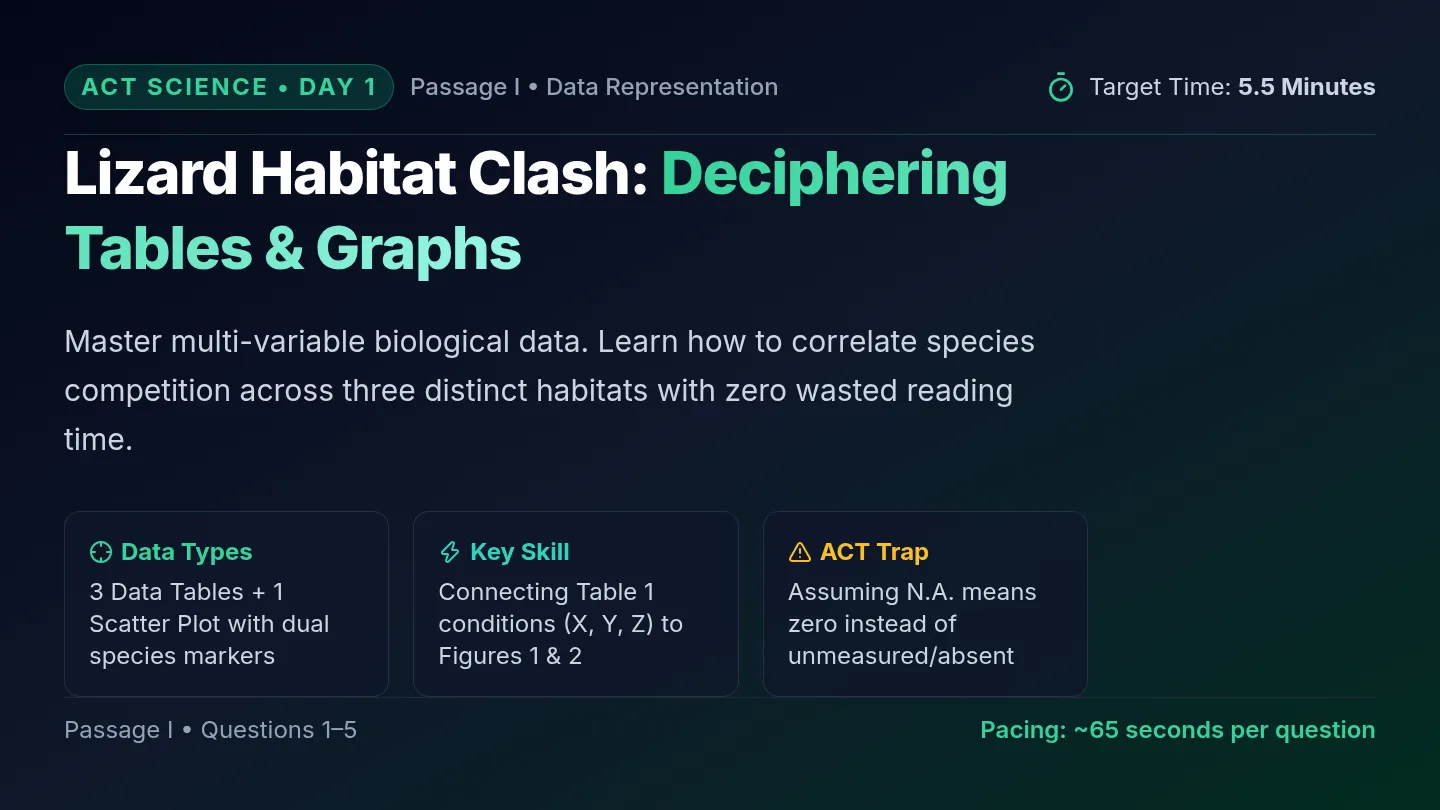
A seven-day ACT Science preparation sprint covering each passage type from data representation to conflicting viewpoints.

AI

Allison Ingraham

14
Prefix Code Bellwork

Prefix Code Bellwork

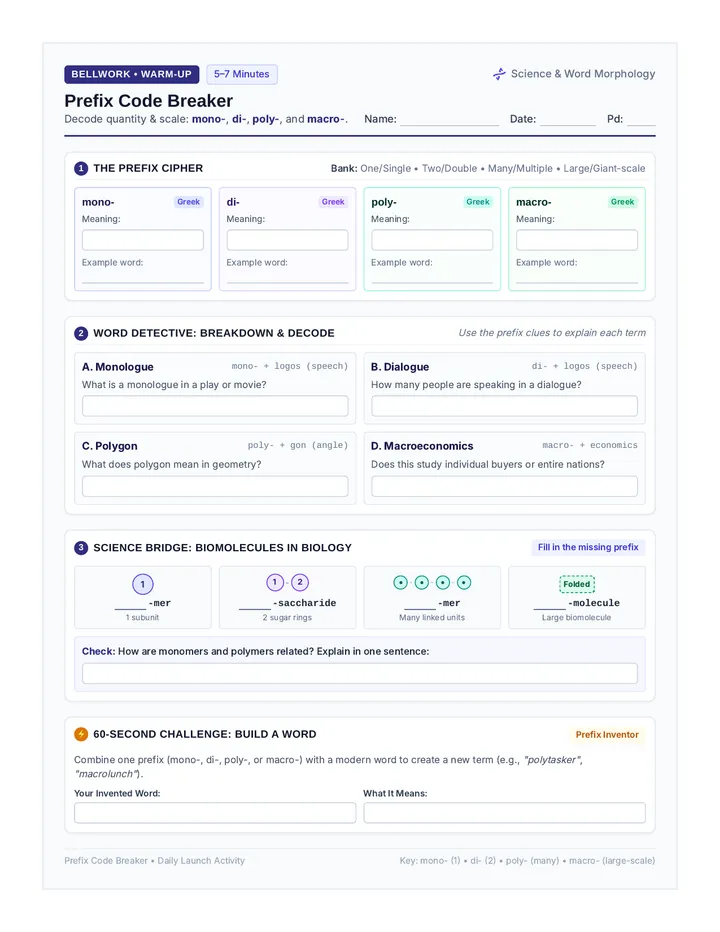
A focused, print-ready 5-minute bellwork activity introducing and reinforcing the Greek/Latin prefixes mono-, di-, poly-, and macro- through prefix decoding, word analysis, and biomolecule application.

S

stewart

Observation Lab Slides

Eco Detectives

A first-week life science sequence that builds essential science practices—meticulous observation, evidence-based reasoning, cooperative discourse, and testable inquiry—through interactive Kagan structures set within ecosystem contexts.

MH

Meagan Hudson

6