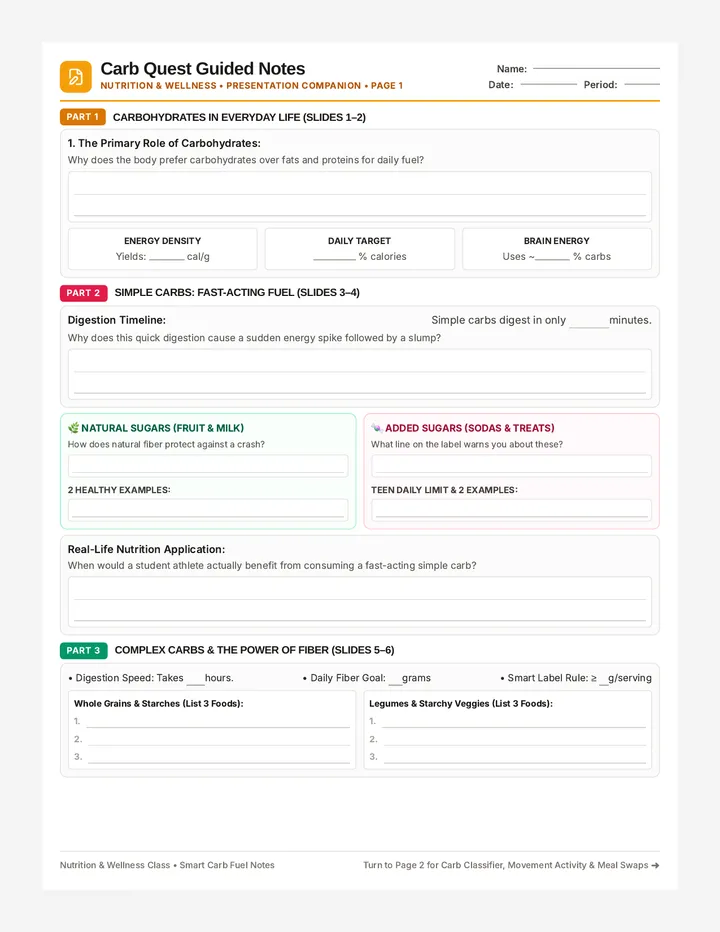
Day 1 Foundations Worksheet Day 1 of 4 High School Nutrition • Macronutrient Science
Carbohydrates in Human Nutrition
Student Name:
Date:
Period:
Score:
Today's Nutrition Focus: Carbohydrates as the body's primary energy macronutrient (45–65% of daily calories) and whole vs. refined sources. Nutrition Day 1
Part 1: Nutrition Textbook Definitions
Locate each term in your nutrition textbook / glossary and record the definition
1. Carbohydrates Textbook Chapter:
Textbook Definition (Macronutrient providing 4 calories per gram for body & brain fuel):
2. Simple Carbohydrate Textbook Chapter:
Textbook Definition (Fast-digesting sugars found naturally in fruit/milk or added to processed snacks):
3. Complex Carbohydrate Textbook Chapter:
Textbook Definition (Long polysaccharide chains in grains, legumes, and tubers providing lasting stamina):
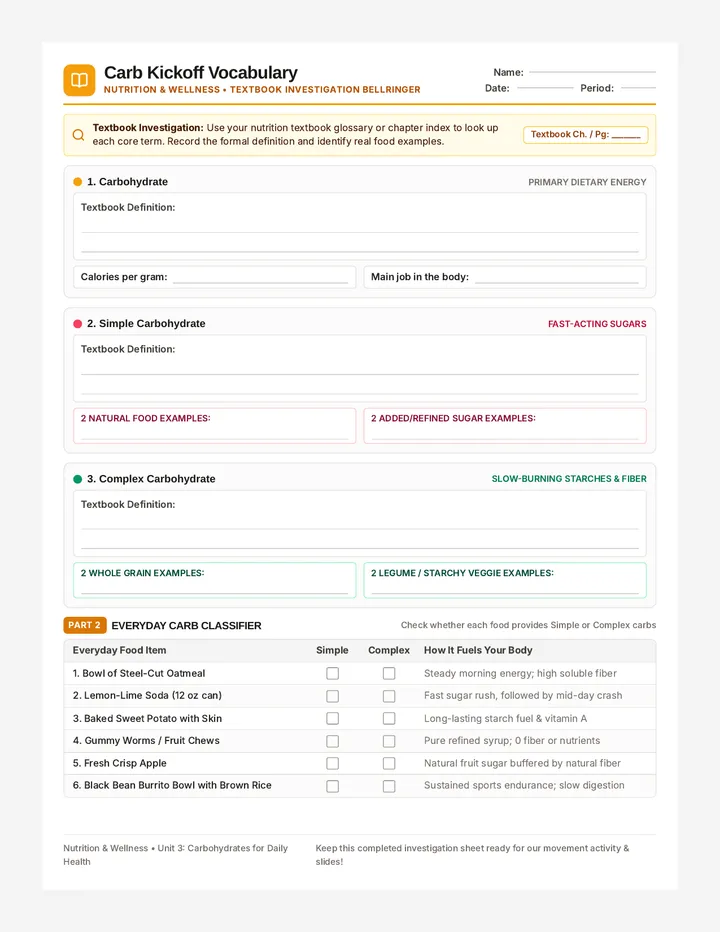
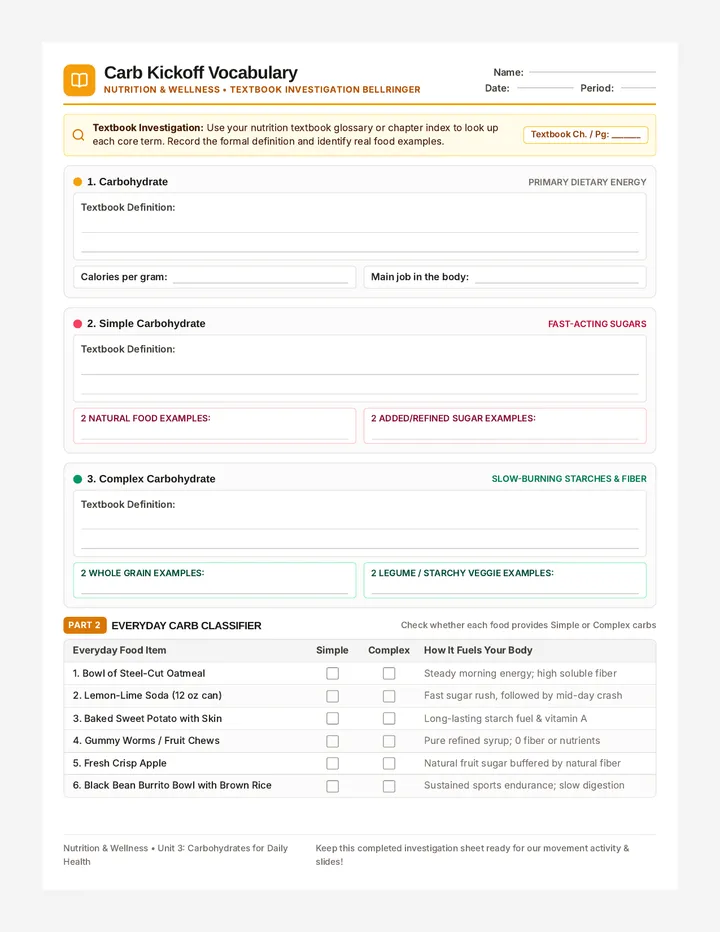
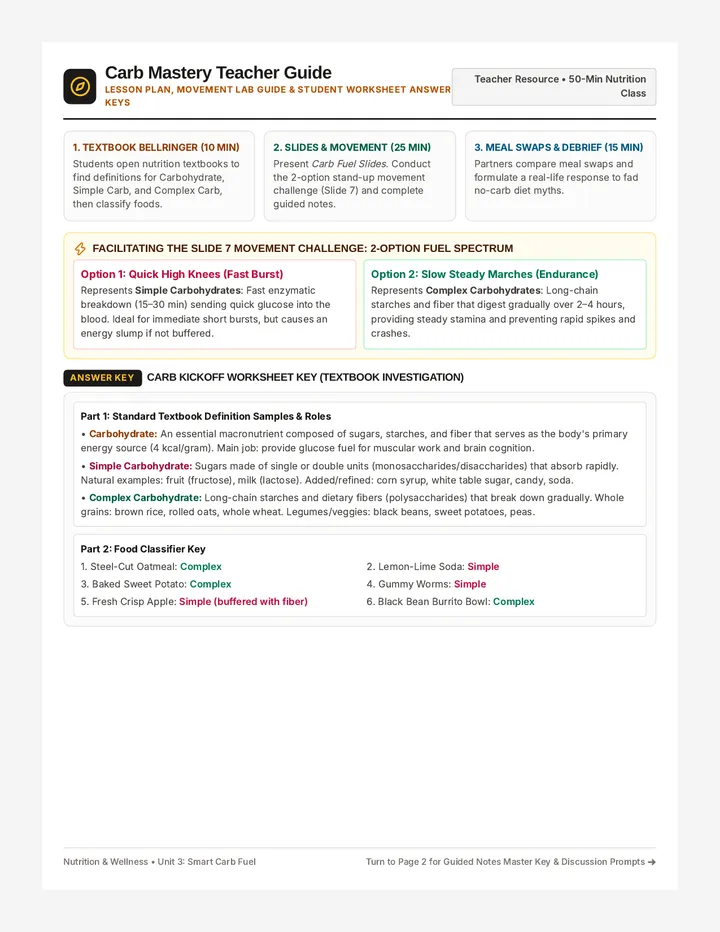
Part 2: Nutritionist Food Classification
Categorize foods into fast-burning vs nutrient-dense sustained fuels
Pantry Food Bank:
Table Sugar Brown Rice Gummy Bears Whole Wheat Bread Lemon Soda Sweet Potato Orange Juice Rolled Oats
Simple Carbs (Quick Spikes / Empty Energy) 4 Foods
Complex Carbs (Nutrient-Dense / Steady Stamina) 4 Foods
Dietitian Case Question: A teen athlete eats a bag of sour gummies right before practice and crashes 20 minutes in. What complex carb snack would you recommend 2 hours prior instead, and why?
High School Nutrition • Unit 2 Carbohydrates Turn in completed worksheet to your instructor
Day 2 Sugars Worksheet Day 2 of 4 Nutrition Science Series
The Sugar Breakdown Worksheet
Name:
Date:
Period:
Score:
Today's Focus: Defining sugars, glucose, and starch, and tracing how carbohydrate chains digest into cell fuel. Tuesday • Sheet 2
Part 1: Textbook Definitions
Locate each vocabulary term in your textbook and record the exact definition
4. Sugars Textbook Page / Chapter:
Textbook Definition:
5. Glucose Textbook Page / Chapter:
Textbook Definition:
6. Starch Textbook Page / Chapter:
Textbook Definition:
Part 2: Practice Activity • Molecular Match & Digestion Story
Connect the concepts
A. Analogy Match: Write the letter of the analogy matching each vocabulary term.
1. Glucose
2. Starch
3. Sugars
A. A massive freight train of hundreds of linked glucose cars storing plant energy.
B. A single dollar bill; the universal fuel currency your cells spend immediately.
C. Short 1 or 2-car toy train units that give an immediate sweet taste on your tongue.
B. Digestion Timeline: Fill in each blank using Starch , Glucose , or Sugars .
1. Eating a baked potato or pasta delivers giant plant storage chains known as .
2. Digestive enzymes in your saliva and small intestine break these chains into individual molecules.
3. In contrast, soda and fruit candy provide fast-absorbing, simple sweet .
Carb Decoder Unit • Day 2 Standalone Sheet Turn in completed paper to teacher
Day 3 Regulators Worksheet Day 3 of 4 Nutrition Science Series
The Body Regulators Worksheet
Name:
Date:
Period:
Score:
Today's Focus: Defining dietary fiber and insulin, and discovering how they regulate digestion and blood sugar balance. Wednesday • Sheet 3
Part 1: Textbook Definitions
Locate each vocabulary term in your textbook and record the exact definition
7. Dietary Fiber Textbook Page / Chapter:
Textbook Definition:
8. Insulin Textbook Page / Chapter:
Textbook Definition:
Part 2: Practice Activity • Body Balance Scenarios
Analyze fiber & insulin in action
A. Myth Busters: Circle T (True) or F (False).
1. Dietary fiber passes through the human digestive tract largely undigested because our enzymes cannot break it down.
T F
2. Insulin raises blood glucose levels whenever you eat carbohydrates.
T F
Correction / Explanation: What does insulin actually do to glucose in the blood?:
B. Cause & Effect Flowchart: What happens when you eat an apple (high fiber + natural sugars)?
Step 1: In the Gut
Fiber slows down digestion so glucose enters blood...
(Quickly or Slowly?)
Step 2: Pancreas Signal
The pancreas releases a steady, moderate pulse of...
(Name the hormone)
Step 3: In the Cells
Cells absorb glucose steadily, providing...
(Sugar crash or Sustained fuel?)
Carb Decoder Unit • Day 3 Standalone Sheet Turn in completed paper to teacher
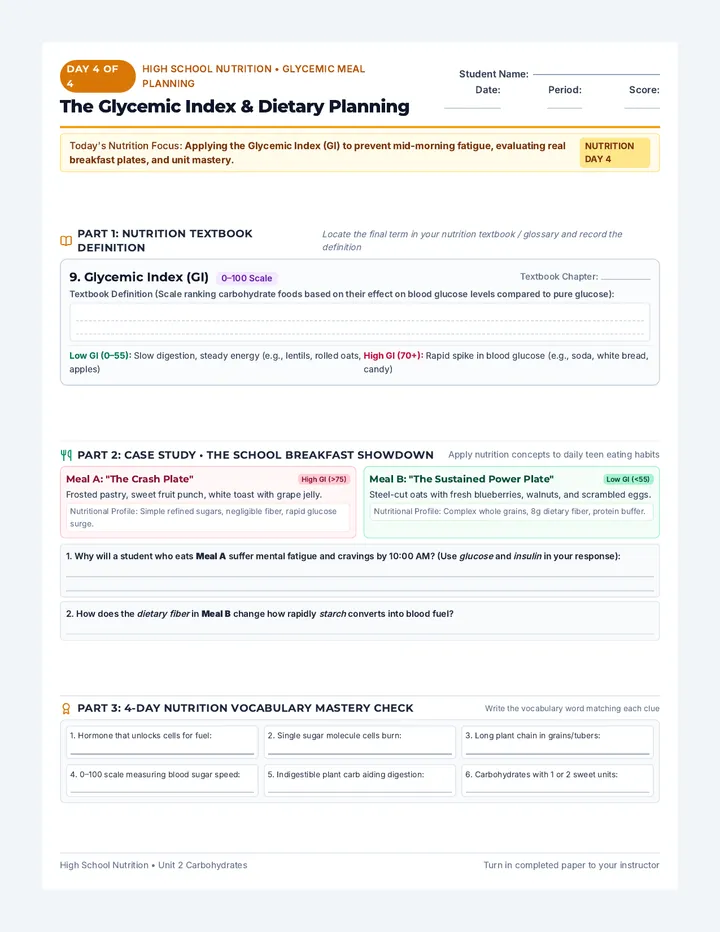
Day 4 Glycemic Worksheet Day 4 of 4 Nutrition Science Series
The Glycemic Index & Energy Lab
Name:
Date:
Period:
Score:
Today's Focus: Defining the Glycemic Index (GI), evaluating meals, and demonstrating 4-day vocabulary mastery. Thursday • Sheet 4
Part 1: Textbook Definition
Locate the final vocabulary term in your textbook and record the exact definition
9. Glycemic Index (GI) 0–100 Scale
Textbook Page / Chapter:
Textbook Definition:
Low GI (0–55): Slow digestion, gradual glucose release (e.g., lentils, rolled oats, apples)
High GI (70+): Rapid spike in blood glucose (e.g., soda, white bread, candy)
Part 2: Case Study • The Breakfast Showdown
Apply vocabulary concepts to real life
Meal A: "The Quick Rush" High GI
Frosted pastry, sweet fruit punch, and white toast with grape jelly.
Nutritional Profile: Simple sugars, low fiber, rapid glucose surge.
Meal B: "The Steady Burn" Low GI
Rolled oats with blueberries, walnuts, and scrambled eggs.
Nutritional Profile: Complex carbs, high dietary fiber, gradual glucose flow.
1. Why will a student who eats Meal A suffer an energy "crash" by 10:00 AM? (Use glucose and insulin in your explanation):
2. How does the dietary fiber in Meal B change how rapidly starch converts into blood fuel?
Part 3: 4-Day Vocabulary Mastery Check
Write the vocabulary word matching each clue
1. Hormone that unlocks cells for fuel:
2. Single sugar molecule cells burn:
3. Long plant chain of glucose units:
4. 0–100 scale of blood sugar speed:
5. Indigestible plant carb aiding digestion:
6. Carbohydrates made of 1 or 2 sugar units:
Carb Decoder Unit • Day 4 Standalone Sheet Turn in completed paper to teacher
Carb Chain Modeling Lab Activity Day 1 Lab High School Nutrition • Dietary Food Modeling
Carb Chain Modeling Lab Activity
Student Names:
Date:
Period:
Nutrition Science Principle (Monomers vs. Food Polymers):
Each individual paperclip represents one single sugar ring (monomer). Simple carbohydrates are loose clips or 2-clip pairs that your digestive enzymes break apart in seconds. Complex carbohydrates (starches) are long chains of 20+ linked clips that require continuous mechanical and chemical work to dismantle into usable glucose.
Materials (Zero Prep Needed!):
1 box of standard classroom paperclips (or linking cubes)
Stopwatch or classroom phone timer
Your lab partner (Partner A & Partner B)
Build Your Three Molecular Models:
Model 1 (Glucose): Place 1 loose paperclip.Model 2 (Table Sugar): Hook exactly 2 clips together.Model 3 (Starch Chain): Link 20 clips into 1 long chain.
Part 1: The Digestion Speed Experiment
Time how fast your "enzyme hands" unhook each model
Carbohydrate Model Clips in Chain Time to Unhook All Clips Fuel Delivery Speed Model 2: Simple Sugar (Sucrose) 2 clips Instant flash burn Model 3: Complex Starch (Potato/Oats) 20 clips Steady sustained release
Part 2: Real Food Matching
Match each real food to its paperclip model
1. Lemonade Soda
Pure simple sugar liquid
Model:
2. Baked Sweet Potato
Dense plant starch chains
Model:
3. Gummy Worms
High-fructose corn syrup
Model:
4. Bowl of Brown Rice
Complex starch granules
Model:
Post-Lab Dietary Analysis
1. Why did unhooking Model 3 take significantly longer than Model 2? How does this physical trial explain why whole grains keep you full for 3–4 hours while a candy bar leaves you hungry in 30 minutes?
2. When individual paperclips are finally separated, what specific biological molecule do they each represent in your bloodstream?
High School Nutrition • Day 1 Hands-On Lab Sheet Turn in completed lab report at the end of the period
Carb Foundations Slides Day 1 Nutrition Class Series
Macronutrient Foundations
Carbohydrates in Human Nutrition
Understanding the body's premier energy macronutrient (45–65% of daily calories) and how food choices impact daily stamina.
Dietary Question: Why does eating 50g of carbs from oatmeal feel completely different than 50g from soda?
Slide 1 of 5
Dietary Guidelines
The Essential Energy Macronutrient
4 Calories Per Gram
Carbohydrates are your brain and central nervous system's preferred and most efficient fuel source.
Dietary Guidelines recommend 45% to 65% of daily caloric intake come from quality carbohydrates.
MyPlate Principle
• "Make Half Your Grains Whole": Swap refined white flour for whole wheat, oats, and quinoa.
• Whole carbs deliver vitamins, minerals, and fiber alongside fuel.
Nutrition Terms: Carbohydrates • Simple Carbohydrate • Complex Carbohydrate Slide 2 of 5
Food Comparison
Simple vs. Complex on Your Plate
Simple Carbohydrates
Quick Burn
1–2 unit sugar rings. Digests in minutes, spiking blood sugar followed by quick hunger.
Dietary Sources: Table sugar, candy, soda, honey, energy chews, sweet tea.
Complex Carbohydrates
Sustained Stamina
Hundreds of linked units. Requires steady digestion, providing 3–4 hours of stable energy.
Dietary Sources: Brown rice, sweet potatoes, whole grain bread, black beans.
Nutrition Tip: Simple carbs are useful for quick mid-game boosts; complex carbs power daily school focus. Slide 3 of 5
Hands-On Investigation
Lab: The Carb Chain Modeling Challenge
1. Build Foods
1 clip = single glucose. 2 clips = simple table sugar. 20 clips = complex starch in an oat flake.
2. Digestion Race
Your hands act as digestive enzymes. Time how fast you can unhook Model 2 vs Model 3.
3. Diet Connection
Match real snacks (soda, sweet potato, gummy candy, brown rice) to their model!
Hands-On Goal: Physically feel why long-chain whole grains deliver sustained energy to athletes and students!
Daily Debrief
Day 1 Exit & Synthesis
Before Leaving Nutrition Class Today:
1 Record unhooking times and food matches on your Carb Chain Lab Sheet .
Day 2 Sugars Worksheet Day 2 of 4 High School Nutrition • Dietary Sugars & Staples
Sugars & Starch in the Diet
Student Name:
Date:
Period:
Score:
Today's Nutrition Focus: Differentiating natural vs. added sugars, dietary starch sources, and how saliva converts food to blood glucose. Nutrition Day 2
Part 1: Nutrition Textbook Definitions
Locate each term in your nutrition textbook / glossary and record the definition
4. Sugars Textbook Chapter:
Textbook Definition (Simple sweet carbs; AHA recommends limiting added sugars to under 25-36g daily):
5. Glucose Textbook Chapter:
Textbook Definition (The body's blood sugar currency required by red blood cells and the human brain):
6. Starch Textbook Chapter:
Textbook Definition (Plant energy storage chains in bread, potatoes, and grains; broken down into glucose):
Part 2: Practice Activity • Molecular Match & Digestion Story
Connect dietary food forms to bodily absorption
A. Food Analogy Match: Write the letter of the analogy matching each term.
1. Glucose
2. Starch
3. Sugars
A. Starchy staples (potatoes, pasta): 100-car freight trains of linked glucose units.
B. Blood fuel currency: The single dollar bill cells spend immediately for movement.
C. Sweet additions (cane sugar, syrup): 1 or 2-car toy trains absorbed in minutes.
B. Digestion Timeline: Fill in each blank with Starch , Glucose , or Sugars .
1. Eating a whole wheat bagel or baked potato delivers large dietary chains of .
2. Salivary enzymes in your mouth and digestive juices chop these chains into single units.
3. In contrast, drinking a soda floods the digestive tract with fast-absorbing, processed .
High School Nutrition • Unit 2 Carbohydrates Turn in completed worksheet to your instructor
Cracker Digestion Lab Activity Day 2 Lab Enzymatic Chemical Digestion
Cracker Digestion Lab Activity
Student Name:
Date:
Period:
Biochemical Mechanism (Chemical Digestion in Saliva):
An unsalted saltine cracker is composed almost entirely of bland, long-chain starch molecules. Your saliva contains the digestive enzyme salivary amylase , which breaks the chemical bonds linking starch chains into sweet tasting maltose and glucose sugars.
Materials Needed:
1-2 unsalted soda / saltine crackers
Stopwatch or classroom digital timer
Cup of water (to cleanse palate beforehand)
Step-by-Step Protocol:
Rinse mouth with plain water.
Place a cracker piece on your tongue. Do NOT chew or swallow!
Let saliva saturate the cracker and note taste changes at each time mark.
Timed Sensory & Breakdown Log
Record sensory data every 30 seconds
Time Mark Texture Observation Sweetness (1 to 5) Biochemical Explanation 0 Seconds (Initial) Dry, crisp, solid cracker 1 (Bland / No sweet) Intact starch chains (too large to taste sweet) 30 Seconds 60 Seconds 90 Seconds 120 Seconds
Post-Lab Analysis Questions
1. At what time mark did you first notice a distinctly sweet flavor develop? Why did the cracker taste sweeter over time even though no sugar was added?
2. Complete the chemical transformation: Starch (Giant Polymer) + Salivary Amylase ➔ ______________________. Why must the body break starch into single glucose units before it enters blood cells?
Day 2 Hands-On Lab Sheet • Cracker Digestion Turn in completed lab report to your science teacher
Sugar Breakdown Slides Day 2 Nutrition Class Series
Dietary Sugars & Label Literacy
The Sugar Breakdown
Decoding natural vs. added sugars on Nutrition Facts labels and discovering how oral enzymes convert dietary starches into cellular blood glucose.
Dietary Question: How much added sugar is hidden in popular teen beverages and pantry snacks?
Slide 1 of 5
Food Label Literacy
Natural Sugars vs. Added Sugars
Natural Sugars (Whole Foods)
Found naturally in whole fruits (fructose) and milk/dairy (lactose).
Packaged with dietary fiber, water, and essential micronutrients that temper blood sugar absorption.
Added Sugars (Processed)
Cane sugar, high-fructose corn syrup, syrups added during manufacturing.
AHA Guideline: Max 25g/day (6 tsp) for teens. 1 can of soda has ~40g (10 tsp) of added sugar!
Nutrition Math: 4 Grams of Sugar = Exactly 1 Teaspoon of Granulated Sugar. Slide 2 of 5
Digestive Physiology
How Starchy Foods Become Blood Glucose
The Digestive Journey Begins in Mouth
When you eat a potato or whole grain bread, you swallow starch chains.
Salivary enzymes instantly start hydrolyzing these chains into sweet maltose and single glucose units.
Why Glucose Matters to Health
Glucose is the only form of carbohydrate that can cross the intestinal wall into human blood vessels.
Your brain burns roughly 120 grams of glucose per day just to keep thoughts sharp and reflexes quick!
Key Hierarchy: Starch (giant food chain) ➔ Digestion in saliva & gut ➔ Glucose (cell fuel in blood). Slide 3 of 5
Hands-On Investigation
Lab: The Cracker Digestion Challenge
Step 1: Place
Place the unsalted cracker on your tongue. Do NOT chew or swallow!
Step 2: Saturate
Let salivary amylase enzymes break down the starch polymers in real time.
Step 3: Rate
Record sweetness ratings (1 to 5) every 30 seconds on your lab sheet.
Sensory Science: Experience first-hand how biological enzymes transform bland food starch into sweet fuel!
Daily Debrief
Day 2 Exit & Synthesis
Before Leaving Nutrition Class Today:
1 Complete all sweetness ratings and reaction questions on the Cracker Lab Sheet .
2 Fill out textbook definitions for Sugars, Glucose, and Starch on your
Day 3 Regulators Worksheet Day 3 of 4 High School Nutrition • Fiber Intake & Metabolism
Dietary Fiber & Blood Sugar Balance
Student Name:
Date:
Period:
Score:
Today's Nutrition Focus: The 25–38g daily fiber guideline, soluble vs. insoluble food sources, and insulin homeostasis. Nutrition Day 3
Part 1: Nutrition Textbook Definitions
Locate each term in your nutrition textbook / glossary and record the definition
7. Dietary Fiber Textbook Chapter:
Textbook Definition (Indigestible plant parts; promotes gut health, binds cholesterol, and slows glucose absorption):
Daily Recommended Intake: 25g/day (Females) • 38g/day (Males) • Best sources: Beans, oats, berries, chia seeds.
8. Insulin Textbook Chapter:
Textbook Definition (Pancreatic hormone that unlocks muscle and liver cells to absorb blood glucose after meals):
Metabolic Role: Prevents dangerous hyperglycemia and manages energy storage into glycogen.
Part 2: Practice Activity • Dietary Health Scenarios
Analyze fiber & insulin in daily nutrition
A. Fiber Nutrition Truths: Circle T (True) or F (False).
1. Over 90% of Americans do not meet their daily recommended dietary fiber intake (25–38 grams).
T F
2. Insulin's job is to raise blood sugar whenever you eat a sugary snack.
T F
Dietitian Correction: What does insulin actually do to blood glucose after you eat?:
B. Whole Food vs Liquid Sugar: What happens when you eat a whole apple (with peel)?
Step 1: In the Gut
Soluble fiber forms a gel so glucose enters blood...
(Gradually or in a Flood?)
Step 2: Pancreas Signal
The pancreas releases a controlled, moderate dose of...
(Name the hormone)
Step 3: Energy Result
Cells absorb glucose smoothly, preventing...
(A mid-morning crash)
High School Nutrition • Unit 2 Carbohydrates Turn in completed worksheet to your instructor
Fiber Filter Lab Activity Day 3 Lab Digestive Mechanics & Hormones
Fiber Filter Lab Activity
Lab Partners:
Date:
Period:
Scientific Principle (The Fiber Gel Matrix & Insulin Gatekeeper):
Soluble dietary fiber binds water in the stomach to form a thick, protective gel network. This physically traps glucose molecules, slowing down how fast sugar passes through the intestinal wall into the bloodstream. This prevents rapid blood sugar spikes and allows insulin to smoothly open cellular doors.
Lab Materials:
2 funnels with mesh filter paper
2 collection beakers (100 mL) + stopwatch
Liquid A: Plain colored sugar water (50 mL)
Liquid B: Hydrated chia/oat fiber gel solution (50 mL)
Investigation Procedure:
Pour Liquid A into Funnel 1; time how long 30 mL filters through.
Pour Liquid B into Funnel 2; observe gel formation and drainage rate.
Measure and compare flow rates to model glucose absorption.
Filtration & Absorption Data Table
Compare no-fiber vs high-fiber digestion models
Liquid Sample Visual Viscosity Time to Drain 30 mL Simulated Blood Sugar Effect Cup A (Sugar Water) Thin, watery, fast-flowing Cup B (Fiber Gel Mix) Thick, gel-like, cohesive
Post-Lab Biochemical Analysis
1. How did the presence of dietary fiber alter the flow rate through the filter? How does this physical property protect your pancreas from having to pump out an emergency spike of insulin?
2. The "Lock & Key" Model: In your own words, what role does insulin play once glucose successfully enters the bloodstream? What happens to glucose levels in the blood when the cell "door" opens?
Day 3 Hands-On Lab Sheet • Fiber Filter Turn in completed lab report to your science teacher
Body Regulators Slides Day 3 Nutrition Class Series
Metabolic Health & Dietary Fiber
Dietary Fiber & Insulin Balance
Closing the dietary fiber gap, preventing cardiovascular disease, and understanding how the hormone insulin manages blood glucose equilibrium.
Dietary Question: Why does eating fiber protect against Type 2 diabetes and high cholesterol?
Slide 1 of 5
Public Health Nutrition
Closing the Fiber Gap (25–38g / Day)
Soluble Fiber (The Sponge)
Dissolves into a thick gel in your gut.
• Binds dietary cholesterol to protect your heart.
• Slows glucose entry into blood, preventing spikes.
• Foods: Oats, beans, lentils, chia seeds, apples.
Insoluble Fiber (The Broom)
Does not dissolve; adds healthy bulk to digestive tract.
• Promotes regular digestion and prevents constipation.
• Feeds healthy gut microbiome bacteria.
• Foods: Whole wheat bran, brown rice, vegetables.
Nutrition Fact: Less than 5% of Americans meet the recommended 25–38 grams of daily fiber! Slide 2 of 5
Hormonal Homeostasis
Insulin: Protecting Metabolic Health
How the Pancreas Manages Fuel
When carbohydrates digest, blood glucose rises. Your pancreas delivers a measured pulse of insulin into circulation.
Insulin acts as a cellular key, unlocking muscle and liver doors to pull sugar out of blood vessels.
Preventing Insulin Resistance
Constant surges of high-sugar refined foods force the pancreas into overdrive. Over time, cells become "numb" to insulin.
Dietary Protection: Fiber-rich whole foods keep insulin demands steady, preventing Type 2 diabetes risk!
Homeostasis Goal: Keep fasting blood glucose in the healthy 70–100 mg/dL sweet spot. Slide 3 of 5
Hands-On Investigation
Lab: The Fiber Filter Simulation
Model A: Liquid Sugar (Zero Fiber)
Models drinking sweet soda or fruit punch with zero fiber.
Liquid drains instantly through the filter, simulating a dangerous surge of glucose into blood vessels.
Model B: High-Fiber Whole Food
Models eating whole steel-cut oats, beans, or chia seeds.
The soluble gel matrix meters drainage, showing how fiber buffers blood sugar absorption!
Nutrition Principle: Fiber physically slows digestive transit, protecting your pancreas and heart!
Day 4 Glycemic Worksheet Day 4 of 4 High School Nutrition • Glycemic Meal Planning
The Glycemic Index & Dietary Planning
Student Name:
Date:
Period:
Score:
Today's Nutrition Focus: Applying the Glycemic Index (GI) to prevent mid-morning fatigue, evaluating real breakfast plates, and unit mastery. Nutrition Day 4
Part 1: Nutrition Textbook Definition
Locate the final term in your nutrition textbook / glossary and record the definition
9. Glycemic Index (GI) 0–100 Scale
Textbook Chapter:
Textbook Definition (Scale ranking carbohydrate foods based on their effect on blood glucose levels compared to pure glucose):
Low GI (0–55): Slow digestion, steady energy (e.g., lentils, rolled oats, apples)
High GI (70+): Rapid spike in blood glucose (e.g., soda, white bread, candy)
Part 2: Case Study • The School Breakfast Showdown
Apply nutrition concepts to daily teen eating habits
Meal A: "The Crash Plate" High GI (>75)
Frosted pastry, sweet fruit punch, white toast with grape jelly.
Nutritional Profile: Simple refined sugars, negligible fiber, rapid glucose surge.
Meal B: "The Sustained Power Plate" Low GI (<55)
Steel-cut oats with fresh blueberries, walnuts, and scrambled eggs.
Nutritional Profile: Complex whole grains, 8g dietary fiber, protein buffer.
1. Why will a student who eats Meal A suffer mental fatigue and cravings by 10:00 AM? (Use glucose and insulin in your response):
2. How does the dietary fiber in Meal B change how rapidly starch converts into blood fuel?
Part 3: 4-Day Nutrition Vocabulary Mastery Check
Write the vocabulary word matching each clue
1. Hormone that unlocks cells for fuel:
2. Single sugar molecule cells burn:
3. Long plant chain in grains/tubers:
4. 0–100 scale measuring blood sugar speed:
5. Indigestible plant carb aiding digestion:
6. Carbohydrates with 1 or 2 sweet units:
High School Nutrition • Unit 2 Carbohydrates Turn in completed paper to your instructor
Meal Makeover Lab Activity Day 4 Lab Applied Nutrition Engineering
Meal Makeover Lab Activity
Team Members:
Date:
Period:
Mission Objective (Engineering a Low-GI Sustained Energy Plate):
Analyze a common high-GI "Crash Plate" (GI > 75), plot its blood sugar trajectory on the coordinate grid, and engineer a redesigned Low-GI "Power Plate" (GI < 55) using complex carbohydrates, dietary fiber, and smart food pairings.
Part 1: The Ingredient Swap Challenge
Swap each High-GI item for a smart Low-GI alternative
High-GI Crash Item (GI) Smart Low-GI Swap Option Nutritional Benefit (Fiber / Starch) 1. White Bagel with Jelly (GI: 82) 2. Sugary Corn Flakes (GI: 81) 3. Processed Fruit Punch (GI: 78) 4. Potato Chips (GI: 75)
Part 2: 3-Hour Blood Sugar Trajectory Graph
Plot both curves on the grid lines below
Blood Glucose (mg/dL) ↑ 160 140 (Spike) 120 100 (Base) 80 60 (Crash) 0 hr (Meal) 0.5 hr 1.0 hr (Peak) 1.5 hr 2.0 hr 2.5 hr 3.0 hr Time Elapsed →
Graphing Instructions:
Red Curve (High-GI): Plot baseline at 100 ➔ spike to 150+ at 45 min ➔ crash below 70 by hour 2.
Green Curve (Low-GI): Plot baseline at 100 ➔ gentle rise to ~115 ➔ steady taper at 95–100 past hour 3.
Nutritional Defense & Vocabulary Synthesis
Explain how your redesigned meal uses complex carbohydrates and dietary fiber to moderate insulin release and maintain steady glucose levels for learning:
Day 4 Hands-On Lab Sheet • Meal Makeover Turn in completed lab report to your science teacher
Glycemic Science Slides Day 4 Nutrition Class Series
Applied Dietary Planning
Glycemic Index & Meal Planning
Applying the Glycemic Index to prevent the mid-morning school slump, balance meals, and support sustained cognitive focus.
Dietary Question: How can understanding food digestion speed help you maintain peak focus all day?
Slide 1 of 5
The Metric System of Fuel
The Glycemic Index (GI) 0–100 Scale
Low GI (0–55)
Digests slowly; delivers a steady, sustained trickle of glucose into blood.
Oats, apples, lentils, chickpeas, berries, plain Greek yogurt.
Medium GI (56–69)
Moderate breakdown rate; balanced digestion speed for active days.
Brown rice, sweet corn, bananas, whole grain rye bread.
High GI (70–100)
Surges blood sugar rapidly, triggering a panic insulin release.
White bread, candy, corn flakes, fruit punch, soda, jelly.
Nutrition Tip: Pair carbs with protein or healthy fats (e.g., apples + peanut butter) to lower the total GI! Slide 2 of 5
Metabolic Physiology
The Physiology of the 10:00 AM Crash
Plate A: High-GI "Crash Plate"
• Fast simple sugars surge blood glucose above 150 mg/dL.
• Pancreas pumps out an emergency flood of insulin.
• Cells rapidly vacuum up glucose, plunging blood sugar below 70 mg/dL.
• Result: Brain fog, shaky hands, and intense sugar cravings by 10 AM.
Plate B: Low-GI "Power Plate"
• Soluble fiber & complex starches meter enzymatic breakdown.
• Glucose enters the bloodstream as a gentle, manageable stream.
• Pancreas delivers a smooth, low-dose insulin response.
• Result: Sharp mental recall, steady mood, and energy past 4th period!
Metabolic Wisdom: High peaks lead to deep valleys; gentle slopes sustain focus. Slide 3 of 5
Applied Nutrition Engineering
Lab: The Meal Makeover Challenge
Task 1: Swap Foods
Examine the 4 High-GI Crash Items. Select superior Low-GI replacements on your lab table.
Task 2: Plot Curves
Use the labeled coordinate grid: Plot the red dashed crash line vs. your green power curve!
Task 3: Defend Plate
Write a dietitian defense using complex carbs , dietary fiber , and insulin !
Goal: Can your team engineer a delicious breakfast plate with an average GI under 50?
Carbohydrate Nutrition Quiz Unit Assessment Nutrition Science Series
Carbohydrate Nutrition Quiz
Name:
Date:
Period:
Score: / 50
Directions: Select the best answer for multiple choice questions. Write complete responses for short-answer items. Page 1 of 2
Part 1: Molecular Foundations & Digestion (Questions 1–5)
1. Nutritionists recommend complex carbohydrates over simple carbohydrates for sustained energy primarily because complex carbohydrates:
A Contain zero calories compared to natural sugars
B Break down slowly, releasing steady fuel into the blood
C Bypass the digestive system and enter cells directly
D Are strictly found in artificial dietary supplements
2. Which of the following foods is the most nutrient-dense source of complex carbohydrates (starch and fiber)?
A 12-ounce can of lemon-lime soda
B Handful of fruit-flavored gummy candies
C Bowl of steel-cut rolled oatmeal
D Two tablespoons of pure table sugar
3. In human nutrition and metabolism, why is glucose considered the body's primary carbohydrate currency?
A It is the single sugar molecule that human cells combust for ATP
B It cannot be stored in the body and must be eaten constantly
C It is the sweet-tasting disaccharide found in honey
D It acts solely as an indigestible scrub brush in the intestines
4. When a person eats a plain unsalted cracker or baked potato, chemical digestion begins in the mouth because saliva contains an enzyme that:
A Transforms dietary fats into dietary fiber
B Hydrolyzes large starch chains into smaller sweet sugars
C Destroys all carbohydrates before they reach the stomach
D Converts single glucose units back into giant starch polymers
5. Real-World Nutrition Analysis: A soccer player needs rapid fuel at halftime (in 5 minutes), but needs lasting stamina for tomorrow's 90-minute championship game. Which carbohydrate type should they choose at halftime, and which type should they eat 3 hours before the game? Explain the biochemical reason.
Carb Masters Unit Assessment • Page 1 Continue to Page 2 for Questions 6–10 →
Carbohydrate Nutrition Quiz (Continued)
Student Name:
Part 2: Hormonal Homeostasis, Dietary Fiber, and Glycemic Fuel Application Page 2 of 2
6. Why does eating a whole fresh apple cause a much slower and healthier blood sugar rise than drinking 8 ounces of processed apple juice with the exact same grams of sugar?
A The processed apple juice contains zero total carbohydrates