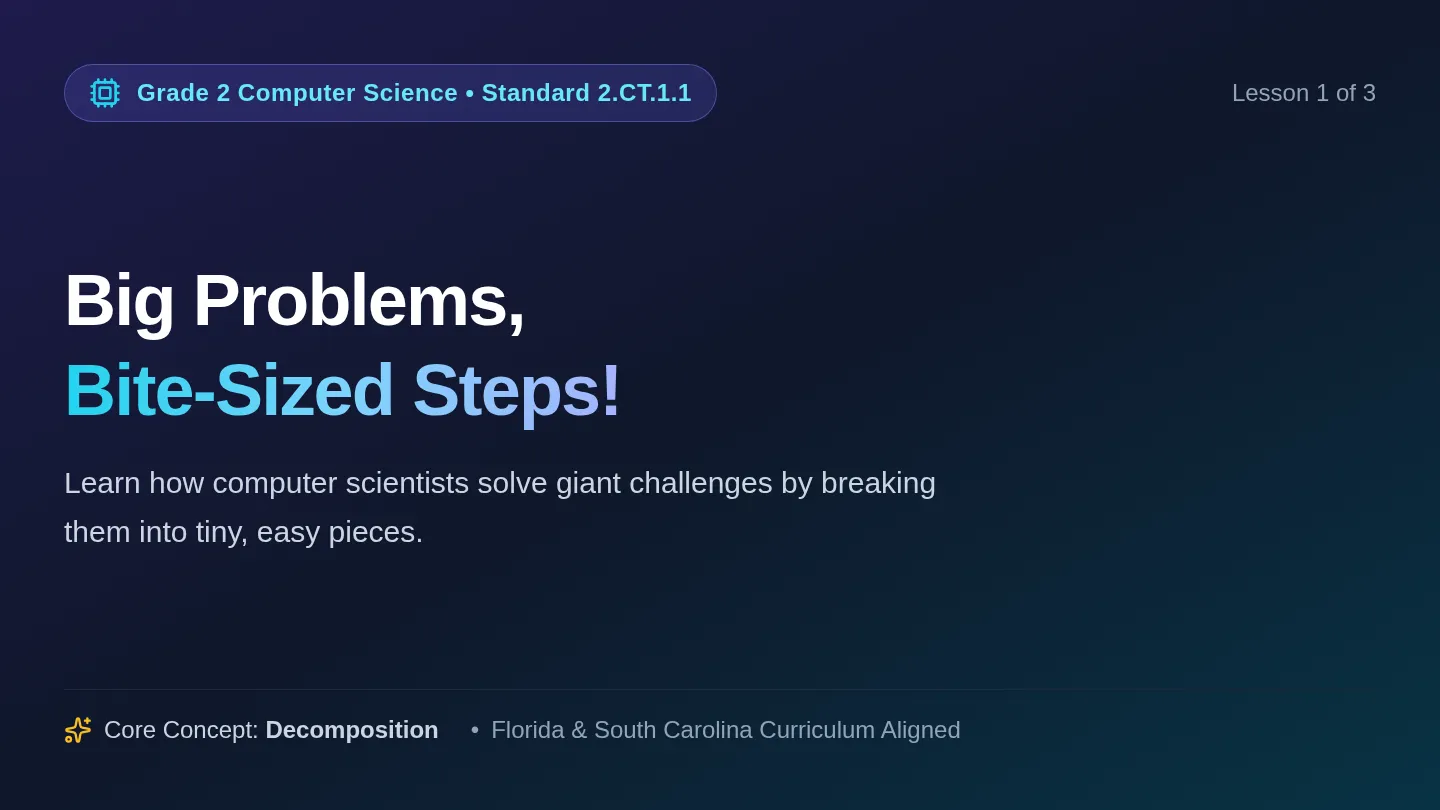
Bite Sized Slides Grade 2 Computer Science • Standard 2.CT.1.1
Lesson 1 of 3
Big Problems,
Bite-Sized Steps!
Learn how computer scientists solve giant challenges by breaking them into tiny, easy pieces.
Core Concept: Decomposition
• Florida & South Carolina Curriculum Aligned
Secret Code Word
What is Decomposition?
01
A Giant Problem
Trying to do an entire big job all at once can feel too hard and overwhelming!
Example: "Clean your entire house right now!"
Decomposition Power
Breaking that giant job down into small, bite-sized tasks that are easy to finish.
Solution: 1. Pick up socks ➔ 2. Make bed ➔ 3. Put toys in bin!
💡 Computer Rule: Computers can only follow one small instruction at a time!
Real-World Test
The Sandwich Robot
02
If you just tell a robot: "Make me a sandwich!" it will freeze!
1
Sub-Task A
Take two slices of bread from the bag
2
Sub-Task B
Scoop peanut butter and spread on bread
3
Sub-Task C
Scoop sweet jelly and spread on top
4
Sub-Task D
Press both slices together gently
By decomposing the goal into 4 small steps, the robot succeeds every time!
Daily Life Example
Decomposing "Get Ready for School"
03
How do you break down your morning into 3 manageable chunks?
Part 1
Dressing
Pick clothes
Put on shirt & pants
Tie up shoes
Part 2
Fueling Up
Pour cereal & milk
Eat breakfast
Drink cold water
Part 3
Packing
Pack homework folder
Zip up lunchbox
Head to the bus!
Each part is a small puzzle piece. When joined in order, your morning is complete!
You Are The Programmer
Your Task Breaker Mission
Ready!
Turn & Talk With Your Partner:
1
Pick a big task: "Brushing Your Teeth" or "Building a Lego Tower."
2
Decompose it into exactly 3 or 4 bite-sized steps .
3
Check: Did you leave out any hidden step (like opening the cap)?
Next up: Grab your Routine Breakdown Worksheet ! Standard 2.CT.1.1 in Action
Routine Breakdown Worksheet Routine Breakdown Worksheet
Computer Science • Grade 2 • Standard 2.CT.1.1 (Decomposition)
Task Breakers Series
Lesson 1: Practice Sheet
Student Name:
Date:
Key Word: Decomposition means taking one large problem or chore and breaking it down into smaller, bite-sized steps so it is simple to solve or complete.
Part 1
Deconstruct a Big Chore
Your goal is "Make a Cold Bowl of Cereal." Write 3 small steps in order to decompose this big morning task.
Step 1 (First sub-problem):
Step 2 (Next sub-problem):
Step 3 (Last sub-problem):
Part 2
Order the Decomposed Steps
A student decomposed "Brushing Your Teeth," but the steps got mixed up! Write numbers 1, 2, 3, and 4 in the circles to place them in correct order.
Brush teeth gently in small circles for 2 minutes.
Rinse mouth and toothbrush thoroughly with clean water.
Wet toothbrush and squeeze pea-sized toothpaste onto bristles.
Put toothbrush away and wipe face with a clean towel.
Florida SC.2.CS-CT.1.1 • South Carolina 2.CT.1.1 Page 1 of 2
The Missing Step Detective
Decomposition Detective • Finding What's Left Out
Task Breakers Series
Lesson 1: Page 2
Part 3
Find the Missing Sub-Problem
Maya decomposed the task of "Feeding the Class Hamster," but she forgot one critical sub-step! Read her list below:
Sub-task 1: Take the empty hamster bowl out of the cage.
Sub-task 2: Scoop fresh hamster seeds from the food bin.
Sub-task 3: [ ??? MISSING STEP ??? ]
Sub-task 4: Place the bowl back inside and lock the cage door securely.
What is the missing sub-task that Maya needs to do between Step 2 and Step 4?
Part 4
Your Turn: Decompose "Planting a Seed"
A gardener wants to grow a bright sunflower. Break down the big job of "Planting a Seed" into 3 clear, manageable parts.
Part A: Preparing the soil & pot
Part B: Placing the seed
Part C: Water and sunlight care
Self-Check: I broke big tasks into smaller pieces!
Got it! Need help
Task Breakers • Lesson 1 Practice Page 2 of 2
Task Chop Teacher Guide Task Chop Teacher Guide
Educator Facilitation Plan • Lesson 1: Decomposition Foundations
Grade 2 CS
Curriculum Standard Identification:
Florida Curriculum:
SC.2.CS-CT.1.1: Resolve a problem by decomposing it into smaller, manageable sub-problems (e.g., breaking a story into beginning, middle, and end; sorting objects).
South Carolina Curriculum:
2.CT.1.1: Decompose a problem or task into smaller, manageable parts (e.g., break down the steps of a daily routine or the parts of a multi-step task).
Instructional Pacing (45–50 Minutes)
Hook & Kinesthetic 10 Min
Robot Teacher Demo: Tell class you are a robot that only follows atomic steps. Ask a student to direct you to take off your shoe. If they say "take off shoe," freeze and say "ERROR: Step too large!" Prompt them to break it down.
Direct & Guided 15 Min
Bite Sized Slides: Walk through slides 1–5. Discuss the sandwich robot and morning routine breakdown. Model identifying "hidden" micro-steps (e.g., untying shoelaces before pulling).
Independent & Exit 20 Min
Routine Breakdown Worksheet: Students complete Part 1 & 2 individually or in pairs. Reconvene for 5 min to share solutions for Maya's class hamster missing step.
Common Student Misconceptions
Lumping too much: Writing "Make breakfast and eat it" as one step instead of splitting food prep from eating.Skipping prerequisites: Forgetting essential preparatory steps like opening a container before pouring.Confusing sequence with decomposition: Clarify that decomposition is splitting the goal; sequencing puts those splits in order.
Key Discussion Prompts
"Why can't computers understand instructions like 'be good' or 'clean up'?"
"What happens if we leave out one tiny step in a four-step routine?"
"How does breaking a giant homework project into 3 bite-sized steps help your brain?"
Differentiation Strategies
Support / Scaffolding:
Provide sentence starters: "First, I get the...", "Next, I pour the...", "Finally, I...". Allow verbal explanation or quick sketch diagrams in place of written sentences for emerging writers.
Extension / Challenge:
Have advanced learners decompose a complex process like "How a Traffic Light Changes" or "How to Wash an Entire Car" into 6 distinct sequential sub-problems with conditional checks.
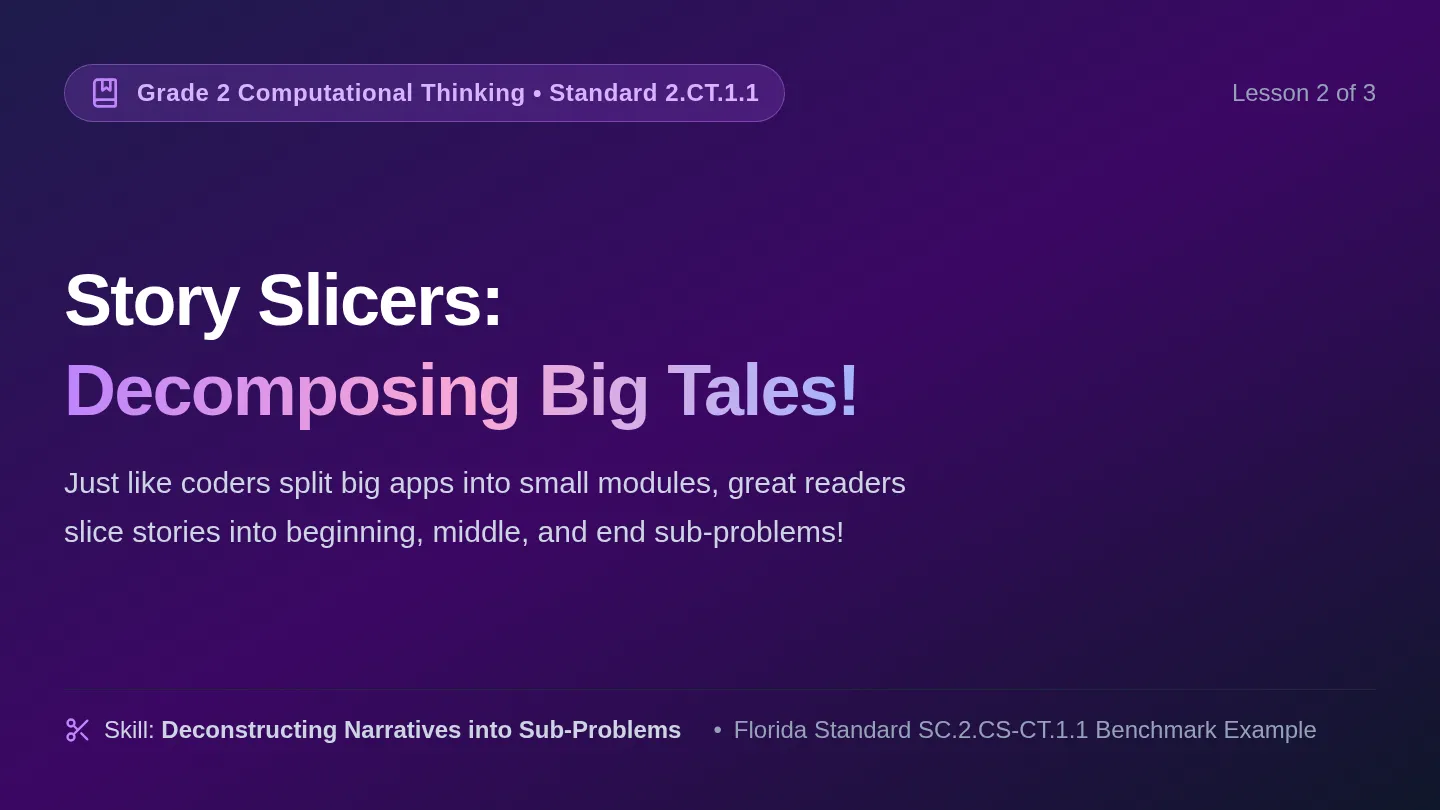
Story Slicers Slides Grade 2 Computational Thinking • Standard 2.CT.1.1
Lesson 2 of 3
Story Slicers:
Decomposing Big Tales!
Just like coders split big apps into small modules, great readers slice stories into beginning, middle, and end sub-problems!
Skill: Deconstructing Narratives into Sub-Problems
• Florida Standard SC.2.CS-CT.1.1 Benchmark Example
Computational Reading
Every Story is a Problem to Solve
01
Sub-Problem 1
Beginning
Who is in trouble? What goal or challenge pops up first?
📍 Identifies the main goal
Sub-Problem 2
Middle
What obstacles get in the way? What steps do characters try?
⚡ Action & sub-tasks
Sub-Problem 3
Ending
How is the challenge solved? What was the final result?
🎉 Solution verified!
💡 Coder Rule: Decomposing a story makes it easy to understand, retell, and debug!
Decomposition in Action
The Lost Soccer Ball Case
02
The Big Problem: The recess soccer ball vanished! How do the students decompose the search?
PART 1: BEGINNING
Notice the ball is missing right before game kickoff.
Sub-task: Form search pairs!
PART 2: MIDDLE
Search sub-zone A (the swings) then sub-zone B (the bushes).
Sub-task: Check behind bushes!
PART 3: ENDING
Find ball wedged under the fence. Bring it back to the field.
Sub-task: Game starts on time!
Instead of running around aimlessly, the students decomposed the search into 3 clear steps!
Quick Check
Which Sub-Problem Is It?
03
"Leo accidentally spills a whole jar of shiny glitter on the art table!"
Is this the Beginning, Middle, or End sub-problem?
A. Beginning
This introduces the main problem that must be decomposed!
B. Middle
Getting the broom and dustpan to clean.
C. Ending
Table is spotless and ready for painting.
Decomposing helps us locate exactly where in the story each action happens!
Detective Workshop
Your Story Solver Organizer
Action
Your Mission Steps:
Story Solver Organizer Story Solver Organizer
Decomposing Stories into Sub-Problems • Standard 2.CT.1.1
Task Breakers Series
Lesson 2: Organizer
Student Name:
Date:
Scenario: The Classroom Library Mix-Up
During rainy day recess, a tall stack of 30 library books fell over and mixed together across the carpet! Some books are science books, some are fiction stories, and some need tape repairs. The teacher asks the class to solve the mess before reading time begins in 15 minutes.
Task 1
Decompose the Challenge into 3 Sub-Problems
Beginning Sub-Problem: Identifying & Sorting First Step
What is the very first small sub-problem the students must solve to start clearing the floor?
Middle Sub-Problem: Action & Repair Action Step
What specific action steps should the students take to fix torn pages and separate book bins?
Ending Sub-Problem: Checking & Finishing Final Step
How do they verify that all books are returned to the correct shelf before the timer dings?
Task 2 Concept Check: Why did we break this big mess into 3 parts?
A Because big problems are easier to solve in small pieces.
B Because computers do not like doing any work.
Florida SC.2.CS-CT.1.1 Example (Story Decomposition) Page 1 of 2
Create Your Story Blueprint
Decomposing Your Own Narrative Problem
Task Breakers Series
Lesson 2: Page 2
Pick ONE scenario below (circle it) and decompose it into 3 ordered sub-problems with an action for each!
[ A ] Lost Puppy in the Park • [ B ] The Broken Bicycle Chain • [ C ] Building a Snow Fort
1. Beginning Phase (What is the starting situation?) Sub-Problem 1
2. Middle Phase (What steps and tools are used?) Sub-Problem 2
3. Ending Phase (How is the mission completed?) Sub-Problem 3
Partner Verification: Did my partner split the story into 3 clear parts?
Yes, great breakdown! Needs one more step
Task Breakers Series • Lesson 2 Organizer Page 2 of 2
Story Slicers Rubric Story Slicers Rubric
Observational Rubric & Conference Log • Standard 2.CT.1.1
Teacher Assessment
Use this 4-level rubric to assess student mastery of decomposing problems into manageable sub-parts (Florida SC.2.CS-CT.1.1 / South Carolina 2.CT.1.1). Assess during small-group conferring or upon reviewing the Story Solver Organizer.
Standard 2.CT.1.1 Performance Levels
1 - Beginning
2 - Developing
3 - Proficient (Target)
4 - Advanced
Identifies that a big task exists, but cannot split it into smaller sub-problems without continuous teacher prompting. Lumps everything into one sentence.
Splits task into 2 parts but misses key intermediate sub-problems or inverts chronological order (e.g., puts ending step before action step).
Successfully decomposes narrative/routine into 3 distinct, ordered sub-problems (Beginning, Middle, End) with actionable steps for each.
Consistently decomposes complex scenarios into 4+ granular sub-tasks, identifies missing steps independently, and justifies why ordering matters.
Student Conferring & Observation Tracker
Record observations during workshop
Student Name Score (1-4) Observed Strengths / Next Steps Mastery Met? [ ] Y [ ] N [ ] Y [ ] N [ ] Y [ ] N [ ] Y [ ] N [ ] Y [ ] N
Targeted Instructional Interventions
For Level 1 / 2 (Struggling with Sub-Problems):
Use physical manipulative cards with pictures (e.g., photo of spilled books, photo of sorting bins, photo of clean shelf). Ask: "Which photo shows how we start? Which shows our middle job?"
For Level 4 (Exceeding):
Challenge students to identify a potential failure or "bug" in one of their sub-problems and create a backup branch step (e.g., "What if the book tape is completely out?").
Task Breakers Series • Lesson 2 Assessment Guide Standards: FL SC.2.CS-CT.1.1 | SC 2.CT.1.1
Mission Debug Slides Grade 2 Computer Science • Standard 2.CT.1.1
Lesson 3 of 3
Mission Debug:
Fixing Broken Steps!
When an algorithm goes wrong, don't throw it all away! Decompose the code to find the exact sub-problem with the bug.
Core Skill: Decomposing Sequences & Debugging Sub-Tasks
• Florida SC.2.CS-CT.1.1 & South Carolina 2.CT.1.1
Programmer Mystery
What is a Computer Bug?
01
A Bug = An Error in the Code
A bug happens when an instruction is missing , in the wrong order , or pointing the wrong way!
Debugging = Fixing the Bug
Instead of rewriting everything, we decompose the steps and test each sub-part one by one!
💡 Golden Rule: Decomposition lets you isolate exactly WHERE the error happened!
Case Study
Rover 2000's Maze Mishap
02
Rover bumped into a wall! Let's inspect each decomposed sub-phase:
Phase 1
Exit Dock
"Move Forward 2 steps."
Status: Works Perfectly!
Phase 2
Turn Corner
"Turn Left into the wall!"
BUG FOUND: Should Turn Right!
Phase 3
Reach Station
"Move Forward 3 steps."
Status: Waiting for Phase 2 fix!
We only need to fix Phase 2 ! Decomposition saved us from starting over from zero.
Coder Strategy
The 3-Step Debug Protocol
03
1
Decompose
Split the whole program into smaller sub-tasks.
2
Test & Isolate
Run each sub-task to see where the problem happens.
3
Repair & Run
Fix only the broken sub-task, then test the full solution!
🎯 Smart coders don't panic—they use decomposition to track down bugs!
Final Challenge
Robot Repair Workshop
Go!
Today's Lab Activities:
1
Open your Robot Repair Worksheet .
2
Inspect the 3-phase algorithm and locate the bug.
3
Complete the Mastery Exit Ticket to earn your badge!
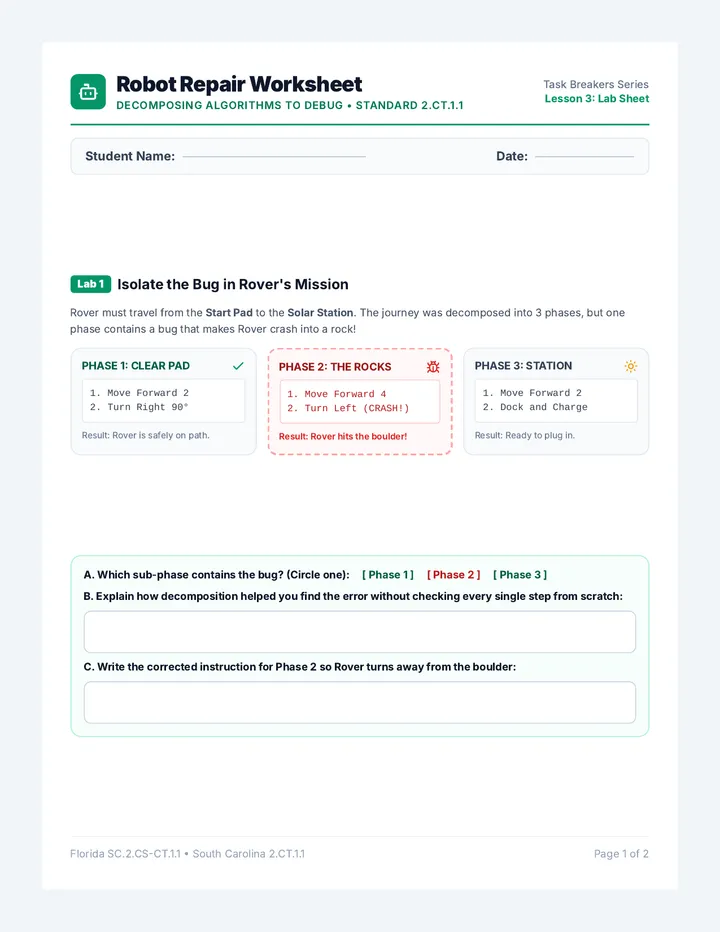
Robot Repair Worksheet Robot Repair Worksheet
Decomposing Algorithms to Debug • Standard 2.CT.1.1
Task Breakers Series
Lesson 3: Lab Sheet
Student Name:
Date:
Lab 1
Isolate the Bug in Rover's Mission
Rover must travel from the Start Pad to the Solar Station . The journey was decomposed into 3 phases, but one phase contains a bug that makes Rover crash into a rock!
Phase 1: Clear Pad
1. Move Forward 2
Result: Rover is safely on path.
Phase 2: The Rocks
1. Move Forward 4
Result: Rover hits the boulder!
Phase 3: Station
1. Move Forward 2
Result: Ready to plug in.
A. Which sub-phase contains the bug? (Circle one): [ Phase 1 ] [ Phase 2 ] [ Phase 3 ] B. Explain how decomposition helped you find the error without checking every single step from scratch:
C. Write the corrected instruction for Phase 2 so Rover turns away from the boulder:
Florida SC.2.CS-CT.1.1 • South Carolina 2.CT.1.1 Page 1 of 2
The Clean-Room Robot Builder
Decomposing a Large Robotic Program
Task Breakers Series
Lesson 3: Page 2
You are programming a classroom helper bot to "Clean the STEM Lab." Decompose this big job into 3 sub-problem routines. Write 2 specific instructions inside each sub-problem!
Sub-Problem 1: Pick Up Building Blocks & Tools Module A
Sub-Problem 2: Wipe the Work Tables Clean Module B
Sub-Problem 3: Return to Charging Dock Module C
Code Check: Did you separate each job into its own small block?
Yes, fully decomposed!
Task Breakers Series • Lesson 3 Practice Page 2 of 2
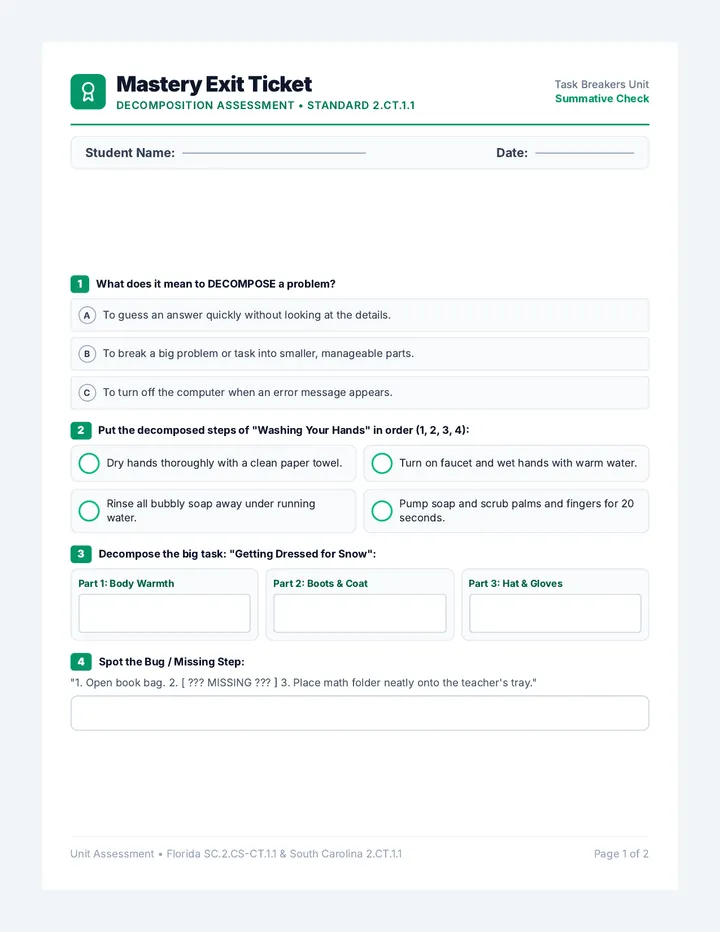
Mastery Exit Ticket Mastery Exit Ticket
Decomposition Assessment • Standard 2.CT.1.1
Task Breakers Unit
Summative Check
Student Name:
Date:
1
What does it mean to DECOMPOSE a problem?
A To guess an answer quickly without looking at the details.
B To break a big problem or task into smaller, manageable parts.
C To turn off the computer when an error message appears.
2
Put the decomposed steps of "Washing Your Hands" in order (1, 2, 3, 4):
Dry hands thoroughly with a clean paper towel.
Turn on faucet and wet hands with warm water.
Rinse all bubbly soap away under running water.
Pump soap and scrub palms and fingers for 20 seconds.
3
Decompose the big task: "Getting Dressed for Snow":
Part 1: Body Warmth
Part 2: Boots & Coat
Part 3: Hat & Gloves
4
Spot the Bug / Missing Step:
"1. Open book bag. 2. [ ??? MISSING ??? ] 3. Place math folder neatly onto the teacher's tray."
Unit Assessment • Florida SC.2.CS-CT.1.1 & South Carolina 2.CT.1.1 Page 1 of 2
Mastery Exit Ticket Answer Key
Educator Evaluation & Scoring Guide • Standard 2.CT.1.1
Teacher Key
Question 1: Definition (Decomposition) Correct: B
Correct Answer: B — "To break a big problem or task into smaller, manageable parts."Criteria: Student recognizes the core vocabulary and meaning of decomposition.
Question 2: Sequencing Decomposed Steps Order: 4, 1, 3, 2
• Step 1: Turn on faucet and wet hands.
• Step 2: Pump soap and scrub 20 sec.
• Step 3: Rinse all bubbly soap away.
• Step 4: Dry hands thoroughly with towel.
Question 3: Decomposing Snow Routine 3 Pts Total
Sample Acceptable Student Answers: Part 1: Put on warm sweater and thick snow pants / thermals.Part 2: Step into insulated snow boots and zip heavy winter coat.Part 3: Pull knit hat over ears and put on waterproof mittens / gloves.Scoring: 1 point per logical, distinct sub-step that aligns with the target category.
Question 4: Spot the Missing Step 1 Pt Total
Acceptable Answers: "Take out math folder" or "Pull folder out of the backpack."Key Insight: The student identifies that one cannot place the folder on the tray while it is still inside the closed bag.