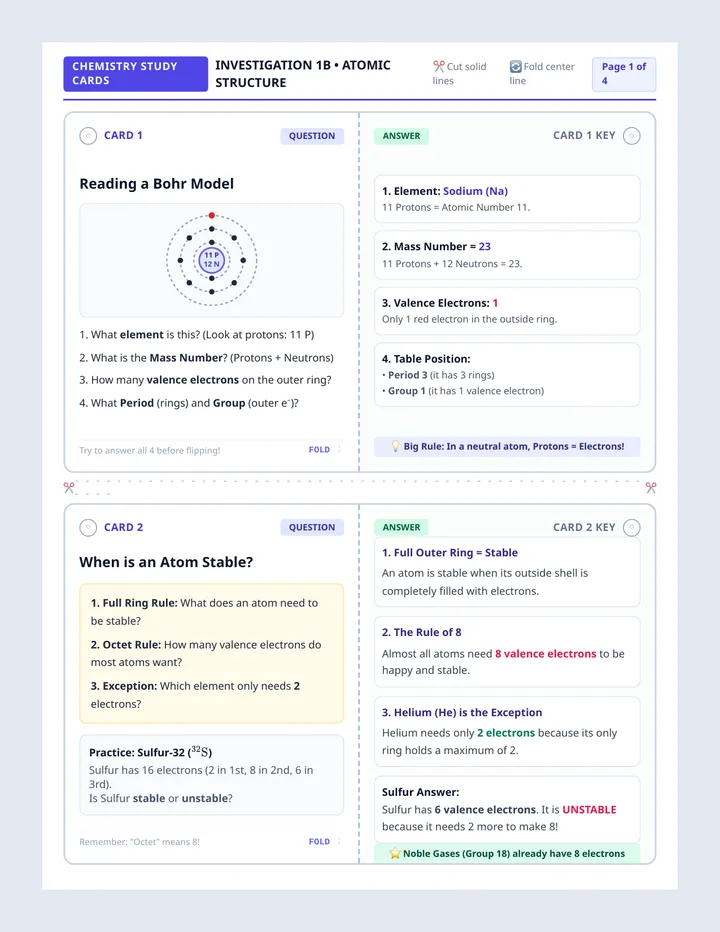
Atomic structure, quantum models, and periodic trends establish the fundamental nature of matter. Stoichiometry, gas properties, and equilibrium constants facilitate quantitative analysis of chemical reactions and molecular interactions.
A comprehensive answer key and step-by-step worked solutions document for the Foundations Practice Exam (Version B), providing detailed explanations for all calculation-based questions to support educator grading and student self-correction.
A highly structured student study guide featuring a metric organizer, rule summaries for sig figs and naming, and interactive worked example pairs mapping directly to Chapter 1-4 chemistry calculation types.
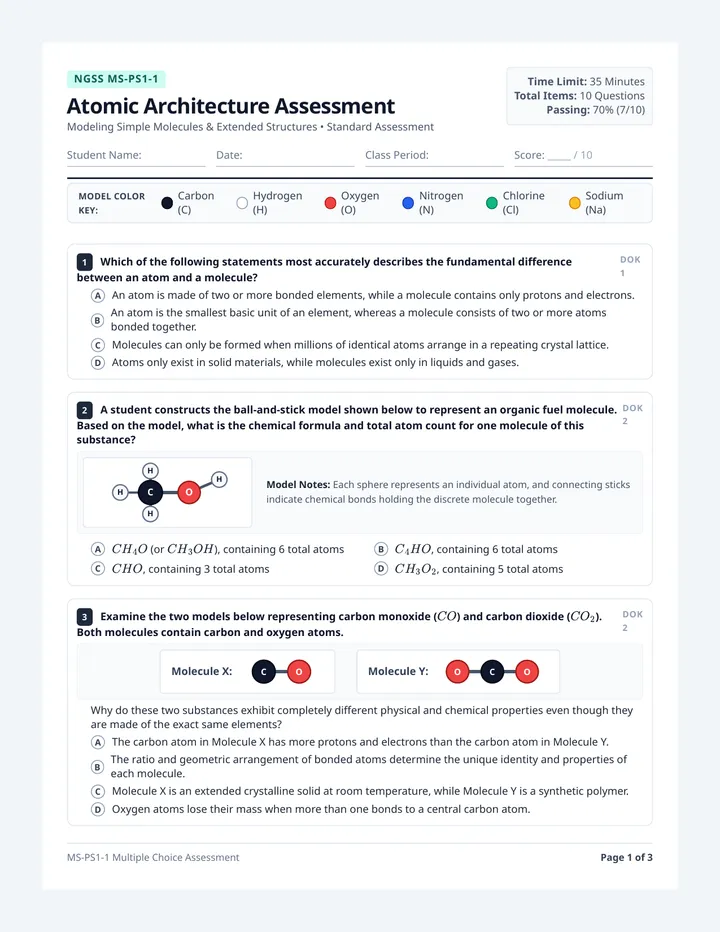
A parallel 40-question multiple-choice practice exam covering Chapters 1-4 of introductory chemistry (measurements, matter, energy, and atomic structure) with new numerical values and contexts that map perfectly to the original exam's answer key.
A 1-page printable resource containing 2 identical high-impact exit tickets to easily print, cut, and distribute for quick formative assessment on Group 7 trends.
A 1-page printable resource featuring 4 distinct collaborative task cards covering shielding mechanisms, displacement equations, everyday uses, and state transitions.
A 2-page laboratory investigation guide detailing simulated halogen displacement reactions with clear procedures, observations grids, and a CER analysis framework.
A 2-page print-ready guided worksheet with name/date fields, physical properties completion table, atomic shielding diagram questions, and displacement equation practice problems.
A high-impact, visual slide presentation covering Group 7 trends, color changes, subatomic shielding, and displacement rules. Optimized for 1440x810 layout.
A 2-page print-ready teacher guide detailing lesson pacing, pedagogical strategies, common student misconceptions, questioning guides, and answer keys for the entire Halogen Havoc unit.
A teacher-facing master key and instruction guide for the Matter and Bonding assessments. Includes full correct answers, explanatory scoring advice, and mathematical derivations of the Coulomb's Law tiered challenges.
A 3-page tiered exam covering Ions, Electrostatic Force, Ionic Bonding, and Coulomb's Law. Moves through three tiers of cognitive scaffolding: Tier 1 (Foundation - 2-choice visual matching), Tier 2 (Core - guided ionic transfer drawings & step-by-step Coulomb decoding), and Tier 3 (Challenger - advanced proportional scaling math).
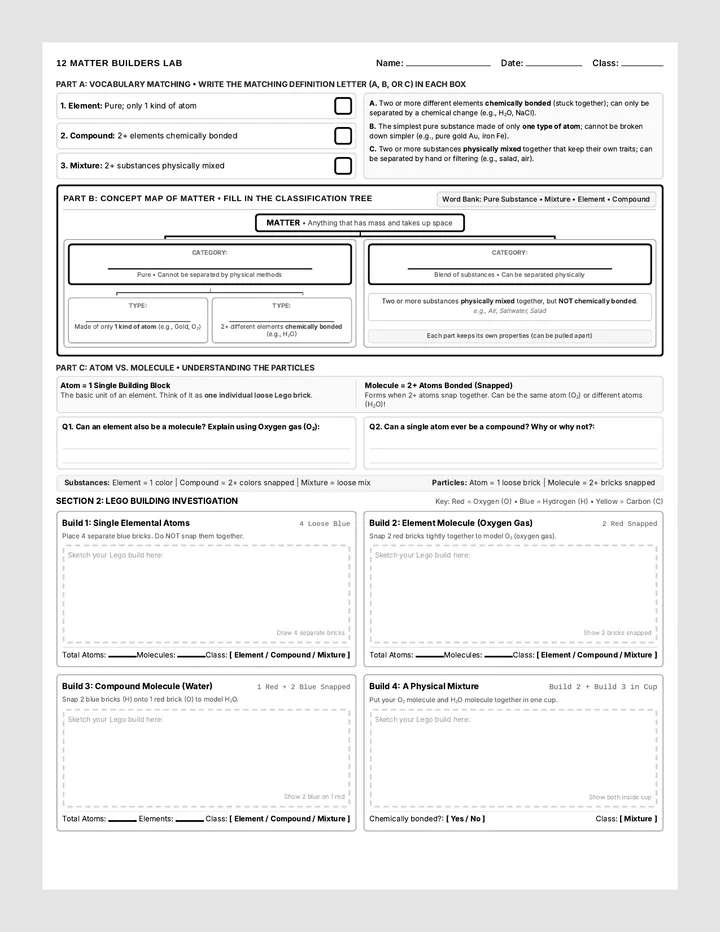
A 2-page assessment with custom graphic organizers, visual particle-model identification cards, horizontal/vertical mapping, and conceptual short-answer items featuring supportive sentence starters.
Un programme complet de révision intensive pour le Brevet, regroupant des fiches, exercices et corrigés détaillés en français et en physique-chimie.
A comprehensive, highly engaging chemistry exploration of nuclear processes, including radioactive decay, nuclear stability, fission, fusion, half-life calculations, and modern nuclear technologies. Studentsrotate through four interactive stations to master atomic chemistry.
A comprehensive physics sequence exploring the dual nature of light, the electromagnetic spectrum, and the interactions of radiation with matter, including the photoelectric effect and polarization.
A partner-based research project for 9th-grade conceptual physics students focusing on diverse topics from celestial mechanics to the physics of dance. Students move through a structured research process with mandatory teacher checkpoints for source reliability.
A comprehensive set of tools for middle school chemistry students to master the formal scientific method in their lab reports.
A comprehensive review package for CHEM 1406, featuring in-depth study guides for key topics and a full practice exam with detailed solutions.
A chemistry research project focused on individual elements of the periodic table, designed for special education students. It includes two tracks: a one-week 'Senior Sprint' for graduating students and a two-week 'Junior Journey' for in-depth exploration.
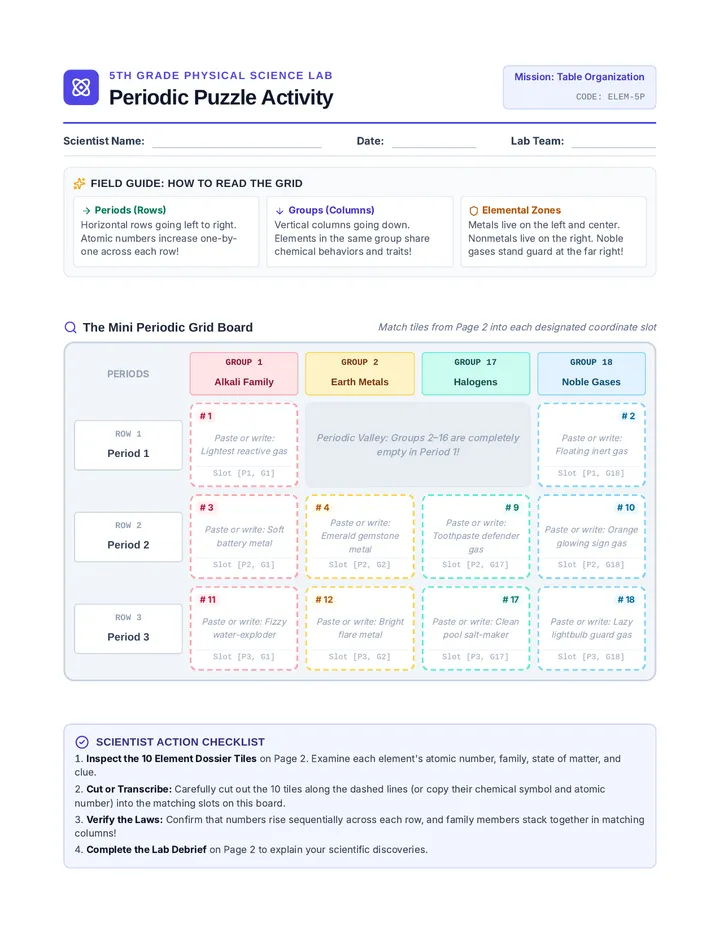
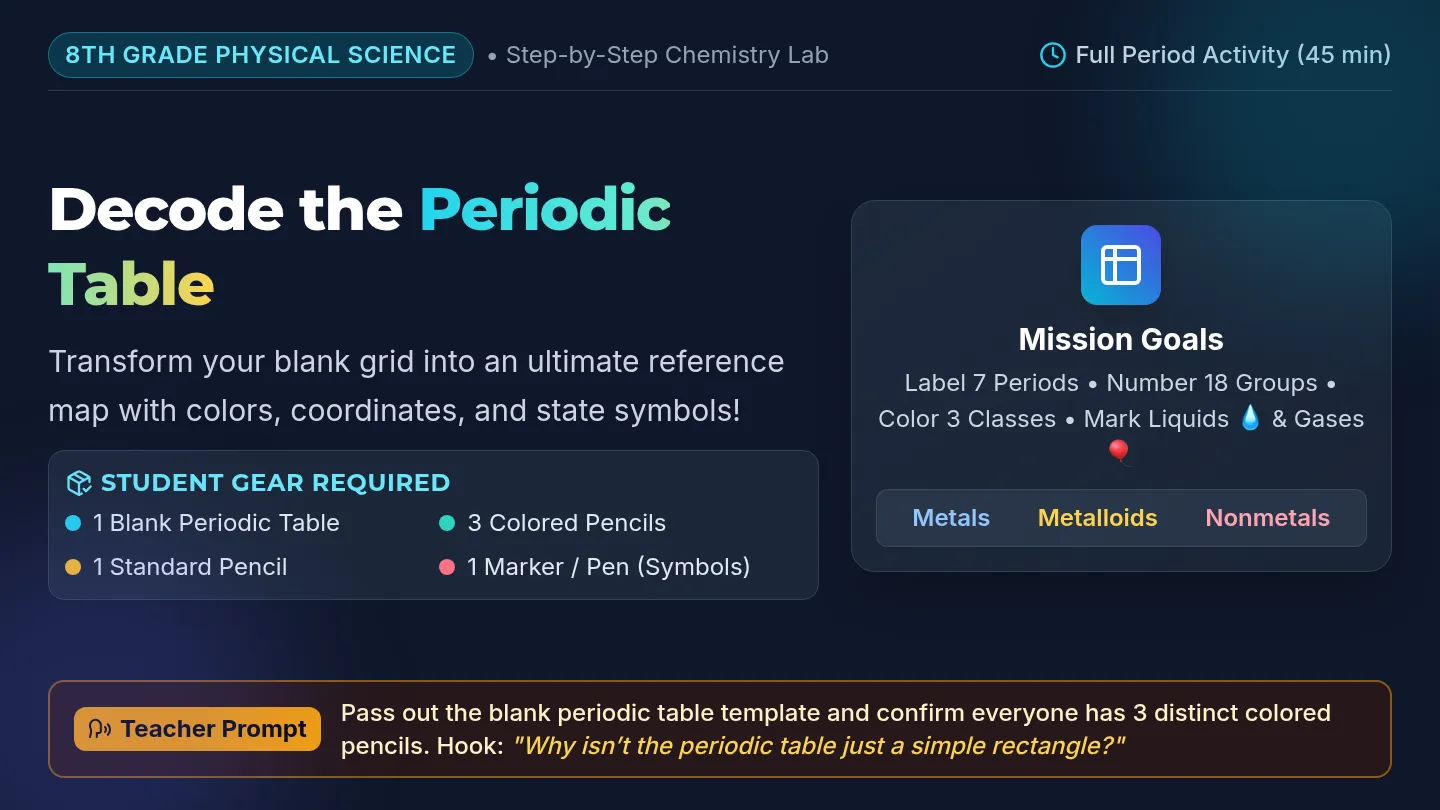
A bilingual (English/Spanish) unit exploring the structure and organization of the periodic table, focusing on atomic properties and element classification.
A comprehensive end-of-year review for 5th Grade NGSS science standards, organized by domain to ensure mastery of physical, life, and Earth sciences.
A comprehensive review of all 5th Grade NGSS Science standards, covering matter, ecosystems, Earth systems, and space science through vocabulary practice, graphic organizers, and critical thinking questions.
A comprehensive collection of core science units covering Environmental Science, Biology, and Physical Science. This sequence provides high-impact instructional slides, hands-on lab experiences, guided notes, and differentiated assessments for five major scientific domains.
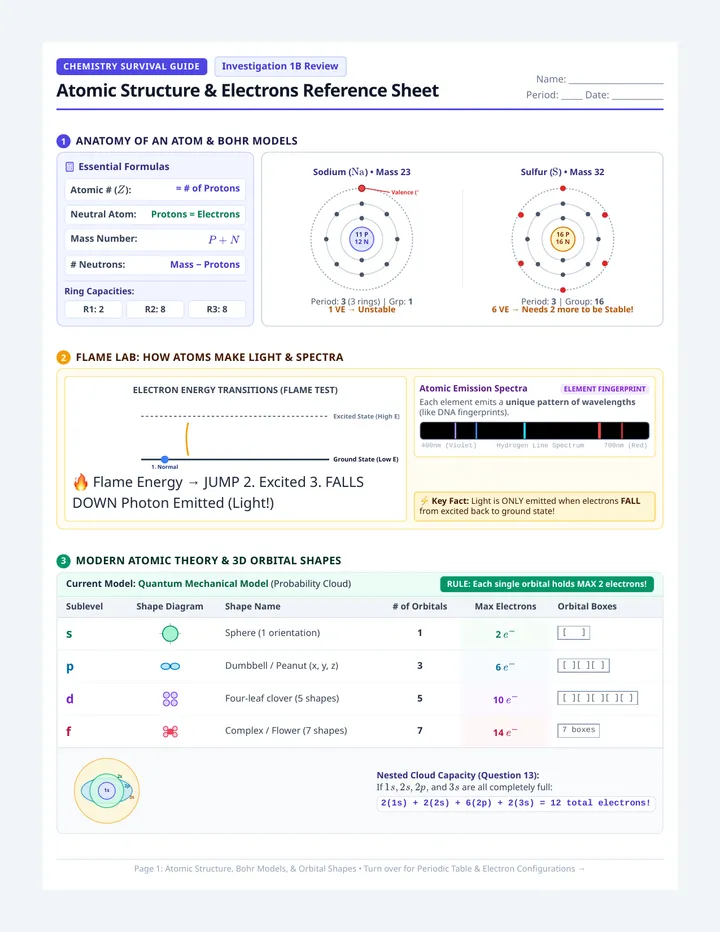
A series of lessons focused on mastering the structure of the atom, radioactive isotopes, and the organization of the periodic table.
An exploration of the building blocks of life, focusing on the structure, function, and chemical identification of biological macromolecules.
A comprehensive final summative project for high school seniors that transforms traditional case study research into a hands-on forensic investigation. Students analyze multiple evidence types including DNA, fingerprints, blood spatter, and toxicology to solve a complex cold case.
A comprehensive 42-day collection of class starters for an 8th-grade forensics course, covering foundations, physical evidence, biological evidence, and forensic reasoning.
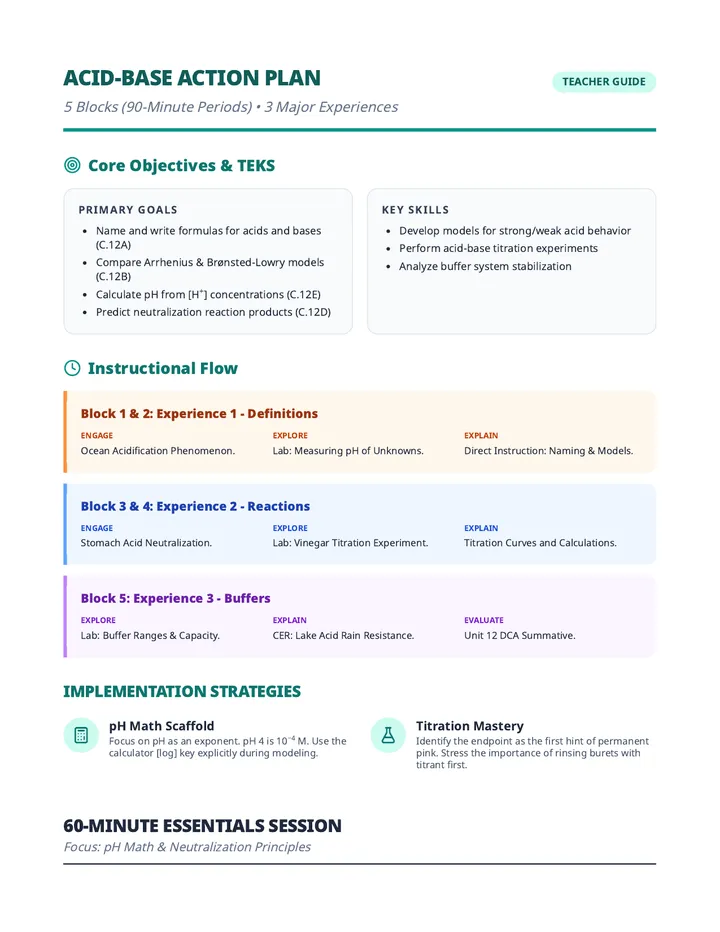
A comprehensive unit exploring the properties, reactions, and mathematical relationships of acids and bases, featuring pH calculations, titrations, and buffer systems.
A comprehensive review of organic chemistry and biochemistry topics including carbohydrates, carboxylic acids, esters, amines, amides, and proteins. This sequence prepares students for a final assessment through structured notes, visual organizers, and a full-length mock exam.
A specialized curriculum designed to prepare students for introductory chemistry laboratory examinations, focusing on practical applications, quantitative calculations, and organic structure identification.
A comprehensive review sequence covering chemical bonding, VSEPR theory, covalent nomenclature, and intermolecular forces. Includes a structured study guide, a visual slide deck, and a detailed answer key.
A two-week environmental science review sequence focusing on key takeaways: climate change, pollution, renewable energy, and biodiversity. Students compile a 'Field Dossier' review packet as a final course artifact.
A comprehensive review of foundational chemistry concepts including atomic structure, periodic trends, chemical bonding, and stoichiometry to prepare students for midterm assessments.
A comprehensive study sequence covering atomic structure, periodic trends, chemical bonding, and nomenclature to prepare students for chemistry assessments.
A comprehensive study and practice package for Chemistry 1406 Exam 2. It contains a highly structured, side-by-side strategy guide paired with a 30-question practice exam, and a matching detailed answer key with step-by-step rationales.
A comprehensive MCAS Chemistry preparation module containing a visual-heavy study guide, a high-structure test-taking checklist/reference sheet, and a detailed teacher answer guide.
A hands-on, highly engaging, low-cost end-of-year science unit designed for 6th-grade students of lower academic levels. It features simplified, visual step-by-step guides for independent, sensory-rich experiments exploring kitchen chemistry, forces, and density.
The master blueprint for the Molecular Threads Biology curriculum, featuring a comprehensive yearlong syllabus and a teacher reference guide for weaving biochemistry anchors into every unit.
A comprehensive, highly accommodated, and tiered assessment suite covering states of matter, atomic structure, classifications of matter, periodic table trends, ions, and ionic bonding with Coulomb's Law. Built-in diverse learner supports include visual organizers, sentence starters, 2-choice questions, and step-by-step guided calculations.
A comprehensive scientific investigation where students research, experiment, and analyze the chemical and environmental factors that contribute to creating the world's largest soap bubbles.
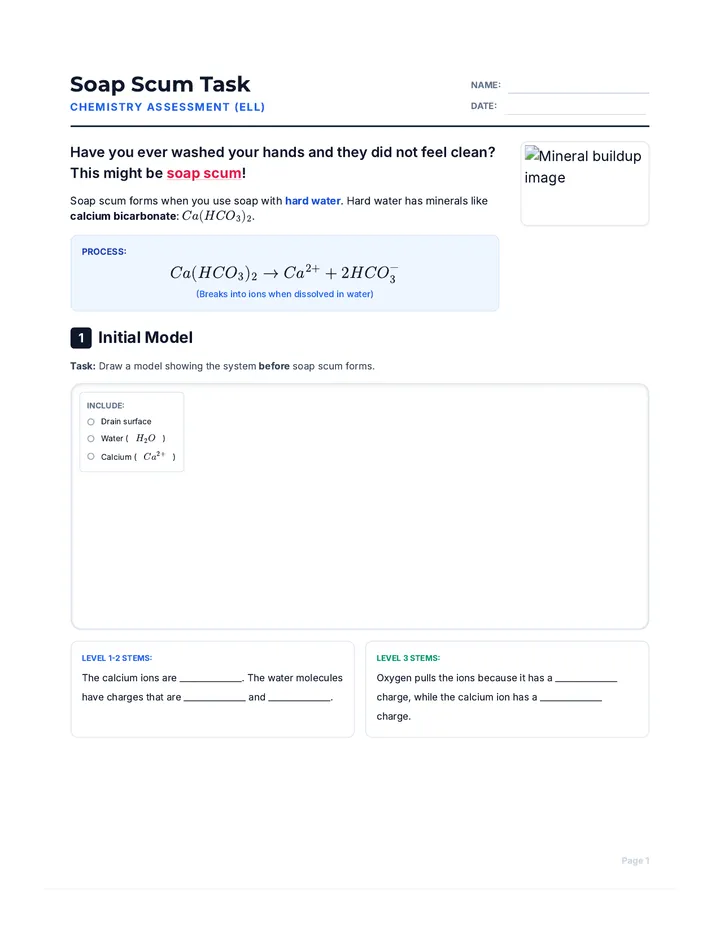
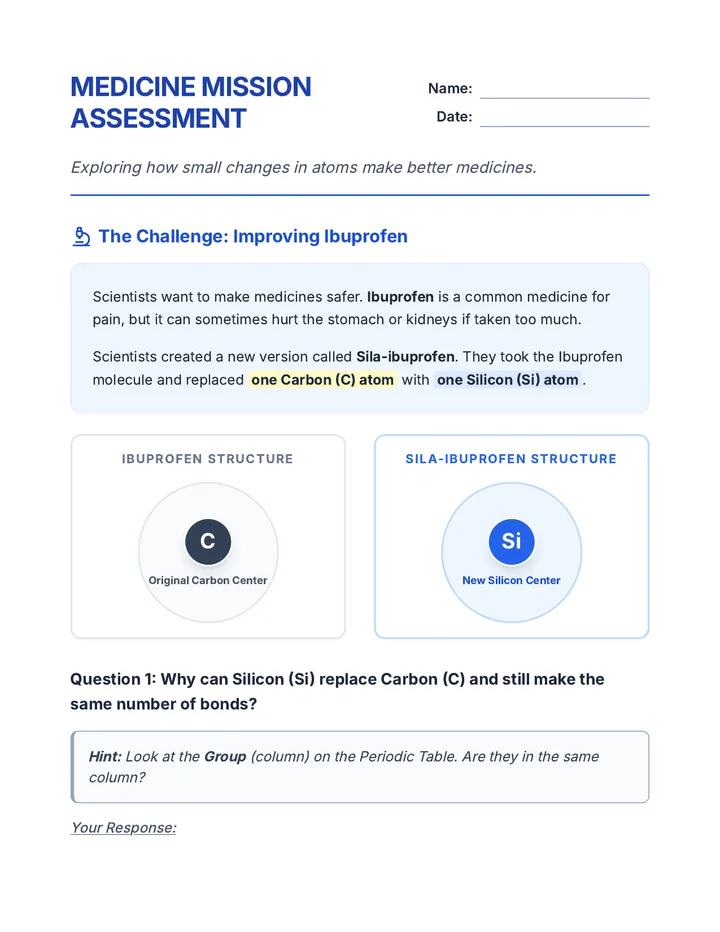
A modified-text lesson covering why elements react, the formation of cations and anions, and how ionic bonds are formed. Designed for lower reading levels with clear visuals and simplified language.
A comprehensive assessment on Indiana Biology standards focusing on homeostasis, levels of organization, and feedback loops, including ILEARN-style item types and CER responses.
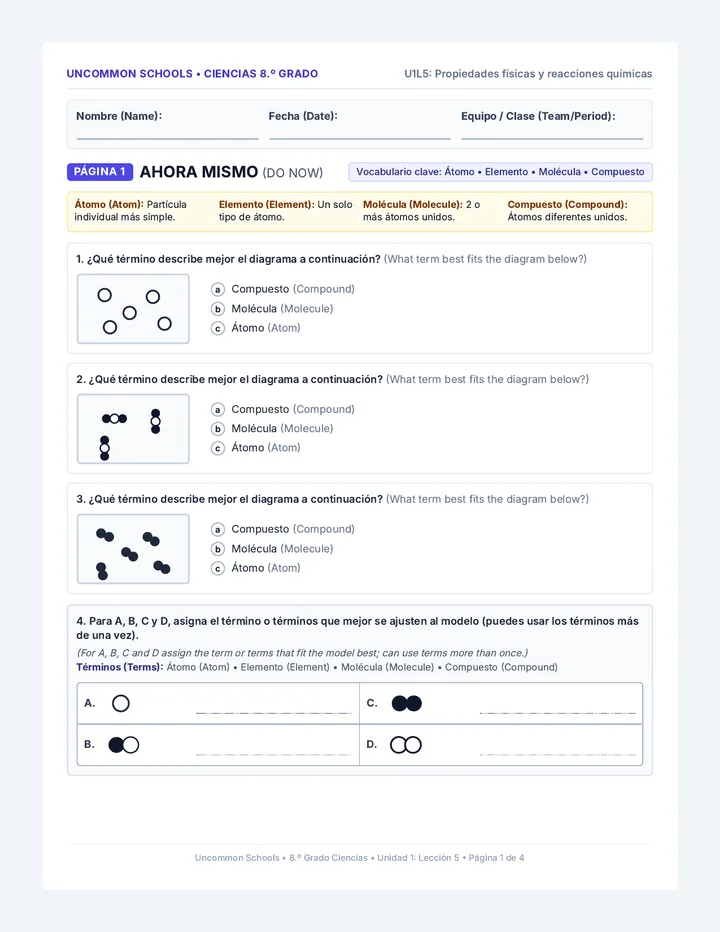
An introductory chemistry lesson based on Maya's discovery of atoms, bonds, and reactions, available in English and Spanish with hands-on practice.
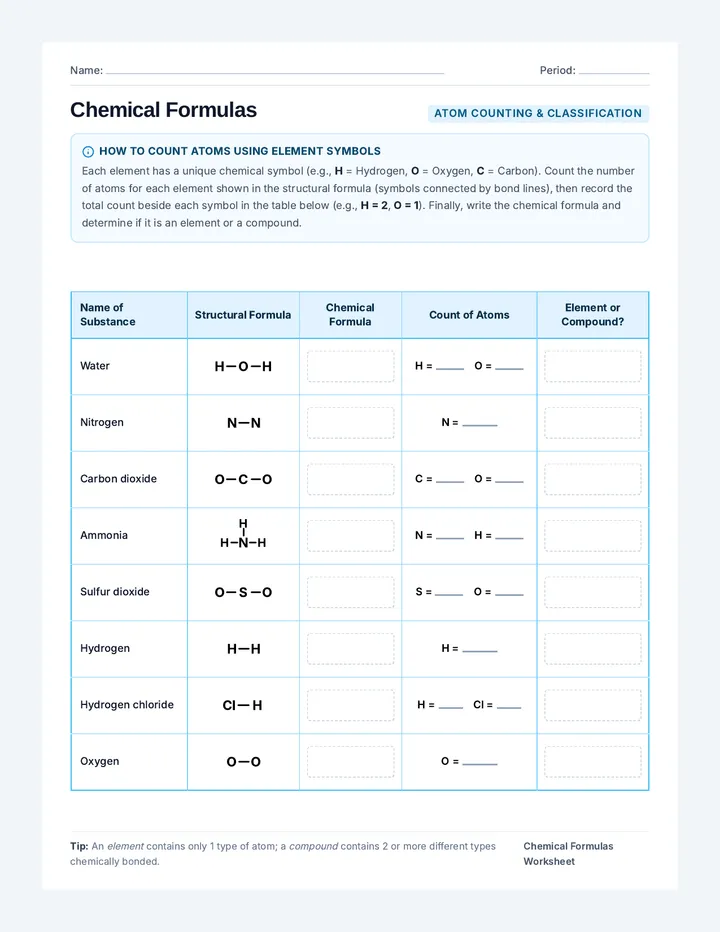
A comprehensive IPC chemistry final exam lesson covering counting atoms, bonding, reactions, and balancing equations. Includes the exam, student answer sheet, and teacher key.
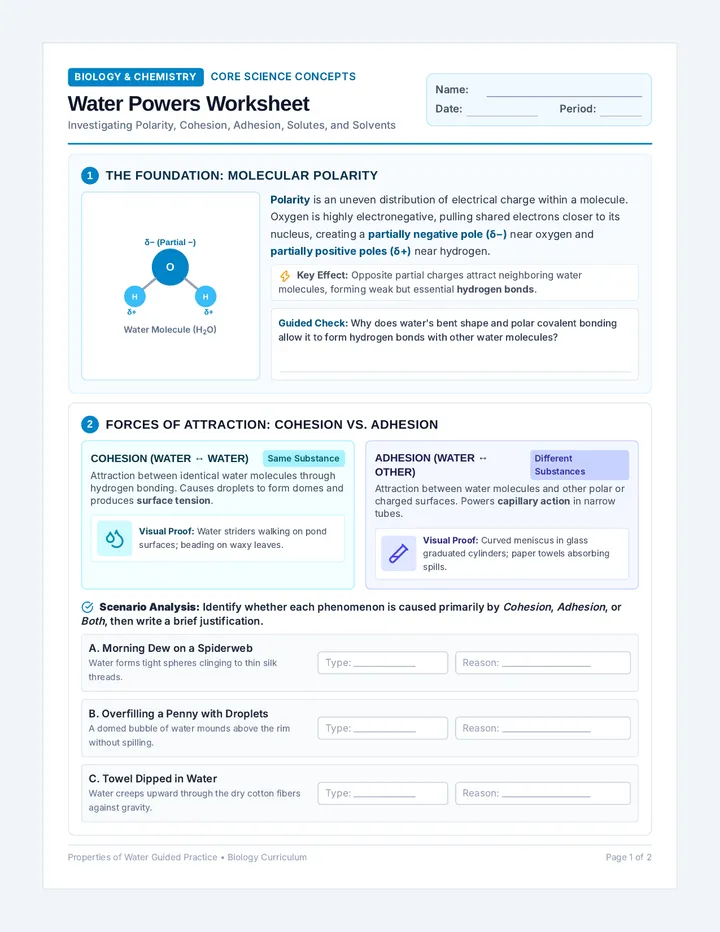
An introductory science lesson on surface tension where students conduct a hands-on experiment at home using coins, water, and soap to observe how molecules stick together.
A hands-on chemistry lab designed for students with intellectual disabilities to observe the oxidizing power of bleach through fabric discoloration. The lesson emphasizes lab safety and the chemical strength of household cleaners.
Comprehensive preparation unit covering chemistry fundamentals from Chapters 1 to 4, including scientific measurements, matter, energy, and atomic structure. Contains a parallel practice exam, a detailed study guide, and an answer key with worked solutions.
A high-stakes forensic science simulation where 7th-grade students analyze fingerprints, ink chromatography, and trace evidence to solve the theft of a high-tech robotics prototype. Students must synthesize multiple lines of evidence to narrow down four suspects to one culprit.
An investigation into force, motion, and friction, focusing on an author's use of evidence and the nuances of language.
A narrative exploration of the water cycle, focusing on character interaction, theme, and plot development within a scientific context.
An exploration of the law of conservation of mass through informational text, focusing on reading for details, main ideas, and relationships between concepts.
A comprehensive workshop where students explore the intersection of food science and environmental sustainability, focusing on food waste reduction and traditional preservation techniques.
A comprehensive post-exam project framework for Auburn High School AP students to conduct original research or engineering designs over four weeks, culminating in a professional poster fair.
Students compile all evidence, review suspect statements, and present their final verdict to solve the case.
The investigation moves to the lab to perform ink chromatography on the ransom note and compare results with suspect writing samples.
Detectives analyze physical evidence, focusing on fingerprint classification and handwriting analysis of a recovered ransom note.
Students are introduced to the crime scene, learn proper observation techniques, and create a scale sketch of the missing trophy's location.
An integrated math and science lesson where 4th graders use measurement, budgeting, and chemical property analysis to create and investigate custom slime.
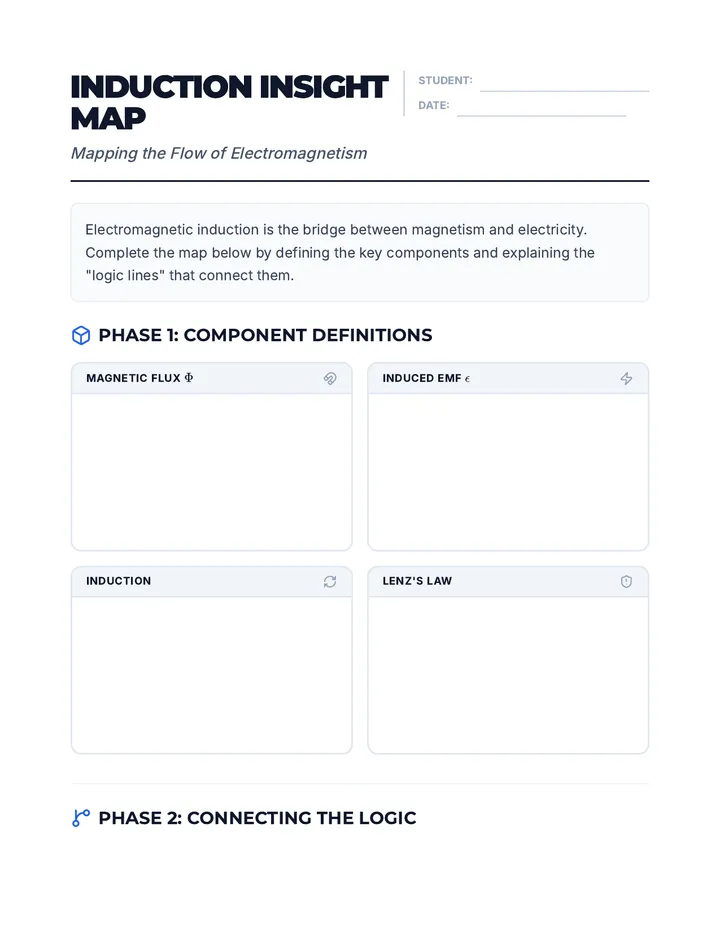
A 5-day intensive exploration of magnetic forces and fields, focusing on atomic-level causes, field interactions, and mathematical modeling of forces on charged particles. Students progress from anchoring phenomena to complex mathematical applications and a comprehensive unit review.
A comprehensive unit on chemical quantitative analysis, focusing on the mathematical foundations of chemistry through dimensional analysis, the mole concept, and stoichiometry.
A focused sequence on the mechanical process of dimensional analysis in chemistry, prioritizing algebraic substitution and grid-based problem-solving over real-world scenarios.
A comprehensive 5-day chemistry unit investigating the relationships between gas pressure, volume, temperature, and moles using lab inquiries, mathematical modeling, and real-world applications.
A 10-day exploration of the Behavior of Gases using Kinetic Molecular Theory, various gas laws, and real-world phenomena to understand gas behavior at both molecular and macroscopic scales. Students will investigate compressibility, gas variables, ideal behavior, and mixtures.
A comprehensive review of introductory chemistry lab concepts, including safety, measurement, atomic structure, bonding, and chemical reactions, based on midterm exam objectives.
A unit focused on the quantitative relationships in chemical reactions, covering everything from basic molar mass to complex limiting reactant and percent yield calculations.
A series of high-stakes science laboratory mysteries designed for middle school students. Each mystery focuses on a specific branch of science (Biology, Physics, Chemistry, Geology, Ecology) and uses 8 forensic clues to solve a case.
This sequence introduces 8th-grade students to atomic structure through historical models, subatomic particle properties, and isotope calculations. Students will use a blueprint-inspired approach to build, calculate, and analyze the fundamental building blocks of matter.
A comprehensive sequence for undergraduate chemistry students exploring the intersection of the Ideal Gas Law and stoichiometry, featuring real-world applications like airbag engineering and atmospheric science.
A comprehensive review of the states of matter and phase changes designed for diverse learners, featuring simplified text, visual aids, and structured graphic organizers.
A Star Wars-themed STEM lesson for 6th graders featuring high-impact, novel experiments. Students master the 'Dark Side' through optical invisibility (refraction index matching) and Force-sensitive magnetic slime (chemical polymerization).
A full-length practice exam mirroring the final's format, accompanied by a comprehensive step-by-step solution manual.
Detailed one-page study summaries covering the seven core pillars of introductory chemistry found in the final exam.
A comprehensive lesson on graphing and interpreting heating and cooling curves, focusing on phase changes and energy transfers.
A quantitative investigation into latent heat. Students use calorimetry data to calculate the enthalpy of fusion for ice and model the molecular-level energy transitions that occur during phase change plateaus.
A high-energy, station-based lesson where students investigate the thermodynamics of phase changes. Students analyze intermolecular forces to explain why melting is endothermic and freezing is exothermic, using evidence from heating curves and molecular models.
A review lesson focused on mastering chemical bonds, molecular geometry (VSEPR), and intermolecular forces (IMFs) through structured practice and visual instruction.
An inquiry-based lesson where students use the Predict-Observe-Explain (POE) cycle to discover and distinguish between London dispersion, dipole-dipole, and hydrogen bonding.
A matching 7-page detailed answer key with step-by-step explanatory rationales for all 30 practice exam questions. Highlights correct option letters and breaks down calculations, stoichiometry mole-ratios, balanced chemical equations, and solubility rules for easy self-study or teacher facilitation with enlarged, highly readable black typography.
A highly structured side-by-side study companion and practice exam with enlarged, highly readable black typography. Pairs condensed high-yield summary tables, formula maps, and rules in the left column directly with a 30-question practice exam in the right column across 7 beautifully spaced pages.
A 10-slide review presentation covering the core concepts of the Internal Systems unit. Topics include biological levels of organization, feedback loop components, atomic foundations of macromolecules, enzyme kinetics, and CER strategies for case study analysis. Designed with a clean, clinical aesthetic and high-visibility text.
A fully realized 32-item Biology assessment focusing on Indiana standards for homeostasis and macromolecules. Every question is individually authored, covering atoms, enzymes, and cell transport. Part V includes two extended reading case studies with integrated data for high-rigor CER synthesis. No placeholders used.
Answer key for the Advanced Internal Systems Biology Assessment. Features standard-aligned summaries, DOK levels, and comprehensive CER scoring rubrics for high-level data analysis scenarios. All 30 items included. Column headers standardized. CER reasoning sections are properly formatted to stay on one page.
Complete answer key for the Advanced Internal Systems Biology Assessment. Features standard-aligned summaries, DOK levels, and comprehensive CER scoring rubrics for high-level data analysis scenarios. CER reasoning sections are properly formatted to stay on one page. All 30 items included. Column headers standardized.
A rigorous 30-item Biology assessment with a focus on higher-order thinking (DOK 2-3). Features multi-page layout optimization for print efficiency, fully authored distractors for all questions, and polished data visualizations with legends. CER response areas now include writing lines. Section numbering fixed.
Complete answer key for the advanced 32-item Biology assessment. Features detailed rubrics for the extended CER case studies and a contiguous crosswalk of all questions, ensuring full matching with the student test version.
A fully realized 30-item Biology assessment focusing on Indiana standards for homeostasis and macromolecules. It features a majority of DOK 2 and 3 questions, authored contiguously. Part V includes extended reading passages (case studies) with integrated data for high-rigor CER synthesis.
Updated interview transcripts for five suspects, adding Secretary Sarah and IT Ian to the investigation. Includes structured student response areas and a teacher answer key for motive analysis. Optimized for 7th-grade readability and print continuity across three 8.5x11 pages.
The final answer key and solution guide for the teacher, updated for the 5-suspect roster. Details Coach Miller as the culprit and provide a clear elimination rationale for Carl, Peters, Sarah, and Ian. Optimized for single-page 8.5x11 printing.
Final assessment document where student groups synthesize all evidence to name their primary suspect. Includes sections for justifying the accusation with physical, chemical, and motive-based reasoning. Optimized to fit perfectly on a single 8.5x11 page with an accompanying teacher guide.