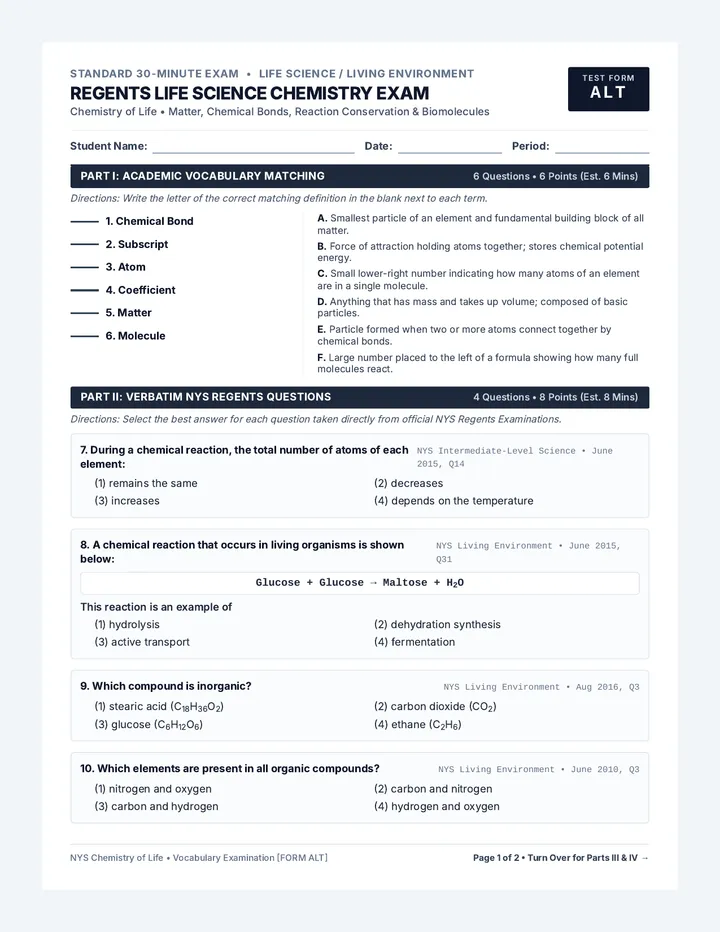
Chemistry Detective Worksheet ENChemistry Detective Maya Discovers the Secrets of Chemistry Name: Date: Part 1: The Science Classroom Maya walked into her IPC science class feeling nervous. Her teacher, Mr. Hernandez, had beakers around the room. “Maya,” he said, “today you will become a chemistry detective.” Mr. Hernandez laughed. “Chemistry explains how things change and why substances react.” Part 2: Counting Atoms Mr. Hernandez wrote H2O on the board. He explained that the small number is a subscript. H2 means 2 hydrogen atoms. Maya practiced counting atoms in compounds like CO2 (1 carbon, 2 oxygen) and C6H12O6. Chemistry was like solving puzzles. Part 3: Chemical Bonding The teacher explained chemical bonding. Ionic bonds happen when electrons are transferred. Covalent bonds happen when electrons are shared. Maya learned that sodium and chlorine combine to make salt (Na + Cl → NaCl), and hydrogen and oxygen share electrons to form water. Part 4: Balancing Chemical Equations Mr. Hernandez wrote: H2 + O2 → H2O. “This equation is not balanced,” he explained. Maya counted the atoms. Together they balanced it: 2H2 + O2 → 2H2O. Maya understood that matter cannot disappear during a chemical reaction. Part 5: Chemical Reactions Everywhere At the end of class, the students mixed vinegar and baking soda. Bubbles formed! Mr. Hernandez explained signs: color change, gas production, temperature change, and a new substance. Maya whispered, “Chemistry is everywhere.” Vocabulary / Vocabulario Subscript: Subíndice Ionic: Iónico Covalent: Covalente Bond: Enlace Balanced: Balanceado Reaction: Reacción Matter: Materia Compound: Compuesto Comprehension Questions 1. Who was Maya’s teacher and how did she feel at first? 2. What is a subscript and what does it tell you about H2O? 3. Explain the difference between Ionic and Covalent bonds. Chemistry Practice Oxygen atoms in CO2: Is Na + Cl → NaCl balanced? Vocabulary Matching A. Atom B. Ionic Bond C. Covalent Bond D. Reaction Sharing electrons Smallest unit of matter Rearranging into new substances Transfer of electrons
Detective de Química Hoja de Trabajo ESDetective de Química Maya Descubre los Secretos de la Química Nombre: Fecha: Parte 1: El Salón de Ciencias Maya entró a su clase de ciencias IPC sintiéndose nerviosa. Su maestro, el Sr. Hernández, había colocado vasos de laboratorio por el salón. “¡Maya!”, dijo él, “hoy te convertirás en una detective de química”. El Sr. Hernández se rio. “La química explica cómo cambian las cosas y por qué reaccionan las sustancias”. Parte 2: Contando Átomos El Sr. Hernández escribió H2O en el pizarrón. Explicó que el número pequeño es un subíndice. H2 significa 2 átomos de hidrógeno. Maya practicó contando átomos en compuestos como CO2 (1 carbono, 2 oxígenos) y C6H12O6. La química era como resolver rompecabezas. Parte 3: Enlaces Químicos El maestro explicó los enlaces químicos. Los enlaces iónicos ocurren cuando se transfieren electrones. Los enlaces covalentes ocurren cuando se comparten electrones. Maya aprendió que el sodio y el cloro se combinan para formar sal (Na + Cl → NaCl). Parte 4: Balanceando Ecuaciones Luego, el Sr. Hernández escribió: H2 + O2 → H2O. “Esta ecuación no está balanceada”, explicó. Maya contó los átomos. Juntos balancearon la ecuación: 2H2 + O2 → 2H2O. Ella entendió que la materia no desaparece. Parte 5: Reacciones en Todas Partes Al final de la clase, los estudiantes mezclaron vinagre y bicarbonato. ¡Rápidamente se formaron burbujas! Maya gritó emocionada. El Sr. Hernández explicó las señales: cambio de color, gas, temperatura y sustancias nuevas. Maya susurró: “La química está en todas partes”. Preguntas de Comprensión 1. ¿Quién era el maestro de Maya y cómo se sintió ella al principio? 2. ¿Qué es un subíndice y qué indica sobre el H2O? 3. Explica la diferencia entre enlaces Iónicos y Covalentes. Práctica de Química Átomos de oxígeno en CO2: ¿Está balanceado Na + Cl → NaCl? Relación de Conceptos A. Átomo B. Enlace Iónico C. Enlace Covalente D. Reacción Compartir electrones Unidad más pequeña de materia Reordenamiento en nuevas sustancias Transferencia de electrones
Chemistry Lab Practice English Spanish KeyLab Skills Mastery Chemical Formulas & Equations Practice Name: Date: The Story / La Historia Maya looked at H2O and CO2 on the board. Mr. Hernandez explained: "The small number is a subscript. It tells us how many atoms are inside." Later, they mixed vinegar and baking soda. Foam overflowed! "A chemical reaction!" Maya yelled. Matter cannot disappear; we balance equations to show the truth. Maya observó el H2O y el CO2 en el pizarrón. El Sr. Hernández explicó: "El número pequeño es un subíndice". Luego, mezclaron vinagre y bicarbonato. ¡La espuma se desbordó! "¡Una reacción química!". La materia no desaparece; balanceamos ecuaciones. Science Vocabulary Key / Clave de Vocabulario Atom / Átomo Bond / Enlace Matter / Materia Subscript / Subíndice Reactant / Reactivo Product / Producto Balanced / Balanceado Reaction / Reacción Compound / Compuesto 1 Atom Counting CO2 Carbon: Oxygen: NaCl Sodium (Na): Chlorine (Cl): 2 Balancing Table EquationCount (L / R)Balanced?H2 + O2 → H2OH:__ O:__H:__ O:__[ ] YES [ ] NO | | 2H2 + O2 → 2H2O | H:__ O:__ H:__ O:__ | [ ] YES [ ] NO | | C + O2 → CO2 | C:__ O:__ C:__ O:__ | [ ] YES [ ] NO | | Mg + O2 → MgO | Mg:__ O:__ Mg:__ O:__ | [ ] YES [ ] NO | Critical Thinking / Pensamiento Crítico Maya observed the vinegar and baking soda reaction. What signs did she see? / ¿Qué señales de reacción observó Maya?
Chemistry Master Answer KeyMaster Answer Key Chemistry Detective & Lab Mastery Set Teacher Reference 1. Story Comprehension (EN / ES) 1. Teacher/Feel: Mr. Hernandez / Nervous 2. Subscript: Number of atoms in molecule 3. H2O Sub: 2 atoms of Hydrogen 4. CO2 Sub: 2 atoms of Oxygen 5. Bonding types: Ionic / Covalent 6. Reaction Signs: Bubbles, Color, Temp change A. Atom - 2 B. Ionic - 4 C. Covalent - 1 D. Reaction - 3 2. Lab Practice Answers CO2: Oxygen: 2 NaCl: Sodium: 1 EquationBalanced?H2 + O2 → H2ONo2H2 + O2 → 2H2OYesC + O2 → CO2YesMg + O2 → MgONo Sample Critical Thinking Response: "Maya observed gas production (bubbles and foam). This proved a chemical reaction was occurring between the vinegar and baking soda, forming CO2. Matter was rearranged into new substances."