Ideation frameworks, business planning structures, and startup financial modeling. Strengthens skills in concept validation, market strategy, and capital management.
A year-long, self-paced entrepreneurship curriculum spanning September to May for alternative education students in work-study placements. Students transform real-world work experience into a modular business plan and slide presentation.
A comprehensive sequence focused on mastering business presentation skills and understanding company valuation for a professional audience.
Students learn to use digital tools to organize, compare, and analyze market data using advanced spreadsheet techniques like formulas, sorting, and filtering.
A 10-day project-based learning unit integrating 4th grade Math (multiplication/division) and Science (photosynthesis/life cycles). Students choose between designing a community garden or creating a garden business plan, applying their knowledge of plant systems to real-world calculations.
A comprehensive 5-day unit on payroll accounting, covering gross pay calculations, tax deductions, and employer-provided benefits through real-world business scenarios.
A comprehensive exploration of the hospitality and tourism industry, covering hotel management, culinary arts, event planning, and marketing through the lens of professional excellence.
A 40-lesson 6th-grade introductory computer skills course that guides students from initial business ideas through financial budgeting, marketing campaigns, and a final investor pitch. Focuses on word processing, spreadsheets, digital media, and presentation skills.
An industrial engineering-focused sequence for 11th-grade physics investigating how physical properties (density, magnetism, conductivity) dictate large-scale separation methods in recycling, mining, and environmental cleanup. Students analyze the physics of centrifuges, eddy currents, and the economic trade-offs of engineering design.
A project-based sequence for 4th graders exploring the intersection of geological science, engineering, and economics. Students investigate the properties of rocks and minerals, simulate mining operations, and apply material science to civil engineering proposals.
This 4th-grade sequence explores the economic and environmental complexities of mineral extraction. Through simulation and case studies, students learn how natural resources are turned into products, the physical impact of mining on the landscape, and strategies for land restoration and conservation.
A rigorous graduate-level sequence on normative decision theory, covering decision trees, utility theory, Value of Information (VoI), and sensitivity analysis for strategic organizational decision-making.
A graduate-level engineering sequence focusing on the lifecycle management, scalability, and reproducibility of AI systems using MLOps practices. Students transition from notebook-based research to production-grade engineering, covering containerization, data versioning, orchestration, and scalable serving.
An engaging, hands-on summer camp series for grades 3-5 focusing on teamwork, STEM, gardening, healthy living, and creative problem-solving. This lesson includes a comprehensive multi-day student workbook and a showcase presentation preparation kit.
A modular, self-paced entrepreneurship project designed for alternative education students in work-study programs. It bridges real-world work experience with business planning, allowing students to design and pitch their own mock business.
A high school introduction to business lesson exploring the journeys of historical young entrepreneurs who defied the odds. Students conduct an internet scavenger hunt to investigate their startup strategies, financial hurdles, and marketing breakthroughs.
An immersive entrepreneurship lesson where students become 'venture detectives' to investigate local businesses, analyzing how they started, their revenue streams, and their growth strategies.
A digital design lesson focusing on social media brand personas, digital footprint, and visual design aesthetics using Adobe and Canva. Students compare contrasting brand voices, from Wendy's playful roasts to polished professional corporate presences.
A dynamic, video-driven exploration of modern entrepreneurship for high schoolers. Students analyze real-world case studies and founder interviews, then plan and pitch their own mini-business ventures using a structured, practical blueprint.
This lesson covers the design and purpose of a marketing plan, focusing on customer analysis, market analysis, and the marketing mix. Students will evaluate competition across diverse industries and practice ESB-style assessment questions.
Explore the process of identifying problems and developing innovative solutions, culminating in an elevator pitch for a new business idea.
Discover the characteristics of an entrepreneur, the importance of a growth mindset, and the balance between risk and reward.
This lesson concludes the unit on business presentation skills and company valuation, testing students on the FIT model, the Rule of Three, and core financial assessment concepts.
A comprehensive review of the unit's key concepts followed by a summative assessment to measure student understanding.
Peek inside the internal departments of a company to understand how functions like Marketing, Finance, and HR work together.
A high-energy, collaborative introductory lesson on entrepreneurship where students become 'Origin Hunters,' investigating the real-world, messy, and inspiring starting points of famous household brands.
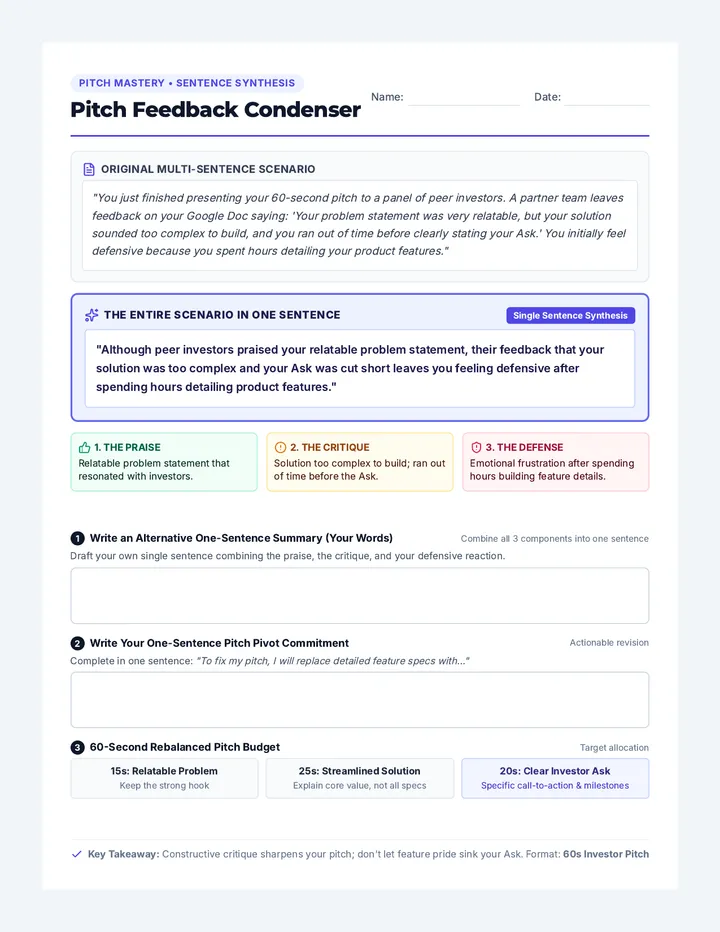
Craft a persuasive business pitch and deliver/review startup presentations to simulate a real-world investor round.
Deconstruct business model basics and complete a streamlined Lean Canvas for a student-led venture concept.
Explore the entrepreneurial mindset, identify real-world problems, and brainstorm innovative startup solutions.
Synthesizing presentation skills and valuation concepts to deliver high-stakes shareholder or capital market pitches.
Understanding the components of business worth, including tangible assets, intangible assets, and core profitability metrics like EBIT.
Techniques for making information stick using stories, analogies, and the WIIFM principle.
Introduction to the Rule of Three and the FIT model for organizing and delivering effective business presentations.
A playful showcase preparation kit for Day 9. Includes a printable speaking practice dashboard, cut-out presentation rehearsal cards, a table setup checklist, a foldable nameplate, and a parent guest feedback collector.
An interactive and playful multi-day student workbook for Grades 3-5 campers. Includes structured daily templates, creative design challenges, and expanded drawing canvases aligned with the 4-H Learn by Doing camp curriculum.
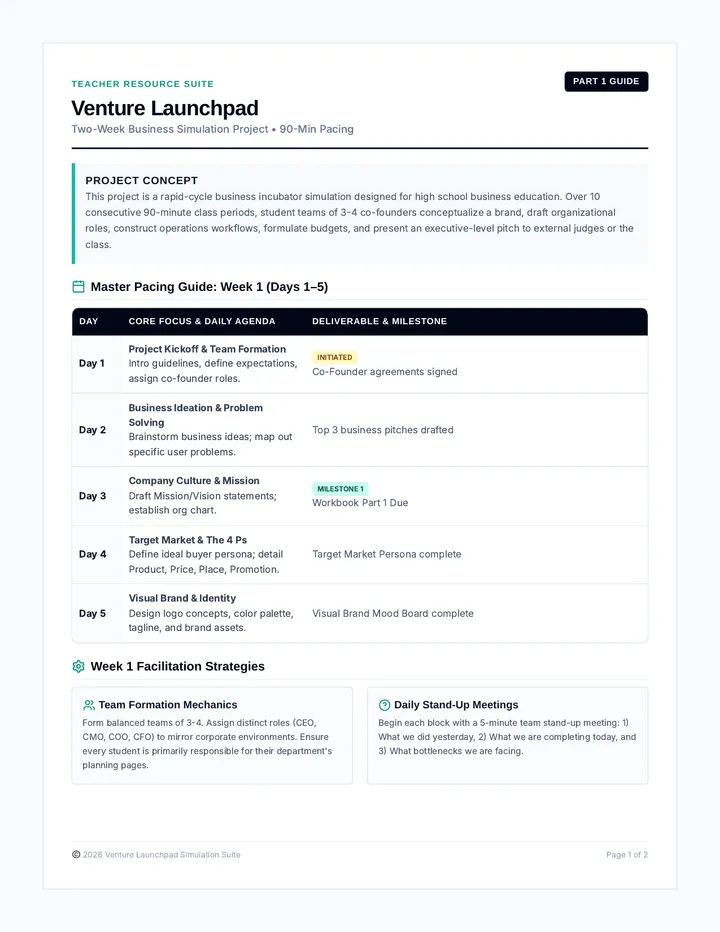
A 2-page teacher-facing facilitation guide and grading rubric. It details an 8-week implementation timeline, guidance for integrating work-study observations, and a comprehensive rubrics grid for evaluating student portfolios and pitches.
A 5-slide presentation template designed for alternative education students to pitch their entrepreneurial ideas. It provides visual structured layouts for defining their work-study observations, solution, target audience, startup costs, and elevator pitch.
A 2-page document containing 8 printable, progressive weekly task cards designed for self-paced progress during independent work-study hours. Each card provides actionable business prompts, reflection activities, and real-world tie-ins to guide students' entrepreneurial projects.
A 2-page workspace guide: Page 1 outlines the 4 pillars to draft a 60-second elevator pitch script; Page 2 provides a peer-evaluation scorecard for the Shark Tank-style Venture Forum.
Visual slides that guide students on structuring a pitch, delivering with impact, and presenting their business model to investors.
A visual, structured Lean Canvas template that allows students to map out all 9 key segments of their business model on a single print-ready sheet.
An interactive project workbook for students to define their startup concept, outline their target customer personas, define their unique value proposition, and map competitor solutions.
Engaging case studies of pioneering modern entrepreneurs—Melanie Perkins (Canva) and Tristan Walker (Walker & Co)—with visual comprehension and analytical mapping questions.
A visual note-taking worksheet designed to accompany the Venture Spark slides, prompting students to fill in key entrepreneurial concepts and record their initial 'Friction Hunter' business ideas.
Interactive lecture slides introducing the entrepreneurial mindset, the core traits of successful innovators, and the importance of solving real-world problems.
A multi-day entrepreneurship sequence that guides high school students through developing an entrepreneurial mindset, designing a business model, and pitching their own startup concepts.
A comprehensive 7-day introduction to business and entrepreneurship. Students explore foundations, economic principles, ownership models, internal structures, and the mindset and process needed to launch a new business idea.
A two-part technology sequence for Primary 3 students exploring the dual nature of technology and the engineering design process for creating helpful inventions.
A 5-6 week capstone project framework for Grade 10 Exploring Technology, focusing on a Minimum Viable Product (MVP) approach and weekly engineering milestones.
A comprehensive unit focused on the digital launch of marketing campaigns, bridging the gap between design and messaging to create persuasive online presences.
A unit focused on the visual principles of brand identity, moving from theory (color, type) to creation using vector-based tools like Google Drawing.
A comprehensive identity design unit where students explore the psychological and visual elements of branding, including color theory, typography, and logo composition.
A project-based learning unit where high school students design and market a new hospitality venture, from initial concept to a full marketing campaign and presentation.