Mechanical and electrical engineering fundamentals combined with machine learning, robotics, and CAD design. Examines AI ethics and systems thinking within the context of modern technical problem-solving.
The complete 8-day camp program containing the comprehensive Teacher Manual, printable Challenge Task Cards, and the daily Student Camp Journal.
A 2-day hands-on STEM engineering challenge where 3rd-grade students design, build, and test index card bridges to explore balanced and unbalanced forces, gravity, and load-bearing structures.
An engineering design challenge where students design, prototype, and test an insulated cup to keep water cold. Emphasizes thermal energy transfer, materials science properties, the engineering process, and data analysis.
An engaging, hands-on physics and engineering lesson where students design, build, and test protective landing craft for fragile payloads (eggs), exploring forces, deceleration, and structural integrity.
An engineering design challenge where students design, prototype, and test magnet mazes, exploring how different backing materials block or allow magnetic forces to pass through.
A rigorous STEM project combining structural engineering with advanced mathematics. Students design, budget, build, and test spaghetti bridges using ratios, proportions, cost-efficiency metrics, quadratic modeling, and catenary curves.
Students explore the engineering wonders of bird nests, observing local bird behavior and designing their own nest models using natural materials to understand animal adaptations and structural design.
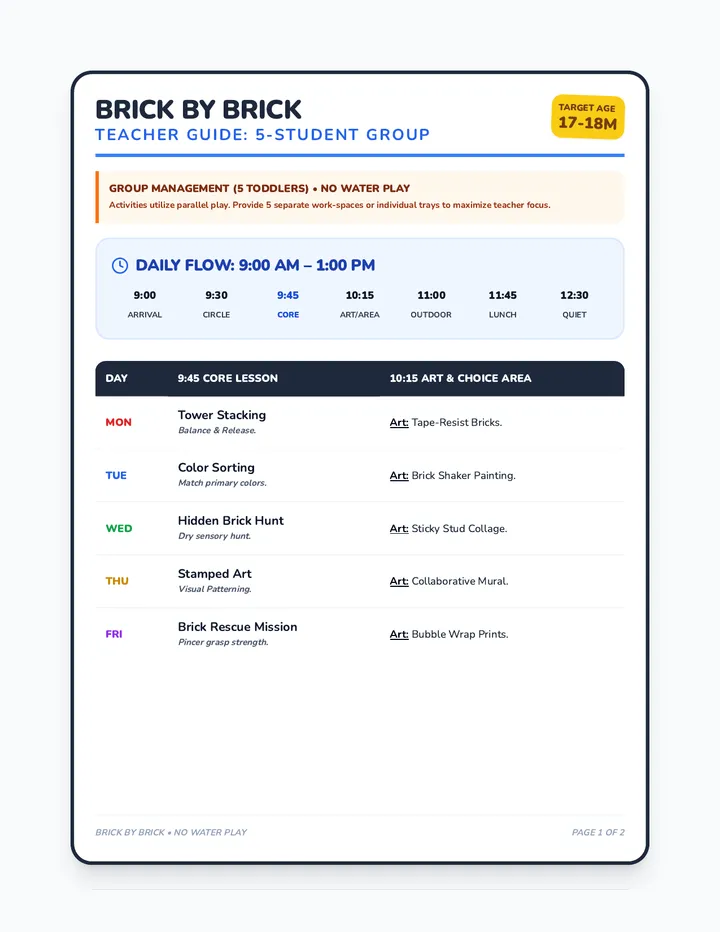
Challenges toddlers to use their problem-solving skills to 'rescue' bricks from different materials like tape or playdough, enhancing finger strength.
Uses bricks as unconventional tools for artistic expression. Toddlers learn about shapes and patterns through stamping and paint exploration.
A dry sensory experience where toddlers search for bricks hidden among soft materials. Focuses on tactile exploration and object permanence.
Introduces basic color identification using primary colored bricks. Toddlers explore grouping and matching in a low-pressure, playful environment.
Focuses on the fundamental skill of vertical stacking and the concept of balance. Toddlers practice grasp and release while building coordination.
A scaffolded 2-page student worksheet bundle featuring a problem brainstorming section, a large sketching space, step-by-step 3D paper-folding visual instructions, and dash-bordered labels to write, cut, and paste onto their paper prototypes.
Interactive presentation slides to introduce the design thinking concept, spot everyday problems at home/school/shop, and guide Primary 3 students in using 3D paper folding techniques to build their prototypes.
A black and white print-friendly single-page teacher-facing grading rubric containing a 4-tiered criteria grid mapping directly to the student milestones, combined with a manual evaluator profile and structured feedback boxes.
A black and white print-friendly 5-page student design booklet with name lines, materials checklists, drawing studio boxes, milestone timelines, and evaluation prompts.
A detailed teacher's guide updated to remove dark backgrounds while keeping a clean, professional academic layout. Corrected font sizing to 12pt equivalent (16px) and improved observation area for teacher notes. Corrected text contrast for accessibility. Font family updated to Serif.
A visually striking presentation updated to ensure strict slide containment, improved contrast, and a dedicated blank drafting zone for the biotechnology cloning project. Use of Serif font family as requested.
A comprehensive 4-page student research packet updated to remove dark backgrounds while maintaining professional branding and academic layout. Corrected font sizing to 12pt equivalent (16px) and improved overall contrast.
The final reflective essay prompt for the unit, asking students to synthesize their learning and explain the importance of intentional housing design in the human services field.
A student advocacy worksheet for creating a community action plan, encouraging students to apply their housing design knowledge to real-world school or home sustainability changes.
Slides for the Reflection and Connections lesson, focusing on local green building examples and guiding students toward community advocacy and final reflection.
A teacher guide for the final lesson of the Housing and Interior Design unit, focusing on real-world local applications, student advocacy, and final reflective synthesis.
A peer feedback sheet for the Design Challenge presentations, using the 'Glow and Grow' format to encourage constructive evaluation among student firms.
A professional infographic for the College of Computer Science and Engineering, Batch 47. Features a vertical strip layout with technical icons and "Prince Sattam University" branding. Includes study duration, major descriptions, and student availability for both genders. Optimized for A4 printing.
Answer key for the Signal Scout Worksheet, providing correct binary codes, path mapping descriptions, and the decoded image pattern.
A hands-on student worksheet covering the encoding, transmission (wires vs. air), and decoding stages of digital communication, featuring binary puzzles and path mapping.
A master answer key and teacher resource for the "Power Up Vocabulary" worksheet set.
An engineering-themed analysis activity where students describe the structure and function of a battery and draft a circuit system blueprint.
A tactile cut-and-paste vocabulary activity for 4th graders to match definitions to science terms like system, energy, function, and structure.
A sentence completion and context clues worksheet for 4th-grade students to practice using science vocabulary in the context of energy transfer and circuits.
A vocabulary worksheet for 4th graders featuring matching and word box exercises focused on energy, system, function, and structure.
A structured review resource covering essential concepts for the CompTIA A+ Core 1 and Core 2 exams, including network ports, command-line references, the 6-step troubleshooting methodology, detailed hardware diagrams, and BIOS/UEFI configuration settings.
The official answer key and scoring guide for the CompTIA A+ Comprehensive Exam. Includes rationales for multiple-choice answers and a multi-point rubric for grading performance-based scenario responses.
A comprehensive 40-question multiple choice and 5 performance-based question exam covering both CompTIA A+ Core 1 and Core 2 domains. Designed to simulate the rigor and scenario-based nature of the actual certification exam.
A comprehensive teacher's guide for the Power Paths lesson, including a pacing guide, shop equipment list, discussion prompts, and troubleshooting tips for teaching electrical circuits.
A 3-day cross-curricular STEAM unit where students research biological adaptations, design biomimetic engineering solutions, perform scale calculations, and write a synthesized informational article.
An introductory unit on Housing and Interior Design within the Human Services field. Students explore basic housing needs, sustainable green building, universal design for accessibility, the impact of local resources and climate on home construction, and residential energy efficiency.
A comprehensive unit focused on the digital launch of marketing campaigns, bridging the gap between design and messaging to create persuasive online presences.
A comprehensive Hi-Lo unit for 6th graders exploring the scale of the universe, our place in the Milky Way, the technology used to explore space, and the history of human spaceflight.
A comprehensive technical course on reading and interpreting commercial HVAC mechanical blueprints, focusing on symbol recognition, duct sizing, and system layout analysis.
A graduate-level exploration of sustainable set design, focusing on ecoscenography, material science, modular engineering, and digital fabrication to move the theater industry toward a circular economy.
A graduate-level sequence exploring the intersection of structural engineering, physics, and project management in theatrical technical direction. Students master load calculations, CAD for fabrication, automation mechanics, budgeting, and rigging safety.
A comprehensive 6th-grade engineering sequence exploring how geometric properties like triangulation, tessellation, and symmetry contribute to structural stability and architectural strength.
A project-based sequence where 4th-grade students learn the fundamentals of vector illustration and user interface design to create their own mobile app mockup. Students progress from basic shape manipulation to high-fidelity digital prototyping and user testing.
A comprehensive 8th-grade sequence on digital image manipulation and UI design, covering raster editing, ethics, visual hierarchy, and app prototyping. Students progress from basic compositing to creating high-fidelity interface mockups.
A Kindergarten sequence introducing digital design through geometric shapes. Students learn to manipulate, layer, and repeat shapes to create complex scenes like robots and cities.
A project-based sequence for 11th-grade students to learn the science and engineering behind Contingency Management Systems, moving from operational definitions to a full prototype pitch.
A hands-on STEM lesson where students design, build, and launch water bottle rockets. They apply Newton's Laws of Motion to optimize force, mass, and aerodynamics for maximum flight distance.
An inquiry-based science lesson where third graders engineer custom soil mixtures, test properties like absorbency, and explore global soil origins and characteristics.
Days 15 to 19 of Regents preparation. Breaks down Regents experimental design standards, distinguishing criteria from constraints, identifying variables, and evaluating biological trade-offs.
Days 10 to 14 of Regents preparation. Analyzes negative and positive feedback mechanisms, thermoregulation, blood glucose maintenance, and nervous/endocrine system integration.
Days 1 to 4 of Regents preparation. Investigates trophic levels, carrying capacity, energy flow, adaptations, and the keystone role of sea otters in maintaining kelp forest homeostasis.
Days 5 to 9 of Regents preparation. Focuses on the biogeochemical cycling of carbon, nitrogen, water, and phosphorus, including cellular respiration and photosynthesis connections.
A project-based lesson where students design and build a balloon-powered vehicle to demonstrate Newton's Three Laws of Motion. Students act as 'Kinetic Engineers' to apply physics principles to a real-world engineering challenge.
Students engineer functional solar ovens to investigate thermal energy transfer through convection, conduction, and radiation while celebrating the start of Indiana's summer weather.
A comprehensive introduction to automotive disc and drum brake systems, covering components, operation, and ASE-style diagnostic theory for first-year students.
A collection of comprehensive week-long curricula for toddlers aged 17-18 months. Each themed week focuses on developmental play, sensory exploration, and fine motor skills for a group of 5 students with zero water play.
A comprehensive physics unit covering the behavior of mechanical and electromagnetic waves. Students transition from hands-on slinky exploration to advanced optical modeling and mathematical derivations.
A comprehensive unit exploring the world of digital printing, from desktop publishing to industrial wide-format and specialty sublimation techniques. Students gain technical knowledge and practical design skills for print production.
A high-energy STEM unit focusing on energy transformation and engineering design, themed around the 'Revenge of the Sixth'. Students explore potential and kinetic energy by building and testing galactic siege engines.
A fast-paced makerspace series where students tackle engineering challenges. This unit focuses on structural integrity and seismic resistance using everyday materials.
A physics unit wrap-up focusing on collisions, momentum, and vehicle safety engineering. This sequence transitions from hands-on lab investigation to independent data analysis and mathematical modeling.
A series of materials focused on building and programming assistive technology interfaces, specifically switch-based controls for accessibility.
A comprehensive guide to mastering the Roblox game Forsaken, covering everything from basic survival and looting to advanced combat tactics and base building. Designed for young gamers to navigate the post-apocalyptic world safely and successfully.
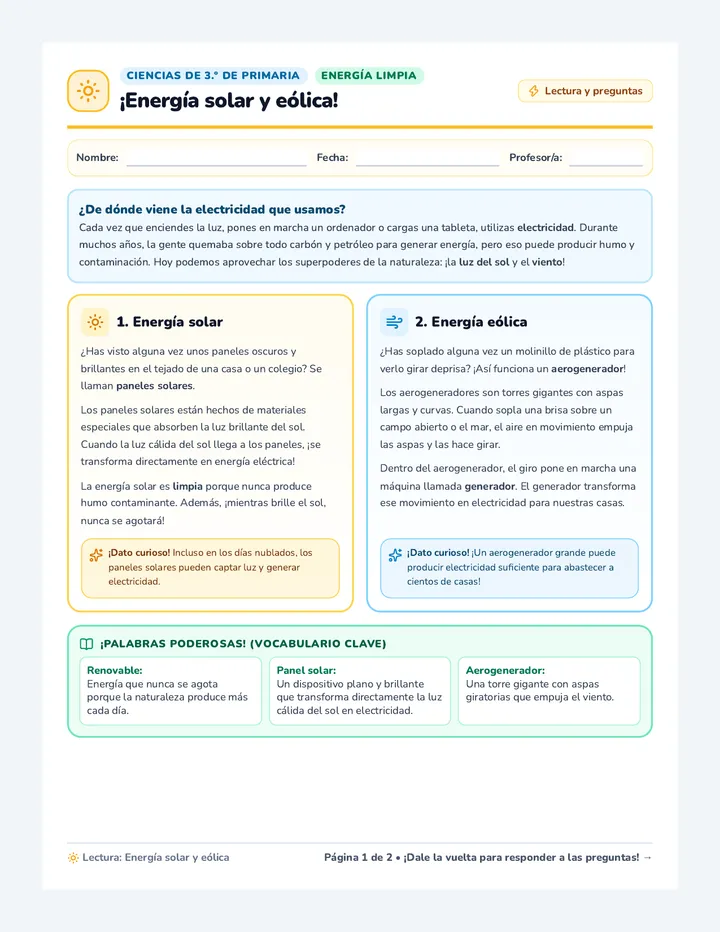
A five-day science unit exploring solar energy through hands-on experiments, engineering challenges, and interactive lessons. Students learn about photons, photovoltaic cells, solar thermal energy, and the role of renewables in our future.
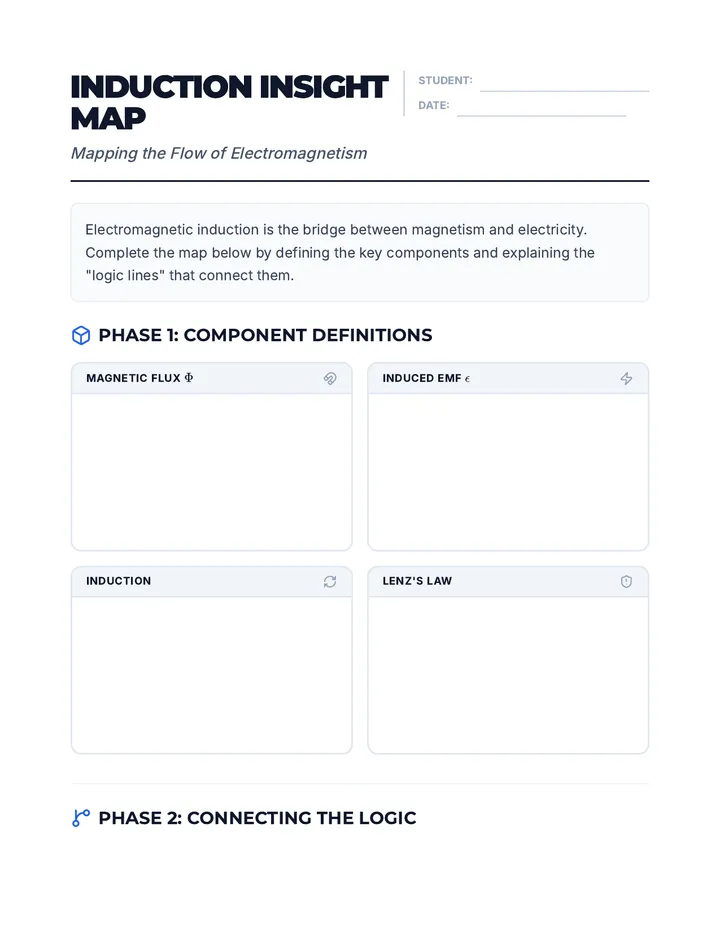
A 5-day intensive exploration of magnetic forces and fields, focusing on atomic-level causes, field interactions, and mathematical modeling of forces on charged particles. Students progress from anchoring phenomena to complex mathematical applications and a comprehensive unit review.
An interactive STEM challenge and read-aloud experience based on Leo Timmers' 'Elephant Island'. Students design and build floating island rafts to rescue Arnold and his friends.
A comprehensive history and hands-on design lesson for 9th-10th graders exploring how intellectual property and patents shape our world. Students analyze technical diagrams, dissect famous historical patents, and write a mock patent application for a tool of their own design, blending technical drawing with precise expository writing.
Day 3 of the Nature Hacks unit. Students synthesize their research and engineering blueprints to write a cohesive informational synthesis article, and complete a multi-disciplinary rubrics-based self-assessment.
Day 2 of the Nature Hacks unit. Students draft schematic drawings of their biomimetic solutions, apply scale factor mathematics to size their designs, and write technical specifications.
Day 1 of the Nature Hacks unit. Students explore the concept of biomimicry, read informational sources about animal/plant adaptations, and extract key data for their engineering designs.
A hands-on STEM challenge based on The Wizard of Oz where students design and build a balloon-powered rescue vehicle to save Dorothy and her friends from the sleeping effects of the Poppy Field. This lesson guides students through the complete engineering design process, combining physical science concepts with literary connections.
A student-centered engineering and design initiative where students engage in hands-on science and technology challenges. This lesson contains the pre- and post-surveys to measure students' growth in confidence, teamwork, and technical skills.
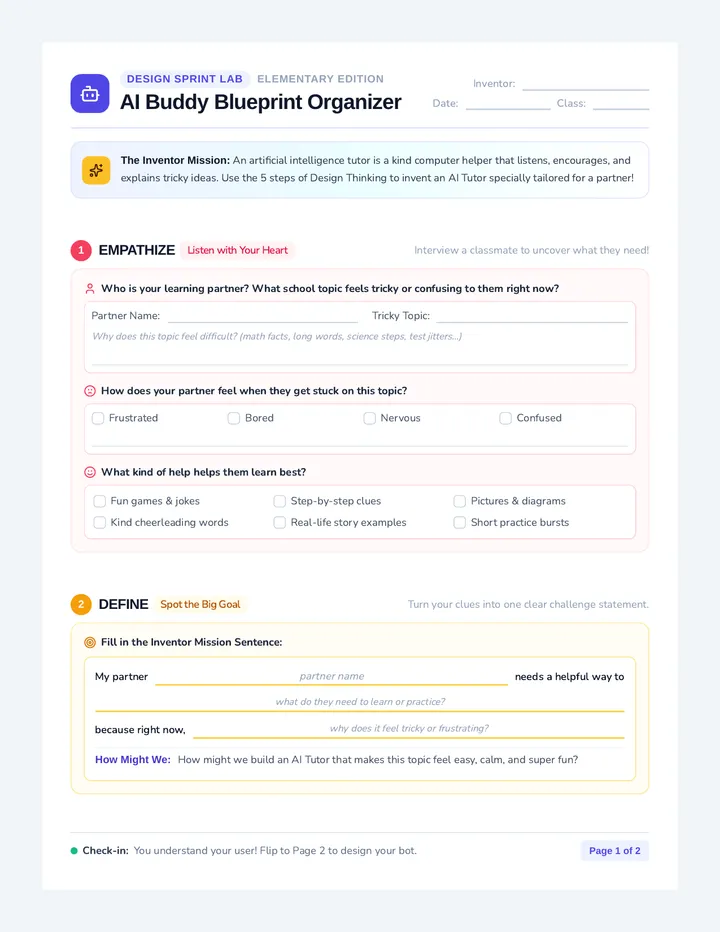
A 3-part mini-lesson series designed to teach middle schoolers how to use AI tools responsibly for final projects. The series focuses on AI as a thinking partner, prompt engineering, and critical fact-checking through a modern 'Notebook/Sketch' aesthetic.
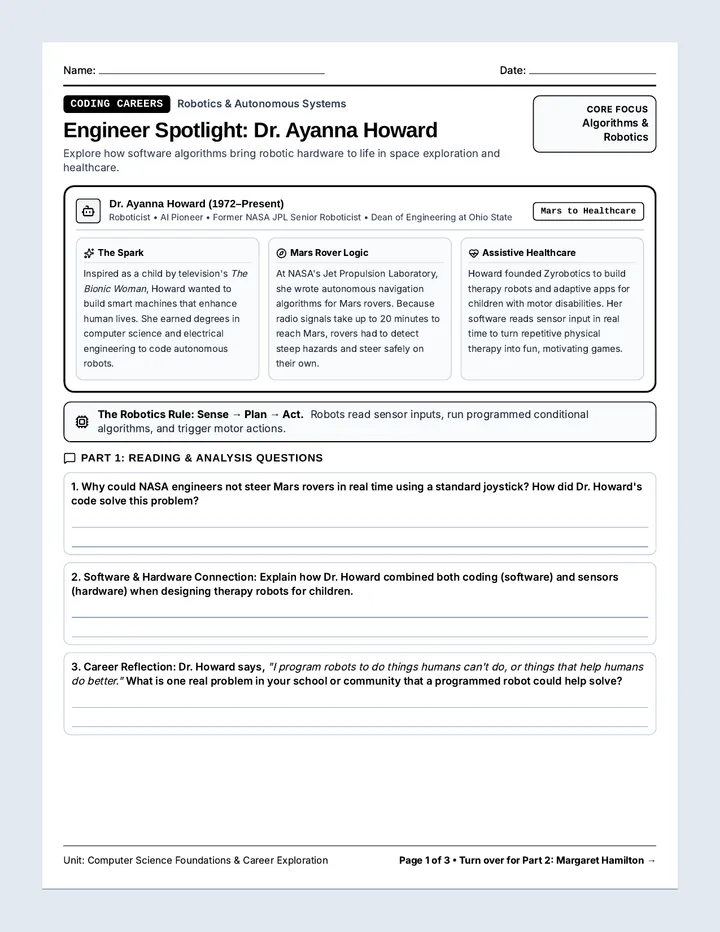
A capstone unit exploring the intersections of machine learning, data ethics, and the societal impact of algorithmic decision-making. Students transition from being technical builders to critical auditors of modern software.
A week-long exploration of binary code, patterns, and digital communication designed for 4th-grade students. This sequence covers how patterns form codes for devices, the process of binary image transfer, and how engineers use code to solve problems like image brightness.
A two-part technology sequence for Primary 3 students exploring the dual nature of technology and the engineering design process for creating helpful inventions.
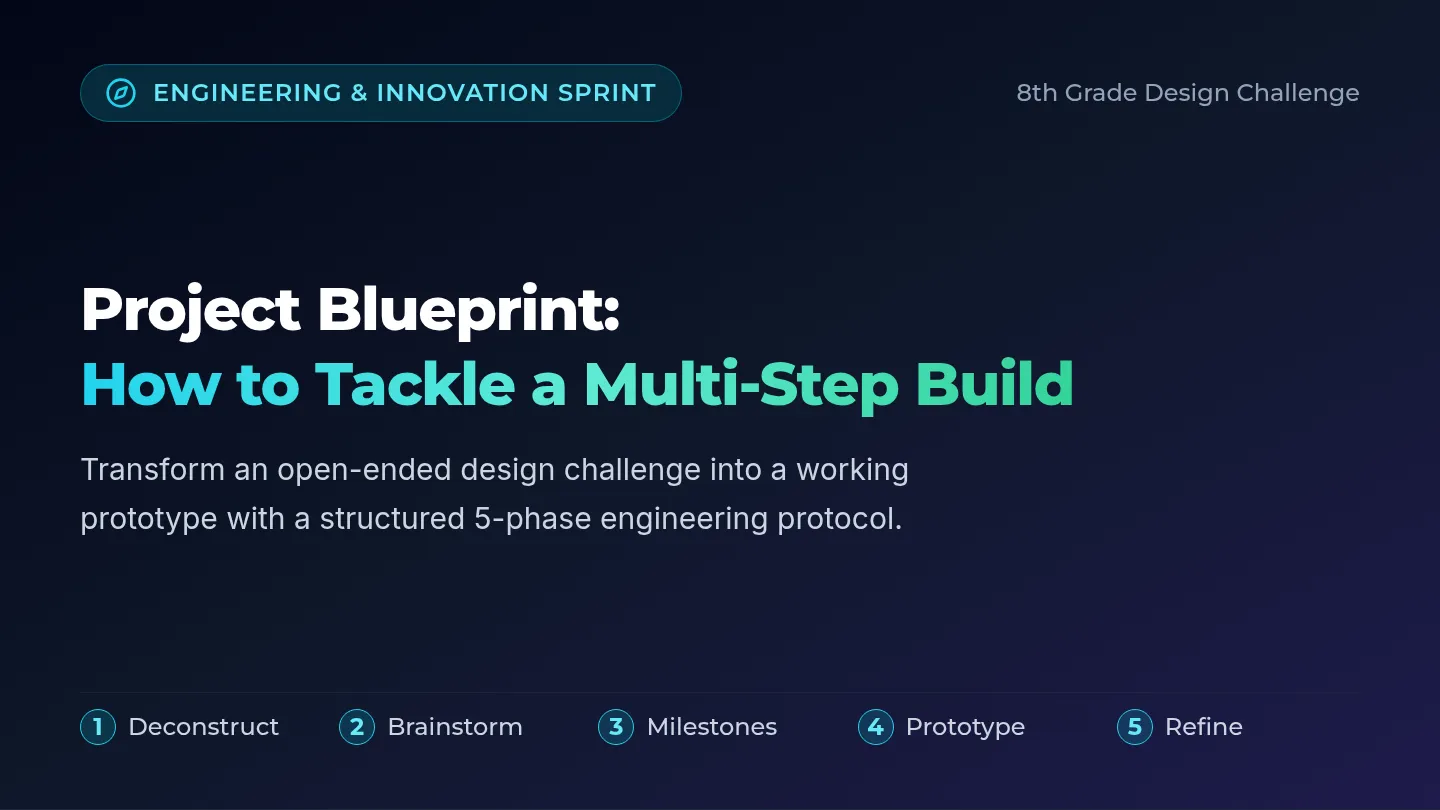
A 5-6 week capstone project framework for Grade 10 Exploring Technology, focusing on a Minimum Viable Product (MVP) approach and weekly engineering milestones.
Un programme complet conçu pour transformer un débutant en analyste de données capable de manipuler MySQL pour le Big Data et l'IA. Le parcours couvre les bases, les agrégations, les jointures et l'optimisation pour les grands volumes de données.
Un parcours complet pour transformer un débutant en analyste de données SQL, couvrant des bases fondamentales aux requêtes complexes pour le Big Data.