Fundamental principles of force, motion, and energy across classical and modern contexts. Examines matter properties, wave behavior, thermodynamics, and electromagnetism through mechanics and atomic studies.
An active, inquiry-driven introduction to forces, gravity, friction, and magnetism. Students explore concepts through a slide deck, guided notes, hands-on inquiry journals with data graphing, independent scenario practices, and a differentiated choice board.
An engineering and physics lesson where students design, build, and test magnetic mazes to explore magnetic forces and the Engineering Design Process. Students investigate magnetic permeability and iterate on their designs to solve navigational challenges.
An engineering design challenge where students design, prototype, and test magnet mazes, exploring how different backing materials block or allow magnetic forces to pass through.
An upper elementary STEM lesson where students explore magnetic fields, poles, and non-contact forces by designing and building a physical magnet maze. Includes visual slides, a hands-on student design guide, and a comprehensive teacher lesson plan.
A multi-sensory lesson exploring the science of sound and the history of music technology through the lens of the classic cassette tape. Students will learn how sound is recorded, visualize music through art, and craft a creative story behind their own 'mixtape'.
A lesson exploring the characteristics of magnetic and electric forces, their similarities and differences, and the fundamental concept of electromagnetism.
A focused review lesson on graphing independent and dependent variables, the constant pull of gravity, and the fundamental laws of magnetism.
This lesson explores the invisible forces of gravity and magnetism, while teaching students how to organize and visualize scientific observations through graphing. Students will learn to identify variables and create accurate line graphs from experimental data.
A high-energy science lesson where students explore the five forms of energy (heat, electrical, light, sound, and magnetic) through a collaborative board game and interactive presentation.
A Star Wars-themed STEM lesson for 6th graders featuring high-impact, novel experiments. Students master the 'Dark Side' through optical invisibility (refraction index matching) and Force-sensitive magnetic slime (chemical polymerization).
Une évaluation complète sur les interactions et les forces pour le niveau 4ème, incluant des diagrammes objets-interactions et des tracés de vecteurs.
An introductory lesson on electromagnetic induction, covering magnetic flux, Faraday's Law, and Lenz's Law through visual demonstrations and guided practice.
A comprehensive high school physics curriculum sequence aligned with the Connecticut Next Generation Science Standards (CT-NGSS), focusing on core concepts, quantitative problem-solving, and visual models.
Une séquence de physique de niveau Première sur l'optique géométrique et les lentilles minces convergentes. Elle aborde la modélisation géométrique des lentilles, la construction graphique des images, les relations mathématiques de Descartes et de grandissement, ainsi que les trois méthodes de mesure de la distance focale (objet à l'infini, autocollimation, méthode de Bessel).
A comprehensive physics sequence exploring the dual nature of light, the electromagnetic spectrum, and the interactions of radiation with matter, including the photoelectric effect and polarization.
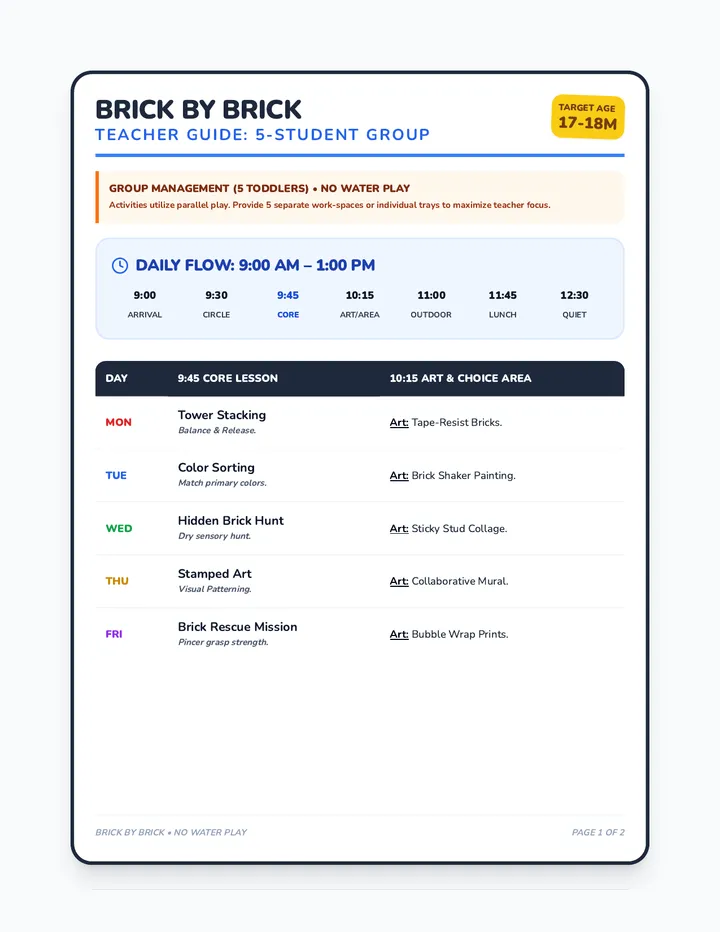
A collection of comprehensive week-long curricula for toddlers aged 17-18 months. Each themed week focuses on developmental play, sensory exploration, and fine motor skills for a group of 5 students with zero water play.
A comprehensive physics unit covering the behavior of mechanical and electromagnetic waves. Students transition from hands-on slinky exploration to advanced optical modeling and mathematical derivations.
A 4-day science unit for high school Essential Skills students exploring light sources, movement, reflection, shadows, and the visible spectrum. Each day includes visual slides, hands-on activities, and simplified assessments designed for accessibility and engagement.
A comprehensive unit focused on mastering the three pillars of exposure: Aperture, Shutter Speed, and ISO, culminating in full manual mode proficiency.
A comprehensive exploration of physical science and civic foundations, designed for elementary students to engage with waves, energy, government structures, and the roles of citizens.
A comprehensive 5-day review week covering 3rd-grade math and ELA standards themed around space exploration. Includes Earth, Sun, Moon, and Planets with focus on area, fractions, word problems, and opinion/informational writing.
A five-day science unit exploring solar energy through hands-on experiments, engineering challenges, and interactive lessons. Students learn about photons, photovoltaic cells, solar thermal energy, and the role of renewables in our future.
A two-part educational series exploring the Artemis II mission with a focus on how space research drives technological innovation for Earth and expands our scientific understanding of the Moon.
A five-day high school chemistry unit exploring thermochemistry, collision theory, enthalpy diagrams, and calorimetry through the lens of body heat and chemical reactions. Students investigate the anchoring phenomenon of exercise-induced heat while mastering TEKS C.13 standards.
A project-based workbooklet and guide where Year 5 students design their ultimate future school. The project is broken down into structured, bite-sized daily steps integrating English, Maths, Science, Geography, and Art.
An interactive STEM challenge and read-aloud experience based on Leo Timmers' 'Elephant Island'. Students design and build floating island rafts to rescue Arnold and his friends.
An engineering design challenge where students design, prototype, and test an insulated cup to keep water cold. Emphasizes thermal energy transfer, materials science properties, the engineering process, and data analysis.
A deep dive into electromagnetic radiation, covering the spectrum, wave-particle duality, polarization, and the photoelectric effect through guided instruction and hands-on laboratory exploration.
An 11-day series of class starters focused on forensic reasoning, case synthesis, and professional communication of findings.
A 10-day series of class starters covering biological evidence, blood patterns, DNA analysis, and ethics in genetics.
An 11-day series of class starters exploring physical and trace evidence, including fingerprints, hair, fibers, and soil.
A 10-day series of class starters focused on observation skills, documentation, ethics, and the history of forensic science.
A 30-minute engineering challenge where students build and test structures using six different material stations to understand earthquake stability.
Une leçon d'éveil sensoriel pour les élèves de maternelle, centrée sur la découverte des textures à travers le toucher. Les élèves apprennent à identifier et nommer les sensations : dur, mou, doux et piquant.
Students become lab investigators in this high-energy science lesson, testing unknown substances for magnetism, density, and solubility to reveal their hidden identities. This lesson covers 4th-grade physical properties of matter through hands-on exploration and collaborative investigation.
A hands-on indoor scavenger hunt where students analyze soil and glass evidence to solve a forensic mystery. Students identify unique characteristics like pH, texture, refractive index, and fracture patterns.
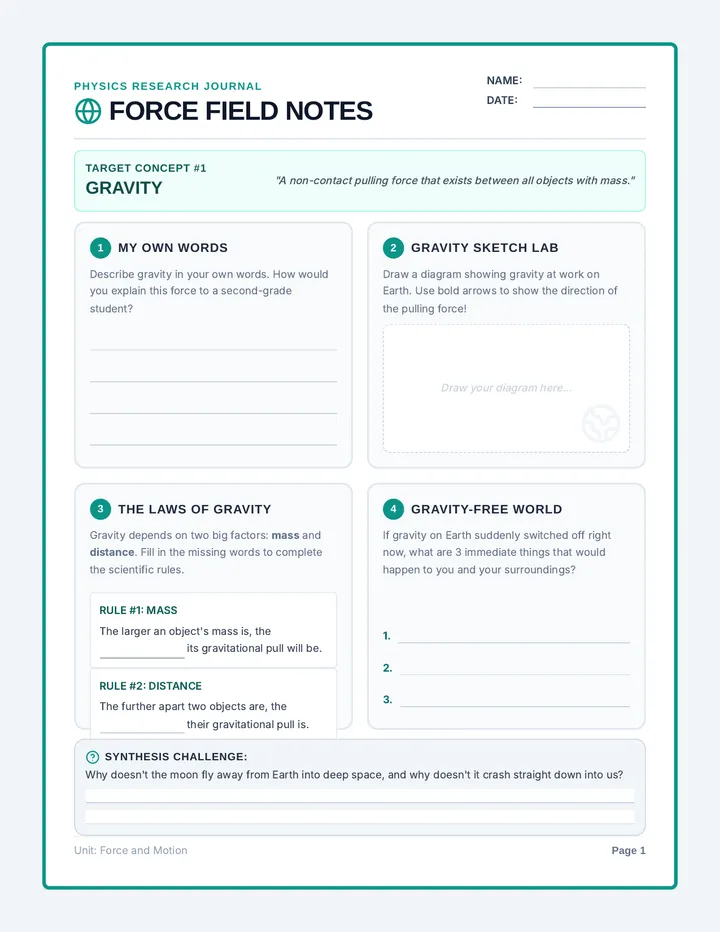
A structured 1-page visual guided notes and graphic organizer sheet for students to fill out during the slide-deck instruction.
A 3-page step-by-step hands-on guided inquiry journal for students to predict, observe, record data, and graph motion outcomes across gravity, friction, and magnetism investigations.
A high-impact, visual slide deck introducing forces, gravity, friction, and magnetism. Includes interactive conceptual matching, vector visual analysis, and a structured walkthrough for the friction graphing experiment.
A 6-slide design challenge deck designed to guide students visually through the concepts of magnetism, non-contact forces, material testing, and iterative maze engineering.
A 3-page printable pack featuring two complete pathing templates (orthogonal grid and concentric radial maze designs) and a hands-on material testing log sheet.
A 3-page student-facing STEM workbook containing a blueprint planning sheet, testing/iteration log, and a high-retention exit ticket with reflective writing prompts about magnetism and force vectors.
A 3-page printable guide for teachers featuring background science, step-by-step facilitation prompts, material checklists, lesson timeline, and a rubric for the Attraction Traction magnetic maze design challenge.
A 2-page print-ready teacher instructional plan and facilitation guide for running the Force Field Engineers magnet maze lab. Includes NGSS standards, a materials checklist, lesson pacing, inquiry prompts, a 3-tier grading rubric, and classroom troubleshooting tips.
A 2-page collection of printable layout templates, assembly components, and cutouts for building custom student magnet mazes. Includes a 1-inch printable grid board and a materials folding lab sheet.
A 2-page print-ready student lab handbook for the Magnet Maze engineering challenge. It includes a material testing matrix, maze blueprinting grid, testing logs, and reflective engineering prompts.
A 2-page teacher facilitation guide containing next-generation science standards (NGSS) alignments, a detailed 60-minute pacing guide, visual setup directions, a structured engineering design rubric, and a guide to solving common student misconceptions.
A 5-slide visual presentation for teachers to introduce non-contact forces, magnetic fields, attraction/repulsion, and the step-by-step engineering constraints of the Magnet Maze challenge.
A comprehensive STEM sequence for grades 1-5 focusing on structural engineering and physics. Students progress from exploring material properties and shapes to designing complex, efficient structures, building their understanding of forces, stability, and the engineering design process.
A comprehensive unit on rotational mechanics, mapping the transition from linear motion to angular dynamics through technical analysis and real-world applications.
An undergraduate-level exploration of solid-state crystallography, moving from real-space lattice geometry and packing efficiency to the mathematical abstraction of reciprocal space and X-ray diffraction analysis. Students master the geometric principles that govern material properties at the atomic scale.
This sequence bridges the gap between abstract geometry and physical law by introducing group theory as a tool for analyzing physical systems. Students classify shapes, translate operations into matrix algebra, derive conservation laws via Noether's Theorem, and apply symmetry to quantum selection rules.
This sequence explores the physics of rotational inertia through the lens of geometry. Students transition from point-mass calculations to analyzing extended rigid bodies, investigating how the spatial distribution of mass affects an object's resistance to angular acceleration.
This sequence investigates the Square-Cube Law and scaling relationships, examining how changes in an object's dimension affect its surface area, volume, and physical behavior. Students analyze biological constraints, structural engineering limits, and thermal properties through the lens of geometric proportions.
A Pre-K engineering sequence exploring shape composition, stability, and structural design through hands-on block play and spatial reasoning challenges.
Students investigate how geometric properties influence the stability and function of structures. They analyze triangles versus squares, identify shapes in real-world bridges, and design structures under geometric constraints.
A 2-page student guide for a paper airplane aerodynamics lab. Page 1 tracks plane folding, weight distribution tests, and flight distances. Page 2 features an expanded 3rd-grade readability passage explaining the forces of flight (lift, gravity, thrust, drag), followed by a 6-question comprehension check.
A 2-page student guide for a solar shadow-tracking sundial lab. Page 1 tracks paper plate construction and shadow angles. Page 2 features an expanded 3rd-grade readability passage explaining Earth's rotation and solar paths, plus a 6-question comprehension check.
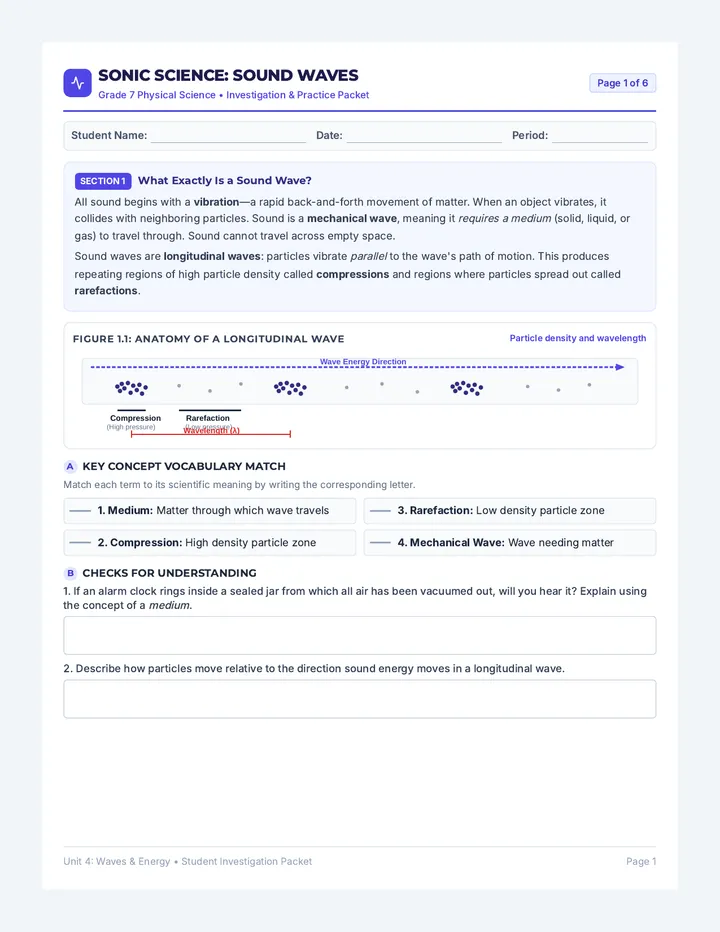
A 2-page student guide for a sound waves physics lab. Page 1 tracks acoustic cup-and-string build steps and vibration levels. Page 2 features a 3rd-grade readability passage explaining sound waves and vibrations, plus a comprehension check with 6 questions.
A 2-page student guide for a static electricity lab. Page 1 tracks attraction forces (jumping tissue paper and rolling cans). Page 2 features an expanded 3rd-grade readability passage explaining protons, electrons, and static charge, plus a 6-question comprehension check.
A 2-page student guide for a hovercraft forces lab. Page 1 tracks hovercraft build steps and test runs. Page 2 features an expanded 3rd-grade readability passage explaining friction and air cushions, plus a 6-question comprehension check.
A 2-page student guide for a slime-making polymers lab. Page 1 tracks the chemical mixture (glue and contact lens solution). Page 2 features an expanded 3rd-grade readability passage explaining polymer chains (chemical bonds), plus a 6-question comprehension check.
A 2-page student guide for a surface tension lab. Page 1 is a visual step-by-step experiment tracker using dish soap and milk. Page 2 features an expanded 3rd-grade readability passage explaining surface tension, plus a 6-question comprehension check.
A 2-page student guide for a water and weather experiment. Page 1 tracks rain density using shaving cream and food coloring. Page 2 features an expanded 3rd-grade readability passage explaining weather clouds, plus a 6-question comprehension check.
An introductory slide deck for the Sizzling Summer Science labs, reviewing safety rules and providing highly visual step-by-step guidance for each of the four experiments, including the paper planes flight lab.
A 2-page student guide for a liquid density lab. Page 1 is a visual step-by-step experiment tracker. Page 2 is a 3rd-grade readability passage explaining density and why oil and water do not mix, plus a comprehension check with 6 questions.
A 2-page student guide for a forces and motion lab. Page 1 tracks rocket construction and distances. Page 2 features a 3rd-grade readability passage explaining thrust and aerodynamic stability (fins), plus a comprehension check with 6 questions.
A 2-page student guide for a kitchen chemistry lab. Page 1 is a visual step-by-step experiment tracker. Page 2 is an in-depth 3rd-grade readability passage explaining chemical reactions, followed by a 6-question comprehension check.
A 3-day cross-curricular STEAM unit where students research biological adaptations, design biomimetic engineering solutions, perform scale calculations, and write a synthesized informational article.
Un programme complet de révision intensive pour le Brevet, regroupant des fiches, exercices et corrigés détaillés en français et en physique-chimie.
A collection of integrated science and ELA reading passages covering conservation of mass, the water cycle, and force and motion. Each passage targets specific ELA standards including key ideas, craft and structure, and language.
A collection of 8 hands-on science activities designed for elementary-aged children, covering chemistry, space, botany, and physics with a mix of instruction cards, journals, and lesson plans.
A comprehensive final summative project for high school seniors that transforms traditional case study research into a hands-on forensic investigation. Students analyze multiple evidence types including DNA, fingerprints, blood spatter, and toxicology to solve a complex cold case.
A comprehensive unit exploring the properties, reactions, and mathematical relationships of acids and bases, featuring pH calculations, titrations, and buffer systems.
A partner-based research project for 9th-grade conceptual physics students focusing on diverse topics from celestial mechanics to the physics of dance. Students move through a structured research process with mandatory teacher checkpoints for source reliability.
A 2-day science investigation exploring the chemical decomposition of hydrogen peroxide and baking soda, focusing on gas production, pressure, and its real-world implications for waste management and chemical safety.
This unit explores how chemical reactions occur and how they reach a state of balance. Students investigate reaction kinetics, energy changes, and the principles of dynamic equilibrium through modeling and laboratory investigation.
A comprehensive end-of-year review for 5th Grade NGSS science standards, organized by domain to ensure mastery of physical, life, and Earth sciences.
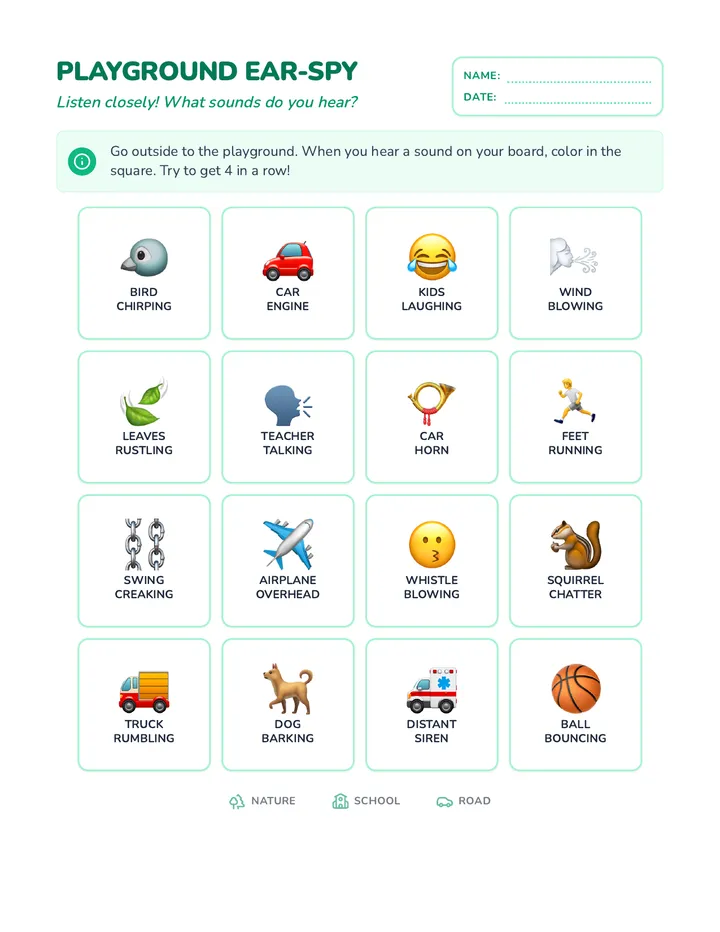
A comprehensive middle and high school project-based lesson where students explore acoustic ecology by recording, charting, and analyzing the decibel levels and sound frequencies of various school zones to map their auditory environment and understand its impact on human behavior.
A high school music and physics lesson where students explore architectural acoustics, analyze how materials and dimensions affect sound, and apply Sabine's Formula to calculate and optimize reverberation times for world-class concert halls.
A retro 90s-themed science lesson where fourth-grade students explore the concepts of pitch and amplitude (volume) through the analog mechanics and culture of cassette tapes.
A 45-60 minute science lesson for 4th graders exploring sound waves through the lens of retro cassette tapes and music. Students will investigate how amplitude and wavelength relate to volume and pitch.
A 2-day hands-on engineering and art project where students build a paper zoetrope to explore the physics of light and the foundations of animation. Day 1 focuses on construction and the science of persistence of vision, while Day 2 focuses on creating and testing animation strips.
This integrated lesson explores the properties of matter and the forces of gravity. Students will analyze scientific claims by identifying the reasons and evidence used to support them, bridging physical science concepts with critical reading skills.
An exploration of light behavior including reflection, refraction, and diffraction. Students develop mathematical models like Snell's Law and analyze the biological impacts of wave optics in animals.
This four-day lesson guides students through the physics of sound, focusing on pitch and wavelength. It features a teacher-led demonstration of vibrating strings/rulers and a high-interest scientific journal article designed for Lexile 600-800 readers.
An immersive hands-on investigation into the physics of sound where students build DIY instruments to explore vibrations, pitch, and volume. This lesson bridges sensory exploration with acoustic engineering principles.
A physical science and music integration lesson exploring how vibration and frequency create sound, culminating in an acoustic instrument design project. Students analyze the mechanics of pitch and resonance across different instrument families.