Shape Shifters Slides SHAPE SHIFTERS
Grade 1 • Engineering Essentials
The Challenge
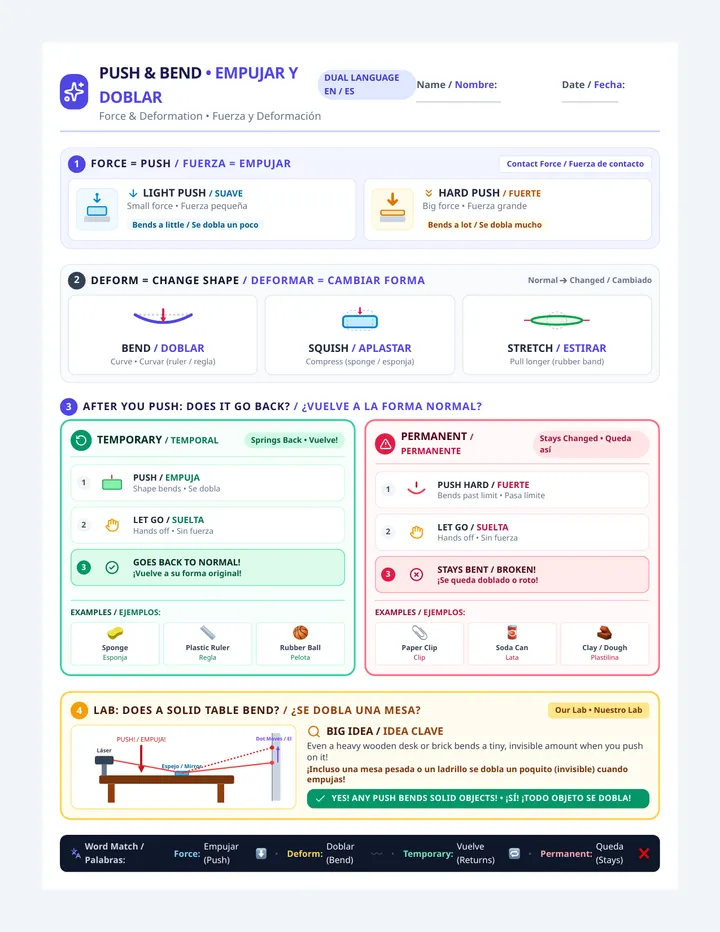
Can we make a floppy piece of paper strong enough to hold a heavy book?
We will use our hands to change the shape of the paper!
Our Supplies
Paper
(3 sheets)
Tape
(A few pieces)
Books
(For testing!)
Test 1: The Cylinder
Step 1
1
Roll your paper into a tube .
2
Tape the edge so it stays round.
?
Predict: How many books will it hold?
CIRCLE
Test 2: The Square
Step 2
1
Fold your paper 4 times .
2
Tape it into a box shape.
?
Will this be stronger or weaker?
SQUARE
Work Time!
15:00
Build
Test
Record Results
The Result
"Changing the shape changed how strong the paper was!"
Shapes matter in engineering!
Which shape held the most?
Why did the square collapse?
How did you push or pull the paper to change its shape?
Shape Shifters Worksheet Shape Shifters
Grade 1 • Recording Sheet
Name:
Date:
The Big Question:
Which shape is the strongest?
The Cylinder
My Prediction
Draw how many books...
Actual Strength
Books held
The Square
My Prediction
Draw how many books...
Actual Strength
Books held
The Discovery
Circle the winning shape:
Cylinder
Square
We (push / pull) the paper to change its .
Shape Shifters Teacher Guide TEACHER RESOURCE Engineering Essentials
Shape Shifters
Grade 1 • 30 Minute Lesson Plan
Lesson 1 of 5
TEKS Standards
1.6(A): identify and describe physical properties of objects (shape).1.11(B): explore how pushing and pulling can change the shape of an object.
Materials
3 sheets of copy paper
Masking tape
Set of identical books (5-10)
Recording Sheet
Pro-Tips
Use the same weight of paper and the same books for all groups to ensure "fair tests." Encourage students to tape the paper firmly so the shape doesn't "unroll" during the test.
0-5 MIN
Introduction & Hook
Hold up a single sheet of paper. Ask: "Is this paper strong? Can it hold a book?" Let it flop over. Explain that today, we are "Shape Shifters." We will use our hands to push, pull, and fold paper to make it stronger.
"We are engineers today. Engineers use shapes to solve problems!"
5-20 MIN
Hands-on Engineering
Step 1: The Cylinder
Guide students to roll paper into a tube (cylinder) and tape the edge. Have them predict how many books it will hold on their worksheet before testing. Place books one by one until it collapses.
Step 2: The Square
Guide students to fold paper 4 times to create a square prism. Tape the edge. Ask: "Do you think this shape will be stronger or weaker?" Test again and record.
20-30 MIN
Discussion & Reflection
Gather students. Ask which shape was the champion. (Usually the cylinder is strongest because it distributes weight evenly without 'weak' corners).
Key Question:
"How did pushing and pulling the paper change its job?"
Have students complete the final reflection section on their recording sheet.
Span Solvers Slides SPAN SOLVERS
Grade 2 • Engineering Essentials
The Problem
We need to cross a 12-inch gap (the "river").
Our bridge must be strong enough to hold a "car" (a heavy toy or glue bottle).
12 INCHES
Pushes and Pulls
The Push
When the car sits on the bridge, it pushes down . This is called Compression.
The Pull
Materials can also be pulled apart . This is called Tension.
The Engineer's Secret
"A strong bridge spreads the PUSH out so no single part has to do all the work!"
Flat Beam
The Arch
Supplies:
Cardboard Strips
Pipe Cleaners (Cables!)
Tape
Popsicle Sticks
Span Solve Time!
20:00
Build the Deck
Add Supports
The Testing Zone
Ask Yourself:
Does it reach across the gap?
Can it hold the "car"?
Where is it bending (pushing)?
Success is Learning!
If it breaks, you found a weak spot to fix!
Span Solvers Worksheet Span Solvers
Grade 2 • Design Brief
Name:
Date:
The Mission
Build a bridge that spans a 12-inch gap and holds 1 "car."
My Blueprint
Sketch your bridge design below
Land A
The River
Land B
Compression (Push)
Where is the car pushing down on your bridge? Draw a red arrow on your blueprint.
Tension (Pull)
Are any parts being pulled tight ? (Like pipe cleaner cables). Draw a blue line on your blueprint.
Test Results
Crossed the gap!
Held the car!
Engineer's Note
If I could build it again, I would change:
Span Solvers Teacher Guide TEACHER RESOURCE Engineering Essentials
Span Solvers
Grade 2 • 30 Minute Lesson Plan
Lesson 2 of 5
TEKS Standards
2.11(B): explore how pushes and pulls can change the motion and shape of objects.2.13(A): identify how the use of tools and materials can help solve a problem.
Materials
Cardboard strips (various lengths)
Pipe cleaners (cables)
Popsicle sticks
Masking tape
"River" markers (tape on floor or 12" apart boxes)
Weight (Glue bottle/toy car)
Key Questions
"Where is the bridge bending? Is that a push or a pull?" "What material is keeping the bridge from falling into the river?"
0-5 MIN
Bridge Anatomy
Review from Grade 1: Shapes matter. Introduce the Bridge Deck (the part we drive on) and Supports . Introduce Compression (the car pushing down) and Tension (pulling forces in cables or the bottom of the deck).
5-25 MIN
The Build Challenge
Students work in pairs to bridge the 12-inch gap. They must use at least two different materials (e.g., cardboard for the deck, pipe cleaners for tension cables).
Facilitation Tip:
If a bridge is sagging in the middle, ask: "How can we pull it back up? Can we use a pipe cleaner like a rope to pull it toward a higher support?"
Students record their design and identify the forces on their worksheet.
25-30 MIN
Load Testing
Demonstrate testing with the "car" weight. Discuss why certain bridges failed (buckled under compression) vs. why others held (distributed the push).
"Engineers call it an 'iteration' when they fix a design that didn't work the first time!"
Triangle Tech Slides TRIANGLE TECH
Grade 3 • Engineering Essentials
The Enemy: Gravity
Gravity is the force that pulls everything toward the center of the Earth.
"If we want to build UP, we have to fight the pull of DOWN."
Vertical Stability
The Perfect Shape
Squares are Wobbly
They can tilt and fold easily under pressure.
Triangles are Rigid
They don't change shape unless a side breaks!
The Power of the Truss
Connecting triangles creates a TRUSS.
Trusses distribute force across many paths.
Skyscrapers
Cranes
Radio Towers
Tower Challenge
Build the tallest tower using only triangles!
20:00
30
Straws
24"
Tape
The Debrief
Observations:
• Did your tower lean? Why?
• Where did the "gravity pull" win?
• How did the base size affect stability?
Triangle Tech Worksheet Triangle Tech
Grade 3 • Tower Analysis
Name:
Date:
The Challenge
Build the tallest tower using 30 straws and tape.
Tower Height _____ inches
Final Tower Sketch
Label where you used triangles!
Triangle Count
How many triangles did you use in your design?
The Pull of Gravity
Did your tower lean or stay straight?
Straight
Leaning
Engineering Reflection
Which part of your tower was the most stable?
If you had 10 more straws, where would you add them to fight gravity?
Triangle Tech Teacher Guide TEACHER RESOURCE Engineering Essentials
Triangle Tech
Grade 3 • 30 Minute Lesson Plan
Lesson 3 of 5
TEKS Standards
3.11(A): demonstrate and explain that a force (gravity) is a pull that can cause motion.3.13(B): design a solution to a problem and explain how it meets criteria and constraints.
Materials
Plastic straws (30 per group)
Masking tape (24 inches per group)
Scissors
Yardstick/Tape measure
Vocabulary
Gravity: Pull force toward Earth.
Truss: A framework of connected triangles.
Constraint: A limit (like 30 straws).
0-5 MIN
Gravity & Verticality
Explain that today we are building up . Gravity wants to pull our tower down . If our tower isn't balanced or strong, gravity will win and pull it to the floor.
"The taller we go, the harder gravity pulls on our structure!"
5-25 MIN
The Straw Tower Challenge
Students must use straws and tape to build the tallest tower. They should discover that triangles are more rigid than squares.
"Ask students: Look at your tower. If I push it gently, where does it wiggle? Can you add a triangle there to stop the wiggle?"
Constraints: Max 30 straws. Straws can be cut. Only use the tape provided.
25-30 MIN
Measurement & Review
Measure the height of the tallest "free-standing" towers. Discuss why the tallest ones stayed up (wide bases, many triangles/trusses).
Why did some towers fall?
How did triangles help?
Force Fighters Slides FORCE FIGHTERS
Grade 4 • Engineering Essentials
External Forces
Wind
Horizontal force that pushes against the sides.
Gravity
The constant vertical pull we've been fighting.
Foundation
The ground shifting or moving underneath.
Structural Integrity
How do we keep a building from sliding or toppling when a big wind hits?
Anchoring
Bracing
The Hurricane Test
Your mission: Build a structure that can survive the "Wind Tunnel" (a hair dryer or fan).
Constraints:
Cereal box cardboard
Pipe cleaners
Only 6 inches of tape
Fight the Force!
15:00
Strategy:
Can you build a 'low profile' structure?
Observation:
Watch for where the wind catches the cardboard.
Post-Storm Analysis
Why did some fail?
Too top-heavy (gravity pull)
Large surface area (wind catch)
Weak connections
"An engineer must design for the worst possible conditions, not just the best ones!"
Structural Integrity Award
Force Fighters Worksheet Force Fighters
Grade 4 • Impact Report
Name:
Date:
The Mission
Build a structure that survives a 10-second "hurricane" blast.
Constraints
Cardboard, 3 Pipe Cleaners, 6" Tape
Structural Design
Draw your structure after the test
Drawing Area
Forces Encountered
Horizontal Push (Wind)
Vertical Pull (Gravity)
Rotational Force (Twisting)
Fail Points
Where did it wobble or break first?
Engineer's Debrief
Integrity Strategy
How did you make your structure aerodynamic (so the wind went around it)?
Iteration Plan
If you could use bracing (diagonal supports), where would you put it?
Force Fighters Teacher Guide TEACHER RESOURCE Engineering Essentials
Force Fighters
Grade 4 • 30 Minute Lesson Plan
Lesson 4 of 5
TEKS Standards
4.11(A): design a descriptive investigation to explore the effect of forces such as wind and gravity.4.13(B): design a solution to a problem and describe the structural integrity of the design.
Materials
Cereal boxes / Thin cardboard
Pipe cleaners (3 per group)
Masking tape (6 inches)
Hair dryer or Box fan
Scientific Terminology
Structural Integrity: The ability of a structure to hold together under a load.
Aerodynamic: Having a shape that reduces the drag from air moving past.
0-5 MIN
External Load Intro
Explain that we've mostly fought Internal Loads (weight of the building) so far. Today, we fight External Loads : Wind. When wind hits a building, it creates pressure. We need to design structures that let air flow around them or are anchored enough to not tip.
5-25 MIN
Hurricane Survival Build
Students build a structure using minimal tape. The goal is to survive a 10-second blast from a hair dryer at 3 feet away.
Encourage Bracing:
Show how a diagonal pipe cleaner can prevent a square cardboard frame from folding sideways (parallelogramming).
Students must test their structure and record findings on the Impact Report .
25-30 MIN
Post-Storm Review
Invite groups to share why their building survived or fell. Introduce the term Aerodynamics . Did anyone build a curved shape? Did anyone add holes for wind to pass through?
Connection to Lesson 5: Efficiency is next!
Structure Showdown Slides STRUCTURE SHOWDOWN
Grade 5 • Engineering Essentials
Efficiency OPTIMIZED
The Final Level
In Grades 1-4, we learned about Shapes, Forces, and Integrity.
Now, we must master EFFICIENCY.
Efficiency = Doing More with Less
Maximum Load
The most weight the structure can hold.
Minimum Mass
Using the least amount of material possible.
The Formula
\[ \text{Ratio} = \frac{\text{Weight Held}}{\text{Material Used}} \]
"The higher the number, the better the engineer!"
Mission: Load-to-Weight
Supply Budget
10 Popsicle Sticks
5 Pipe Cleaners
12" of Tape
The Goal:
Build a tower at least 8 inches tall . We will weigh your tower, then test how many pennies it can hold!
Showdown Time!
20:00
Research
Optimize
Calculate
Efficiency Champions
Final Discussion
• Did the lightest tower hold the most?
• What material was the most "efficient"?
• If we had a bigger budget, would our efficiency go up or down?
You are now a certified Engineer!
Structure Showdown Worksheet Structure Showdown
Grade 5 • Efficiency Audit
Name:
Date:
Engineering Data
Structure Mass
_____ g
(Weight of tower)
Load Capacity
_____ g
(Weight of pennies)
Efficiency Ratio
_____ : 1
(Capacity / Mass)
Optimized Blueprint
Highlight material-saving features
SCALE: 1 BOX = 1 INCH
Design Decisions
What did you remove to save mass?
Which shape was most efficient?
Fail Mode
Describe exactly how the structure failed. Did the popsicle sticks snap (compression) or did the tape pull apart (tension)?
Conclusion
"My design demonstrated efficiency by..."
Structure Showdown Teacher Guide TEACHER RESOURCE Engineering Essentials
Structure Showdown
Grade 5 • 30 Minute Lesson Plan
Lesson 5 of 5
TEKS Standards
5.11(A): explain that a force has both direction and magnitude.5.13(A): design a solution to a problem and compare the efficiency of several solutions.
Materials
Popsicle sticks (10 per group)
Pipe cleaners (5 per group)
Masking tape (12 inches)
Digital scale (grams)
100+ Pennies / Washers
Math Integration
Students will divide the total mass held (magnitude of load) by the mass of their structure to find their Efficiency Ratio .
0-5 MIN
Magnitude & Direction
Review forces from G1-4. Introduce Magnitude : the strength or amount of force. Explain that in engineering, we want a small amount of material (small magnitude of internal force) to handle a large magnitude of external load. This is efficiency.
5-25 MIN
The Efficiency Showdown
Groups build a tower at least 8 inches tall. Before testing, weigh the empty tower and record it on the audit sheet. Then, add weights until failure.
Observation Guidance:
"Notice if your tower fails by snapping or bending. Is that force a push or a pull? How could you change the material's direction to handle that magnitude better?"
25-30 MIN
Compare & Contrast
The Reveal:
Post ratios on the board. Identify the "Showdown Champion" (highest ratio). Discuss why a lightweight structure was sometimes stronger than a heavy one.
Finish by having students complete their "Efficiency Audit" reflection.