Pesky Biters Slides Bug Busters • Lesson 1 Grade 5 Science
Friend or Foe?
Pesky Biters & Buzzers
Why do some bugs bother us? Let's investigate bites, buzzes, and itchy bumps!
What is a nuisance? • 4 Pesky Culprits
Power Word
Vocabulary Check
Word Alert
NUISANCE
Say it: NOO-suhns
A bug or thing that bothers us and causes trouble.
1
They Bite and Itch
Bites leave swollen, itchy red bumps.
2
They Buzz Loudly
Loud buzzing right in your ear!
3
They Spread Germs
They carry dirt and sickness to our food.
Quick Question: Name one bug that bothers you outside!
CULPRIT #1
The Mosquito
Bug File
Straw Mouth
It uses a mouth like a thin straw (a proboscis ) to drink blood.
Bug Spit (Saliva)
It spits into your skin so blood flows. Your skin gets an itchy bump!
Old Puddles
They lay eggs in still water, like puddles, buckets, and bird baths.
Why It's a Nuisance: Itchy bites and can spread sickness.
CULPRIT #2
The Housefly
Bug File
No Teeth to Bite!
Flies cannot bite. They spit on solid food to melt it, then drink it like soup!
Germy Feet
Flies land on trash and animal poop. Then they land on our food and spread germs!
Picnic Ruiner
Flies have super fast eyes. They see your hand move before you can swat them!
Quick Tip: Keep food covered outside!
Think & Share: Why shouldn't you eat food a fly walked all over?
Culprits #3 & #4: Wasps and Fleas
Bug File
CULPRIT #3
The Wasp
Smooth Stinger: It can sting you many times without dying.Sharp Poison: Venom causes quick pain and swelling.Protects Nest: Stings if people get too close to its nest.
CULPRIT #4
The Jumping Flea
Super Jumper: No wings, but can leap high into pet fur.Blood Sucker: Bites cats and dogs to drink blood.Itchy Skin: Makes pets scratch their skin raw.
Both bugs cause pain and irritation to people and pets! Watch out!
How to Stop These Pests
Easy Actions
Dump Water
Empty out buckets and plant saucers so mosquitoes cannot lay eggs.
Use Bug Spray
Spray keeps biting bugs from landing on our skin.
Fix Door Screens
Keep screen doors closed to block flies and wasps.
Next: Bug Clues Worksheet Let's solve the mysteries!
Bug Clues Worksheet Bug Busters • Lesson 1
Name: Date:
Bug Clues: Who Is the Pest?
Read the short clues. Use the word bank to name each bug!
1
Word Match: Match the Word to its Clue
Write the letter on each line.
1. Nuisance
2. Saliva
3. Proboscis
4. Venom
A. Poison inside a stinger
B. A bug that bothers us
C. Bug spit that makes bites itch
D. A long mouth like a straw
2
Mystery Bug Files: Who Did It?
Word Bank: Mosquito Housefly Wasp
Clue File #1 Lives near water
I buzz near your ears.
I poke your skin to drink blood.
My bite leaves a red, itchy bump.
Bug Name:
Clue File #2 In the kitchen
I have no teeth to bite.
I spit on food to turn it into liquid.
My dirty feet carry germs to your food.
Bug Name:
Clue File #3 Under the roof
I have yellow and black stripes.
I build a paper nest outside.
I have a smooth stinger. I can sting many times!
Bug Name:
Bug Busters Student Activity Page 1 of 2
Bug Busters • Lesson 1 (Continued)
Student Investigation Sheet
3
True or False Check
Circle TRUE or FALSE for each sentence.
1. Mosquitoes lay eggs in standing water.
TRUE FALSE
2. Bug spit makes mosquito bites itch.
TRUE FALSE
3. Houseflies chew food with teeth.
TRUE FALSE
4. Wasps can sting you more than once.
TRUE FALSE
4
Fill in the Missing Word
Word Bank: water fleas germs
1. Houseflies carry dirty on their feet.
2. Dump old buckets of to stop mosquitoes.
3. Dogs scratch when tiny jumping bite them.
5
Bug Buster Mission: Stop the Pest!
Pick one bug . Finish the sentence below:
Pick one: mosquitoes flies
"To stop ___________, I can __________________________________________."
Bug Busters Student Activity Page 2 of 2
Pesky Biters Teacher Guide TEACHER GUIDE Bug Busters • Lesson 1 of 2
Instruction & Pacing
Pesky Biters & Buzzers: Teacher Facilitation Guide
Focus: How biting and stinging insects act as biological and environmental nuisances.
Duration 45–50 Mins
Learning Goals
Define nuisance using plain language (a bug that bothers us).
Identify physical traits of mosquitoes, flies, wasps, and fleas.
Explain how insect saliva or venom causes skin discomfort.
Low-Literacy Accommodations
Choral reading of simplified 3-line clue files.Total Physical Response (TPR) : buzzing wings, pinch straw, hop flea.Sentence frame support with word banks on student sheet.
Pacing Breakdown
10 Mins
Hook & Power Word (Slides 1–2): Introduce nuisance ("NOO-suhns"). Use choral response: "A nuisance is something that bugs us!" Ask students to name bugs that bother them outside.
15 Mins
Culprit Dossiers (Slides 3–5): Examine the 4 culprits. Read bullet points together. Emphasize why bites itch (bug spit/saliva) and that flies have no teeth.
15 Mins
Guided Worksheet: Bug Clues: Guide students through the simplified 2-page worksheet. Read clue files aloud in small groups before students write insect names.
10 Mins
Wrap-Up & Action Sentences (Slide 6): Review yard actions (dump water, check screens). Have students complete their sentence frames for Part 5.
Guided Oral Prompts
"When a mosquito bites, why does our skin itch? It's not the needle—it's the saliva, or bug spit, that our body reacts to! Say it with me: sa-LI-va!"
Bug Busters • Teacher Instructional Guide Page 1 of 2
ANSWER KEY Bug Clues Worksheet Solutions
Grading Reference
Part 1: Word Match
1. Nuisance: B (A bug that bothers us)
2. Saliva: C (Bug spit that makes bites itch)
3. Proboscis: D (A long mouth like a straw)
4. Venom: A (Poison inside a stinger)
Part 2: Mystery Bug Files
Clue File #1: Mosquito
Lives near water, drinks blood, itchy bump.
Clue File #2: Housefly
No teeth, melts food, dirty feet carry germs.
Clue File #3: Wasp
Pesky Biters Flashcards Bug Busters • Lesson 1 Flashcards (Cut along dashed lines)
Set 1: Pest Bugs
Cut out these 4 cards. Practice naming each bug and explaining why it is a nuisance!
Culprit #1
Mosquito
Say it: muh-SKEE-toh
• Drinks blood with straw mouth.
• Bug spit makes an itchy bump.
• Lays eggs in standing water.
Culprit #2
Housefly
Say it: HOWS-fly
• Has zero teeth to bite.
• Spits on food to melt it.
• Dirty feet carry germs.
Culprit #3
Wasp
Say it: WAHSP
• Black and yellow stripes.
• Smooth stinger stings many times.
• Injects sharp, painful venom.
Culprit #4
Flea
Say it: FLEE
• Has no wings, but jumps high.
• Hides inside dog and cat fur.
• Bites pets and makes them scratch.
Bug Busters Picture Cards Page 1 of 2
Bug Busters • Lesson 1 Flashcards (Cut along dashed lines)
Set 2: Power Words
Cut out these 4 vocabulary cards. Practice the definitions with a partner!
Power Word
Nuisance
Say it: NOO-suhns
Meaning:
A bug or thing that bothers us, makes noise, or causes trouble.
Power Word
Saliva
Say it: suh-LY-vuh
Meaning:
Bug spit. It enters skin when mosquitoes bite and makes an itchy bump.
Power Word
Proboscis
Say it: pro-BAH-sis
Meaning:
A long mouth like a straw that mosquitoes use to drink blood.
Power Word
Venom
Say it: VEH-nuhm
Meaning:
Poison inside a wasp stinger that causes sharp pain and swelling.
Bug Busters Picture Cards Page 2 of 2
Pesky Biters Exit Ticket Lesson 1 Exit Ticket: Quick Check
Name: Date:
1. What makes a mosquito bite swell up and itch?
A. Poison stinger
B. Bug spit (saliva)
C. Cold wind
2. Which bug has NO teeth and spits on food to melt it?
Mosquito Housefly Wasp
3. Complete the sentence (choose: dump standing water OR shut the screen door ):
To stop pests in my yard, I can .
Bug Busters Formative Check Score: _____ / 3
Cut Here
Lesson 1 Exit Ticket: Quick Check
Name: Date:
1. What makes a mosquito bite swell up and itch?
A. Poison stinger
B. Bug spit (saliva)
C. Cold wind
2. Which bug has NO teeth and spits on food to melt it?
Mosquito Housefly Wasp
3. Complete the sentence (choose: dump standing water OR shut the screen door ):
To stop pests in my yard, I can .
Bug Busters Formative Check Score: _____ / 3
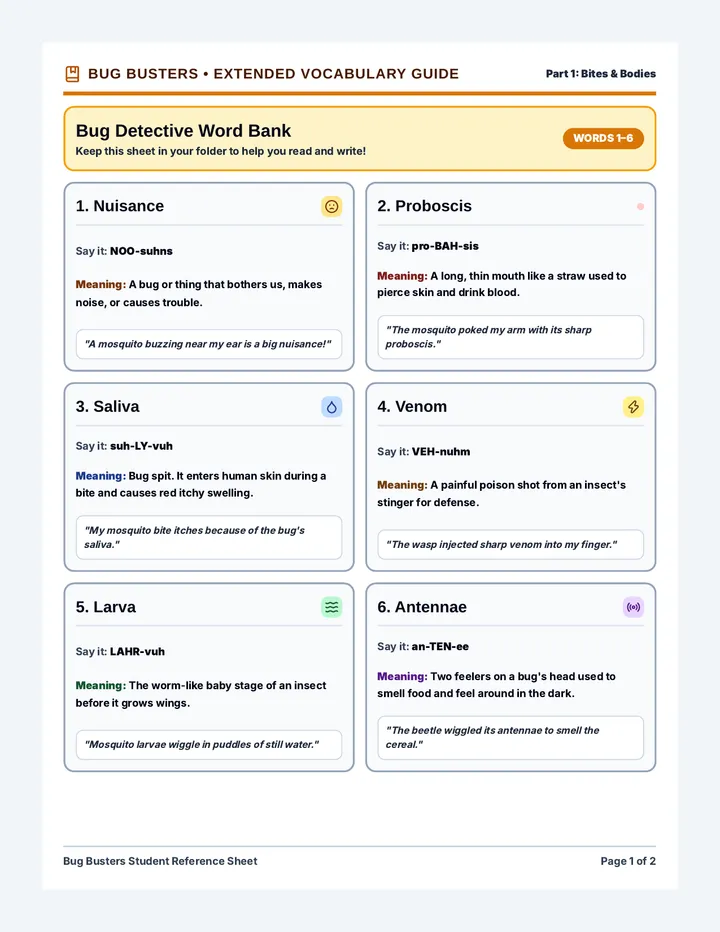
Bug Words Reference Sheet Bug Busters • Extended Vocabulary Guide
Part 1: Bites & Bodies
Bug Detective Word Bank
Keep this sheet in your folder to help you read and write!
Words 1–6
1. Nuisance
Say it: NOO-suhns
Meaning: A bug or thing that bothers us, makes noise, or causes trouble.
"A mosquito buzzing near my ear is a big nuisance!"
2. Proboscis
Say it: pro-BAH-sis
Meaning: A long, thin mouth like a straw used to pierce skin and drink blood.
"The mosquito poked my arm with its sharp proboscis."
3. Saliva
Say it: suh-LY-vuh
Meaning: Bug spit. It enters human skin during a bite and causes red itchy swelling.
"My mosquito bite itches because of the bug's saliva."
4. Venom
Say it: VEH-nuhm
Meaning: A painful poison shot from an insect's stinger for defense.
"The wasp injected sharp venom into my finger."
5. Larva
Say it: LAHR-vuh
Meaning: The worm-like baby stage of an insect before it grows wings.
"Mosquito larvae wiggle in puddles of still water."
6. Antennae
Say it: an-TEN-ee
Meaning: Two feelers on a bug's head used to smell food and feel around in the dark.
"The beetle wiggled its antennae to smell the cereal."
Bug Busters Student Reference Sheet Page 1 of 2
Bug Busters • Extended Vocabulary Guide
Part 2: Pests & Nature
Pests vs. Nature's Helpers
Words about damage, farming, and beneficial friends!
Words 7–12
7. Pest
Say it: PEHST
Meaning: Any insect that damages crops, chews homes, or harms people.
"Termites are pests because they eat wooden walls."
8. Swarm
Say it: SWAWRM
Meaning: A giant, dark cloud of millions of insects flying together.
"A swarm of hungry locusts ate all the farm corn."
9. Cellulose
Say it: SEL-yoo-lohs
Meaning: The tough plant fiber inside wood that termites eat for energy.
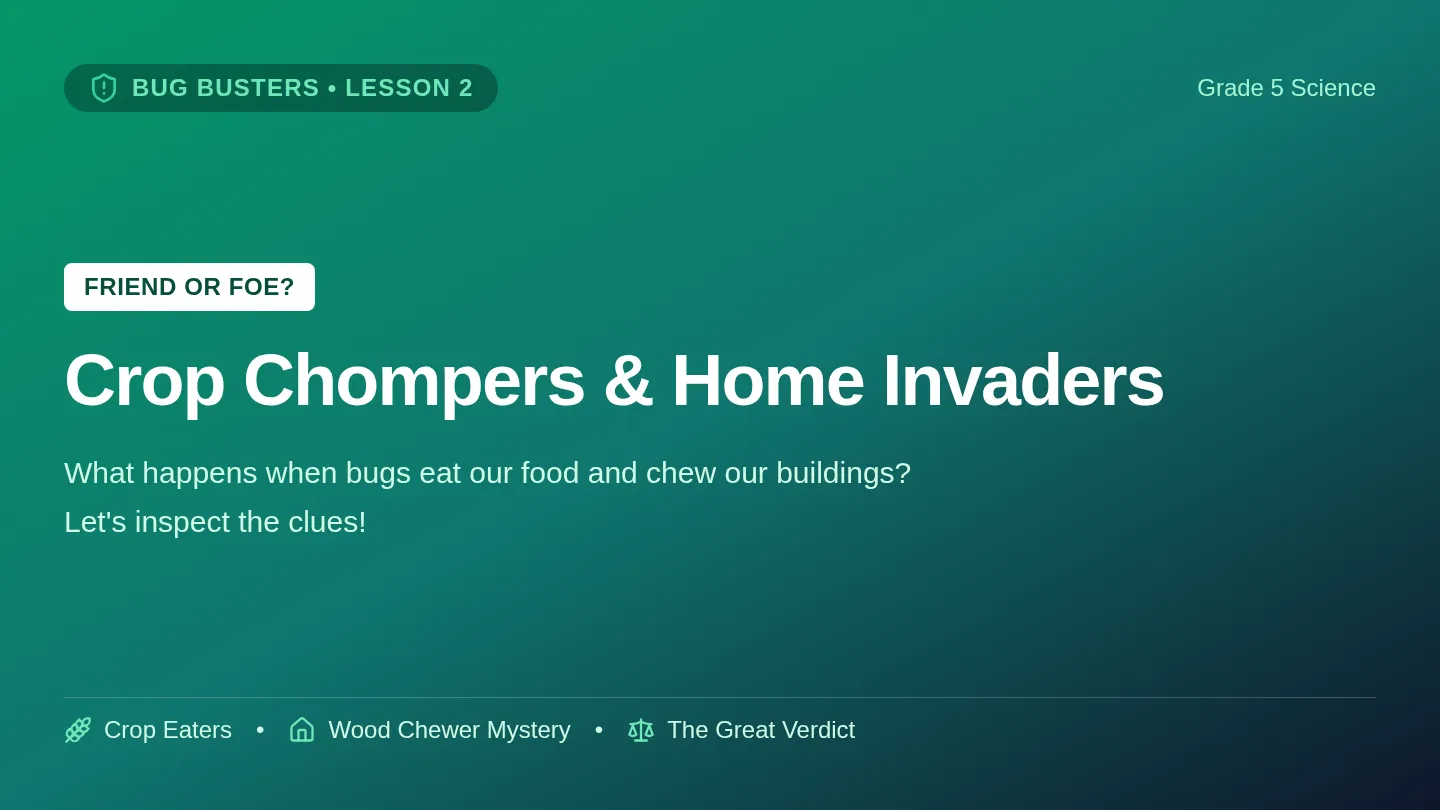
Crop Chompers Slides Bug Busters • Lesson 2 Grade 5 Science
Friend or Foe?
Crop Chompers & Home Invaders
What happens when bugs eat our food and chew our buildings? Let's inspect the clues!
Crop Eaters • Wood Chewer Mystery • The Great Verdict
Power Word
Vocabulary Check
Word Alert
PEST
Say it: PEHST
A bug or animal that ruins crops, hurts homes, or bothers people.
They Eat Our Food
Bugs eat corn, wheat, fruit, and open boxes of cereal.
They Chew Our Houses
Termites chew wood inside walls. They can make homes unsafe.
Big Damage ($$$)
Pests ruin crops and cost billions of dollars every year!
Question: Have you ever found a bug in a pantry box or in fruit?
FARM PESTS
The Crop Chompers
Field Evidence
Locust Swarms
Locusts are grasshoppers that fly in huge clouds called swarms .
The Damage: A swarm can eat a whole farm field in under 30 minutes!
Tiny Aphids
Aphids are tiny green bugs. They drink sweet juice from plant leaves.
The Damage: Leaves turn yellow and die. Garden vegetables stop growing.
When crops are eaten, farmers lose food and money. Crop Emergency!
HOME PESTS
Silent Home Invaders
Indoor Evidence
Termites
Wood Eaters: They chew and eat wood beams inside houses.Hidden Tunnels: They chew inside walls and leave piles of sawdust.
Pantry Beetles
Flour Raiders: Tiny bugs crawl inside boxes of cereal and rice.Sticky Webs: They lay eggs and make webs that ruin food.
Clue for Detectives: Hollow wood or tiny holes in food boxes mean pests are inside!
Friend or Foe? The Plot Twist
Nature's Helpers
When Bugs Are FOES
• They bite us and spread sickness.
• They eat whole fields of crops.
• They chew and weaken wooden houses.
When Bugs Are FRIENDS
• Ladybugs eat garden pests to save plants!
• Honeybees pollinate flowers so fruits grow!
Damage Report Worksheet Bug Busters • Lesson 2
Name: Date:
Bug Detective: Damage Report
Read the clues below. Find out which insect caused the damage!
1
Match the Pest to the Damage
Write the letter of the correct damage on each line.
1. Termite
2. Locust
3. Aphid
4. Pantry Weevil
A. Eats whole farm crops fast in giant clouds
B. Drinks sweet juice from green leaves
C. Chews wood beams inside houses
D. Crawls inside boxes of cereal and flour
2
Crime Scenes: Who Caused the Damage?
Scene #1: The Old Porch Clue: Piles of sawdust
The wood steps feel soft and hollow.
Tiny bugs are eating tunnels inside the wood.
Who did it?
Termite Mosquito Ladybug
Scene #2: The Kitchen Box Clue: Holes in cardboard
Someone opened a new bag of pancake mix.
Tiny dark bugs made webs inside the flour!
Who did it?
Pantry Weevil Wasp Housefly
Bug Busters Student Activity Page 1 of 2
Bug Busters • Lesson 2 (Continued)
Student Investigation Sheet
3
Choose the Best Answer
Circle the letter of the correct answer.
1. Why are locust swarms bad for farmers?
A. They sleep in dirt.
B. They eat all the crops fast.
C. They sting cows.
2. Which helpful bug eats pests off green plants?
A. Ladybug
B. Mosquito
C. Termite
4
Sort the Bugs: Friend or Foe?
Write each bug into the correct box:
Honeybee • Termite • Ladybug • Locust
Helpful Friends (2 bugs)
Destructive Foes (2 bugs)
5
Detective Verdict: Fill in the Blanks
Word Ideas: eats our food chews houses helps plants grow
1. A bug is a FOE when it .
2. A bug is a FRIEND when it .
Bug Busters Student Activity Page 2 of 2
Crop Chompers Teacher Guide TEACHER GUIDE Bug Busters • Lesson 2 of 2
Instruction & Pacing
Crop Chompers & Home Invaders: Facilitation Guide
Focus: Agricultural destruction, structural damage, and the Friend vs Foe balance.
Duration 45–50 Mins
Learning Goals
Identify how crop pests (locusts, aphids) ruin food sources.
Describe how termites chew wood beams inside buildings.
Compare destructive pests to helpful insects (bees, ladybugs).
Literacy & Decoding Tips
Break down words: pan-cake , saw-dust , cup-board .
Reinforce the "-er" suffix: chomp-er , chew-er .
Use the simplified clue cards for paired or choral reading.
Lesson Pacing
10 Mins
Hook & Vocabulary (Slides 1–2): Define PEST ("PEHST"). Point out that a bug is a pest when it ruins human food, chews our homes, or causes trouble.
15 Mins
Direct Instruction (Slides 3–5): Present locusts, aphids, termites, and pantry beetles. Discuss the "Friend or Foe" twist on Slide 5 (e.g. ladybugs save crops from aphids!).
15 Mins
Investigation Activity: Damage Report: Have students complete the simplified worksheet. Guide struggling readers through the 2 short crime scenes and the friend/foe sort.
10 Mins
Verdict Sharing & Debrief: Call on students to read their completed Part 5 sentences. Reinforce that bugs can be both friends and foes depending on what they do.
Turn & Talk Discussion Prompt
"If you were a farmer, which bug would you want in your garden: a ladybug or an aphid? Why?" (Prompt students: "Ladybugs eat the pests!").
Bug Busters • Teacher Instructional Guide Page 1 of 2
ANSWER KEY Damage Report Worksheet Solutions
Grading Reference
Part 1: Match the Damage
1. Termite: C (Chews wood beams inside houses)
2. Locust: A (Eats whole farm crops fast in giant clouds)
3. Aphid: B (Drinks sweet juice from green leaves)
4. Pantry Weevil: D (Crawls inside boxes of cereal and flour)
Part 2: Crime Scene Culprits
Scene #1 (The Old Porch):
Checked: Termite
Sawdust piles and hollow wood floorboards.
Scene #2 (The Kitchen Box):
Crop Chompers Flashcards Bug Busters • Lesson 2 Flashcards (Cut along dashed lines)
Set 1: Crop & Home Pests
Cut out these 4 cards. Practice naming the damage each pest causes!
Home Pest
Termite
Say it: TER-myte
• Chews wood beams inside houses.
• Tunnels silently inside walls.
• Leaves tiny piles of sawdust.
Farm Pest
Locust
Say it: LOH-kuhst
• Grasshopper that flies in giant swarms.
• Devours corn and wheat fields fast.
• Destroys farm crops in minutes.
Plant Pest
Aphid
Say it: AY-fid
• Tiny green insect on leaves.
• Sucks sweet juice from garden plants.
• Makes plant leaves curl and turn yellow.
Food Pest
Pantry Weevil
Say it: WEE-vuhl
• Tiny beetle in flour, rice, and cereal.
• Lays eggs and spins sticky webs.
• Ruins food in kitchen cupboards.
Bug Busters Picture Cards Page 1 of 2
Bug Busters • Lesson 2 Flashcards (Cut along dashed lines)
Set 2: Friends & Concepts
Cut out these 4 cards. Compare the helpful bug friends to the concept words!
Helpful Friend
Ladybug
Say it: LAY-dee-bug
How It Helps:
• Eats harmful aphids off plants.
• Protects garden vegetables and flowers.
Helpful Friend
Honeybee
Say it: HUN-ee-bee
How It Helps:
• Pollinates fruit trees and garden crops.
• Helps apples, berries, and pumpkins grow.
Power Word
Pest
Say it: PEHST
Meaning:
Any insect or animal that eats our food, ruins our homes, or bothers people.
Power Word
Swarm
Say it: SWAWRM
Meaning:
A huge, thick cloud of millions of flying insects moving together.
Bug Busters Picture Cards Page 2 of 2
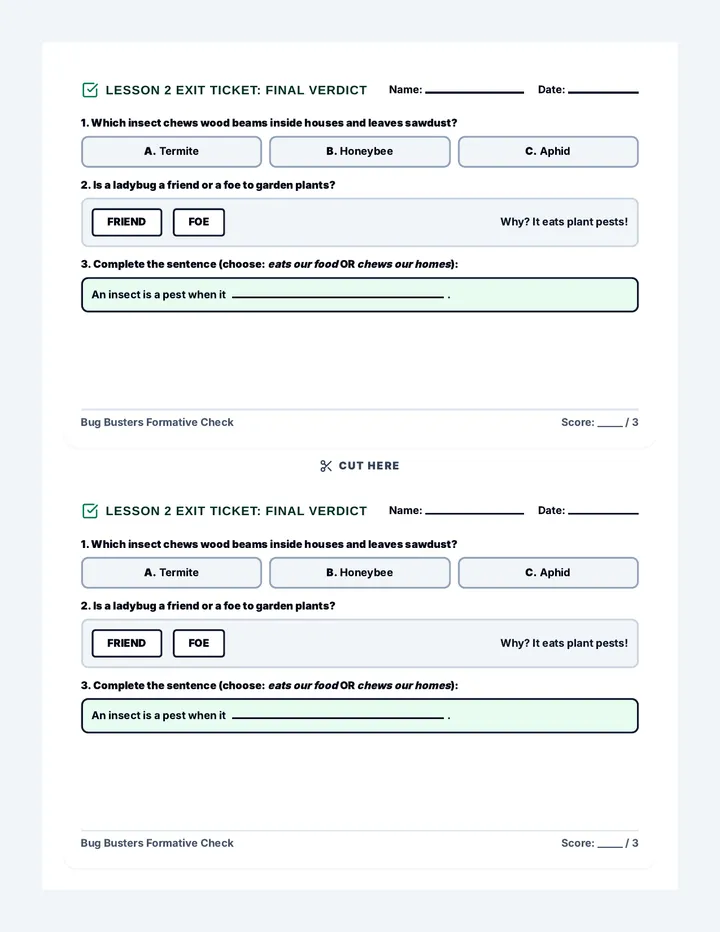
Crop Chompers Exit Ticket Lesson 2 Exit Ticket: Final Verdict
Name: Date:
1. Which insect chews wood beams inside houses and leaves sawdust?
A. Termite
B. Honeybee
C. Aphid
2. Is a ladybug a friend or a foe to garden plants?
FRIEND FOE
Why? It eats plant pests!
3. Complete the sentence (choose: eats our food OR chews our homes ):
An insect is a pest when it .
Bug Busters Formative Check Score: _____ / 3
Cut Here
Lesson 2 Exit Ticket: Final Verdict
Name: Date:
1. Which insect chews wood beams inside houses and leaves sawdust?
A. Termite
B. Honeybee
C. Aphid
2. Is a ladybug a friend or a foe to garden plants?
FRIEND FOE
Why? It eats plant pests!
3. Complete the sentence (choose: eats our food OR chews our homes ):
An insect is a pest when it .
Bug Busters Formative Check Score: _____ / 3