Lenny.com
Explore
Create
ActivitiesNewMathEnglish Language ArtsScience & EngineeringSocial StudiesGlobal LanguagesHealth & Physical EducationSpecial EducationCounseling & Life SkillsArts & CreativityESL
Lenny.com
Lenny.com
Explore
Create
ActivitiesNewMathEnglish Language ArtsScience & EngineeringSocial StudiesGlobal LanguagesHealth & Physical EducationSpecial EducationCounseling & Life SkillsArts & CreativityESL
Lenny.com
Lenny.com

Solutions

Lenny for EducatorsLenny for SchoolsLenny for Districts

Product

ExploreSign inCreateSupportAbout

Resources

Getting startedMTSS Acceleration Program

© 2026 Lenny Learning Inc.

TermsPrivacyAccessibility
LinkedInInstagramX
Lenny

The Mole

Fundamental units for measuring substance amounts using Avogadro’s constant. Equips students with conversion skills between mass, particles, and molar volume for stoichiometric calculations.

Science & EngineeringLife ScienceLiving ThingsAnimalsPlantsBody SystemsTraitsAdaptationsCellsEcosystemsHeredityGenes to TraitsCell DivisionPhysicsComparing MaterialsShapes and PropertiesMagnetsMagnetismLightSoundLight and SoundMatterStates of MatterChanges of StateMixturesPhysical and Chemical ChangeHeating and CoolingHeat and Thermal EnergyEnergyForce and MotionElectrical CircuitsAtoms and MoleculesPeriodic TableMotion in One DimensionMotion in Two DimensionsScalars and VectorsForces and Laws of MotionCircular Motion and GravityMomentum and ImpulseWork, Energy, and PowerWavesElectromagnetic WavesGeometric OpticsElectricity and MagnetismSimple Harmonic MotionThermodynamicsNuclear PhysicsEarth Science & AstronomyWeatherWater CycleRocks and MineralsFossilsEarth's FeaturesEarth's ResourcesEarth's StructureWeather and ClimateEarth EventsFossils and Geologic TimePlate TectonicsHuman ImpactsAstronomyChemistryUnits and MeasurementAtomic StructurePeriodic TrendsChemical BondingNomenclatureMolecular StructureIntermolecular ForcesThe MoleStoichiometryProperties of GasesSolutionsChemical ReactionsBalancing EquationsEnergy ChangesRates of ReactionsEquilibriumAcids and BasesQuantum ModelBiologyClassificationCell StructureThe Chemistry of LifeBiomoleculesCellular TransportCell EnergyCell Growth and DivisionDNAProtein SynthesisMeiosis and Sexual ReproductionPatterns of InheritanceMulticellular OrganismsEvolutionEcologyBiodiversityComputer ScienceAlgorithms and Computational ThinkingProgramming LanguagesComputing SystemsNetworks and InternetData AnalysisCybersecurityAI and Machine LearningSoftware Design and DevelopmentBlockchainEngineering & AIDesigning ExperimentsEngineering PracticesDesign ThinkingEngineering Design ProcessMechanical EngineeringElectrical EngineeringMaterials and StructuresCAD and 3D DesignRoboticsArtificial Intelligence BasicsVibe CodingMachine LearningAI Ethics and SocietySystems ThinkingEntrepreneurship & InnovationEntrepreneurial MindsetBusiness Idea DevelopmentBusiness Plan BasicsMarketing & Customer DiscoveryFinancial Management for Startups

Videos

Explaining Kinetic Molecular Theory and Gas Laws Through Song

Explaining Kinetic Molecular Theory and Gas Laws Through Song

This high-energy educational music video serves as a memorable mnemonic device for mastering the complexities of gas behavior in high school chemistry. Set to a catchy parody rhythm of Falco's 'Rock Me Amadeus,' the song systematically breaks down the Kinetic Molecular Theory, explaining how gas particles move, collide, and interact with their containers. It distinguishes between 'ideal' and 'real' gases, highlighting the specific conditions—high temperature and low pressure—under which real gases behave ideally. The content covers essential chemistry concepts including Avogadro's Hypothesis (equal volumes contain equal molecules at the same temperature and pressure), the definition of a mole (6.02 x 10^23), and the mathematical relationships found in Boyle's, Charles', and Gay-Lussac's laws. It visualizes abstract ideas through diagrams of molecular motion and clearly displays the formulas for calculating changes in pressure, volume, and temperature, culminating in the Combined Gas Law. Teachers can use this video as an engaging hook to introduce a unit on gases or as a powerful review tool before an assessment. The lyrics provide a verbatim checklist of the assumptions of the Kinetic Molecular Theory, making it an excellent resource for 'decoding the text' activities where students identify scientific principles hidden within the rhyme. The humor and rhythm help solidify abstract facts, such as the conditions for ideal gas behavior, into long-term memory.

Mark RosengartenMark Rosengarten

3mins 8s

Materials

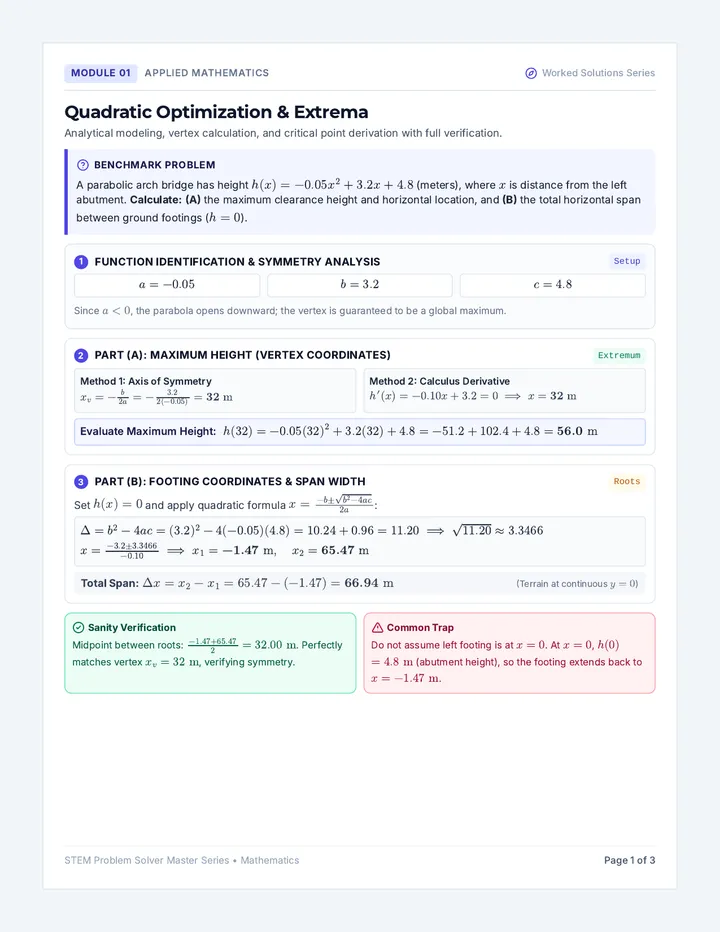
STEM Master Solver Guide

STEM Master Solver Guide

A comprehensive three-part STEM worked-example guide providing detailed, step-by-step solutions for benchmark problems in mathematics, physics, and chemistry. Each page breaks down problem setup, conceptual modeling, algebraic derivation, and rigorous verification techniques.

CZ

Claire Zietsman

Sequences

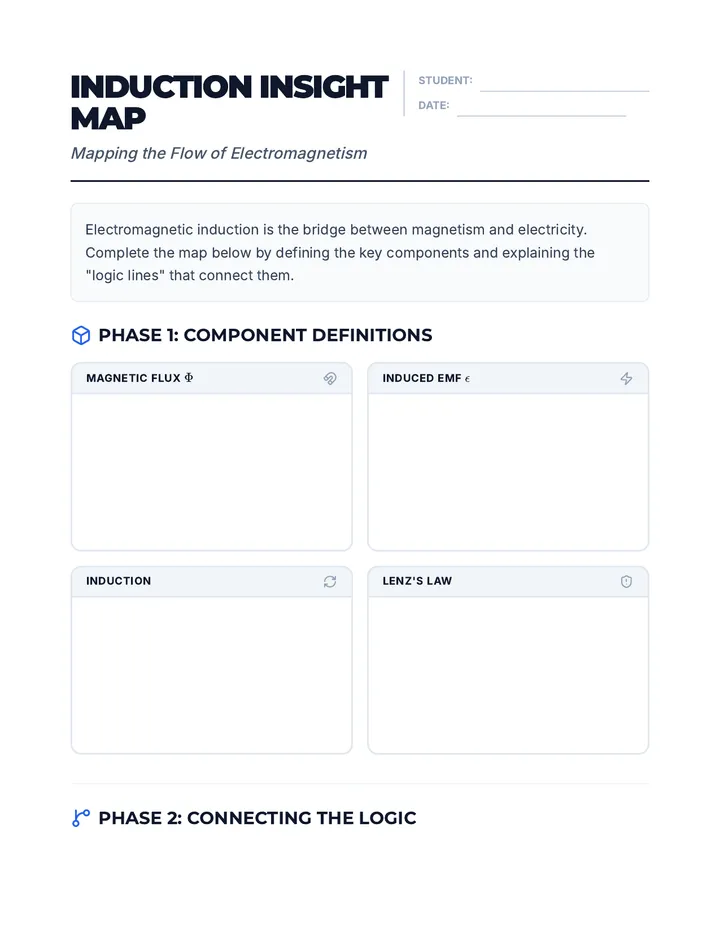
Induction Insight Map Handout

Magnetic Forces Investigation

A 5-day intensive exploration of magnetic forces and fields, focusing on atomic-level causes, field interactions, and mathematical modeling of forces on charged particles. Students progress from anchoring phenomena to complex mathematical applications and a comprehensive unit review.

OM

Olutoyin Makinde

68
Pressure Poster Workshop Handout

Pressure Power

A comprehensive 5-day chemistry unit investigating the relationships between gas pressure, volume, temperature, and moles using lab inquiries, mathematical modeling, and real-world applications.

OM

Olutoyin Makinde

69
KMT Field Manual Packet

Molecular Mayhem Gas Unit

A 10-day exploration of the Behavior of Gases using Kinetic Molecular Theory, various gas laws, and real-world phenomena to understand gas behavior at both molecular and macroscopic scales. Students will investigate compressibility, gas variables, ideal behavior, and mixtures.

OM

Olutoyin Makinde

26
CHEM 1406 Study Guide

CHEM 1406 Lab Midterm Review

A comprehensive review of CHEM 1406 introductory chemistry lab concepts, including safety, measurement, atomic structure, bonding, and chemical reactions.

OM

Olutoyin Makinde

4
Lab Success Study Guide

Lab Chemistry Mastery

A specialized curriculum designed to prepare students for introductory chemistry laboratory examinations, focusing on practical applications, quantitative calculations, and organic structure identification.

OM

Olutoyin Makinde

3
Stoichiometry Master Slides Plus Practice

Stoichiometry Mastery

A unit focused on the quantitative relationships in chemical reactions, covering everything from basic molar mass to complex limiting reactant and percent yield calculations.

OM

Olutoyin Makinde

27

Lessons

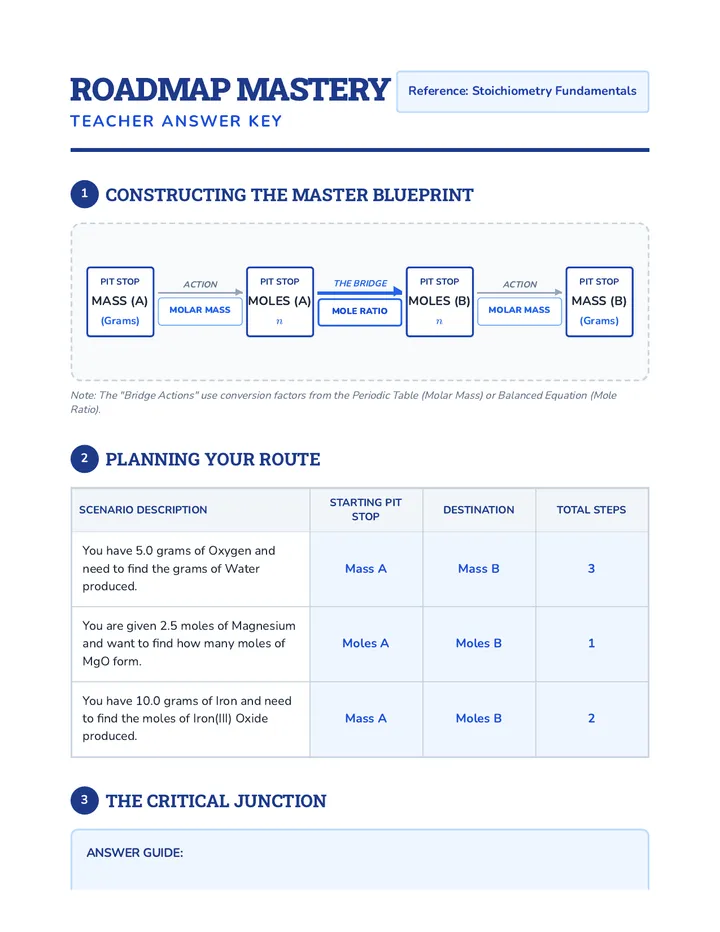
Roadmap Mastery Answer Key

Reaction Roadmap

A comprehensive lesson on mastering the stoichiometry roadmap, covering mole-to-mole conversions, mass-to-mass calculations, limiting reactants, and percent yield through visual slides and interactive sorting activities.

OM

Olutoyin Makinde

13
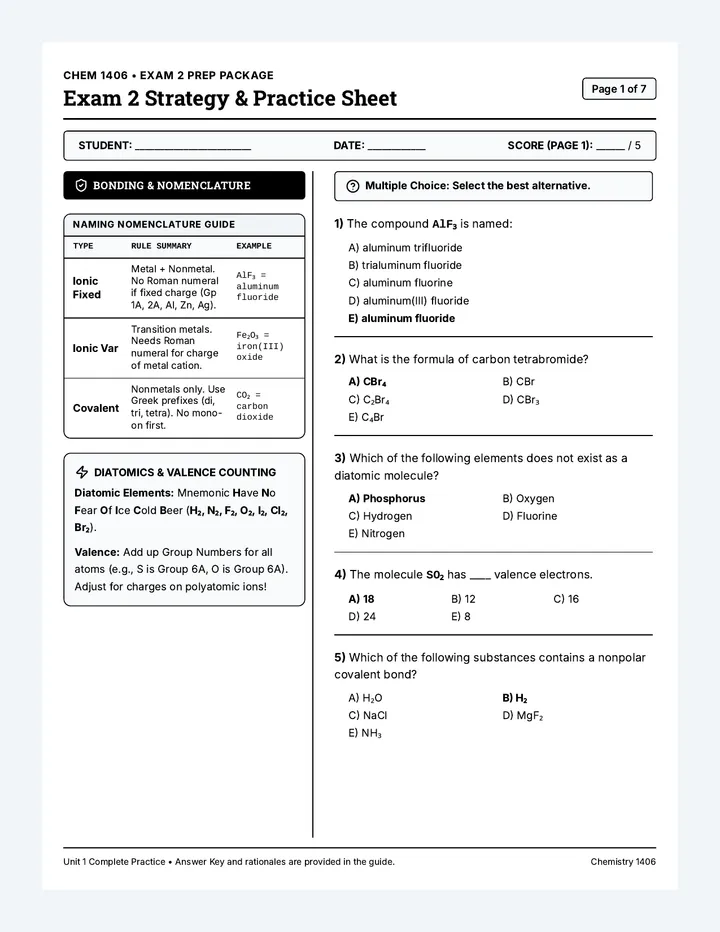
Exam 2 Strategy and Practice Sheet

Exam Prep Package

A comprehensive study and practice package for Chemistry 1406 Exam 2. It contains a highly structured, side-by-side strategy guide paired with a 30-question practice exam, and a matching detailed answer key with step-by-step rationales.

OM

Olutoyin Makinde

2
Molarity Mastery Handout

Concentration Station

A lesson focused on calculating solution concentration using molarity, including necessary unit conversions for mass and volume.

A

aaron.randolph

2
Mole Mastery Explainer

Mole and Molar Mass Basics

A comprehensive introduction to the mole concept and molar mass, covering Avogadro's number and basic mass-to-mole conversions.

A

aaron.randolph

2
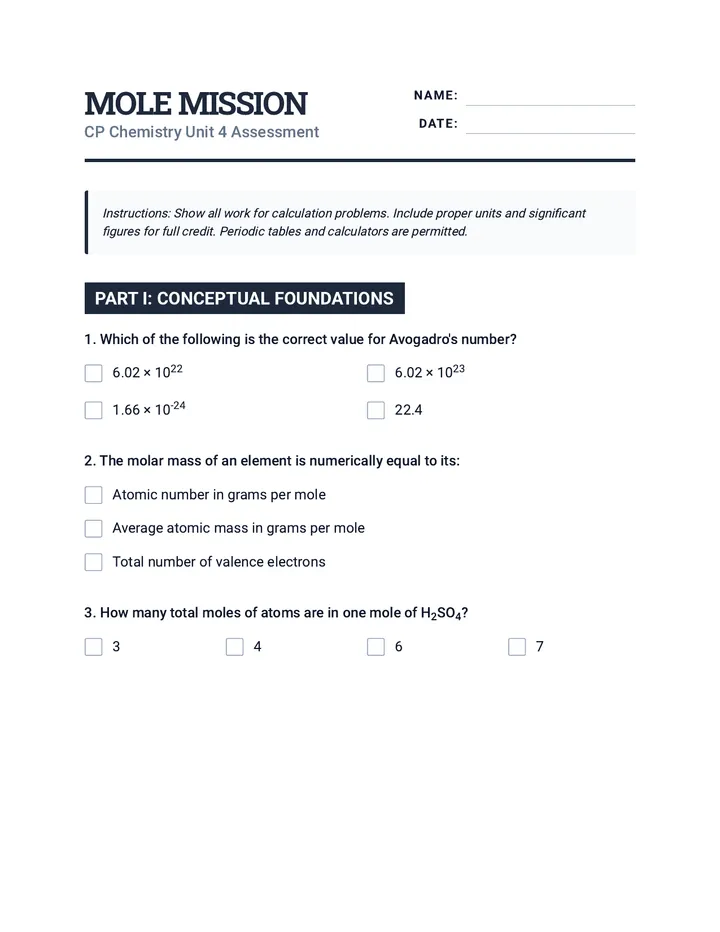
Mole Mission Test

Mole Mission

A comprehensive assessment and review package covering chemical quantities, molar conversions, and stoichiometric calculations for CP Chemistry.

S

ssneierson

3
Stoichiometry Survival Guide Cheat Sheet

Stoichiometry Mastery

A comprehensive lesson on stoichiometry covering mass conservation, molar conversions, and reaction yields. Includes a visual cheat sheet and a mastery assessment.

OM

Olutoyin Makinde

3