Lenny.com
Explore
Create
ActivitiesNewMathEnglish Language ArtsScience & EngineeringSocial StudiesGlobal LanguagesHealth & Physical EducationSpecial EducationCounseling & Life SkillsArts & CreativityESL
Lenny.com
Lenny.com
Explore
Create
ActivitiesNewMathEnglish Language ArtsScience & EngineeringSocial StudiesGlobal LanguagesHealth & Physical EducationSpecial EducationCounseling & Life SkillsArts & CreativityESL
Lenny.com
Science & EngineeringLife ScienceLiving ThingsAnimalsPlantsBody SystemsTraitsAdaptationsCellsEcosystemsHeredityGenes to TraitsCell DivisionPhysicsComparing MaterialsShapes and PropertiesMagnetsMagnetismLightSoundLight and SoundMatterStates of MatterChanges of StateMixturesPhysical and Chemical ChangeHeating and CoolingHeat and Thermal EnergyEnergyForce and MotionElectrical CircuitsAtoms and MoleculesPeriodic TableMotion in One DimensionMotion in Two DimensionsScalars and VectorsForces and Laws of MotionCircular Motion and GravityMomentum and ImpulseWork, Energy, and PowerWavesElectromagnetic WavesGeometric OpticsElectricity and MagnetismSimple Harmonic MotionThermodynamicsNuclear PhysicsEarth Science & AstronomyWeatherWater CycleRocks and MineralsFossilsEarth's FeaturesEarth's ResourcesEarth's StructureWeather and ClimateEarth EventsFossils and Geologic TimePlate TectonicsHuman ImpactsAstronomyChemistryUnits and MeasurementAtomic StructurePeriodic TrendsChemical BondingNomenclatureMolecular StructureIntermolecular ForcesThe MoleStoichiometryProperties of GasesSolutionsChemical ReactionsBalancing EquationsEnergy ChangesRates of ReactionsEquilibriumAcids and BasesQuantum ModelBiologyClassificationCell StructureThe Chemistry of LifeBiomoleculesCellular TransportCell EnergyCell Growth and DivisionDNAProtein SynthesisMeiosis and Sexual ReproductionPatterns of InheritanceMulticellular OrganismsEvolutionEcologyBiodiversityComputer ScienceAlgorithms and Computational ThinkingProgramming LanguagesComputing SystemsNetworks and InternetData AnalysisCybersecurityAI and Machine LearningSoftware Design and DevelopmentBlockchainEngineering & AIDesigning ExperimentsEngineering PracticesDesign ThinkingEngineering Design ProcessMechanical EngineeringElectrical EngineeringMaterials and StructuresCAD and 3D DesignRoboticsArtificial Intelligence BasicsVibe CodingMachine LearningAI Ethics and SocietySystems ThinkingEntrepreneurship & InnovationEntrepreneurial MindsetBusiness Idea DevelopmentBusiness Plan BasicsMarketing & Customer DiscoveryFinancial Management for Startups

Force and Motion

Newton’s laws of motion, friction, and gravity applied to physical systems. Examines the relationship between mass, acceleration, and net force through quantitative calculations and practical observations.

Lenny.com

Solutions

Lenny for EducatorsLenny for SchoolsLenny for Districts

Product

ExploreSign inCreateSupportAbout

Resources

Getting startedMTSS Acceleration Program

© 2026 Lenny Learning Inc.

TermsPrivacyAccessibility
LinkedInInstagramX
Lenny

Videos

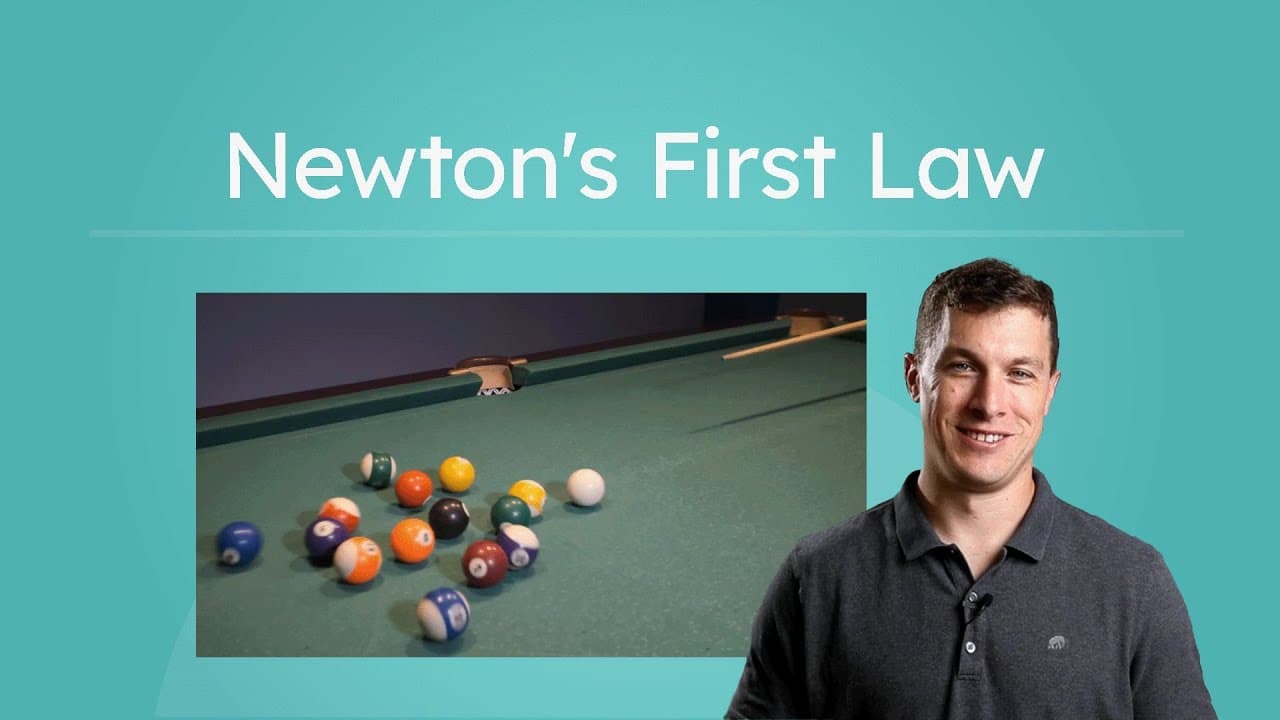
How Newton's First Law Explains Rest and Motion

How Newton's First Law Explains Rest and Motion

This engaging educational video provides a comprehensive introduction to Newton's First Law of Motion, demystifying physics concepts through relatable examples and clear visual aids. The narrator breaks down the law into two main components: objects at rest and objects in motion, explaining that both states require a net force of zero to maintain their status. The video uses humor and casual language—referring to objects "chilling"—to make the abstract concept of inertia accessible to students. Key themes include the definition of net force as the sum of all forces acting on an object, the relationship between force and acceleration, and the importance of free-body diagrams. The content clarifies the distinction between constant velocity and acceleration, emphasizing that a change in direction (like a boat turning) counts as acceleration and thus requires a net force. It also introduces the mathematical notation for net force (Fnet = 0). Ideally suited for middle and high school physical science classrooms, this video serves as excellent instructional material for introducing forces and motion. Teachers can use the built-in practice questions and free-body diagram exercises to check for understanding in real-time. The clear visual representations of forces (gravity, normal force, friction, tension) provide a strong foundation for students learning to analyze physical systems.

Miacademy & MiaPrep Learning ChannelMiacademy & MiaPrep Learning Channel

9mins 11s

How Things Move: Pushes and Pulls

How Things Move: Pushes and Pulls

This engaging educational video introduces young learners to the fundamental concepts of motion and forces through relatable, real-world examples. It begins by observing everyday movement—from children playing on a playground to a Ferris wheel spinning—and establishes the core scientific principle that objects cannot move on their own without the application of a force. The content is paced perfectly for early elementary students, using clear narration and distinct visual cues to explain complex ideas simply. The video breaks down the definition of a force into two primary categories: pushes and pulls. It illustrates "push" forces through actions like throwing a basketball, bowling, and kicking a soccer ball, defining them as pressing something away. Conversely, "pull" forces are demonstrated through tug-of-war, dragging a sled, and opening a can, defined as bringing objects closer. The video also touches on how these forces can work together in activities like fishing. Teachers can use this video as a perfect anchor for a physical science unit on motion and stability. The final segment, which poses questions about specific actions (sweeping, hammering, opening a door), serves as an built-in formative assessment, allowing educators to pause and check for student understanding. It provides a solid foundation for understanding cause and effect in the physical world, making it an essential resource for K-2 science curriculums.

Next Generation ScienceNext Generation Science

2mins 14s

Calculating Speed vs. Velocity: Definitions and Practice

Calculating Speed vs. Velocity: Definitions and Practice

This educational video provides a clear and comprehensive introduction to the physics concepts of speed and velocity. It begins by engaging students with examples of fast-moving objects like race cars and rockets before settling into the mathematical definitions of motion. The narrator uses real-world analogies, such as a long car trip involving both highway driving and traffic jams, to distinguish between average speed and instantaneous speed. The video then introduces the crucial distinction between scalar quantities and vector quantities, explaining how distance relates to speed while displacement relates to velocity. The content covers key themes in kinematics, specifically focusing on the difference between distance (total ground covered) and displacement (straight-line distance from start to finish). It explicitly teaches the formulas for calculating average speed (Distance/Time) and average velocity (Displacement/Time). A significant portion of the video is dedicated to step-by-step worked examples where the narrator calculates both speed and velocity for the same trip, demonstrating how the results differ numerically and conceptually—most notably that velocity requires a direction. For educators, this video is an excellent resource for middle school physical science or introductory high school physics classrooms. It moves beyond simple definitions to application, providing guided practice problems that allow students to test their understanding immediately. The use of visual maps to illustrate the path of travel versus the vector of displacement helps concrete thinkers grasp abstract concepts. Teachers can use this video to introduce motion formulas, reinforce the concept of vectors, or as a flipped classroom assignment before a lab on measuring motion.

Miacademy & MiaPrep Learning ChannelMiacademy & MiaPrep Learning Channel

7mins 42s

Building Blanket Forts with the Science of Tension

Building Blanket Forts with the Science of Tension

In this engaging episode of SciShow Kids, host Jessi and her robot friend Squeaks explore the physics behind a favorite childhood pastime: building blanket forts. The video transforms a fun rainy-day activity into an introductory engineering lesson by explaining how structures stay standing. Jessi demonstrates two specific methods for constructing forts—the basic draped sheet and the 'tent' style using a string—while explaining the scientific principles that make them work. The content focuses heavily on physical science concepts, specifically the idea of 'forces' (pushes and pulls) and 'tension' (a pulling force). The video draws a clear parallel between the mechanics of a blanket fort and the engineering of massive suspension bridges, showing students that the same physical laws apply to both. It introduces key vocabulary like 'tension,' 'anchors,' and 'engineers' in a highly accessible context. For educators, this video serves as an excellent hook for STEM challenges and physical science units. It provides a concrete, low-stakes environment for students to experiment with forces. Teachers can use this video to launch a classroom engineering design challenge where students must plan, build, and test structures, applying the concept of tension to create stability. It validates play as a form of scientific experimentation.

SciShow KidsSciShow Kids

3mins 16s

How Gears Work: Direction, Force, and Speed

How Gears Work: Direction, Force, and Speed

This concise educational video provides a clear, foundational overview of gears as simple machines. It defines what gears are—wheels with interlocking teeth—and visually demonstrates their three primary functions: changing the direction of force, multiplying applied force (mechanical advantage), and multiplying speed. The narration is supported by high-quality close-ups of various gear mechanisms in action, ranging from simple plastic models to heavy industrial machinery. The video explores key mechanical concepts including the relationship between gear size and speed/force. It explains how turning a smaller gear to drive a larger one creates more force but less speed, while the reverse increases speed. The content concludes by connecting these abstract physical principles to concrete, everyday objects like bicycles, fishing reels, watches, and can openers, helping students recognize engineering in their daily lives. For educators, this resource serves as an excellent introduction or review for a unit on simple machines, physics, or engineering. Its short runtime makes it a perfect "hook" to start a lesson or a visual anchor to reinforce textbook definitions. The clear visual evidence of counter-rotation and speed differences allows teachers to pause and ask predictive questions, making it a valuable tool for developing observational skills in STEM subjects.
Next Generation ScienceNext Generation Science

1min 8s

Understanding and Calculating Kinetic Friction

Understanding and Calculating Kinetic Friction

This educational video provides a comprehensive introduction to kinetic friction, a fundamental concept in physics. The lesson begins with a relatable hook about air resistance and the Hyperloop to illustrate the concept of friction as a force that resists motion. It then transitions into a formal definition of kinetic friction, distinguishing it from static friction, and introduces the mathematical formula used to calculate it ($F_k = \mu_k N$). The video explores key themes such as the relationship between normal force and weight, the coefficient of friction, and how surface materials affect friction levels. A comparative table highlights the difference between static and kinetic coefficients, emphasizing that it takes more force to start an object moving than to keep it moving. The narrator uses clear visual aids, including free-body diagrams, to explain how forces interact on objects like a sled being pulled through snow. Ideally suited for middle and high school physical science or physics curriculums, this resource is highly valuable for teaching students how to solve physics problems step-by-step. The video walks viewers through two complete calculation examples—one guided and one for independent practice—reinforcing algebraic skills and the application of scientific formulas. Teachers can use this video to introduce friction, model problem-solving strategies, or as a flipped classroom resource for students to master force calculations.

Miacademy & MiaPrep Learning ChannelMiacademy & MiaPrep Learning Channel

6mins 6s

Materials

Science Action Syllabus

Science Action Syllabus

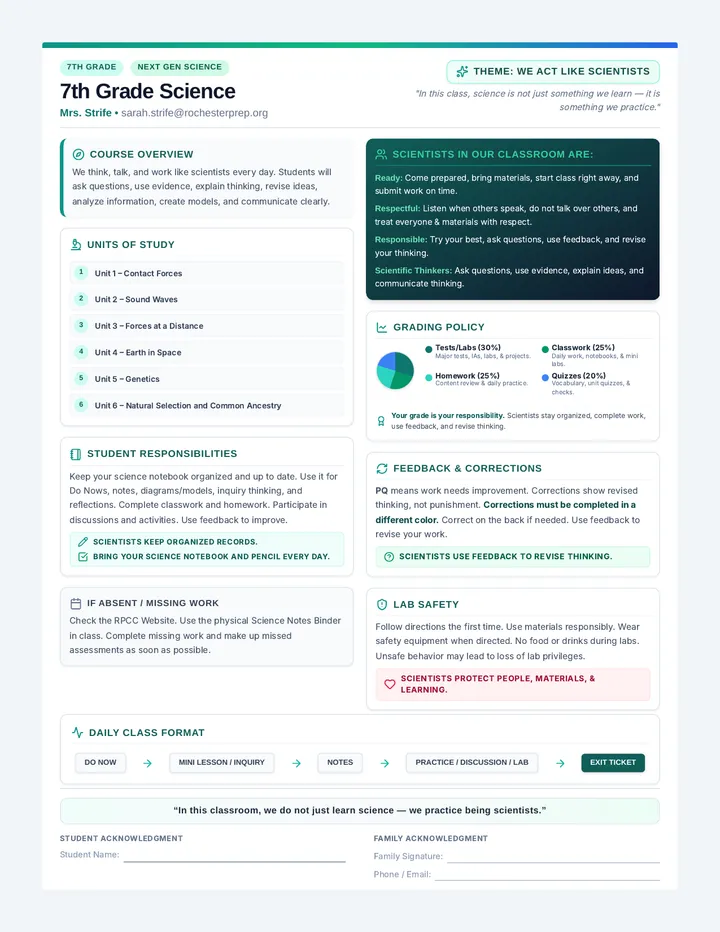
An updated 1-page 7th Grade Science Syllabus for Mrs. Strife. Formatted in a clean, professional, and visually engaging dual-column layout with organized boxes, bold headings, blue/green accent themes, and custom science icons. Includes a newly designed visual 'Grading Policy' section with a clean CSS-based donut chart. Perfect for student and parent onboarding.

SS

Sarah Strife

Load Lab Vocabulary Guide

Load Lab Vocabulary Guide

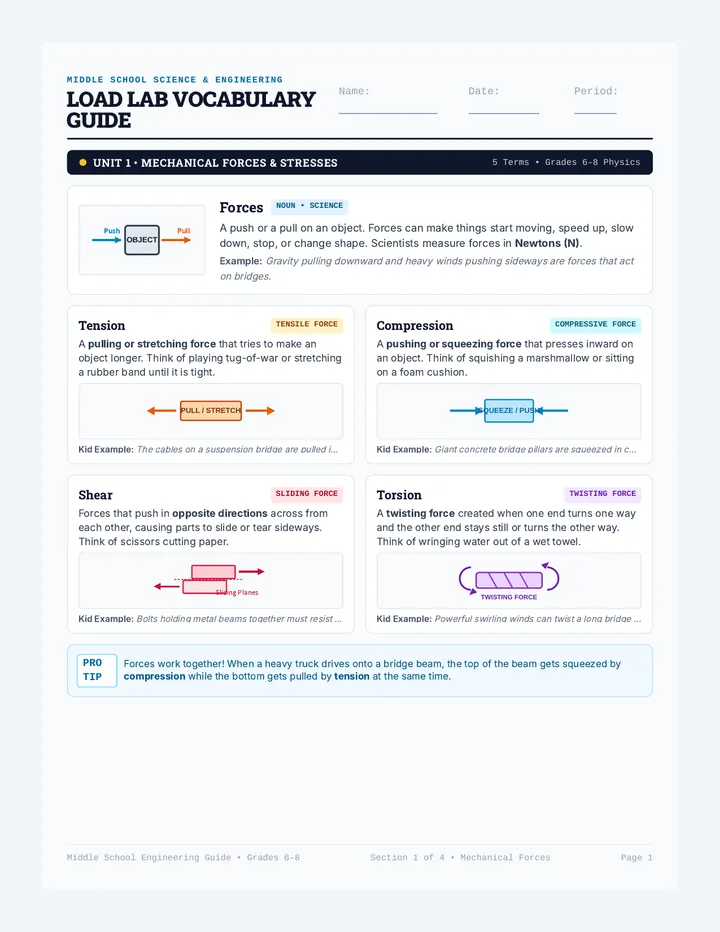
A four-page illustrated vocabulary guide tailored for 6th to 8th graders covering 21 structural engineering and scientific inquiry terms with relatable middle school definitions, real-world examples, and custom vector diagrams.

TC

Theresa Crafts

Horizontal Collisions Adapted Sheet

Horizontal Collisions Adapted Sheet

A two-page adapted, bilingual English-Spanish resource for OpenSciEd 8.1 Lesson 2 on horizontal collisions: Page 1 contains the large-print lab observation sheet with visual response choices, and Page 2 provides a visual vocabulary and concept reference guide for WIDA Level 1 non-readers.

N

nebouchard

Wind Chasers Worksheet

Wind Chasers Worksheet

An accessible, single-page science worksheet for 3rd graders focused on how wind moves, defining wind as moving air, showing warm and cool air movement without pressure jargon, and featuring gentle comprehension questions.

EG

Emily Gianni

Motion Masters Reading Sheet

Motion Masters Reading Sheet

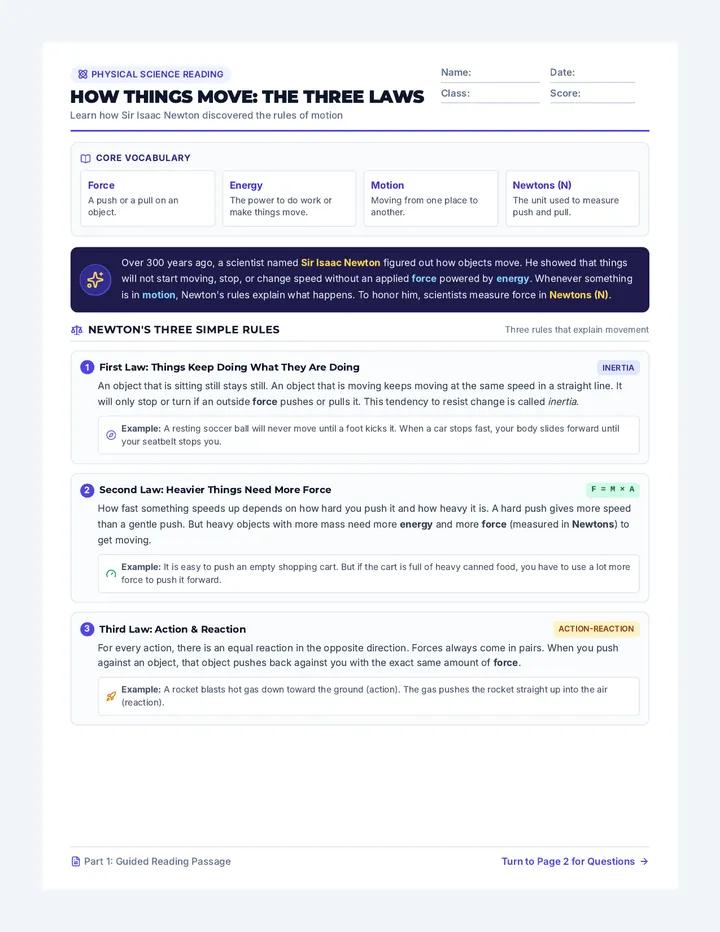
A simplified two-page reading passage and comprehension worksheet introducing Sir Isaac Newton, core physics vocabulary (force, energy, motion, Newtons), and the Three Laws of Motion with accessible explanations, everyday examples, and structured response questions.

AC

Aaron Conlin

Energy Detectives Worksheet

Energy Detectives Worksheet

A two-page printable science practice worksheet exploring how energy is detected through observable evidence like light, sound, heat, and motion. Students analyze everyday scenarios to identify evidence clues and explain how invisible energy reveals its presence.

KB

Kelsey Barofski

Sequences

Planet Profile Slides

Infinite Frontier

A comprehensive Hi-Lo unit for 6th graders exploring the scale of the universe, our place in the Milky Way, the technology used to explore space, and the history of human spaceflight.

JS

Janette Sullivan

54
Naval Architect Challenge Answer Key

Fluid Dynamics

A series of lessons exploring the physics of fluids, including buoyancy, pressure, and fluid flow.

CM

Chuguna Murugesan

28
Vowel Valley Fluency Packet Mastered

Phonics Fluency Fun

A series of phonics lessons focusing on vowel teams, digraphs, and other phonetic patterns through narrative passages and fluency drills.

N

npowers

28
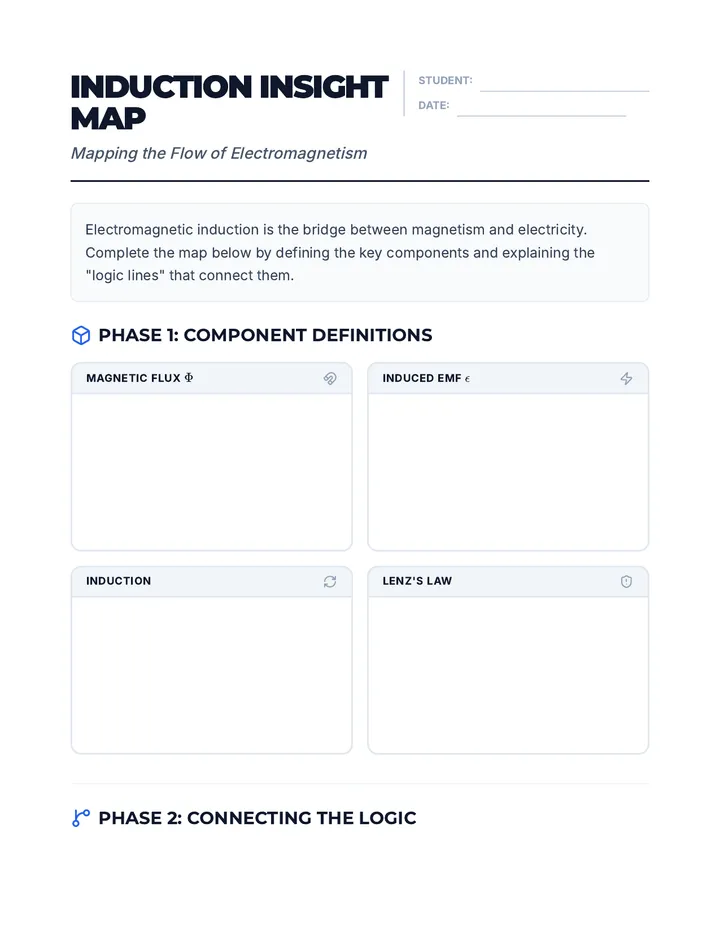
Induction Insight Map Handout

Magnetic Forces Investigation

A 5-day intensive exploration of magnetic forces and fields, focusing on atomic-level causes, field interactions, and mathematical modeling of forces on charged particles. Students progress from anchoring phenomena to complex mathematical applications and a comprehensive unit review.

OM

Olutoyin Makinde

68
Mission Scoring Rubric

Physics Frontiers Research Project

A partner-based research project for 9th-grade conceptual physics students focusing on diverse topics from celestial mechanics to the physics of dance. Students move through a structured research process with mandatory teacher checkpoints for source reliability.

C

ckroeker

13
Climate Crisis Slides

Science Essentials Vault

A comprehensive collection of core science units covering Environmental Science, Biology, and Physical Science. This sequence provides high-impact instructional slides, hands-on lab experiences, guided notes, and differentiated assessments for five major scientific domains.

CB

Chloe Brown

25