Lenny.com
Explore
Create
ActivitiesNewMathEnglish Language ArtsScience & EngineeringSocial StudiesGlobal LanguagesHealth & Physical EducationSpecial EducationCounseling & Life SkillsArts & CreativityESL
Lenny.com
Lenny.com
Explore
Create
ActivitiesNewMathEnglish Language ArtsScience & EngineeringSocial StudiesGlobal LanguagesHealth & Physical EducationSpecial EducationCounseling & Life SkillsArts & CreativityESL
Lenny.com
Lenny.com

Solutions

Lenny for EducatorsLenny for SchoolsLenny for Districts

Product

ExploreSign inCreateSupportAbout

Resources

Getting startedMTSS Acceleration Program

© 2026 Lenny Learning Inc.

TermsPrivacyAccessibility
LinkedInInstagramX
Lenny

Momentum and Impulse

Linear momentum, impulse-momentum theorem, and conservation principles during collisions. Examines force application over time and its effect on object velocity and system stability.

Science & EngineeringLife ScienceLiving ThingsAnimalsPlantsBody SystemsTraitsAdaptationsCellsEcosystemsHeredityGenes to TraitsCell DivisionPhysicsComparing MaterialsShapes and PropertiesMagnetsMagnetismLightSoundLight and SoundMatterStates of MatterChanges of StateMixturesPhysical and Chemical ChangeHeating and CoolingHeat and Thermal EnergyEnergyForce and MotionElectrical CircuitsAtoms and MoleculesPeriodic TableMotion in One DimensionMotion in Two DimensionsScalars and VectorsForces and Laws of MotionCircular Motion and GravityMomentum and ImpulseWork, Energy, and PowerWavesElectromagnetic WavesGeometric OpticsElectricity and MagnetismSimple Harmonic MotionThermodynamicsNuclear PhysicsEarth Science & AstronomyWeatherWater CycleRocks and MineralsFossilsEarth's FeaturesEarth's ResourcesEarth's StructureWeather and ClimateEarth EventsFossils and Geologic TimePlate TectonicsHuman ImpactsAstronomyChemistryUnits and MeasurementAtomic StructurePeriodic TrendsChemical BondingNomenclatureMolecular StructureIntermolecular ForcesThe MoleStoichiometryProperties of GasesSolutionsChemical ReactionsBalancing EquationsEnergy ChangesRates of ReactionsEquilibriumAcids and BasesQuantum ModelBiologyClassificationCell StructureThe Chemistry of LifeBiomoleculesCellular TransportCell EnergyCell Growth and DivisionDNAProtein SynthesisMeiosis and Sexual ReproductionPatterns of InheritanceMulticellular OrganismsEvolutionEcologyBiodiversityComputer ScienceAlgorithms and Computational ThinkingProgramming LanguagesComputing SystemsNetworks and InternetData AnalysisCybersecurityAI and Machine LearningSoftware Design and DevelopmentBlockchainEngineering & AIDesigning ExperimentsEngineering PracticesDesign ThinkingEngineering Design ProcessMechanical EngineeringElectrical EngineeringMaterials and StructuresCAD and 3D DesignRoboticsArtificial Intelligence BasicsVibe CodingMachine LearningAI Ethics and SocietySystems ThinkingEntrepreneurship & InnovationEntrepreneurial MindsetBusiness Idea DevelopmentBusiness Plan BasicsMarketing & Customer DiscoveryFinancial Management for Startups

Videos

How to Identify Elastic and Inelastic Collisions

How to Identify Elastic and Inelastic Collisions

This educational video provides a clear and engaging introduction to the physics of collisions, specifically distinguishing between elastic and inelastic types. Opening with a relatable personal anecdote about a flag football accident, the narrator simplifies complex physics concepts into a straightforward binary: collisions that "stick" (inelastic) and collisions that "bounce" (elastic). The video uses high-quality slow-motion footage and clear graphics to illustrate how kinetic energy behaves differently in each scenario.

Miacademy & MiaPrep Learning ChannelMiacademy & MiaPrep Learning Channel

8mins 34s

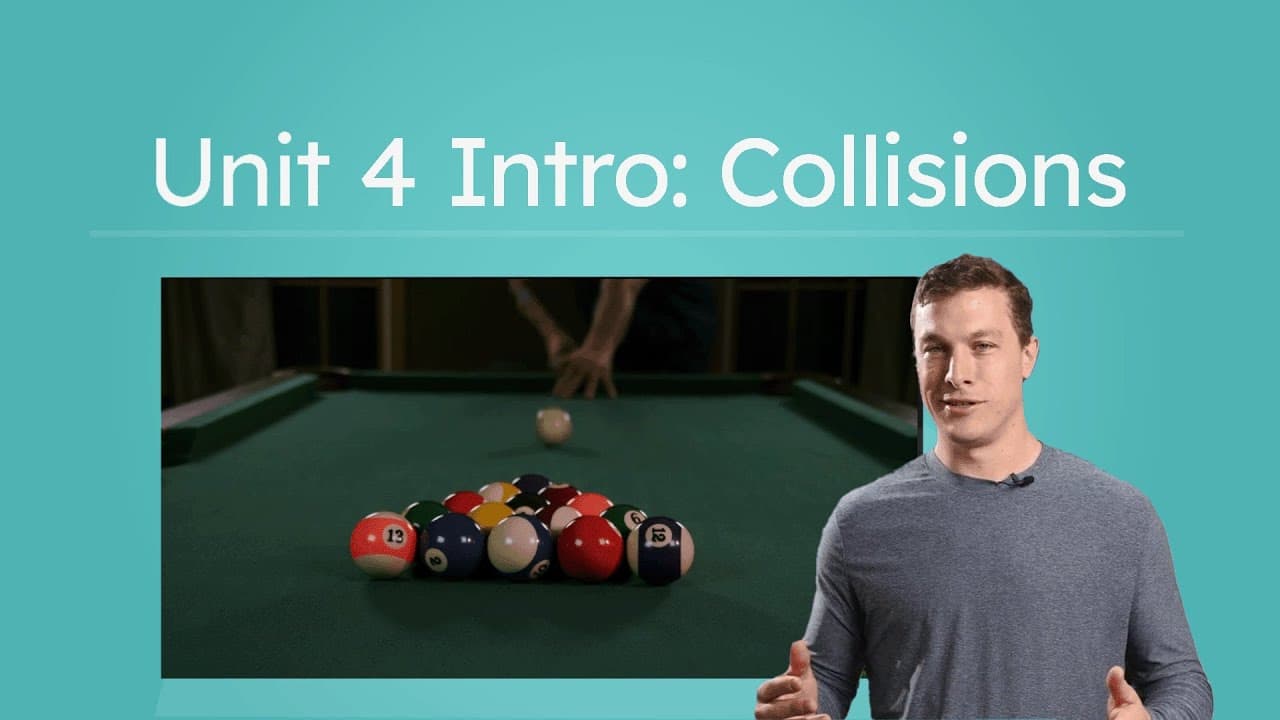
Introduction to Collisions: Momentum, Impulse, and Impact Types

Introduction to Collisions: Momentum, Impulse, and Impact Types

This engaging physics video serves as an introduction to a unit on collisions, moving beyond single-object motion to the interaction between two objects. It systematically breaks down the core concepts necessary to understand these interactions: momentum, impulse, and the classification of collisions as either elastic or inelastic. The video utilizes clear real-world examples ranging from container ships and butterflies to sports like pool, golf, and kickboxing to illustrate abstract physical properties. Key themes include the mathematical definition of momentum ($p=mv$), the Law of Conservation of Momentum, the relationship between force and time in creating impulse ($Δp = FΔt$), and the distinction between objects bouncing (elastic) versus sticking together (inelastic). The content connects mathematical formulas directly to observable phenomena, such as why follow-through is important in sports. For educators, this video is an excellent hook and foundational overview for a high school physics unit on mechanics. It provides clear definitions, introduces essential formulas, and offers ready-made visual analogies that can be analyzed in class. It is particularly useful for visual learners who need to see the connection between equations and physical actions, such as a golf swing or a car crash.

Miacademy & MiaPrep Learning ChannelMiacademy & MiaPrep Learning Channel

5mins 57s

Solving Inelastic Collision Problems in Physics

Solving Inelastic Collision Problems in Physics

A clear, step-by-step physics tutorial that explains inelastic collisions through real-world examples and mathematical problem-solving. The video begins with a relatable personal anecdote about a car accident to define inelastic collisions as events where objects stick together. It distinguishes these from elastic collisions by noting the loss of kinetic energy, permanent deformation, and the shared final velocity of the objects involved.

Miacademy & MiaPrep Learning ChannelMiacademy & MiaPrep Learning Channel

11mins 20s

Understanding and Calculating Elastic Collisions

Understanding and Calculating Elastic Collisions

This educational video provides a comprehensive guide to understanding and calculating elastic collisions in physics. Starting with a relatable analogy of bumper cars, the instructor defines elastic collisions as interactions where objects bounce off one another and kinetic energy is conserved. The video carefully derives the mathematical formula for elastic collisions from the principle of conservation of momentum, showing students exactly where the equation comes from rather than just asking them to memorize it. The content covers key themes such as conservation of momentum, the distinction between initial and final states, the role of mass and velocity, and the importance of directional signs (vectors) in physics calculations. It specifically addresses common challenges, such as handling negative velocities when objects move in opposite directions and managing significant figures in final answers. Designed for high school physics classrooms, this video acts as both a conceptual introduction and a practical problem-solving tutorial. It models the step-by-step process of identifying variables, setting up equations, plugging in values, and performing algebraic manipulations to solve for unknowns. Teachers can use this video to introduce the topic, support students struggling with the math of momentum, or as a review tool before a unit test on mechanics.

Miacademy & MiaPrep Learning ChannelMiacademy & MiaPrep Learning Channel

17mins 53s

Understanding Impulse: The Physics of Force and Time

Understanding Impulse: The Physics of Force and Time

This educational video provides a comprehensive introduction to the physics concept of impulse, defining it as the change in momentum of an object during a collision. The instructor begins with a relatable analogy about golf and the importance of "following through," using this to explain how maximizing the time of contact increases the momentum transferred to the ball. The video then transitions into a formal physics lesson, breaking down the variables that affect impulse: force and time.

Miacademy & MiaPrep Learning ChannelMiacademy & MiaPrep Learning Channel

11mins 26s

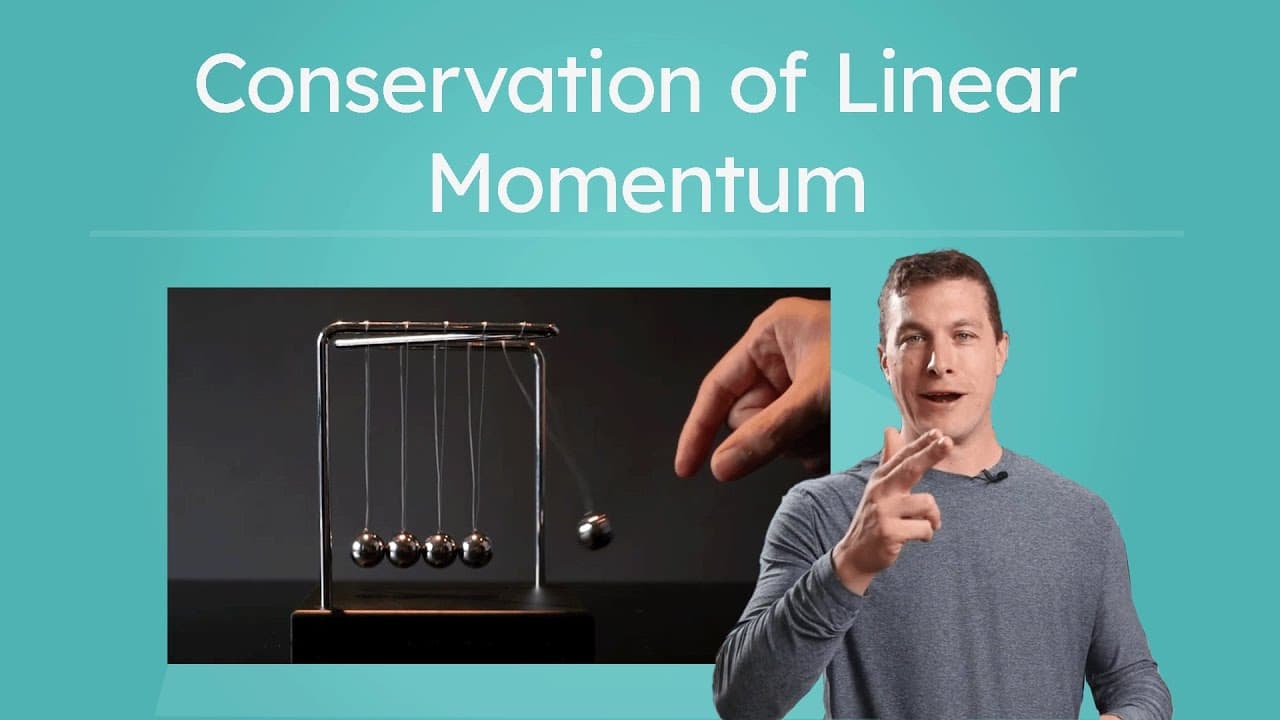
How to Calculate Conservation of Momentum in Collisions and Rockets

How to Calculate Conservation of Momentum in Collisions and Rockets

This educational video provides a clear, mathematically rigorous introduction to the Conservation of Momentum, a fundamental principle in physics. Starting with an engaging hook about unrealistic "movie physics" where recoil is ignored, the instructor defines momentum as a conserved vector quantity. The video transitions into detailed problem-solving demonstrations, showing students how to set up and solve algebraic equations for both collision and propulsion scenarios. The content is divided into three main sections: a review of momentum properties, applications to collisions (using pool balls), and applications to propulsion (using rockets). The instructor carefully guides viewers through the math, emphasizing the importance of significant figures and directional signs (positive vs. negative velocity). Visual demonstrations, including a Newton's Cradle and a slow-motion water bottle rocket launch, help ground the abstract math in physical reality. This resource is highly valuable for high school physics classrooms as it bridges the gap between conceptual understanding and mathematical application. It effectively models problem-solving strategies, explicitly showing every step of the algebraic manipulation. Teachers can use this video to introduce the topic, reinforce lecture material, or as a flipped classroom resource where students learn the calculation methods at home before doing labs in class.

Miacademy & MiaPrep Learning ChannelMiacademy & MiaPrep Learning Channel

12mins 43s

Materials

Dynamique Master Corrigé Final

Dynamique Master Corrigé Final

Un corrigé type complet et rédigé pour le contrôle de dynamique (PAM2). Le document inclut les solutions détaillées pour la conservation de la quantité de mouvement, la machine d'Atwood et les oscillations d'un système masse-ressort, avec calculs et schémas améliorés pour la lisibilité et les sauts de page.

WK

wiem Karboul

OSU Egg Drop Rubric

OSU Egg Drop Rubric

A single-page printable official scoring sheet and rubric for the 'OSU Egg Drop' competition. Features clear visual icon indicators for egg damage states (Intact, Hairline, Catastrophic) and details the high-stakes prize and pizza party conditions. Includes clean, dedicated grading regions for Design and Participation with an official scoreboard.

AC

Aaron Conlin

Collisions Guided Notes

Collisions Guided Notes

A two-page print-ready cloze guided notes handout covering momentum, impulse, elastic and inelastic collisions, and the conservation of momentum. Features structured fill-in blanks, concept diagrams, problem-solving checks, and an engineering-focused exit ticket.

LB

Lora Burt

Zombie Momentum Warmup Worksheet

Zombie Momentum Warmup Worksheet

A physics warmup worksheet themed around a zombie apocalypse, asking students to qualitatively and quantitatively compare the momentum of a heavy 'Tank' zombie versus a fast 'Sprinter' zombie. Includes space for calculations and conceptual explanations of stopping power.

RC

Robert Crager

Physics Challenge Slides

Physics Challenge Slides

عرض تقديمي تفاعلي لملف إنجاز فيزياء ثاني ثانوي (الفصل الثاني) يشتمل على بنك أسئلة شامل متبوع بصفحات الحل والتعليل العلمي الدقيق وفق المنهج الدراسي.

Sequences

Mission Scoring Rubric

Physics Frontiers Research Project

A partner-based research project for 9th-grade conceptual physics students focusing on diverse topics from celestial mechanics to the physics of dance. Students move through a structured research process with mandatory teacher checkpoints for source reliability.

C

ckroeker

13
Momentum Mission Worksheet

Momentum Mechanics

A comprehensive unit on momentum and collisions for 9th grade physics, covering the basic equation, collision types, conservation laws, and Newton's Third Law through real-world examples like vehicle safety and sports.

C

ckroeker

9
Momentum Mechanics Slides

Crash Test Lab

A physics unit wrap-up focusing on collisions, momentum, and vehicle safety engineering. This sequence transitions from hands-on lab investigation to independent data analysis and mathematical modeling.

C

ckroeker

16
Motion Dual Reading Pack

Physics of Motion

A comprehensive unit exploring the principles of kinematics, focusing on the relationship between linear and angular motion through readings, analysis, and real-world applications.

CM

Chuguna Murugesan

8
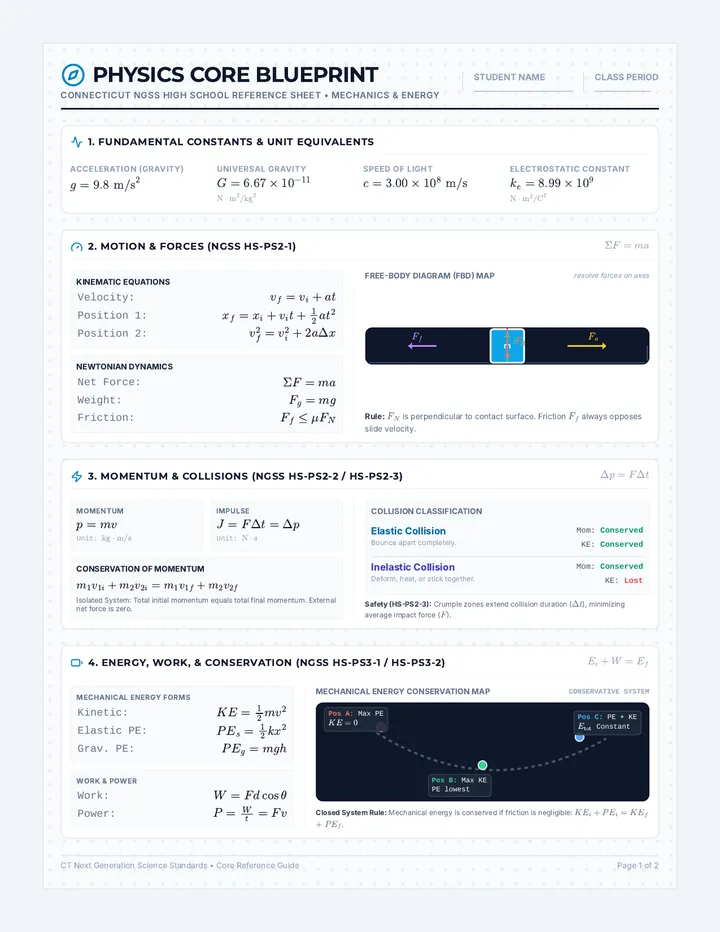
Physics Blueprint Reference Sheet

CT Physics Essentials

A comprehensive high school physics curriculum sequence aligned with the Connecticut Next Generation Science Standards (CT-NGSS), focusing on core concepts, quantitative problem-solving, and visual models.

T

tafranklin

1
Impact Investigations Slides

Momentum Mechanics

A guided discovery sequence on linear momentum, impulse, and 2D collisions, focusing on inquiry-based learning and vector analysis.

KA

Khairol Azmi

7

Lessons

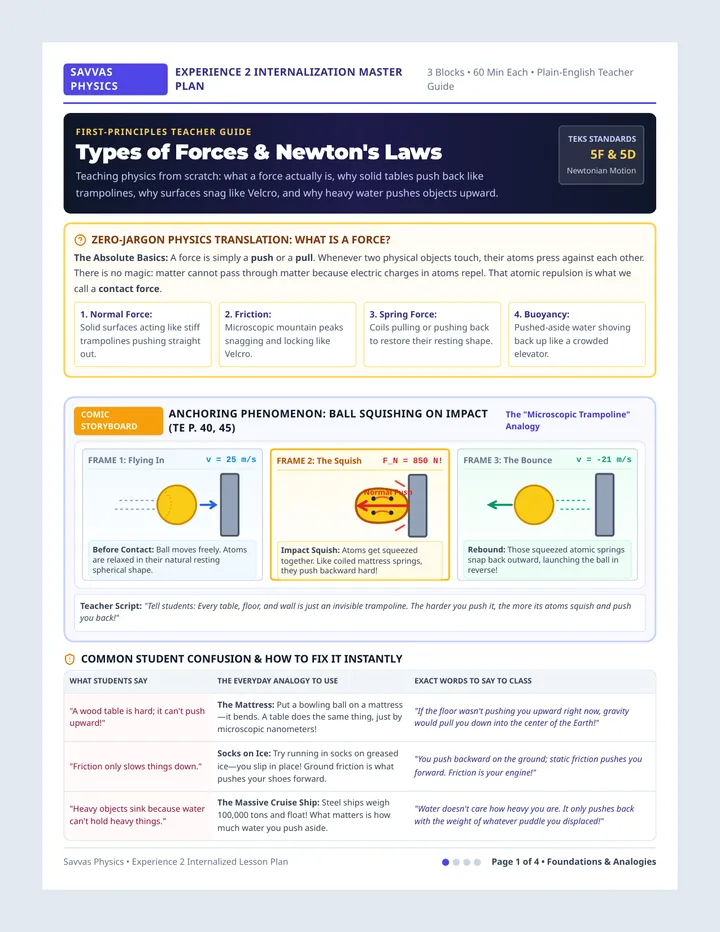
Types of Forces Lesson Plan

Types of Forces

A comprehensive 3-block high school physics lesson deconstructing macroscopic contact forces including elastic deformation, normal force, friction, and buoyancy through empirical inquiry and mathematical modeling.

OM

Olutoyin Makinde

10
Physics Final Study Guide Packet

Conceptual Physics Final Prep

A comprehensive 3-page study guide covering Radioactive Decay, Geophysics, Waves, and Momentum for a 9th grade Conceptual Physics final exam.

C

ckroeker

3
Spin Logic Slides

Rotational Rigor

This lesson explores advanced rotational dynamics, focusing on the application of Newton's Second Law for rotation to massive pulleys and rolling objects where static friction provides the necessary torque for rolling without slipping.

CM

Chuguna Murugesan

8
Collision Course Visual Guide

Collision Course

A conceptual introduction to momentum, Newton's 3rd Law, and conservation laws using car collisions as the primary model. Focused on qualitative understanding and simple single-step math.

C

ckroeker

5
Impact Theory Slides

Impulse Impact

A foundational introduction to momentum, impulse, and the Impulse-Momentum Theorem, exploring how forces acting over time change an object's motion through real-world examples like sports and safety features.

CM

Chuguna Murugesan

4
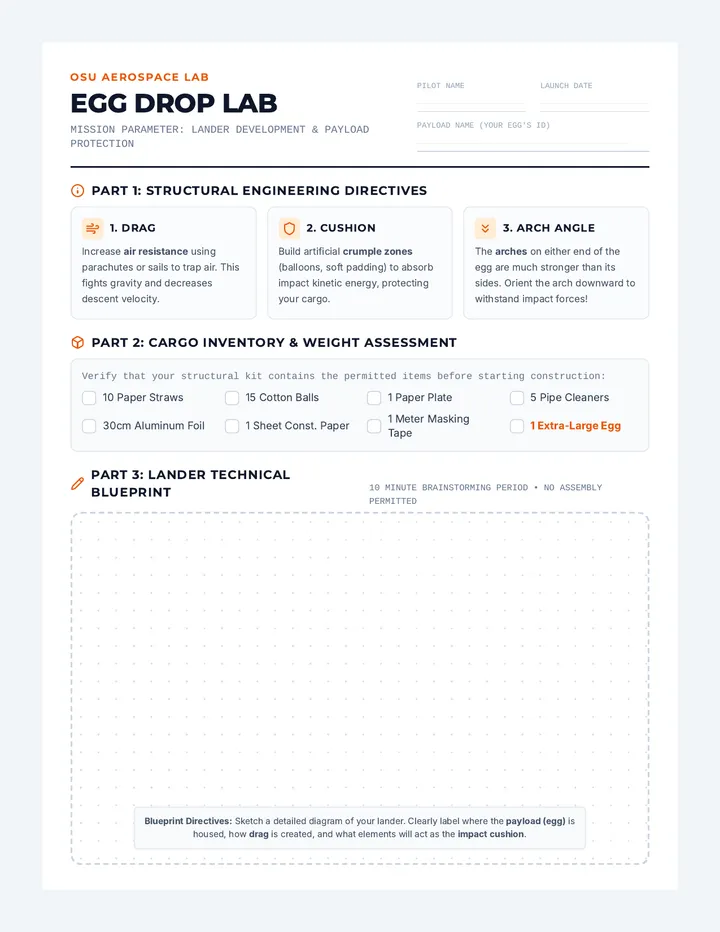
Egg Drop Lab Worksheet

Egg Drop Science

An engaging, hands-on physics and engineering lesson where students design, build, and test protective landing craft for fragile payloads (eggs), exploring forces, deceleration, and structural integrity.

AC

Aaron Conlin

1