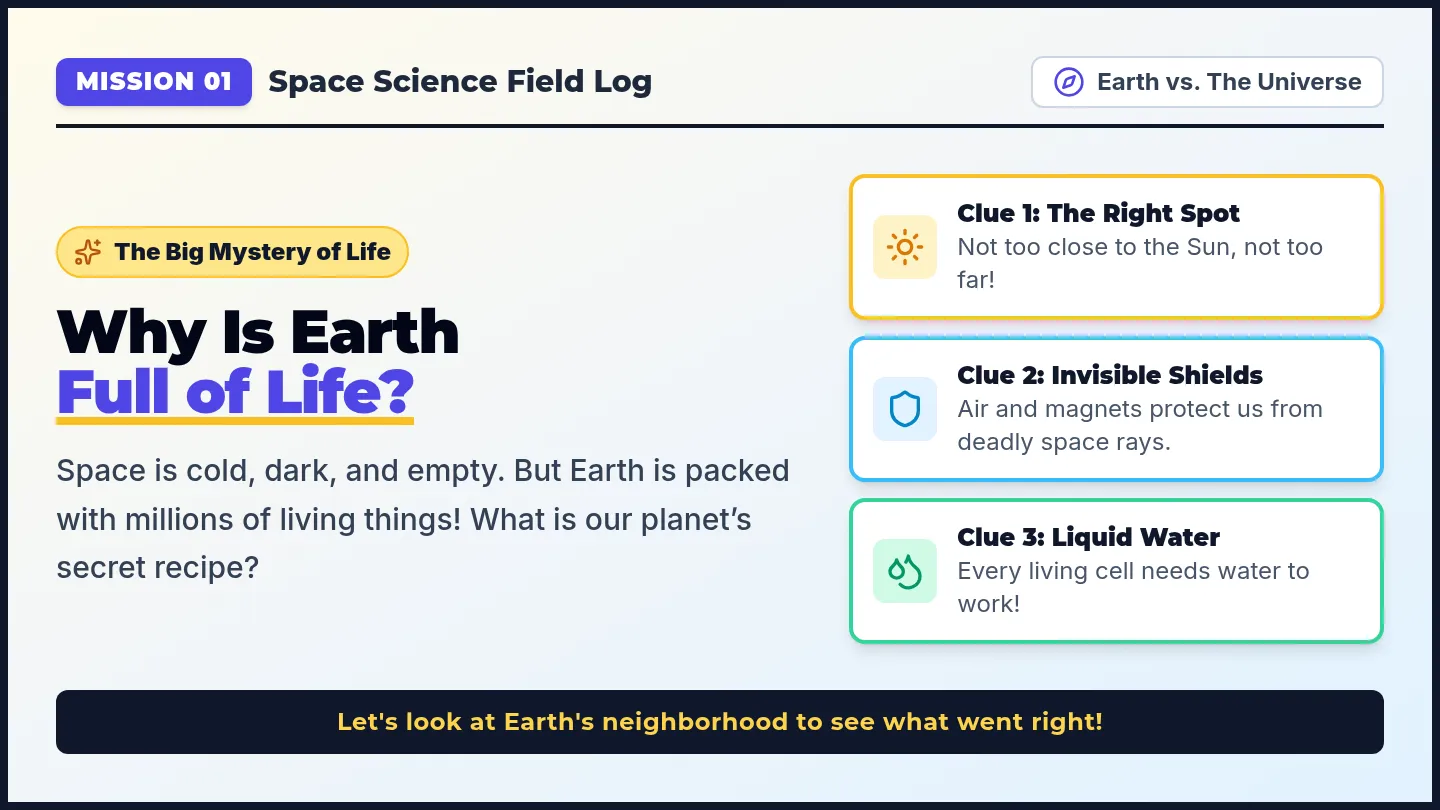
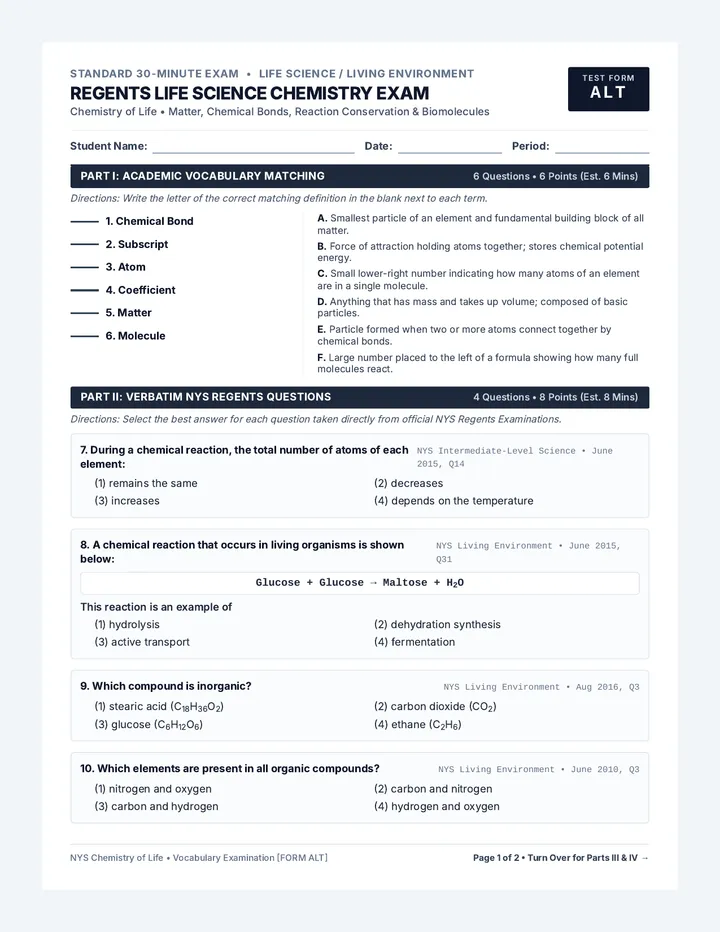
Impact Investigations SlidesCrash Lab Terminal Impact Investigations Decoding the hidden physics of collisions and change. IMPULSE-710 MOMENTUM-V1 The Driving Question "Why does a baseball player follow through on a swing, and why do cars have crumple zones?" Both scenarios involve the same physics, but with opposite goals. Today, we discover the math behind the impact. Quantifying "Oomph" Momentum is mass in motion. It depends on how much stuff is moving and how fast it's going. \[ \vec{p} = m \vec{v} \] Vector quantity (direction matters!) Units: \( kg \cdot m/s \) Massive & Slow Light & Fast Which one is harder to stop? The Impact Event To change an object's momentum, you must apply a Force over a period of Time. Net Force Connection: \[ \vec{F}_{net} = \frac{\Delta \vec{p}}{\Delta t} \] Definition: Impulse (\( \vec{J} \)) \[ \vec{J} = \vec{F} \Delta t \] Impulse-Momentum Theorem \[ \vec{F} \Delta t = \Delta \vec{p} \] The Trade-Off Safety: Minimize Force Increase Time to decrease Force for a fixed change in momentum. Ex: Airbags, Landing with bent knees. Performance: Maximize Δp Increase Time to maximize the Total Change in momentum. Ex: Follow through in golf or tennis. The Cosmic Law Momentum is Conserved \[ \sum \vec{p}_{initial} = \sum \vec{p}_{final} \] In an isolated system (no external net force), the total momentum before a collision equals the total momentum after. Beyond the Line What happens when things collide at angles? We treat the X and Y directions as separate puzzles. Conservation applies to both! \[ \sum p_{ix} = \sum p_{fx} \] \[ \sum p_{iy} = \sum p_{fy} \] XY-GRID Mission Briefing Open your "Momentum Mission" worksheet. We are heading into the Crash Lab to test these principles with real data. Step 1: Predict Step 2: Investigate Step 3: Graph
Momentum Mission WorksheetMomentum Mission LAB DATA SHEET // IMPACT-710 Investigator: Date: 1 Phase One: Initial Quantities Calculate the momentum \( p \) for the following crash test scenarios. Remember: \( p = mv \). Scenario A: Compact Car Mass: 1,200 kg | Velocity: 20 m/s SHOW WORK & CALCULATION: Scenario B: Freight Truck Mass: 15,000 kg | Velocity: 5 m/s SHOW WORK & CALCULATION: Reflection If both vehicles must come to a complete stop, which one requires a greater net force if they stop in the same amount of time? Why? 2 Phase Two: Force-Time Relation Consider a 0.5 kg egg falling. When it hits the ground, it has a velocity of 10 m/s. It comes to a complete stop during the collision (\( v_f = 0 \)). Hard Surface Collision The egg stops in 0.01 seconds. Calculation (\( F = \Delta p / \Delta t \)): Soft Surface Collision The egg stops in 0.2 seconds. Calculation (\( F = \Delta p / \Delta t \)): Discovery Question Compare the Impulse (\( J \)) for both cases. Did it change? Why or why not? Conclusion: 3 Phase Three: Conservation Check ObjectMass (kg)Init. Vel (m/s)Final Vel (m/s)Change in \( p \)Glider A2.05.02.0Glider B4.00.01.5 | 1. Total Initial Momentum (\( \sum p_i \)): 2. Total Final Momentum (\( \sum p_f \)): Analysis: Does the data suggest momentum was conserved? Show your work and explain the Law of Conservation in your own words.
Momentum Mission Answer KeyMomentum Mission OFFICIAL ANSWER KEY // IMPACT-710 1 Phase One: Initial Quantities Scenario A: Compact Car Mass: 1,200 kg | Velocity: 20 m/s \( p = (1200)(20) = \mathbf{24,000 \text{ kg} \cdot \text{m/s}} \) Scenario B: Freight Truck Mass: 15,000 kg | Velocity: 5 m/s \( p = (15000)(5) = \mathbf{75,000 \text{ kg} \cdot \text{m/s}} \) Reflection Answer The truck (B) requires a greater force. Since \( F = \Delta p / \Delta t \), and the truck has a significantly larger change in momentum to reach zero (\( \Delta p = 75,000 \)), it will need over 3x the force of the car to stop within the same time interval. 2 Phase Two: Force-Time Relation Hard Surface Collision \( \Delta p = 0.5(0 - 10) = -5 \text{ N}\cdot\text{s} \) \( F = -5 / 0.01 = \mathbf{-500 \text{ N}} \) Soft Surface Collision \( \Delta p = -5 \text{ N}\cdot\text{s} \) \( F = -5 / 0.2 = \mathbf{-25 \text{ N}} \) Discovery & Conclusion The Impulse (\( J \)) is identical in both cases (\( -5 \text{ N}\cdot\text{s} \)) because the change in momentum is the same (0.5 kg stopping from 10 m/s). Key Takeaway: Increasing collision time significantly reduces the average impact force for the same change in momentum. 3 Phase Three: Conservation Check ObjectMassInitial \( p \)Final \( p \)\( \Delta p \)Glider A2.0 kg10.04.0-6.0Glider B4.0 kg0.06.0+6.0 Total Initial Momentum (\( \sum p_i \)): \( 10.0 + 0.0 = \mathbf{10.0 \text{ kg}\cdot\text{m/s}} \) Total Final Momentum (\( \sum p_f \)): \( 4.0 + 6.0 = \mathbf{10.0 \text{ kg}\cdot\text{m/s}} \) Conservation Analysis Yes, momentum is conserved. The loss of momentum by Glider A (-6.0) was exactly gained by Glider B (+6.0). In an isolated system with no external net force, the total momentum remains constant before and after the interaction.
Collision Facilitator GuideCollision Facilitator LESSON GUIDE // IMPACT & IMPULSE Part of the 'Momentum Mechanics' Bundle Pacing 60-90 Minutes Prerequisites Newton's 2nd Law, Kinematics, Vector addition. Key Concept Impulse is the bridge between force and motion change. 01 The Hook: Crumple Zones Start with Slide 2. If possible, show a crash test video of a 1950s car vs. a 2024 car. Ask students to observe where the energy goes. They'll notice the old car stays stiff but the passenger is jolted—the new car "crumbles" to save the passenger by increasing collision time. 02 Guided Discovery: Phase Two Refer to the Momentum Mission Worksheet (Egg Drop section). This is the pivotal "Aha!" moment. Students often struggle to realize the impulse is identical in both scenarios. Facilitation Tip: Ask, "If you are the egg, do you care about the change in momentum or the force hitting your shell?" They will start to see that force is the factor that breaks the egg. 03 Misconception: Bouncing Explain that a bouncing collision involves a greater impulse than a sticking collision. Use the vector nature of momentum to show that \( \Delta p = (-5) - (5) = -10 \text{ units} \). This is why a rebounding ball exerts more force on a wall than a lump of clay. Critical Thinking Prompts The Bug vs. The Truck "A fly hits the windshield of a fast-moving truck. Which experiences a greater change in momentum?" Answer: They are identical. By Newton's 3rd Law, the force is equal/opposite; by the Impulse-Momentum Theorem, \( \Delta p \) is equal/opposite. The Frictionless Ice "You are stuck on a frictionless ice pond. You have a heavy backpack. How do you reach the shore?" Answer: Throw the bag away from the shore. The impulse you give the bag will give you an equal and opposite impulse, causing you to move toward the shore. Support Strategies Provide a formula card with \( p = mv \) and \( J = F \Delta t \). Help students draw "Initial" and "Final" momentum arrows before calculating. Extension Ideas Analyze energy loss: Compare initial \( KE \) to final \( KE \) in the glider experiment. Research modern car safety features that use the impulse-time trade-off.
Vector Vault SlidesSystem: Vector Vault The Second Dimension Navigating momentum conservation in 2D space. COORD-XY-PRIMARY Expanding the Model Real-world collisions rarely happen on a single line. To solve them, we must treat momentum as a Vector. Rule Number One: X and Y momentum are conserved independently. \( \vec{p}_{A,i} \) \( \vec{p}_{A,f} \) \( \vec{p}_{B,f} \) The Blueprint Strategy 1 Decompose Break velocity vectors into components using trigonometry. \[ p_x = m v \cos \theta \] \[ p_y = m v \sin \theta \] 2 Solve Independently Set up two separate conservation equations for each axis. \[ \sum p_{ix} = \sum p_{fx} \] \[ \sum p_{iy} = \sum p_{fy} \] Combine the final components back into a vector using the Pythagorean Theorem. Collision Categories Elastic Objects bounce apart. Momentum and Kinetic Energy are conserved. Ex: Atomic particles, Billiards. Inelastic Objects stick or deform. Momentum is conserved, but KE is lost to heat. Ex: Car crashes, Football tackle. Mastering the Angled Impact It's time to step onto the pool table. Our mission is to predict the final direction and speed of objects after a glancing collision. NEXT: Angled Impact Lab Data
Angled Impact WorksheetAngled Impact XY-MOMENTUM ANALYSIS // VECTOR-42 Sector: B-COLLISION-2D Investigator: Partner: Date: 01 The Glancing Blow A 2.0 kg ball (A) moving at 6.0 m/s [E] strikes a stationary 2.0 kg ball (B). After impact, Ball A moves at 3.0 m/s at 30° N of E. Initial Momentum (kg·m/s) pX pY Final Vector (Ball B): ____ m/s ____ ° Vector Sketch ObjectFinal pX (mv cos θ)Final pY (mv sin θ)Ball A\( (2)(3)\cos(30^\circ) \)\( (2)(3)\sin(30^\circ) \)Ball B 02 The Intersection T-Bone A 1,200 kg car travels EAST at 25 m/s. A 2,500 kg truck travels NORTH at 15 m/s. They collide and stick together. Initial Momentum Components: Combined Velocity Math (M = 3700): Final Speed ____ m/s Final Angle ____ ° 03 The Fragmented Burst A stationary 10.0 kg shell explodes into three pieces. Piece 1 (3.0 kg) flies WEST at 20 m/s. Piece 2 (4.0 kg) flies SOUTH at 15 m/s. Conservation: Sum P = 0 Piece 3 Speed: ____ m/s Piece 3 Angle: ____ ° Deep Inquiry Why must the vector sum of all fragments equal zero? What would happen if an external force acted during the burst?
Angled Impact Answer KeyAngled Impact Official Answer Key // MASTER DATA 01: The Glancing Blow Initial: px = 12.0 kg·m/s | py = 0.0 kg·m/s Ball A: px = 5.20, py = 3.00 Ball B: vx = 3.4, vy = -1.5 Result: 3.71 m/s @ -23.8° 02: The Intersection T-Bone Initial p: car = 30,000 | truck = 37,500 v Final: vx = 8.11, vy = 10.14 12.98 m/s 51.3° N of E 03: The Fragmented Burst px3 = +60.0 (East) py3 = +60.0 (North) Piece 3 (3.0 kg): vx = 20, vy = 20 28.28 m/s 45.0° * All values rounded to 2 decimal places. Conservation Logic: Total Momentum Before = Total Momentum After (for each axis).